Longevity Science
Longevity Science Glossary:
A Plain-Language A-Z of Ageing Research Terms
Longevity science comes with its own vocabulary: autophagy, epigenetic clocks, senolytics, mTOR, inflammaging, geroscience. These terms appear in news stories, podcasts and clinic marketing, often without explanation. This glossary defines the key terms used across the Longevity Science section in plain language, with links to the articles where each idea is explained in depth. It's organised in four groups: the biology of ageing, how ageing is measured, emerging therapies, and how to read the research. Use it as a reference whenever you come across an unfamiliar term, and as a map of the section.
Key numbers
| Concept | At a glance |
|---|---|
| Hallmarks of ageing | 12 interconnected biological processes (2023 update) |
| Generations of epigenetic clocks | 3: predicting age, predicting health and death, measuring pace of ageing |
| Longest verified human life | 122 years, 164 days |
| Heritability of lifespan | About 7% or less in a study of 400 million people |
| Clinical drug candidates that fail | About 90% |
The biology of ageing
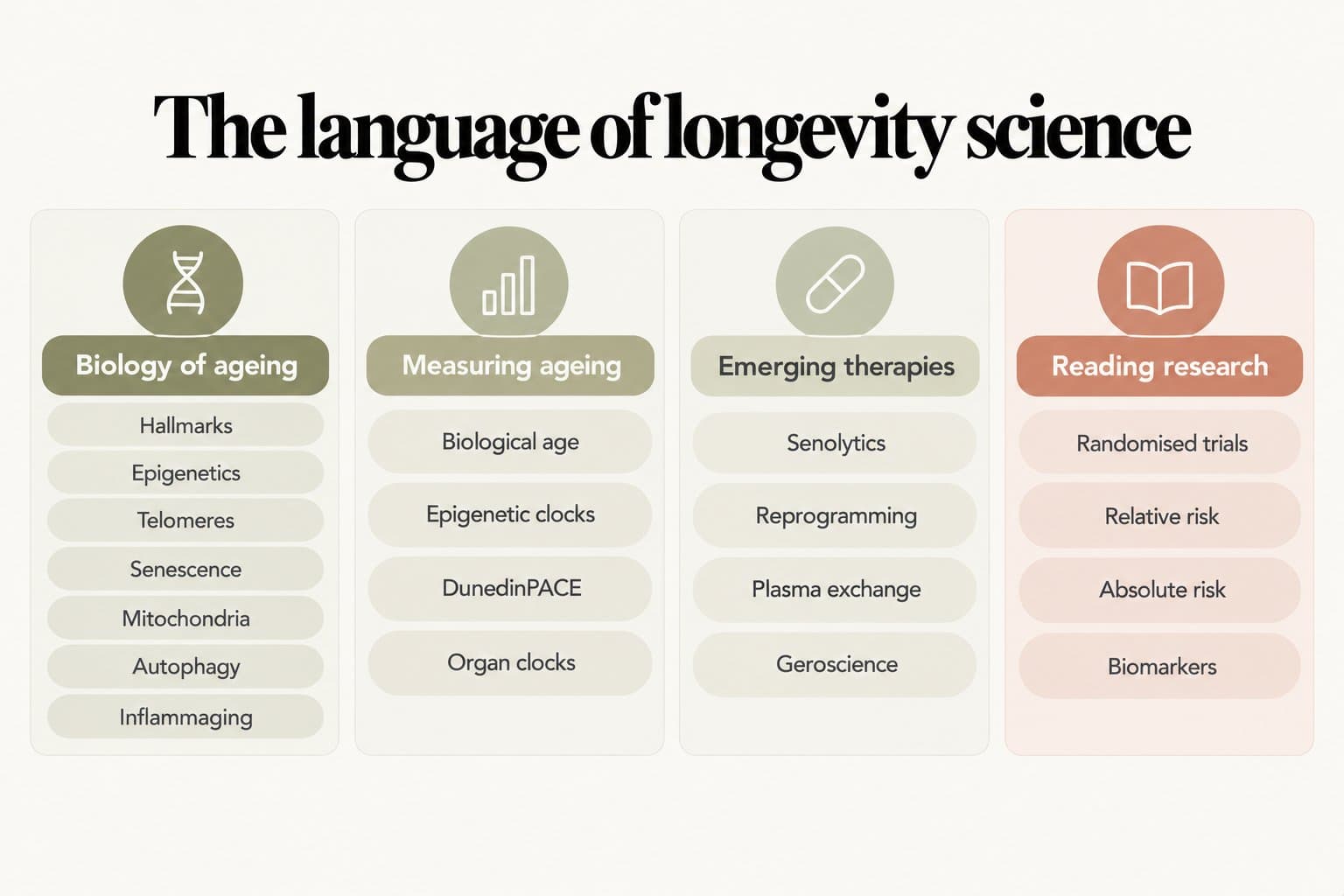
AMPK: an energy sensor in cells, switched on during exercise and fasting, that promotes repair and recycling. See Nutrient-Sensing Pathways.
Autophagy: "self-eating"; the cell's system for wrapping up and recycling damaged parts. Its decline is a hallmark of ageing. See Autophagy.
Cellular senescence: a state in which damaged cells permanently stop dividing but don't die, releasing inflammatory signals. Sometimes called "zombie cells". See Cellular Senescence.
DNA methylation: small chemical tags on DNA that help switch genes on or off; the basis of epigenetic clocks. See Epigenetics and Ageing.
Dysbiosis: an imbalance in the gut microbiome, added as a hallmark of ageing in 2023. See The Gut Microbiome and Fermented Foods.
Epigenetics: the layer of chemical marks and packaging that controls which genes are active, without changing the DNA sequence. See Epigenetics and Ageing.
Hallmarks of ageing: 12 biological processes that drive ageing across species, grouped as primary, antagonistic and integrative. See The Hallmarks of Ageing.
Hayflick limit: the limited number of times most human cells can divide before stopping, discovered in the 1960s. See Cellular Senescence.
Heritability: the share of differences in a trait between people that's due to genetic differences; for lifespan, probably about 7% or less. See The Genetics of Longevity.
IGF-1 (insulin-like growth factor 1): a growth hormone signal; lower signalling is linked to longer life in animals and less disease in people with Laron syndrome. See Nutrient-Sensing Pathways.
Inflammaging: chronic, low-grade, body-wide inflammation that rises with age in many populations. See Inflammaging.
Mitochondria: the cell's power plants, which produce energy and decline in function with age. See Mitochondria and Ageing.
Mitophagy: the recycling of damaged mitochondria through autophagy. See Mitochondria and Ageing.
mTOR: a central growth controller that senses nutrients, especially protein; blocking it with rapamycin extends lifespan in mice. See Nutrient-Sensing Pathways.
NAD+: a molecule involved in energy metabolism and DNA repair whose levels fall with age; the target of supplements such as NMN. See Longevity Supplements.
SASP (senescence-associated secretory phenotype): the mix of inflammatory signals released by senescent cells. See Cellular Senescence.
Sirtuins: NAD+-dependent enzymes involved in DNA repair and metabolism. See Nutrient-Sensing Pathways.
Telomeres: protective caps on the ends of chromosomes that shorten with each cell division. See Telomeres and Ageing.
Measuring ageing
Age acceleration: when biological age measures higher than chronological age. See Epigenetic Clocks Explained.
Biological age: an estimate of how old your body seems, based on molecular or physiological measures, as opposed to your chronological age in years. See How Is Biological Age Actually Calculated?.
DunedinPACE: a third-generation epigenetic clock that measures the pace of ageing, where 1.0 means one year of biological ageing per calendar year. See Epigenetic Clocks Explained.
Epigenetic clock: a test that estimates biological age from DNA methylation patterns, such as the Horvath, PhenoAge and GrimAge clocks. See Epigenetic Clocks Explained.
Healthspan: the years of life lived in good health. Worldwide, people spend on average 9.6 years in poor health. See The Limits of Human Lifespan.
Life expectancy: the average number of years a newborn can expect to live based on current death rates. See The Limits of Human Lifespan.
Organ ageing clock: a test using blood proteins to estimate the biological age of individual organs. See Organ Ageing Clocks.
Proteomics: the large-scale measurement of proteins, used to build organ and proteomic ageing clocks. See Organ Ageing Clocks.
Emerging therapies
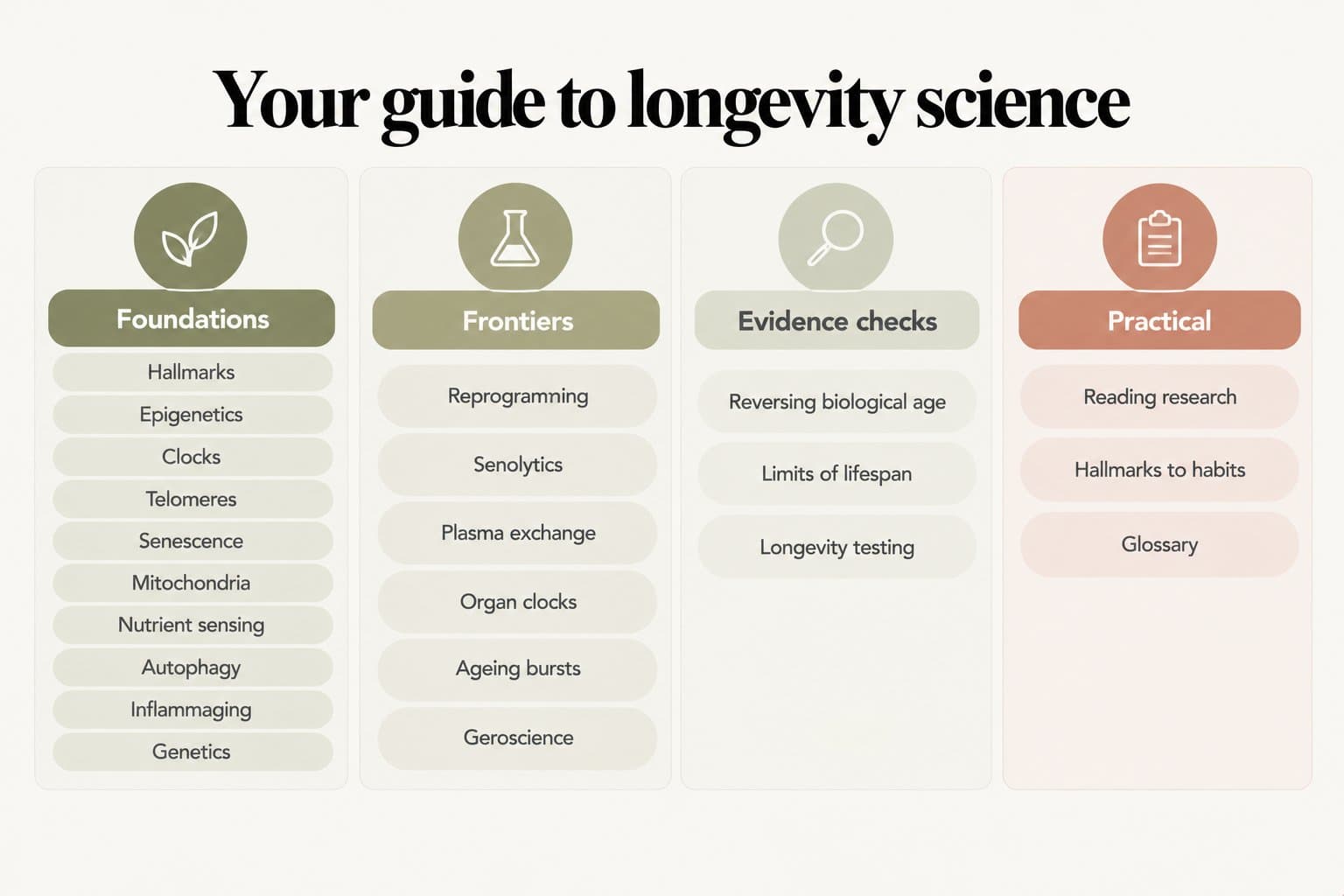
Cellular reprogramming: using factors such as the Yamanaka factors to reset cells to a younger state; partial reprogramming aims to do this without erasing cell identity. See Cellular Reprogramming.
Geroscience: the field that aims to slow the biology of ageing to delay many diseases at once. See Targeting Ageing as a Disease.
Heterochronic parabiosis: joining an old and a young animal so they share blood, used to study blood factors in ageing. See Young Blood and Plasma Exchange.
OSK / OSKM (Yamanaka factors): genes (Oct4, Sox2, Klf4 and c-Myc) that can reprogram mature cells into stem cells. See Cellular Reprogramming.
Rapamycin: an mTOR-blocking drug that extends lifespan in mice; experimental for human longevity. See Longevity Supplements.
Senolytics: drugs designed to kill senescent cells selectively, such as dasatinib plus quercetin. See Senolytics.
TAME (Targeting Aging with Metformin): a planned trial to test whether metformin delays several age-related diseases together. See Targeting Ageing as a Disease.
Therapeutic plasma exchange (TPE): removing blood plasma and replacing it, typically with albumin; being studied for ageing and Alzheimer's disease. See Young Blood and Plasma Exchange.
Reading the research
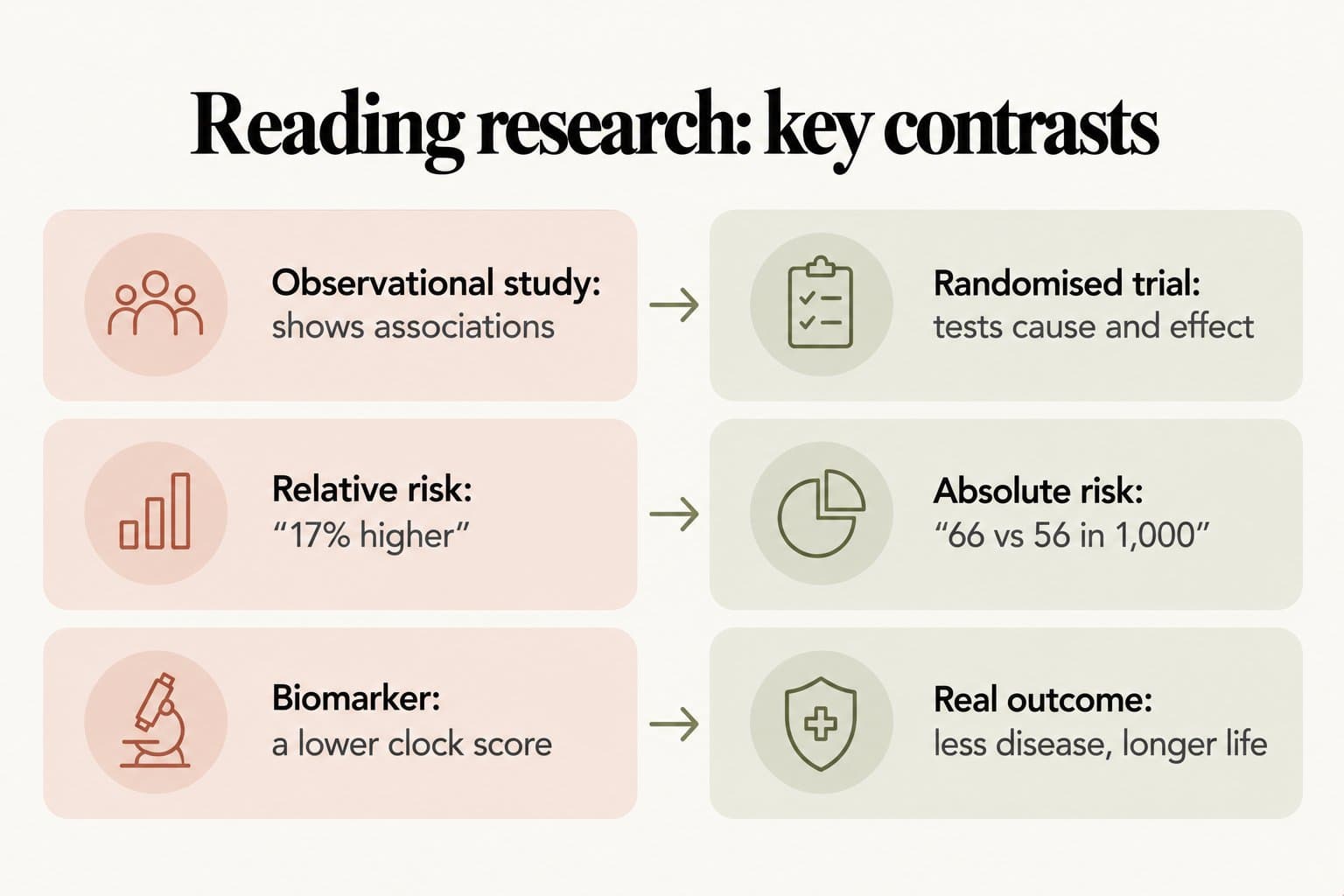
Absolute risk: the actual chance of something happening, such as 66 in 1,000 people. See How to Read Longevity Research.
Biomarker: a measurable sign of a biological process, such as an epigenetic clock score; changes in biomarkers don't always mean changes in health. See Can You Reverse Your Biological Age?.
Confounding: when a third factor explains an apparent link between two things, a common problem in observational studies. See How to Read Longevity Research.
Healthy user bias: the tendency for people who adopt one healthy behaviour to be healthier in other ways too. See How to Read Longevity Research.
Observational study: research that observes people without assigning treatments; it shows associations, not cause and effect.
Randomised controlled trial (RCT): a study that randomly assigns people to a treatment or a comparison group; the strongest single test of whether a treatment works.
Relative risk: how much more or less likely something is in one group compared with another, such as "17% higher". See How to Read Longevity Research.
Recommendations by scenario
| Scenario | What to do |
|---|---|
| New to longevity science | Start with the hallmarks of ageing, then epigenetics and clocks |
| Considering a biological age test | Read about epigenetic clocks, reversal claims and testing before buying |
| Curious about new therapies | Read the Frontiers articles, then check the evidence in the Evidence Checks |
| Want practical steps | Go to From Hallmarks to Habits |
| Reading a longevity headline | Use the seven questions in How to Read Longevity Research |
Start with The Hallmarks of Ageing, then Epigenetics and Ageing and Epigenetic Clocks Explained. Before buying a test, read Can You Reverse Your Biological Age? and Longevity Testing. For headlines, use How to Read Longevity Research.
Practical notes
Longevity science is a fast-moving field, and its language can make early findings sound more certain than they are. Understanding the key terms helps you ask better questions, whether you're reading the news, considering a test or talking with your doctor. For practical steps you can take today, see From Hallmarks to Habits. Our Longevity Doctors are happy to explain any of these concepts in relation to your own health, starting with the free longevity assessment.
- López-Otín C, et al. Hallmarks of aging: an expanding universe. Cell, 2023;186(2):243-278.
- Belsky DW, et al. DunedinPACE, a DNA methylation biomarker of the pace of aging. eLife, 2022;11:e73420.
- Ruby JG, et al. Estimates of the heritability of human longevity are substantially inflated due to assortative mating. Genetics, 2018;210(3):1109-1124.
- Garmany A, et al. Global healthspan-lifespan gaps among 183 World Health Organization member states. JAMA Network Open, 2024;7(12):e2450241.
- Sun D, et al. Why 90% of clinical drug development fails and how to improve it? Acta Pharmaceutica Sinica B, 2022;12(7):3049-3062.
Free longevity assessment
Want these concepts explained
for your own health?
Take the free Aevum Protocol assessment to see how your longevity science and 6 other longevity domains are performing — and get a personalised 90-day plan.
Take the free assessmentKeep reading