Longevity Science
The Genetics of Longevity:
How Much of Your Lifespan Is in Your Genes?
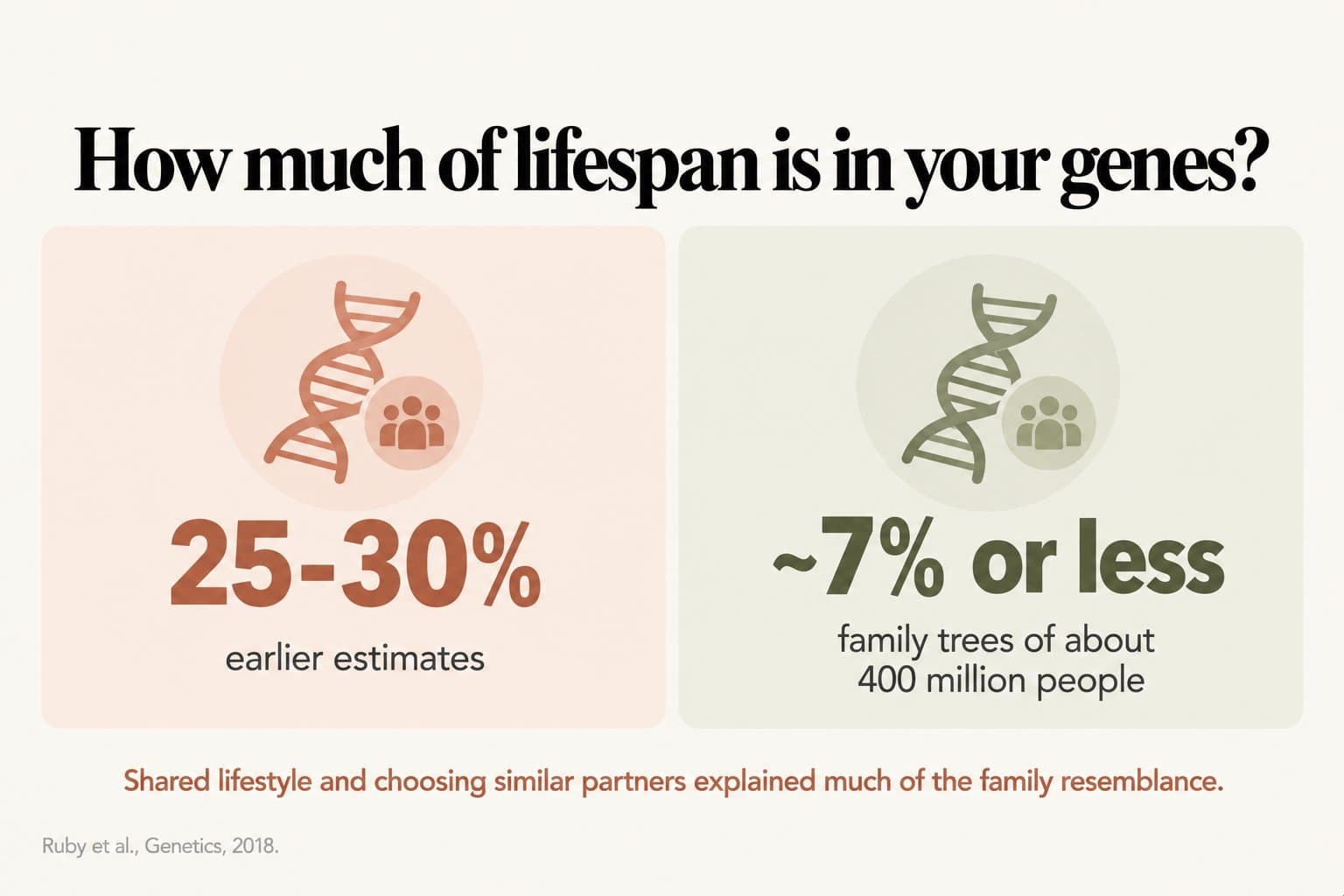
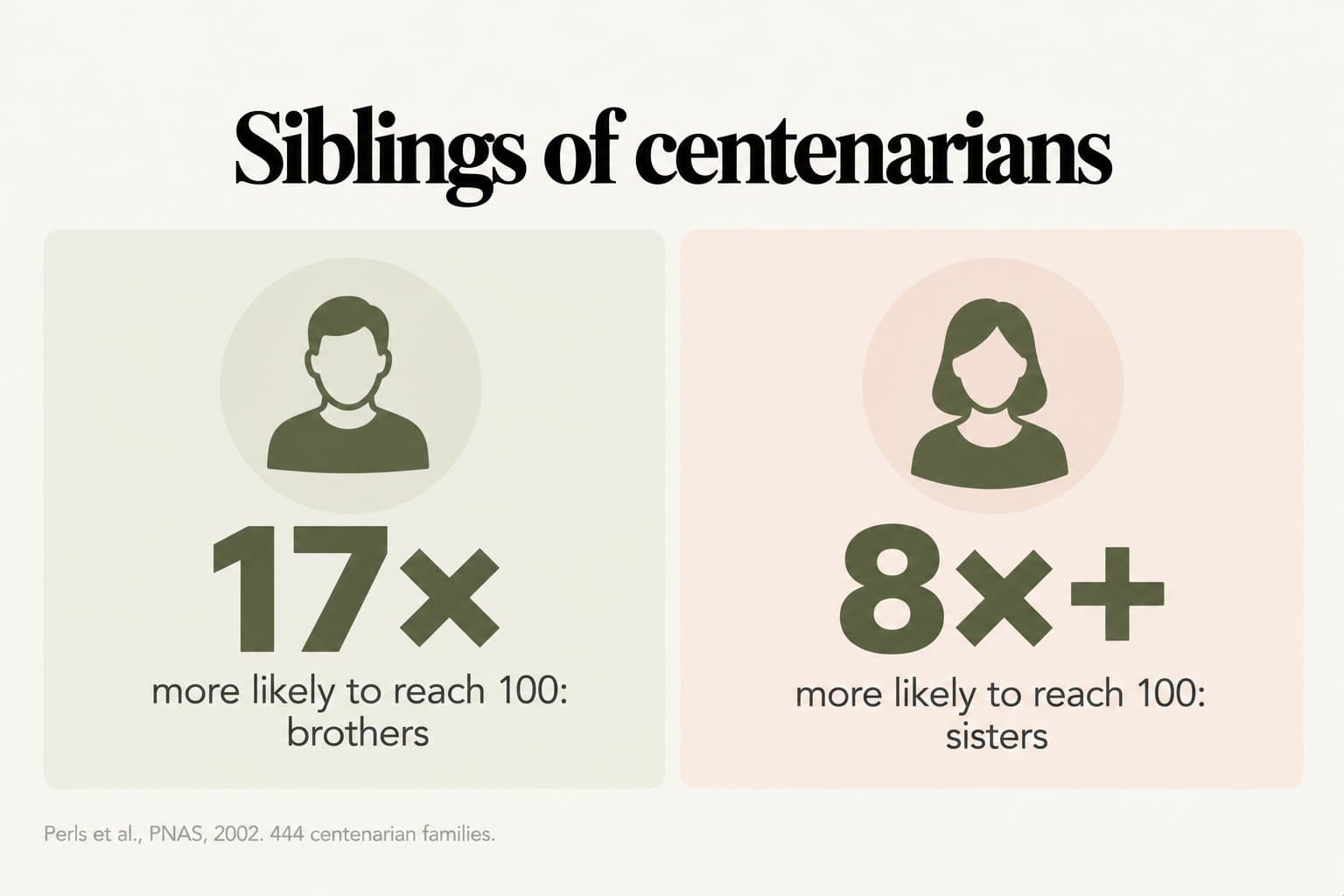
"Good genes" are often credited when someone lives to a great age, and it's natural to wonder whether your parents' lifespans predict your own. The answer is more encouraging than many people expect. Early studies suggested that genes explained 25-30% of the variation in lifespan. But a 2018 analysis of family trees covering about 400 million people found that true heritability is probably about 7% or less. Much of the apparent family resemblance came from shared lifestyle and from people choosing partners similar to themselves. Genes matter more at the extremes: brothers of centenarians were 17 times, and sisters at least 8 times, more likely than average to reach 100 themselves. A few individual genes have consistent effects. The APOE ε4 variant, best known for raising Alzheimer's risk, lowers the odds of reaching exceptional old age, while ε2 may raise them, and variants in FOXO3, part of the insulin/IGF-1 pathway, have been linked to longer life in several populations. Overall, though, lifespan is shaped by many genes with tiny effects plus, above all, environment and behaviour. This article explains what the genetics of longevity can and can't tell you.
Key numbers
| Finding | Detail |
|---|---|
| Heritability of lifespan (Ruby et al., 2018) | About 7% or less, based on family trees of about 400 million people; earlier estimates 25-30% |
| Siblings of centenarians (Perls et al., 2002; 444 families) | Brothers 17 times and sisters at least 8 times more likely to reach 100 |
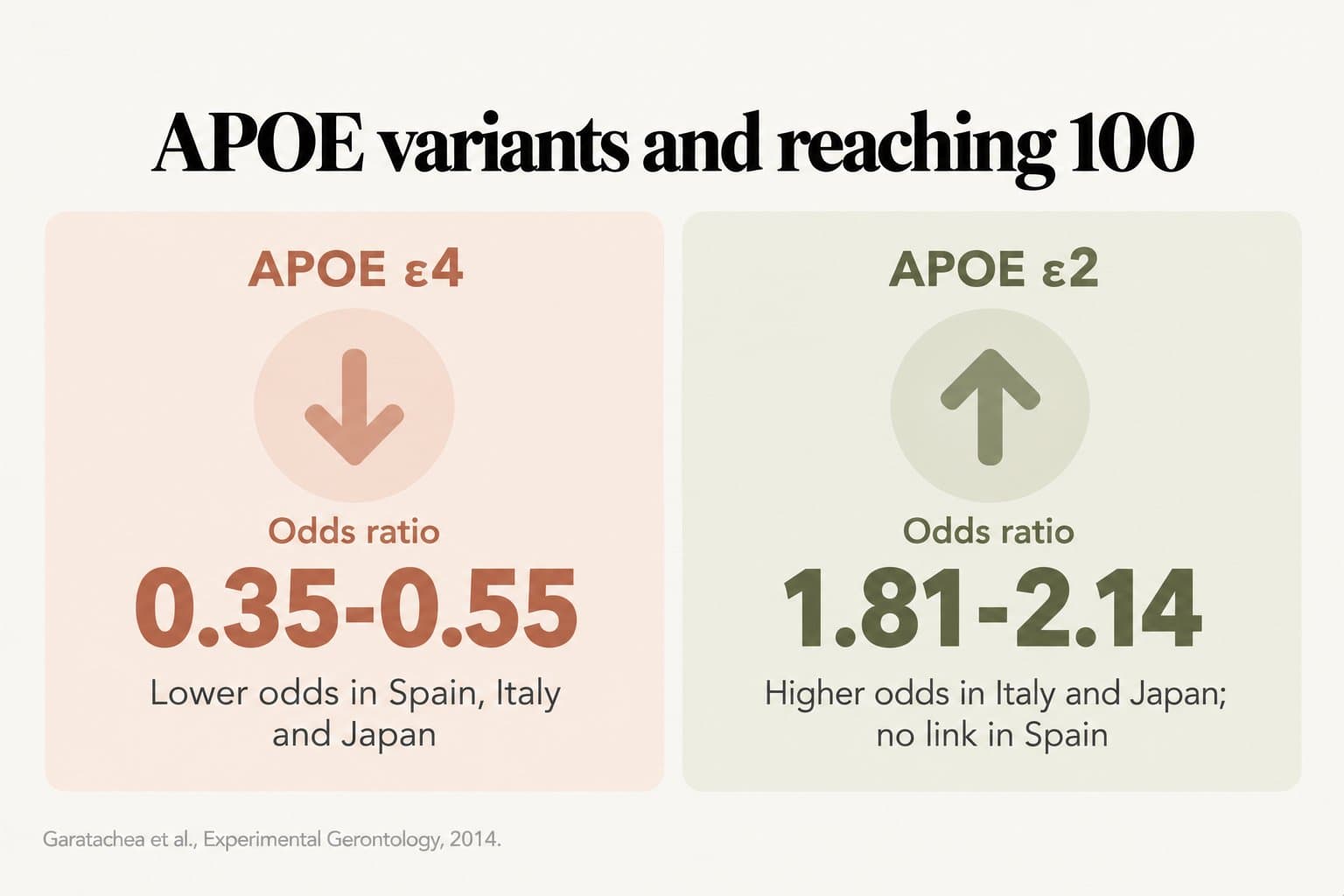
| APOE ε4 and exceptional longevity (Spain, Italy, Japan) | Lower odds of reaching 100 (odds ratios 0.35-0.55) |
| APOE ε2 and exceptional longevity | Higher odds in Italy and Japan (odds ratios 1.81-2.14); no association in Spain |
| FOXO3 | Variant first linked to longevity in Japanese-American men; acts through the insulin/IGF-1 pathway |
How heritable is lifespan?
The old estimate: 25-30%. Heritability describes how much of the variation in a trait across a population is due to genetic differences. Earlier twin and family studies suggested that genes explained around a quarter of the variation in how long people live.
The new estimate: about 7% or less. In 2018, researchers at Calico, a company founded by Google's parent company to study ageing, worked with the genealogy company Ancestry to analyse family trees containing about 400 million people in more than 54 million families. They found that spouses, and even in-laws who share no genes, had correlated lifespans. This pointed to assortative mating: people tend to choose partners with similar backgrounds, habits and environments. After accounting for this, the heritability of lifespan was estimated at about 7% or less. As lead researcher Graham Ruby said: "Genes may still play a role in lifespan, but as our research shows, it's likely a more reduced role than we surmised."
This fits with other evidence in this section: identical twins become more epigenetically different as they age, especially when their lifestyles differ (see Epigenetics and Ageing).
Where genes matter most: exceptional longevity
Genes seem to play a bigger role in reaching extreme old age, such as 100 and beyond. The New England Centenarian Study, led by Thomas Perls at Boston University, studied 444 families with at least one centenarian. Brothers of centenarians were 17 times more likely, and sisters at least 8 times more likely, to reach 100 than the general population. Sisters had about half the risk of death at any given age compared with national averages. The authors concluded that centenarians and their relatives "appear to be more resistant to disease or they survive disease better throughout the lifespan".
Genes linked to longevity
APOE. The APOE gene, which helps transport cholesterol and fats, comes in three common versions: ε2, ε3 and ε4. The ε4 version raises the risk of Alzheimer's disease and heart disease. A 2014 study of centenarians in Spain, Italy and Japan found that carrying ε4 consistently lowered the odds of reaching exceptional longevity, with odds ratios of 0.55 in Spain, 0.41 in Italy and 0.35 in Japan. Carrying ε2 was linked to higher odds in Italy (odds ratio 2.14) and Japan (1.81), but not in Spain.
FOXO3. FOXO3 is part of the insulin/IGF-1 signalling pathway, which controls lifespan in worms, flies and mice (see Nutrient-Sensing Pathways). In 2008, Bradley Willcox and colleagues found that a FOXO3 genotype was "strongly associated with human longevity" in American men of Japanese ancestry in Hawaii. The association has since been studied in other populations. In a follow-up of 8,003 of these men over more than 40 years, carrying the longevity variant was linked to shorter height, and greater height was linked to higher fasting insulin and higher mortality, consistent with a role for growth signalling.
Many genes, small effects. Apart from a few genes such as APOE and FOXO3, large genetic studies have found that lifespan is influenced by many genetic variants, each with a very small effect, many of them related to heart disease, blood pressure, cholesterol, smoking behaviour and brain health.
Why this matters for longevity
The genetics of longevity offers two important messages. First, for most people, genes are not destiny: if heritability is around 7% or less, the great majority of differences in lifespan come from environment, behaviour, healthcare and chance. Long-lived parents help, but shared habits and circumstances explain much of that advantage. Second, studying people who reach 100 and beyond, and the genes that protect them, helps scientists understand how to delay disease, and may point to future treatments. Population claims about long-lived communities also need careful checking (see Eating Patterns for Longevity).
Practical notes
Your family history is still useful: it can reveal inherited risks, such as early heart disease, high cholesterol, diabetes or certain cancers, that call for earlier screening. Genetic testing for longevity genes such as APOE or FOXO3 isn't recommended for routine use, because the results rarely change what you should do and an APOE ε4 result can cause anxiety; anyone considering it should discuss it with a doctor first, ideally with genetic counselling. Whatever your genes, the habits that support healthy ageing, such as not smoking, regular exercise, a healthy diet, good sleep and managing blood pressure, cholesterol and blood sugar, have far greater influence on how long and how well you live (see The Hallmarks of Ageing). Our Longevity Doctors can review your family history and personal risks, starting with the free longevity assessment.
- Ruby JG, et al. Estimates of the heritability of human longevity are substantially inflated due to assortative mating. Genetics, 2018;210(3):1109-1124.
- Perls TT, et al. Life-long sustained mortality advantage of siblings of centenarians. Proceedings of the National Academy of Sciences, 2002;99(12):8442-8447.
- Garatachea N, et al. ApoE gene and exceptional longevity: insights from three independent cohorts. Experimental Gerontology, 2014;53:16-23.
- Willcox BJ, et al. FOXO3A genotype is strongly associated with human longevity. Proceedings of the National Academy of Sciences, 2008;105(37):13987-13992.
- He Q, et al. Shorter men live longer: association of height with longevity and FOXO3 genotype in American men of Japanese ancestry. PLOS ONE, 2014;9(5):e94385.
Free longevity assessment
What does your family history
really tell you?
Take the free Aevum Protocol assessment to see how your longevity science and 6 other longevity domains are performing — and get a personalised 90-day plan.
Take the free assessmentKeep reading