Longevity Science
The Hallmarks of Ageing:
The 12 Biological Processes Behind Getting Older
Why do we age? For most of history, ageing was seen as simple wear and tear. Modern biology gives a more detailed answer. In 2013, scientists led by Carlos López-Otín proposed nine "hallmarks of ageing": common biological processes that drive ageing across species. In 2023 they updated the list to 12, adding disabled autophagy, chronic inflammation and dysbiosis (an imbalanced gut microbiome). To count as a hallmark, a process has to meet three tests: it changes with age, making it worse speeds up ageing in experiments, and improving it slows, stops or reverses ageing. The hallmarks fall into three groups: primary damage that builds up over time, responses that start out protective but become harmful, and system-wide consequences such as inflammation and loss of the body's ability to repair itself. They're closely connected, so changing one usually affects others. This matters because the world is ageing fast: by 2030, one in six people will be 60 or older, and Sri Lanka is the fastest-ageing country in South Asia. The hallmarks are the scientific map behind today's longevity research, and many of them respond to everyday habits.
Key numbers
| Finding | Detail |
|---|---|
| Hallmarks of ageing (López-Otín et al., Cell) | 9 proposed in 2013; expanded to 12 in 2023 |
| Research since 2013 | Close to 300,000 articles published on the topic |
| Global ageing (WHO) | 1 in 6 people aged 60 or over by 2030; 2.1 billion by 2050 |
| Sri Lanka (WHO Sri Lanka) | 12.4% aged 60 or over in 2012; projected 1 in 4 by 2041 |
| Clearing senescent cells in very old mice (Xu et al., 2018) | 36% longer average remaining lifespan |
What ageing is, biologically
The World Health Organization describes ageing as the result of "the accumulation of a wide variety of molecular and cellular damage over time", which leads to "a gradual decrease in physical and mental capacity, a growing risk of disease and ultimately death". The hallmarks framework breaks that damage into specific processes that scientists can measure and, potentially, target.
A process has to meet three criteria to be counted as a hallmark:
- 1. It changes with age.
- 2. Making it worse in experiments speeds up ageing.
- 3. Improving it can slow, stop or reverse ageing.
The 12 hallmarks
The 2023 update groups the hallmarks into three categories.
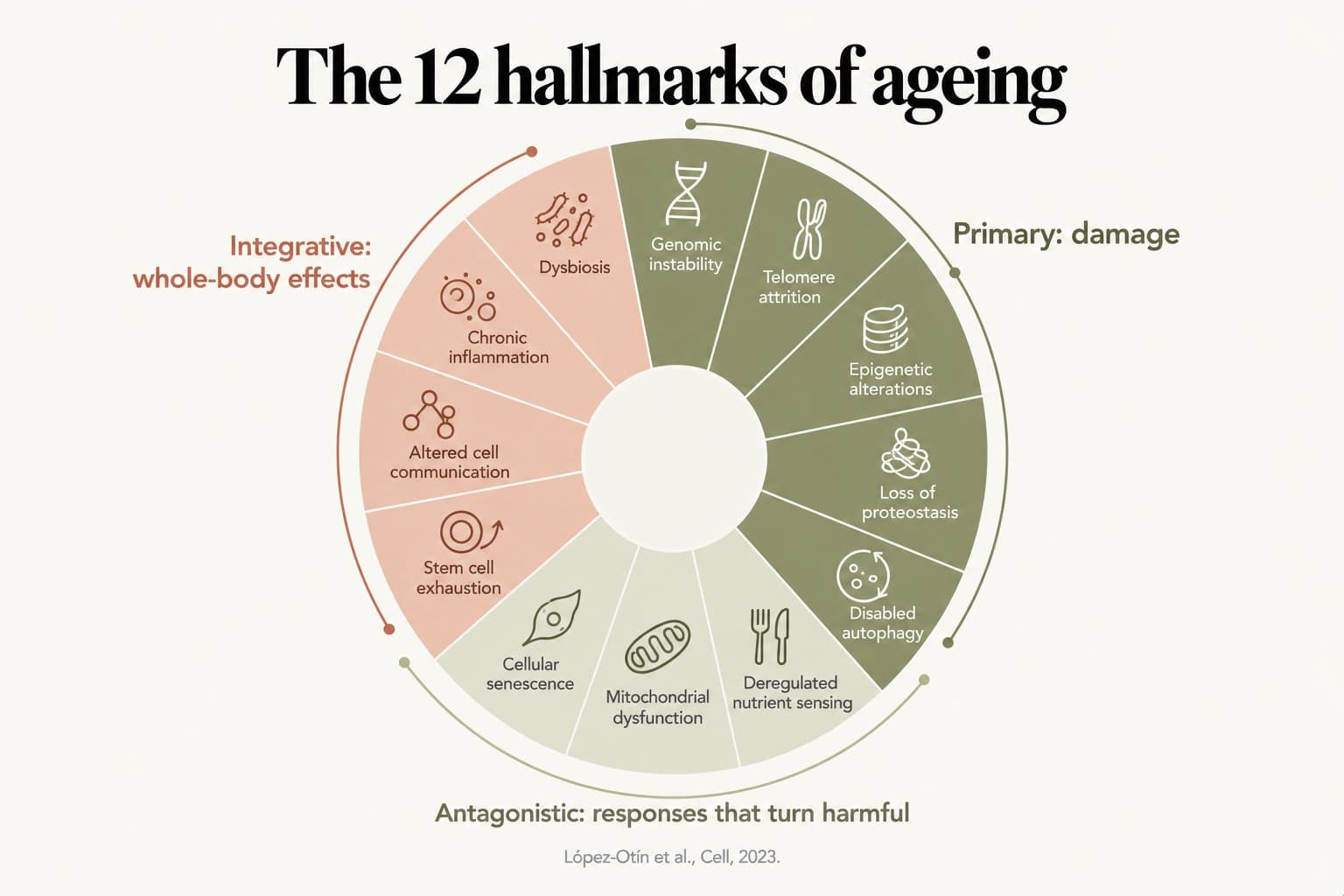
Primary hallmarks: damage that builds up over time.
- Genomic instability: DNA damage accumulates and repair becomes less efficient.
- Telomere attrition: the protective caps on the ends of chromosomes shorten each time a cell divides, eventually limiting how many times it can divide. Telomeres are covered in Telomeres and Ageing.
- Epigenetic alterations: changes in the chemical marks that control which genes are switched on or off, such as DNA methylation. These changes are the basis of epigenetic clocks (see How Is Biological Age Actually Calculated? and Epigenetics and Ageing).
- Loss of proteostasis: the cell's quality control for proteins fails, so misfolded and damaged proteins build up, as seen in Alzheimer's and Parkinson's disease.
- Disabled macroautophagy: autophagy, the cell's recycling system for worn-out components, declines with age. It was previously included under proteostasis and became a hallmark of its own in 2023 (see Autophagy).
Antagonistic hallmarks: protective responses that become harmful. These responses start out protecting the body, but become harmful when they're excessive or chronic.
- Deregulated nutrient sensing: the networks that sense nutrients and control growth and metabolism, such as insulin/IGF-1, mTOR and AMPK, become imbalanced. These pathways help explain why calorie restriction extends lifespan in animals (see Calorie Restriction and Fasting).
- Mitochondrial dysfunction: the cell's power plants produce less energy and more damaging by-products.
- Cellular senescence: damaged cells permanently stop dividing, which protects against cancer, but they release inflammatory signals that harm surrounding tissue. Cellular senescence is covered in Cellular Senescence.
Integrative hallmarks: system-wide consequences. These are the result of damage from the first two groups, and they affect tissues and the whole body.
- Stem cell exhaustion: the stem cells that renew and repair tissues decline in number and function.
- Altered intercellular communication: signalling between cells, through hormones, the nervous system and the immune system, changes with age.
- Chronic inflammation: persistent low-grade inflammation, often called "inflammaging", added as a separate hallmark in 2023 (see Inflammation and Heart Disease).
- Dysbiosis: age-related changes in the gut microbiome, also added in 2023 (see The Gut Microbiome and Fermented Foods).
How the hallmarks connect
The authors emphasise that "the hallmarks are interconnected among each other", and that experimentally changing one "usually affects other hallmarks as well". For example, DNA damage and shortened telomeres can push cells into senescence; senescent cells release inflammatory signals; and chronic inflammation, in turn, damages tissues and stem cells. This is why scientists increasingly see ageing as one interconnected process rather than a list of separate problems.
What the research shows
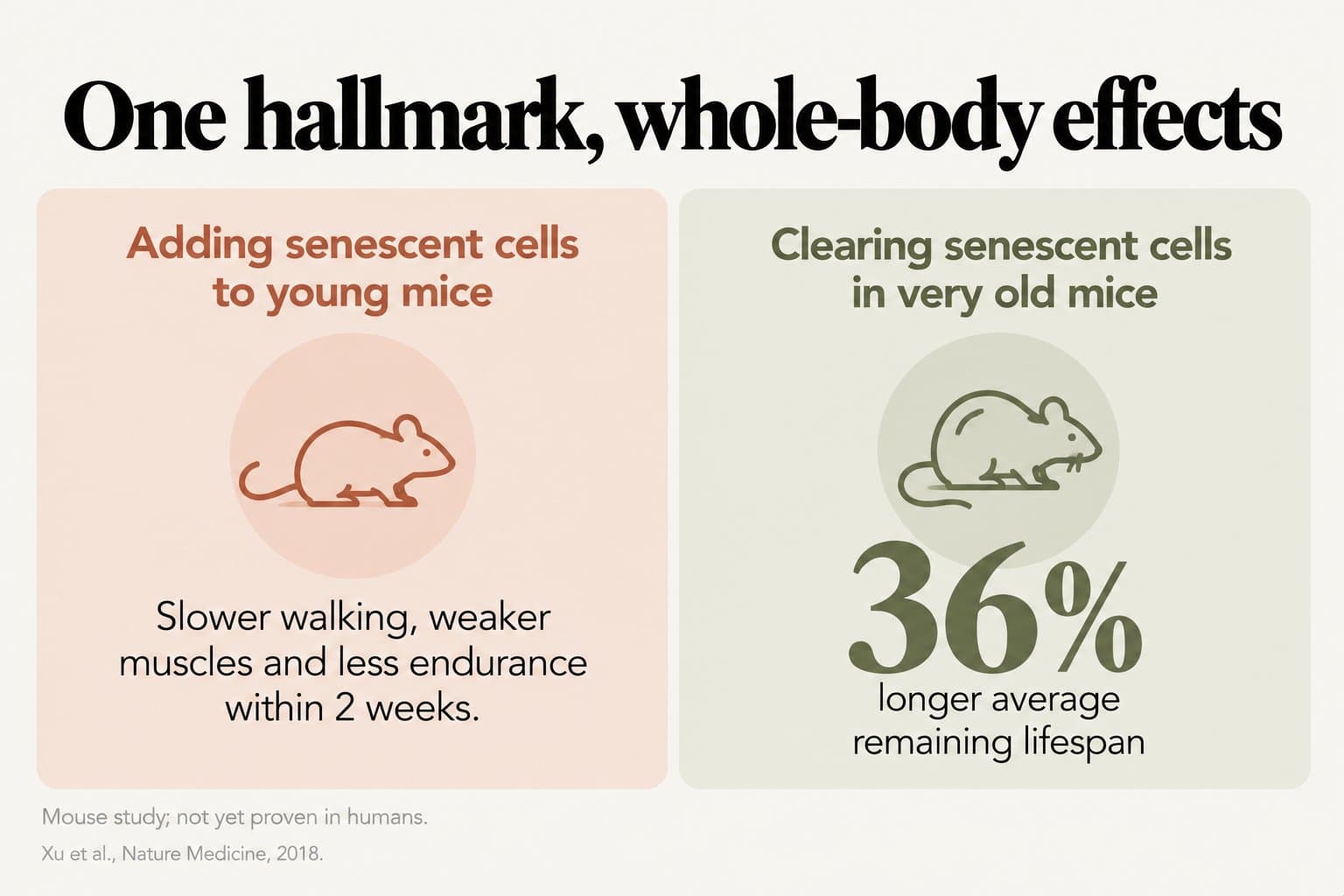
Targeting one hallmark can affect the whole body. A 2018 study in Nature Medicine showed how a single hallmark can drive ageing. When researchers transplanted even a small number of senescent cells into young, healthy mice, the animals developed problems with walking speed, muscle strength and endurance within two weeks, and senescence appeared to spread to other cells. When very old mice, roughly equivalent to people aged 70-80, were treated with a combination of two drugs that clear senescent cells (dasatinib and quercetin), they lived on average 36% longer after treatment than untreated mice.
These are animal results. As a US National Institute on Aging scientist noted, further research is needed "to determine if compounds, like the one used in this study, are safe and effective in clinical trials with people". Senolytic drugs are covered in Senolytics, and many other longevity compounds remain unproven in humans (see Longevity Supplements).
A rapidly growing field. Since the first hallmarks paper in 2013, close to 300,000 scientific articles on the topic have been published. The framework now guides much of the research into ageing, including epigenetic clocks, senolytic drugs, cellular reprogramming and trials of drugs that target ageing itself.
Why this matters for longevity
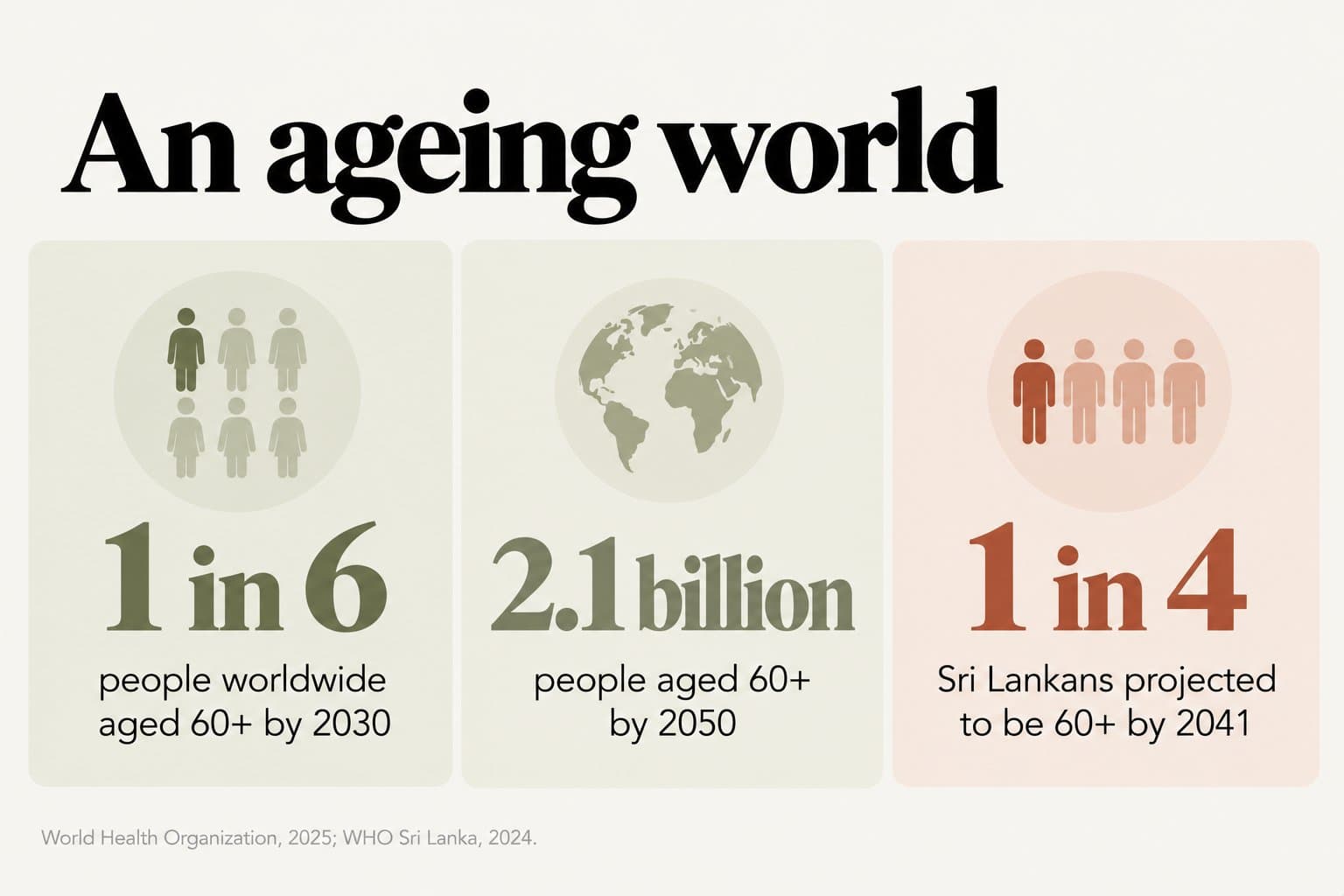
The world is ageing quickly. The WHO estimates that by 2030, one in six people worldwide will be 60 or older, and that this group will reach 2.1 billion by 2050. Sri Lanka has been described as the fastest-ageing country in South Asia: 12.4% of the population was 60 or older in 2012, and this is projected to rise to one in four by 2041.
The hallmarks matter for two reasons. First, they explain why many chronic diseases, including heart disease, type 2 diabetes, cancer and dementia, become more common together with age: they share underlying biological drivers. Second, they suggest that targeting ageing itself could delay several diseases at once, rather than treating them one at a time. This idea, known as geroscience, is covered in Targeting Ageing as a Disease.
Practical notes
You can't buy a pill that switches off the hallmarks of ageing, and most treatments that target them directly are still experimental. But many hallmarks respond to everyday habits. Regular exercise, good sleep, a high-quality diet rich in fibre and plant foods, avoiding smoking and excess alcohol, and managing blood pressure, blood sugar and weight all act on processes such as inflammation, nutrient sensing, mitochondrial function and the gut microbiome (see Eating Patterns for Longevity). How each habit links to the hallmarks is covered in From Hallmarks to Habits. Our Longevity Doctors can help you understand where you stand today, starting with the free longevity assessment.
- López-Otín C, et al. Hallmarks of aging: an expanding universe. Cell, 2023;186(2):243-278.
- López-Otín C, et al. The hallmarks of aging. Cell, 2013;153(6):1194-1217.
- World Health Organization. Ageing and health. Fact sheet, 2025.
- World Health Organization Sri Lanka. Ageing with dignity: the importance of strengthening care and support systems for older persons worldwide. 2024.
- Xu M, et al. Senolytics improve physical function and increase lifespan in old age. Nature Medicine, 2018;24(8):1246-1256.
Free longevity assessment
Which hallmarks of ageing
can your habits reach?
Take the free Aevum Protocol assessment to see how your longevity science and 6 other longevity domains are performing — and get a personalised 90-day plan.
Take the free assessment