Longevity Science
Telomeres and Ageing:
What Your Chromosome Caps Can and Can't Tell You
Telomeres are protective caps at the ends of your chromosomes, often compared to the plastic tips on shoelaces. Each time a cell divides, its telomeres get a little shorter, and when they become too short, the cell stops dividing or dies. This makes telomere shortening one of the 12 hallmarks of ageing. The discovery of how telomeres and the enzyme telomerase protect chromosomes won the 2009 Nobel Prize in Physiology or Medicine. In UK Biobank, where telomere length was measured in about 474,000 people, telomeres were shorter in older people and in men, and women were on average about 7 years "younger" by this measure. Shorter telomeres are linked to a slightly higher risk of death, especially from heart disease. But longer isn't always better: genetic studies show that people born with longer telomeres have a lower risk of coronary heart disease but a higher risk of several cancers. Telomere length also varies greatly between people for reasons that are only partly understood, which makes a single telomere test a poor guide to your individual biological age. This article explains what telomeres do, what the research shows and how to think about telomere testing.
Key numbers
| Finding | Detail |
|---|---|
| Nobel Prize, 2009 | Awarded to Elizabeth Blackburn, Carol Greider and Jack Szostak for discovering how telomeres and telomerase protect chromosomes |
| UK Biobank telomere study | Measured in 474,074 people; women about 7 years "younger" than men; age, sex, ethnicity and white cell count explain only about 5.5% of the variation |
| Telomere length and death (440,551 people, about 14 years) | Each standard deviation longer: 6% lower risk of death from any cause, 8% lower cardiovascular death |
| Genetic study of 83 diseases (Haycock et al., 2017) | Longer telomeres: lower risk of coronary heart disease; higher risk of several cancers |
What telomeres are
Telomeres are stretches of repeated DNA sequence at the ends of every chromosome. They solve a basic problem: the machinery that copies DNA can't copy the very end of a chromosome, so a little is lost every time a cell divides. Telomeres act as a buffer, so the loss comes from repeated, non-essential DNA rather than from genes. They also stop the cell from mistaking the end of a chromosome for broken DNA.
The enzyme telomerase can rebuild telomeres. It's active in egg and sperm cells, stem cells and some immune cells, but in most adult cells it's switched off or very low, so telomeres gradually shorten with each division. When telomeres become critically short, the cell enters senescence, a permanent stop to dividing, or dies. This limit on how many times a cell can divide is known as the "Hayflick limit". Cellular senescence is covered in Cellular Senescence.
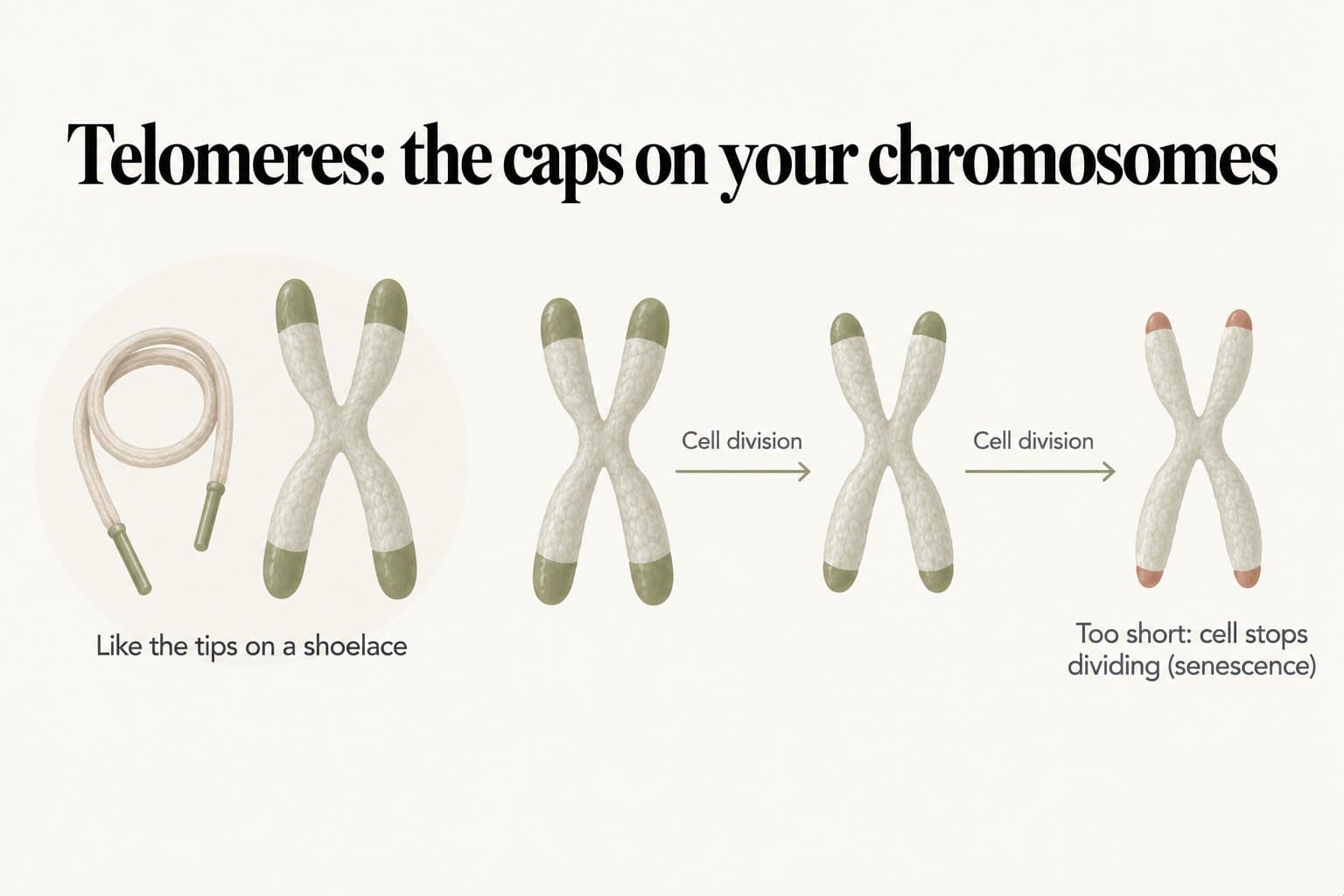
As the Nobel Assembly put it in 2009: "If the telomeres are shortened, cells age." Rare inherited defects in telomerase cause conditions such as some forms of aplastic anaemia and lung and skin disease, showing that telomere maintenance matters for human health.
Telomeres, cancer and the trade-off
Cancer cells need to divide without limit, and most achieve this by switching telomerase back on. Short telomeres therefore act partly as a brake against cancer. This creates a trade-off, which genetic research has made clear.
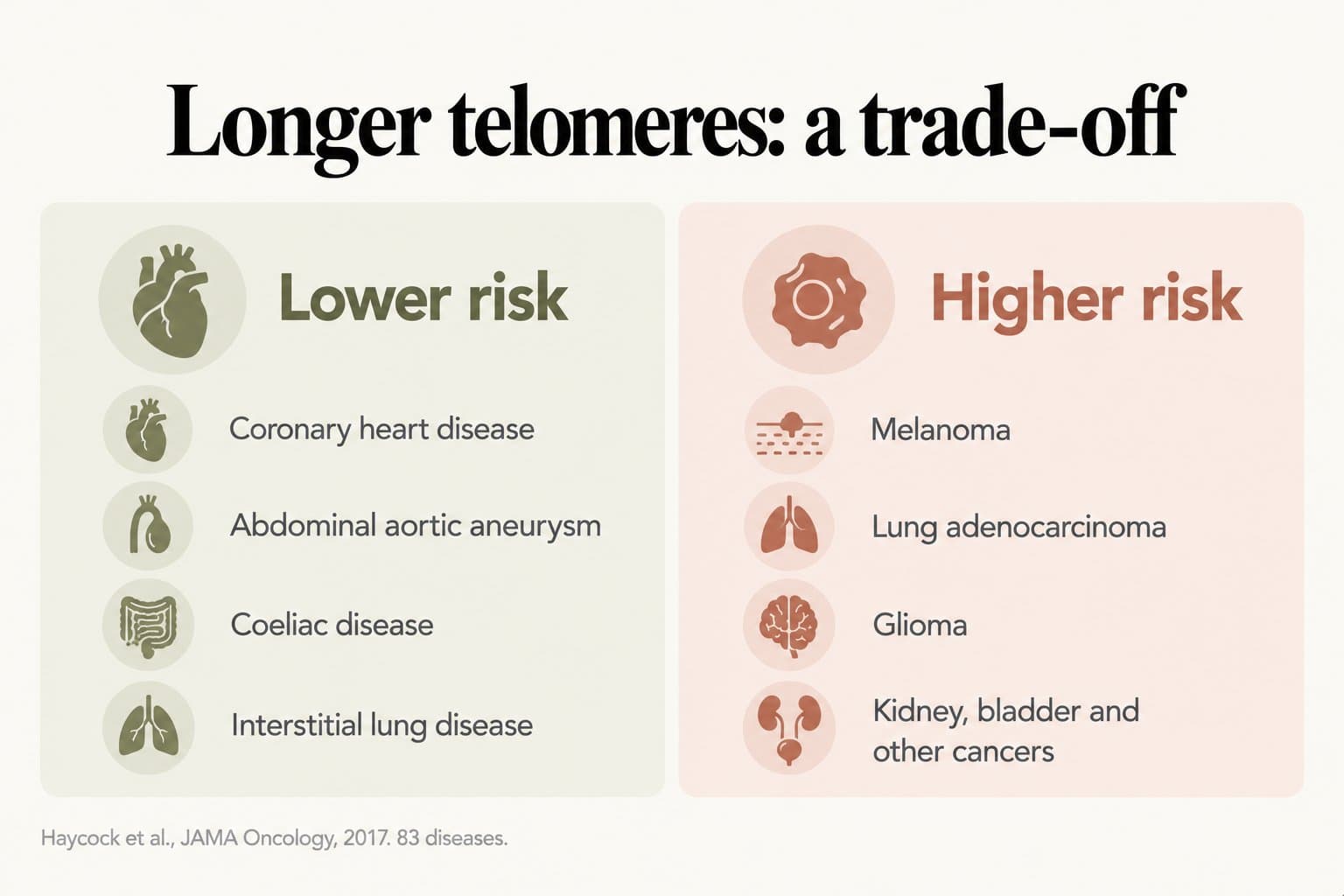
In 2017, the Telomeres Mendelian Randomization Collaboration used genetic variants that determine telomere length from birth to study 83 diseases in more than 420,000 cases and 1 million controls. People genetically predisposed to longer telomeres had:
- Lower risk of coronary heart disease, abdominal aortic aneurysm, coeliac disease and interstitial lung disease
- Higher risk of several cancers, including glioma, lung adenocarcinoma, melanoma and kidney, bladder, testicular and endometrial cancer
The authors concluded that any treatment based on telomere length "may have to consider a trade-off in risk between cancer and other diseases". This is one reason why therapies that simply lengthen telomeres raise safety concerns.
What the research shows
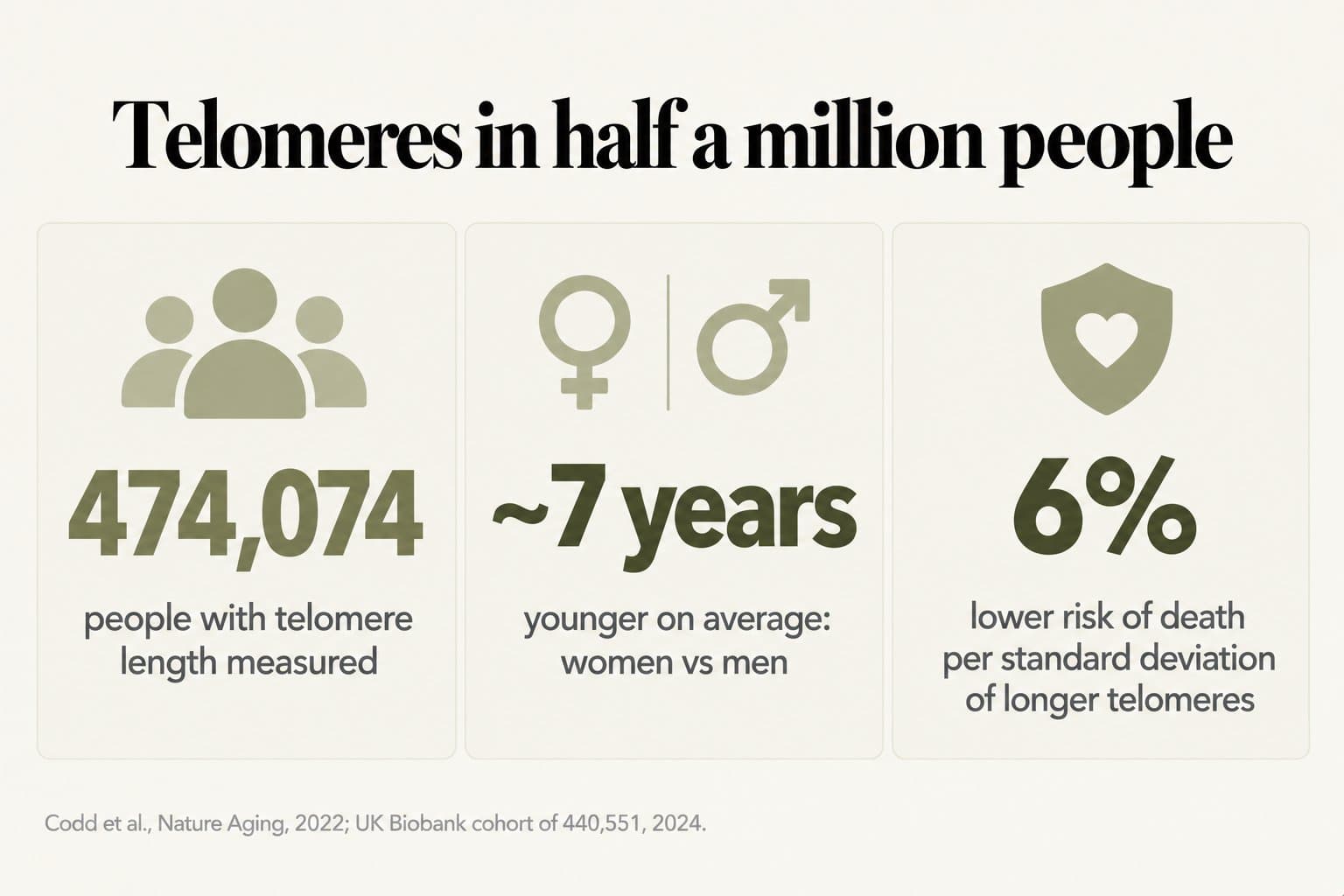
Telomere length in half a million people. UK Biobank measured telomere length in white blood cells from 474,074 people. Telomeres were shorter in older people and in men; women were, on average, about 7 years younger than men by this measure. Telomeres were also longer in people of African and Chinese ancestry than in white Europeans. Yet age, sex, ethnicity and white blood cell count together explained only about 5.5% of the differences between people, showing that telomere length varies widely for reasons that are largely genetic or not yet understood.
In a follow-up of 440,551 UK Biobank participants over about 14 years, each standard deviation of longer telomere length was linked to a 6% lower risk of death from any cause and an 8% lower risk of cardiovascular death. These are real but modest associations.
Stress and lifestyle. A landmark 2004 study by Elissa Epel, Elizabeth Blackburn and colleagues compared mothers caring for a chronically ill child with mothers of healthy children. Among the caregivers, the longer they had been caring for their child, the shorter their telomeres and the lower their telomerase activity, and women who felt most stressed had the shortest telomeres. Later studies have suggested that healthy behaviours, such as physical activity, a good diet and good sleep, may help offset stress-related telomere shortening, although most of this evidence is observational.
Why this matters for longevity
Telomere shortening is a genuine part of the biology of ageing, and it links ageing with cancer, heart disease and the immune system. But as a measure of how fast you're ageing, telomere length has important limits. People are born with very different telomere lengths, a single measurement varies with the method and the laboratory, and longer telomeres carry a higher cancer risk. Newer measures, such as second- and third-generation epigenetic clocks, were designed specifically to capture differences in health and the pace of ageing (see Epigenetic Clocks Explained). Telomere shortening is best understood as one of several interconnected hallmarks (see The Hallmarks of Ageing).
Practical notes
Commercial telomere tests claiming to reveal your biological age were described as "premature" by the lead researcher of the 2017 genetic study, because of the conflicting effects of telomere length on different diseases. If you want a measure of biological ageing, other tools are more informative (see How Is Biological Age Actually Calculated?). Be wary of supplements or treatments marketed as "telomere lengthening": none has been shown to improve health, and boosting telomerase raises theoretical cancer concerns. The habits linked to healthier telomeres are the same ones that support healthy ageing generally: regular exercise, a high-quality diet, good sleep, not smoking and finding ways to manage chronic stress. Our Longevity Doctors can help you choose meaningful measures of your health, starting with the free longevity assessment.
- Nobel Assembly at Karolinska Institutet. The Nobel Prize in Physiology or Medicine 2009. Press release.
- Codd V, et al. Measurement and initial characterization of leukocyte telomere length in 474,074 participants in UK Biobank. Nature Aging, 2022;2(2):170-179.
- Frailty mediating the causality between leucocyte telomere length and mortality: a cohort study of 440,551 UK Biobank participants. EPMA Journal, 2024.
- Telomeres Mendelian Randomization Collaboration (Haycock PC, et al.). Association between telomere length and risk of cancer and non-neoplastic diseases: a Mendelian randomization study. JAMA Oncology, 2017;3(5):636-651.
- Epel ES, et al. Accelerated telomere shortening in response to life stress. Proceedings of the National Academy of Sciences, 2004;101(49):17312-17315.
- López-Otín C, et al. Hallmarks of aging: an expanding universe. Cell, 2023;186(2):243-278.
Free longevity assessment
Want a meaningful measure
of how you're ageing?
Take the free Aevum Protocol assessment to see how your longevity science and 6 other longevity domains are performing — and get a personalised 90-day plan.
Take the free assessment