Longevity Science
Epigenetic Clocks Explained:
How DNA Methylation Measures Biological Age
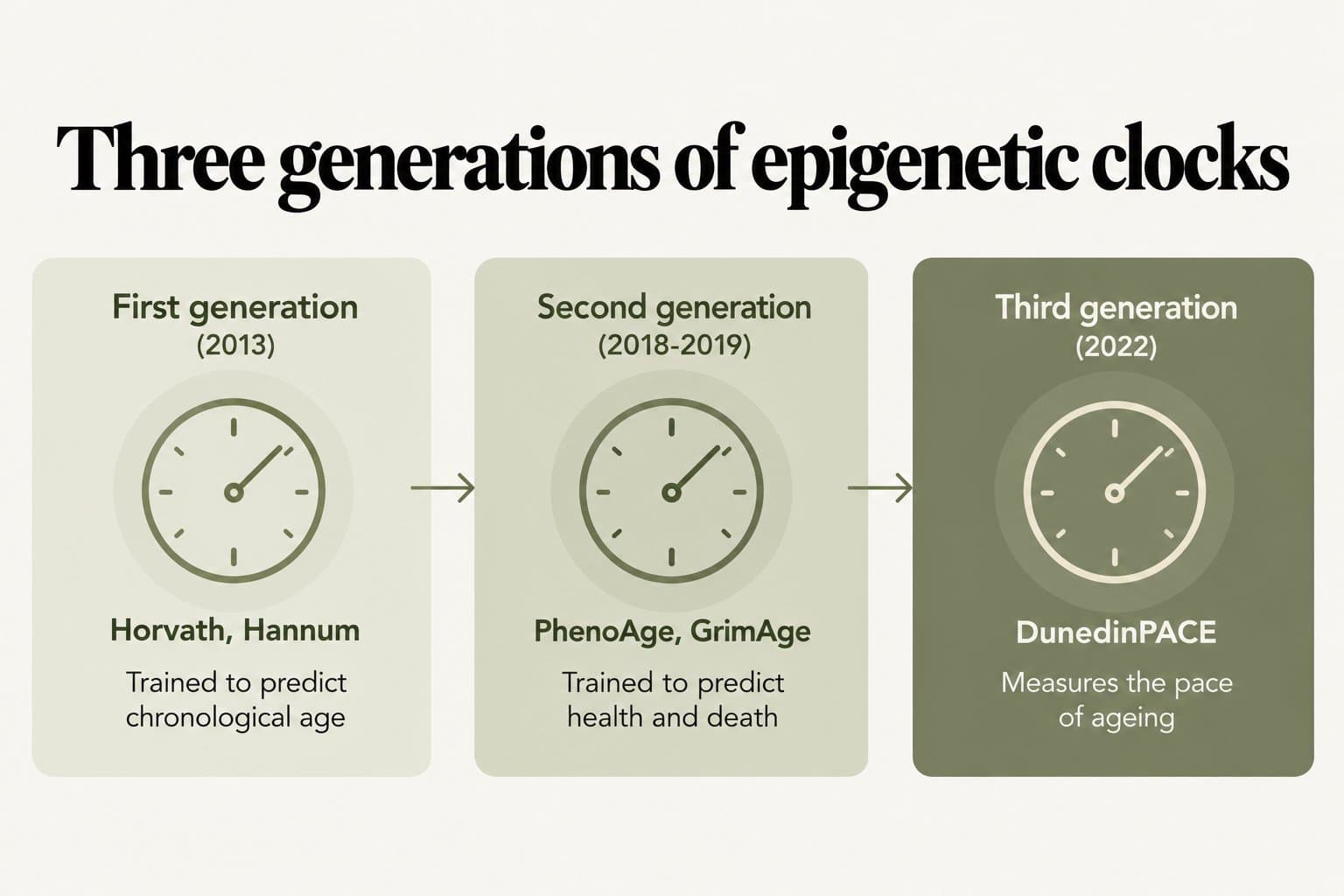
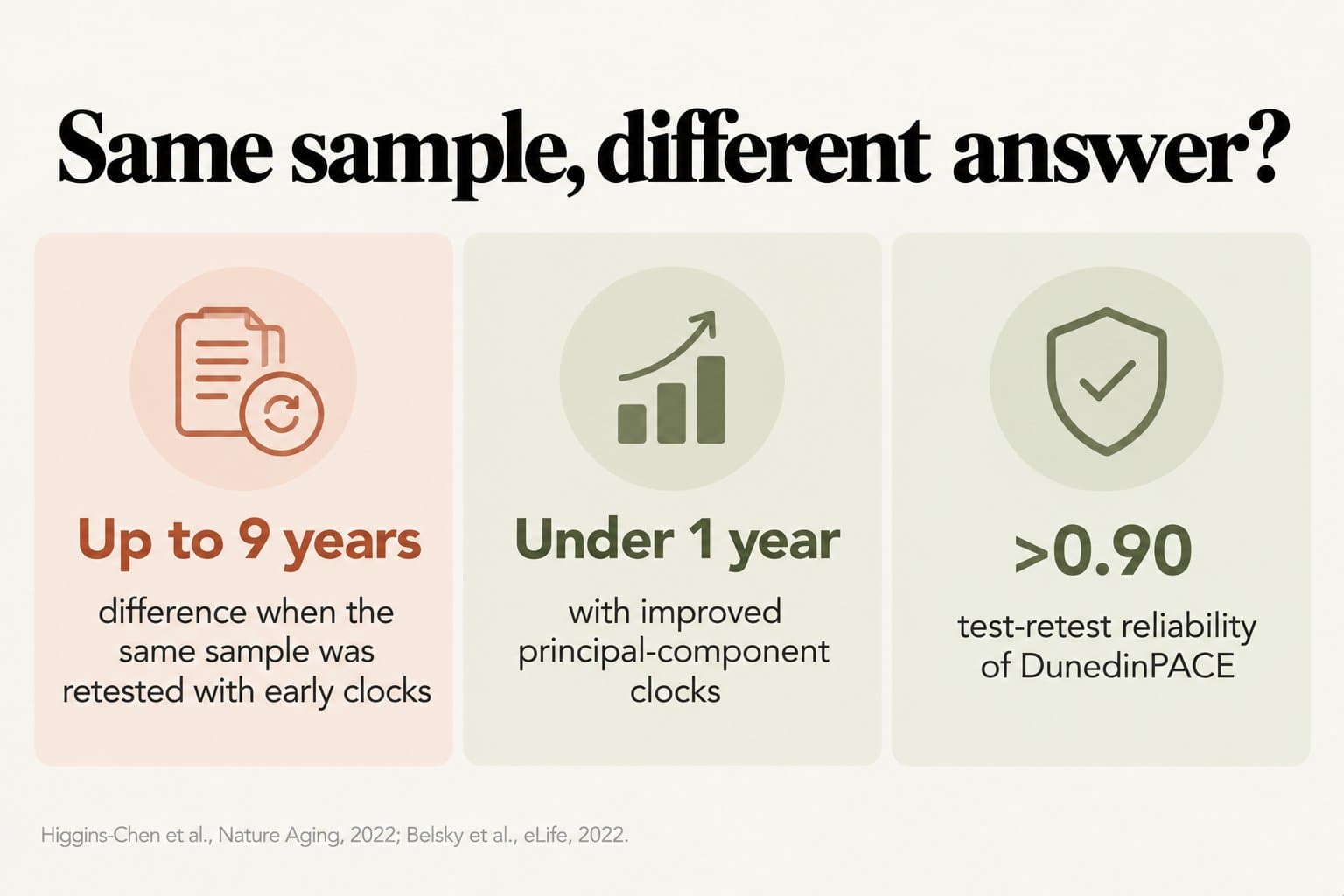
Epigenetic clocks are tests that estimate how old your body is biologically, based on chemical tags called methyl groups at specific sites on your DNA. The first widely used clock, published by Steve Horvath in 2013, used 353 sites to predict age across 51 tissues and cell types with an average error of 3.6 years. Since then the clocks have evolved through three generations. First-generation clocks, such as Horvath's and Hannum's, were trained to predict chronological age. Second-generation clocks, such as PhenoAge and GrimAge, were trained to predict health and risk of death, and are better at predicting disease, frailty and mortality. Third-generation clocks, such as DunedinPACE, measure how fast you're ageing right now, rather than how old you are. Epigenetic clocks are powerful research tools and are increasingly used to test whether interventions slow ageing. But they have limits: results can vary between tests and laboratories, early versions could differ by up to 9 years on the same blood sample, and no clock has yet been shown to guide treatment that improves health. This article explains how the clocks work, how they differ and how to interpret a result.
Key numbers
| Finding | Detail |
|---|---|
| Horvath clock (2013) | 353 sites; about 8,000 samples from 51 tissues and cell types; error about 3.6 years |
| Hannum clock (2013) | 71 sites; trained in blood |
| PhenoAge (2018) | 513 sites; trained on a measure of health based on 9 blood markers |
| DunedinPACE (2022) | Based on 19 biomarkers tracked from age 26 to 45; test-retest reliability above 0.90 |
| Reliability of early clocks (Yale, 2022) | Up to 9 years' difference when the same sample was tested twice; under 1 year with improved methods |
How epigenetic clocks work
DNA methylation, the addition of small chemical tags to DNA, changes with age in a surprisingly predictable way at certain sites in the genome (see Epigenetics and Ageing). To build a clock, scientists measure methylation at hundreds of thousands of sites in thousands of people, then use statistical methods to select the combination of sites that best predicts a target, such as age or risk of death. Most clocks use a blood sample, although some use saliva or cheek swabs.
The result is usually expressed in one of two ways:
- Epigenetic or biological age: for example, a 50-year-old with an epigenetic age of 46. The difference is called "age acceleration" (positive) or "deceleration" (negative).
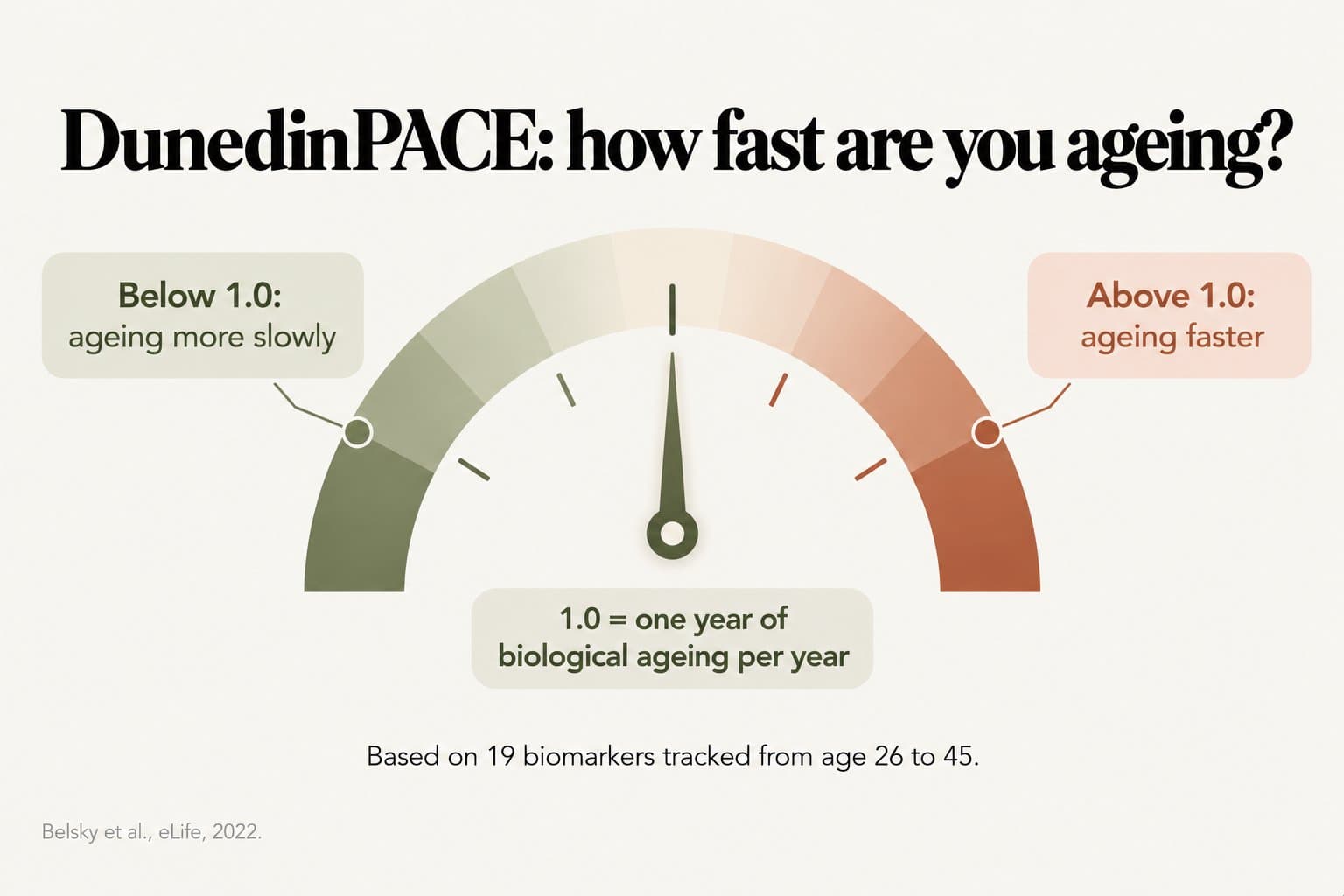
- Pace of ageing: how many years of biological ageing occur per calendar year, where 1.0 is average.
Three generations of clocks
First generation: predicting chronological age. In 2013, Steve Horvath at UCLA published a "multi-tissue" clock based on about 8,000 samples from 51 healthy tissues and cell types. Using 353 methylation sites, it predicted age with a correlation of 0.96 and an error of about 3.6 years. It revealed some striking biology: the epigenetic age of embryonic and reprogrammed stem cells was close to zero, and cancer tissues showed large age acceleration. The same year, Gregory Hannum and colleagues published a blood-based clock using 71 sites.
These clocks predict age well, but because they were trained to match chronological age, they capture less of the difference in health between people of the same age.
Second generation: predicting health and death. Second-generation clocks were trained on health outcomes instead.
- PhenoAge (2018), developed by Morgan Levine, Horvath and colleagues, uses 513 sites and was trained on "phenotypic age", a measure of health and mortality risk based on 9 clinical blood markers and age.
- GrimAge (2019), developed by Ake Lu, Horvath and colleagues, combines methylation-based estimates of seven blood proteins and smoking history, and was trained to predict time to death.
These clocks are better at predicting health. In the Irish Longitudinal Study on Ageing, which compared four clocks in 490 older adults, GrimAge acceleration was linked to 8 of 9 age-related outcomes and remained a significant predictor of walking speed, frailty, use of multiple medicines and death after adjusting for other factors. The first-generation clocks showed few associations with health.
Third generation: measuring the pace of ageing. DunedinPACE, published in 2022 by Daniel Belsky and colleagues at Columbia and Duke universities, takes a different approach. Researchers first tracked 19 biomarkers of organ health, such as blood pressure, cholesterol, kidney and lung function, in people from the Dunedin Study in New Zealand, all born in the same year, at ages 26, 32, 38 and 45. They calculated how fast each person was ageing, then trained a methylation test to predict that pace. A value of 1.0 means about one year of biological ageing per calendar year; 1.2 means ageing 20% faster than average.
Because the researchers chose the most reliable methylation sites, DunedinPACE has test-retest reliability above 0.90, and it has been studied in more than 65 cohorts in over 17 countries. In the CALERIE trial, calorie restriction slowed DunedinPACE by 2-3%, while other clocks didn't change (see Calorie Restriction and Fasting).
What the research shows about reliability
A clock is only useful for tracking a person over time if it gives consistent results. A 2022 study in Nature Aging, led by Albert Higgins-Chen and Morgan Levine at Yale, found that early clocks could differ by up to 9 years when the same blood sample was tested twice, because of technical "noise" at individual methylation sites. As Higgins-Chen put it: "We found epigenetic clocks that could say you are biologically 50 years old on one test, and then 59 on the next." Using a statistical method called principal component analysis, the team rebuilt the clocks so that most repeat measurements differed by less than 1 year.
Other limitations include:
- Different clocks give different answers for the same person, because they measure different things.
- Results vary between laboratories and testing platforms, so tests from different companies aren't directly comparable.
- Short-term factors such as recent illness may affect results.
- Most clocks were developed mainly in people of European ancestry, and may be less accurate in other populations.
Why this matters for longevity
Epigenetic clocks are changing ageing research. Because ageing takes decades, trials that wait for disease or death are slow and expensive; clocks offer a way to see whether an intervention changes the rate of ageing within months or years. They have also confirmed that people of the same age can be ageing at very different rates, and that factors such as smoking, obesity and chronic stress are associated with faster epigenetic ageing.
But a clock is a measurement, not a target. Lowering your epigenetic age score hasn't yet been shown to reduce disease or extend life, and some changes in a score may reflect noise rather than real change. Whether biological age can be reversed is covered in Can You Reverse Your Biological Age?; the reliability of consumer ageing tests is covered in Longevity Testing.
Practical notes
If you're considering an epigenetic age test, choose one that names the clock it uses (second- or third-generation clocks such as GrimAge or DunedinPACE are more informative about health), use the same test if you repeat it, and allow time between tests. Interpret a single result cautiously and alongside proven measures such as blood pressure, blood sugar, cholesterol, fitness and body composition (see How Is Biological Age Actually Calculated?). The habits that slow ageing, such as exercise, good sleep, a healthy diet, not smoking and limiting alcohol, matter whatever your score. Our Longevity Doctors can help you decide whether testing is useful for you and interpret the results, starting with the free longevity assessment.
- Horvath S. DNA methylation age of human tissues and cell types. Genome Biology, 2013;14(10):R115.
- Hannum G, et al. Genome-wide methylation profiles reveal quantitative views of human aging rates. Molecular Cell, 2013;49(2):359-367.
- Levine ME, et al. An epigenetic biomarker of aging for lifespan and healthspan. Aging, 2018;10(4):573-591.
- Lu AT, et al. DNA methylation GrimAge strongly predicts lifespan and healthspan. Aging, 2019;11(2):303-327.
- McCrory C, et al. GrimAge outperforms other epigenetic clocks in the prediction of age-related clinical phenotypes and all-cause mortality. Journals of Gerontology: Series A, 2021;76(5):741-749.
- Belsky DW, et al. DunedinPACE, a DNA methylation biomarker of the pace of aging. eLife, 2022;11:e73420.
- Higgins-Chen AT, et al. A computational solution for bolstering reliability of epigenetic clocks: implications for clinical trials and longitudinal tracking. Nature Aging, 2022;2(7):644-661.
Free longevity assessment
Would an epigenetic age test
change what you do?
Take the free Aevum Protocol assessment to see how your longevity science and 6 other longevity domains are performing — and get a personalised 90-day plan.
Take the free assessment