Nutrition & Metabolism
Eating Patterns for Longevity:
What the Mediterranean Diet and Other Healthy Patterns Have in Common
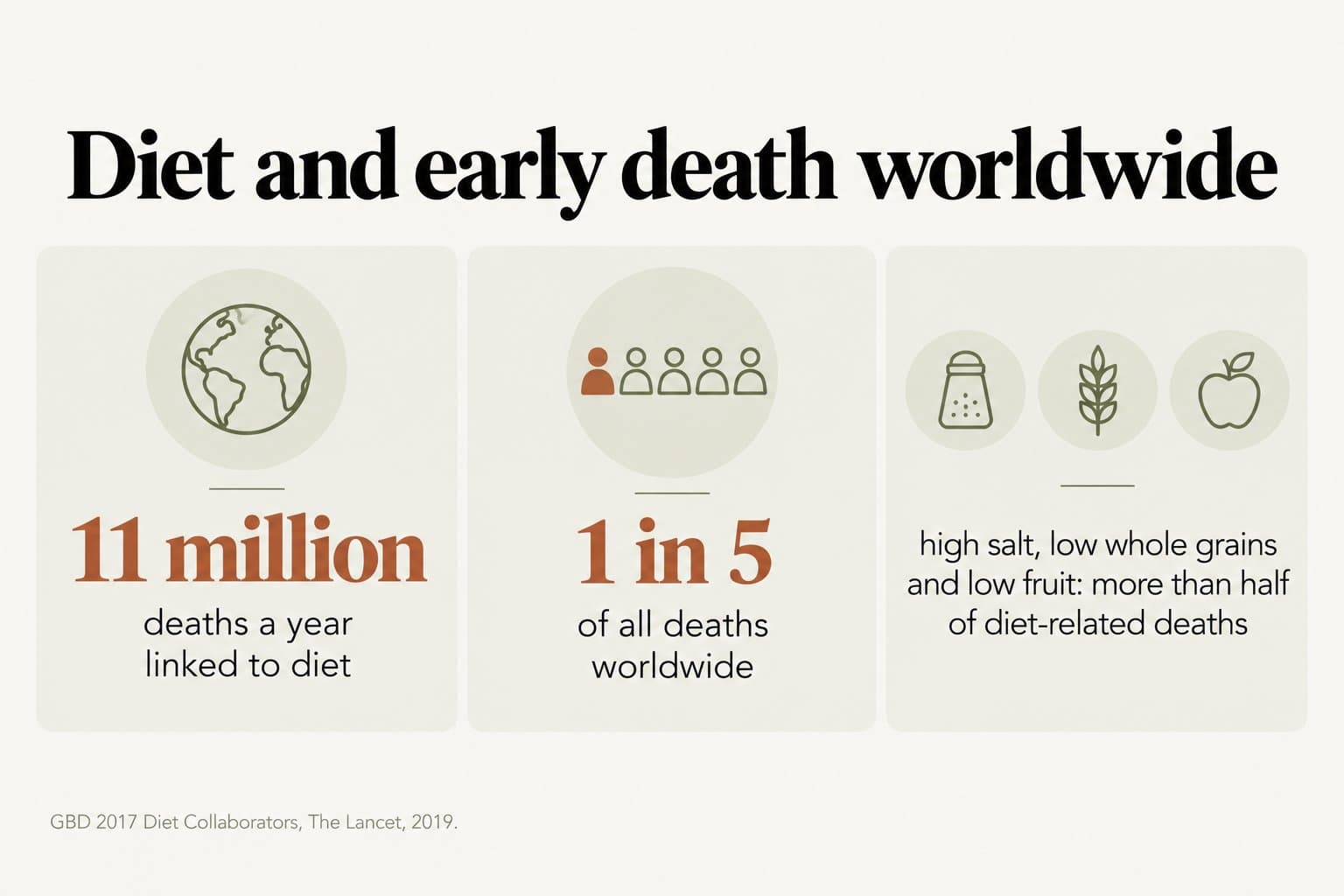
Single nutrients and "superfoods" get most of the attention, but the strongest evidence for a longer, healthier life comes from overall eating patterns. Poor diet is one of the biggest causes of early death: the Global Burden of Disease study estimated that about 11 million deaths worldwide in 2017, 1 in 5, were linked to diet, mainly from eating too much salt and too few whole grains and fruit. Several healthy patterns, including the Mediterranean diet, plant-forward diets and the Alternative Healthy Eating Index, are consistently linked to longer life. In a Harvard study of nearly 120,000 adults followed for 36 years, people who most closely followed any of four healthy patterns had a 14-20% lower risk of death. In the PREDIMED trial, a Mediterranean diet with extra-virgin olive oil or nuts cut major cardiovascular events by about 30%. A 2025 study found that the healthiest eaters had up to 86% higher odds of reaching 70 free of major chronic disease and with good physical and mental function. These patterns share the same core: more vegetables, fruit, whole grains, legumes, nuts and healthy oils, and less red and processed meat, sugary drinks and salt. This article explains the evidence and how to apply it to everyday eating, including a Sri Lankan diet.
Key numbers
| Finding | Detail |
|---|---|
| Deaths linked to diet worldwide (Global Burden of Disease, 2017) | About 11 million, 1 in 5 deaths |
| Leading dietary risks (same study) | High sodium, low whole grains and low fruit: more than half of diet-related deaths |
| Healthy eating patterns and death (119,315 adults, 36 years) | 14-20% lower risk with the highest vs lowest adherence |
| Mediterranean diet trial (PREDIMED, 7,447 adults at high risk) | About 30% fewer major cardiovascular events |
| Healthy eating and healthy ageing (105,015 adults, up to 30 years) | Up to 86% higher odds of healthy ageing to 70 |
Why patterns matter more than single foods
People don't eat nutrients in isolation; they eat meals and habits. Foods interact: fibre slows sugar absorption, healthy fats help absorb vitamins, and eating more of one food usually means eating less of another. That's why researchers increasingly study overall dietary patterns, scored with tools such as:
- The Mediterranean diet score: vegetables, fruit, legumes, whole grains, nuts, fish and olive oil, with moderate wine and little red meat.
- The Alternative Healthy Eating Index (AHEI): designed around foods most strongly linked to chronic disease risk.
- Plant-based diet indexes: that distinguish healthy plant foods (whole grains, legumes, vegetables) from unhealthy ones (refined grains, sugary drinks).
- The Healthy Eating Index: based on national dietary guidelines.
A related pattern, the MIND diet, focuses on brain health (see The MIND Diet and Brain Health).
The global picture
The Global Burden of Disease study analysed diet in 195 countries and estimated that about 11 million deaths in 2017, 1 in 5 worldwide, were linked to poor diet, mostly from cardiovascular disease, followed by cancer and type 2 diabetes. Diets high in sodium, low in whole grains and low in fruit together accounted for more than half of these deaths. Strikingly, more deaths were linked to not eating enough healthy foods than to eating too many unhealthy ones. As the study's lead researcher put it, the leading risks are "high intake of sodium, or low intake of healthy foods".
What the research shows
Several healthy patterns are linked to longer life. A Harvard study followed 75,230 women and 44,085 men for 36 years and scored their diets with four different healthy eating patterns. Compared with those who followed them least, people who followed them most had a lower risk of death:
- Healthful plant-based diet: 14% lower (HR 0.86).
- Alternate Mediterranean diet: 18% lower (HR 0.82).
- Healthy Eating Index: 19% lower (HR 0.81).
- Alternative Healthy Eating Index: 20% lower (HR 0.80).
Each pattern was also linked to lower death rates from cardiovascular disease, cancer and respiratory disease, and the benefits were consistent across racial and ethnic groups. The key message is that there's more than one healthy way to eat.
Horizontal bar chart, more than one healthy way to eat: lower risk of death with the highest vs lowest adherence was 20% for the Alternative Healthy Eating Index, 19% for the Healthy Eating Index, 18% for the Mediterranean diet and 14% for a healthful plant-based diet (Shan et al., JAMA Internal Medicine, 2023, 119,315 adults, 36 years)
The Mediterranean diet in a randomised trial. Most diet evidence comes from observational studies, which can't prove cause and effect. PREDIMED, a Spanish trial of 7,447 adults at high cardiovascular risk, randomly assigned people to a Mediterranean diet with extra-virgin olive oil, a Mediterranean diet with nuts, or advice to follow a low-fat diet. The Mediterranean diets reduced major cardiovascular events, such as heart attack and stroke, by about 30%. The original paper was retracted and republished in 2018 because of problems with randomisation at some sites, but the results held after reanalysis without the affected participants.
Healthy eating and healthy ageing. A 2025 study in Nature Medicine followed 105,015 adults for up to 30 years and looked beyond survival, to "healthy ageing": reaching 70 without major chronic disease and with good cognitive, physical and mental health. Only 9.3% achieved it. The healthiest eaters by the Alternative Healthy Eating Index had 86% greater odds of healthy ageing than those with the least healthy diets. Fruits, vegetables, whole grains, unsaturated fats, nuts, legumes and low-fat dairy were linked to better odds; trans fats, sodium, sugary drinks and red or processed meats to worse.
What about the "Blue Zones"? Regions such as Okinawa, Sardinia and Ikaria have been promoted as "Blue Zones" where people live exceptionally long lives on traditional diets. Some researchers have questioned these claims, arguing that unusually high numbers of very old people may partly reflect poor birth records and age-reporting errors, while Blue Zone researchers dispute this. Whatever the truth, the eating habits described in these regions, mostly plant foods, legumes, whole grains and little processed food, match the patterns supported by stronger evidence.
The common ground
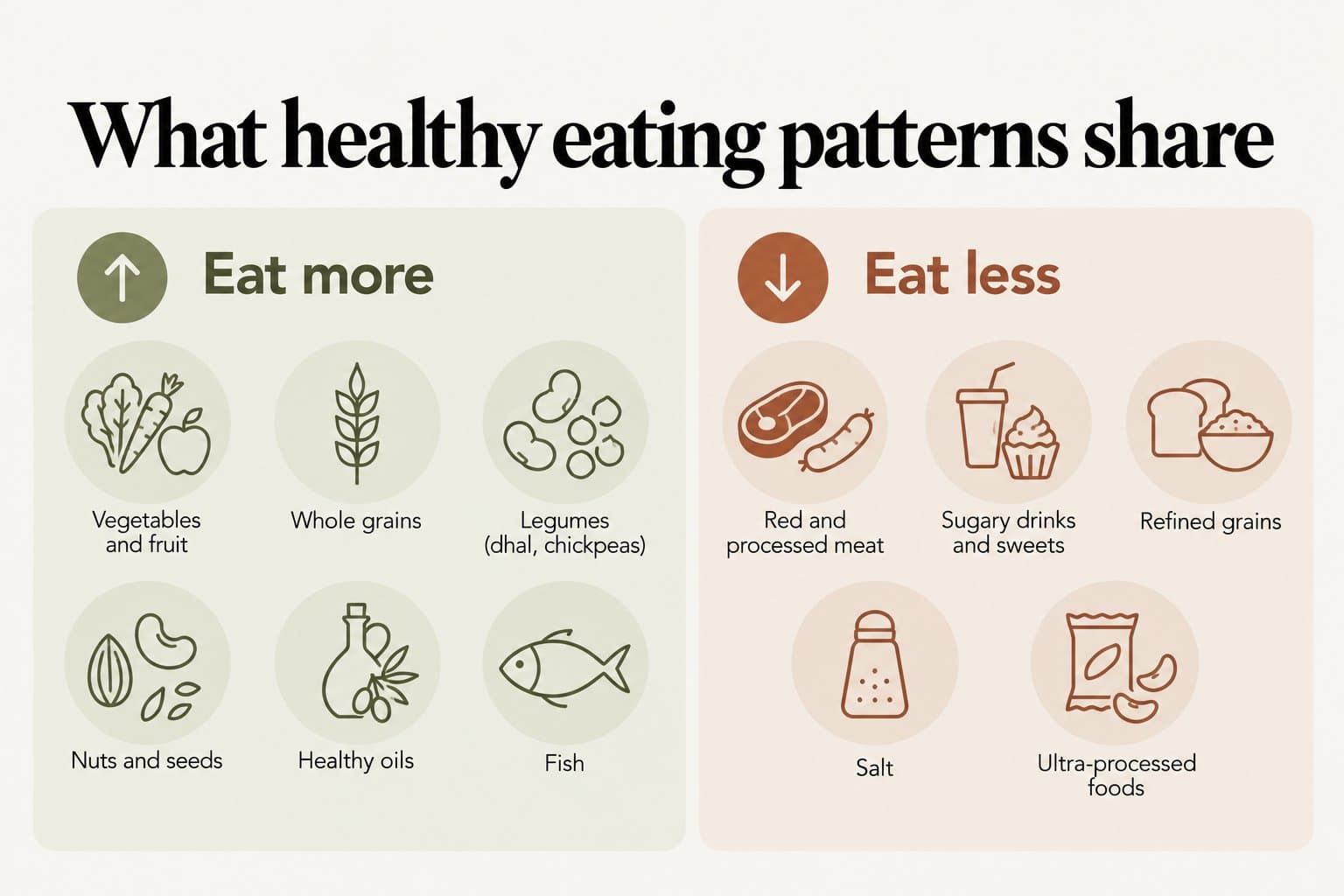
Despite their differences, the healthy patterns share a clear core.
Eat more:
- Vegetables and fruit, in a variety of colours.
- Whole grains instead of refined grains.
- Legumes such as dhal, chickpeas and green gram.
- Nuts and seeds.
- Healthy unsaturated oils.
- Fish.
Eat less:
- Red and especially processed meat.
- Sugary drinks and sweets.
- Refined grains and white flour.
- Salt.
- Trans fats and ultra-processed foods.
Applying it to a Sri Lankan diet
A traditional Sri Lankan rice and curry meal already has many of these elements: dhal, vegetables, greens, fish and spices. The main opportunities are:
- Change the proportions: a smaller portion of rice and more vegetables, greens and legumes on the plate.
- Choose whole grains: red or less-polished rice, kurakkan and other whole grains (see Know Your Rice and Know Your Grains).
- Keep legumes daily: dhal, chickpeas, cowpea and green gram (see Know Your Legumes).
- Watch the salt: in curries, pickles, dried fish and short eats.
- Limit sugary tea, soft drinks and sweets.
- Choose fats wisely (see Fats in the Sri Lankan Diet).
For a practical, meal-by-meal guide, see Building a Longevity Plate.
Why this matters for longevity
Diet influences nearly every pathway of ageing, including blood pressure, cholesterol, blood sugar, inflammation, body weight and the gut microbiome. Healthy eating patterns are linked not only to longer life but to more years free of chronic disease and with good physical and mental function. And because the benefits come from overall patterns rather than any single food, small, sustainable changes across many meals matter more than short-term diets.
Practical notes
- Focus on the pattern, not single foods: no single "superfood" makes up for an unhealthy overall diet.
- Add before you subtract: more vegetables, fruit, legumes and whole grains is the biggest opportunity.
- Choose the healthy pattern you can sustain: Mediterranean, plant-forward or a healthier version of your traditional diet can all work.
- Cut back on salt, sugary drinks and processed meat.
- Make changes gradually, one meal or habit at a time.
- GBD 2017 Diet Collaborators. Health effects of dietary risks in 195 countries, 1990-2017: a systematic analysis for the Global Burden of Disease Study 2017. The Lancet, 2019;393(10184):1958-1972.
- Shan Z, et al. Healthy eating patterns and risk of total and cause-specific mortality. JAMA Internal Medicine, 2023;183(2):142-153.
- Estruch R, et al. Primary prevention of cardiovascular disease with a Mediterranean diet supplemented with extra-virgin olive oil or nuts. New England Journal of Medicine, 2018;378(25):e34.
- Tessier AJ, et al. Optimal dietary patterns for healthy aging. Nature Medicine, 2025;31:1644-1652.
- Newman SJ. Supercentenarian and remarkable age records exhibit patterns indicative of clerical errors and pension fraud. bioRxiv preprint, 2019 (updated 2024).
Free longevity assessment
How close is your everyday diet
to a healthy eating pattern?
Take the free Aevum Protocol assessment to see how your nutrition & metabolism and 6 other longevity domains are performing — and get a personalised 90-day plan.
Take the free assessment