Nutrition & Metabolism
Fats in the Sri Lankan Diet: Types,
Functions, Sources & What to Change
Fat has the worst reputation of any macronutrient, yet it's essential for hormone production, brain structure, and absorbing several vitamins the body can't use without it. In Sri Lanka specifically, fat intake has its own distinct pattern — coconut fat alone accounts for roughly 80% of total dietary fat nationally, while the unsaturated fats most longevity research points toward (omega-3s, monounsaturated fat) remain genuinely low. This article covers what fat actually does in the body, the different types, where Sri Lankans currently get theirs, and specific, practical changes worth making.
Quick Summary
- →Fat isn't optional — it's required for hormone production, brain structure, cell membranes, and absorbing vitamins A, D, E, and K
- →Sri Lanka's fat intake is unusually concentrated in one source — coconut fat makes up around 80% of total dietary fat nationally, while polyunsaturated and monounsaturated fat intake are both notably low
- →Trans fat is now regulated in Sri Lanka — partially hydrogenated oils are banned, but reused frying oil at home and in small food outlets remains a real, unregulated source
- →The coconut oil "good fat or bad fat" debate is genuinely unresolved, though current evidence still favours replacing some saturated fat with unsaturated fat for cardiovascular risk
- →The biggest longevity-relevant gap is omega-3 intake — despite being an island nation with strong fish availability, actual PUFA intake in the average diet remains low
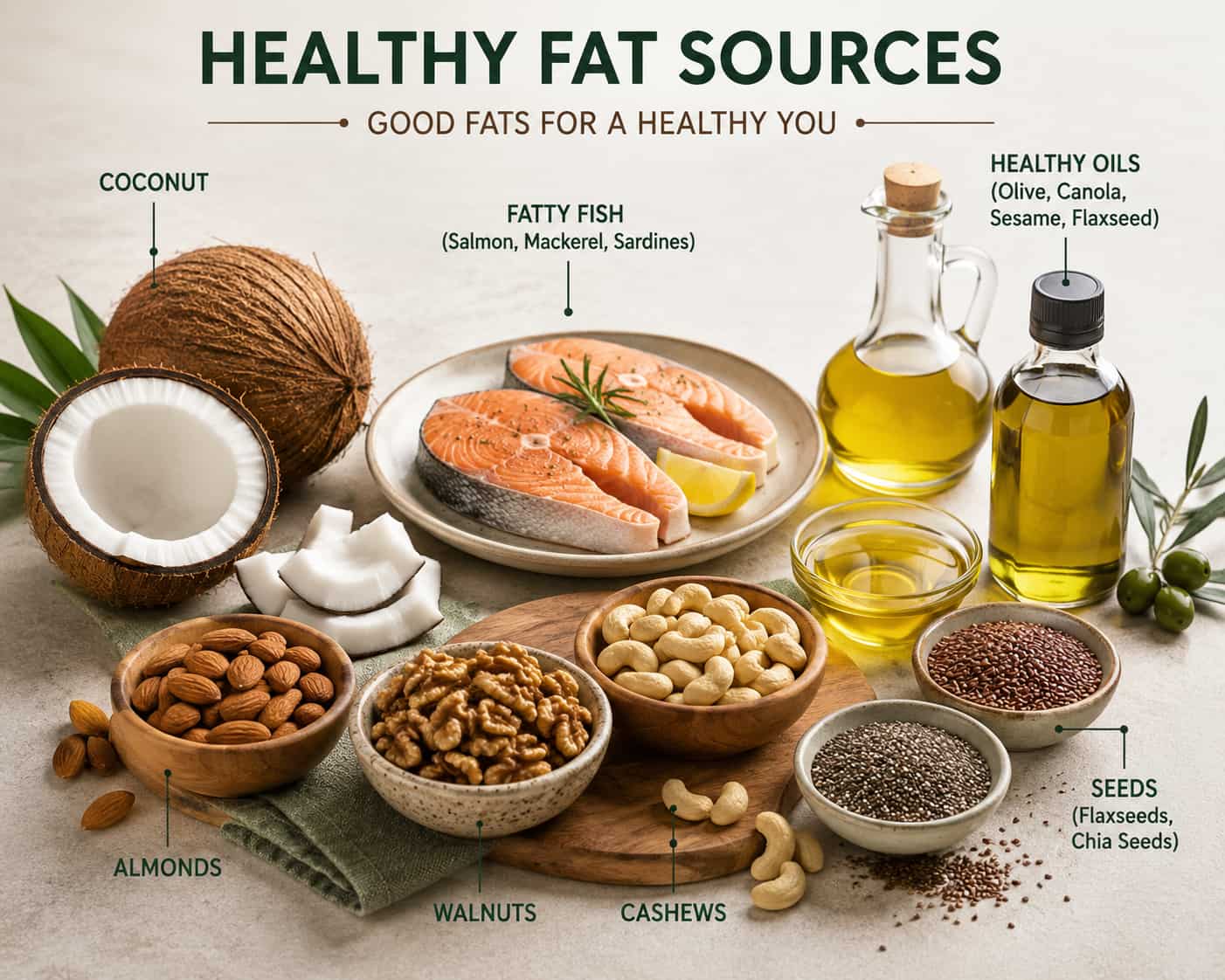
What fat actually does in the body
Fat is a structural and functional necessity, not just a source of calories.
- →Cell membranes — every cell in the body is wrapped in a membrane built largely from fat; membrane composition affects how cells function and communicate
- →Hormone production — sex hormones (oestrogen, testosterone) and other steroid hormones are synthesised from cholesterol, a type of fat
- →Vitamin absorption — vitamins A, D, E, and K are fat-soluble, meaning they require dietary fat to be absorbed at all; a very low-fat diet can lead to deficiencies in these vitamins even if intake looks adequate on paper
- →Brain structure — the brain is roughly 60% fat by dry weight, with specific fatty acids (particularly omega-3 DHA) playing a direct structural role in neurons
- →Energy storage and insulation — fat is the body's most energy-dense storage form and provides cushioning and insulation for organs
A brief look at fat metabolism
Dietary fat is broken down and absorbed differently from carbohydrate or protein. Bile (produced by the liver, stored in the gallbladder) emulsifies fat in the small intestine, breaking large fat globules into smaller droplets that digestive enzymes (pancreatic lipase) can act on. The resulting fatty acids and other fat components are absorbed into intestinal cells, reassembled, and packaged into particles called chylomicrons, which enter the lymphatic system before reaching the bloodstream.
From there, fat is transported through the blood in different types of lipoproteins — commonly discussed as LDL ("bad" cholesterol carrier), HDL ("good" cholesterol carrier), and triglycerides. Cells take up fat for immediate energy use, or it's stored in adipose (fat) tissue for later use. This is also why blood tests measuring LDL, HDL, and triglycerides are used as indirect markers of cardiovascular risk — they reflect how fat is currently being transported and stored, which is influenced substantially by diet, particularly the type of fat consumed.
Types of fat
Saturated fat (SFA) — solid at room temperature, found in coconut fat, ghee, red meat, and dairy. Effects on health vary depending on the specific fatty acid and source, covered in more detail below.
Monounsaturated fat (MUFA) — liquid at room temperature, found in olive oil, avocado, peanuts, and cashews. Generally associated with favourable cardiovascular outcomes.
Polyunsaturated fat (PUFA) — includes two subtypes the body can't produce on its own and must get from food.
- 1Omega-3
Found in oily fish (mackerel, sardines, tuna), flaxseed, and walnuts; associated with anti-inflammatory effects and cardiovascular and brain benefits.
- 2Omega-6
Found in sunflower oil, soybean oil, and most nuts; needed in balance with omega-3, but disproportionately high omega-6 intake relative to omega-3 is common in modern diets and linked to a more pro-inflammatory balance.
Trans fat — created industrially through partial hydrogenation of vegetable oil (typically extracted from seeds such as soybean, sunflower, or rapeseed, or from the fruit of the oil palm), found in margarine, vanaspati, and some baked and fried foods, and in small amounts naturally in dairy and meat from ruminant animals. Naturally occurring unsaturated fats have their double bonds in a bent "cis" shape, which is why liquid oils stay liquid; partial hydrogenation straightens some of these into a "trans" shape instead, making the fat behave like a saturated fat even though it's chemically still unsaturated. Only unsaturated (vegetable) oils can undergo this change — saturated fats like coconut oil or ghee have no double bonds to alter, so they don't carry this risk. Industrial trans fat has no known health benefit and is the type most strongly linked to cardiovascular disease.
Why unsaturated fat is generally considered healthier
The differences between these fat types aren't arbitrary categories — they come down to measurable effects on cholesterol, inflammation, and cell function.
Saturated fat and LDL cholesterol: saturated fat's straight molecular shape affects how the liver regulates cholesterol, generally reducing how efficiently LDL ("bad" cholesterol) is cleared from the blood. Higher circulating LDL is one of the most well-established drivers of atherosclerosis — the gradual build-up of plaque in artery walls that underlies most heart attacks and strokes. This effect varies somewhat by the specific saturated fat and source, which is part of why the coconut oil question below isn't fully settled.
A note on dietary cholesterol itself, separate from saturated fat: foods like eggs, prawns, and organ meat are high in cholesterol, which historically led to advice to limit them for heart health. Current evidence shows dietary cholesterol has a much smaller effect on blood cholesterol for most people than saturated fat does — the liver adjusts its own cholesterol production in response to dietary intake, buffering much of the effect. This doesn't mean cholesterol-rich foods are unlimited, but the bigger lever by far remains saturated and trans fat intake, not cholesterol-containing foods specifically. Eggs, in particular, are a useful and affordable protein source that don't need to be restricted on cholesterol grounds alone.
Trans fat affects both sides of the equation: it raises LDL in a similar way to saturated fat, but also actively lowers HDL ("good" cholesterol, which helps clear excess cholesterol from arteries). This combined effect — worse LDL and reduced HDL protection — is why trans fat carries the strongest cardiovascular risk per gram of any fat type, and why global health guidance treats it as having no minimum safe intake.
MUFA and PUFA generally improve this balance instead of worsening it. Replacing saturated fat with unsaturated fat tends to lower LDL without reducing HDL, improving the overall LDL:HDL ratio that predicts cardiovascular risk — this is a large part of why olive oil is central to Mediterranean diet research.
Omega-3 PUFA does more than affect cholesterol. It also reduces systemic inflammation (which independently damages artery walls over time), lowers triglycerides, modestly reduces excessive blood clotting tendency, and plays a direct structural role in brain and retinal development.
Omega-6 PUFA is a more nuanced case. It does lower LDL on its own, but very high omega-6 intake relative to omega-3 is thought to shift the body toward a more pro-inflammatory state overall. Most modern diets, including the typical Sri Lankan diet, run omega-6-heavy and omega-3-light — so in practice, the priority is usually increasing omega-3 intake specifically, rather than increasing PUFA in general.
Inflammation specifically is worth separating out from the cholesterol story above, since it works through a different mechanism. Trans fat is the clearest pro-inflammatory fat of all — independent of its LDL/HDL effect, it directly raises inflammatory markers like CRP and IL-6. Excess omega-6 relative to omega-3 works similarly but more conditionally: omega-6 fats feed into an inflammatory signalling pathway (via arachidonic acid), while omega-3s feed into a competing anti-inflammatory one, so a heavily skewed ratio tilts the overall balance toward inflammation even though the body needs some omega-6. Saturated fat isn't considered directly pro-inflammatory through this same signalling route, but high intake — particularly alongside excess calories or existing weight gain — is linked to a slower, indirect inflammatory pathway involving gut bacteria and metabolic health. MUFA sits at the neutral-to-mildly-favourable end, with olive oil in particular containing compounds with modest anti-inflammatory effects of their own. Omega-3 remains the clearest lever in the anti-inflammatory direction.
Where Sri Lankans currently get their fat
National dietary research paints a fairly specific picture: coconut fat accounts for roughly 80% of total fat intake among Sri Lankans, primarily through coconut milk in cooking and coconut oil used for frying and tempering. A study of adult Sri Lankan men found total daily fat intake averaging 56g (about 25% of total energy), with saturated fat making up the large majority of that (16.3% of energy) while polyunsaturated fat (1.4%) and monounsaturated fat (2.9%) were both notably low by comparison. Peanuts were the main contributor to what little PUFA intake existed, and small fish were the main MUFA contributor.
Other fat sources in the typical diet include ghee (ගිතෙල්) used in some cooking and traditional sweets, red meat (eaten less frequently than chicken or fish for most households), deep-fried short eats (vadai, cutlets, rolls), and dairy. Rural nutrition survey data shows coconut milk alone providing around 12% of total daily energy intake — a substantial share for a single ingredient.
Daily fat targets: general guideline vs. longevity-focused
| Measure | General / WHO Guideline | Longevity-Focused Target |
|---|---|---|
| Total fat (% of daily energy) | 20–35% | 25–35%, stronger emphasis on composition than total quantity |
| Saturated fat (% of daily energy) | Below 10% | Below 7%, tighter still with existing cardiovascular risk |
| Trans fat | As close to 0% as possible; below 1% of energy | Effectively 0 — no meaningful benefit at any intake level |
| Omega-3 (combined EPA + DHA) | ~250–500mg/day | ~1,000–2,000mg/day, in line with doses studied for cardiovascular and cognitive protection |
| Omega-6 : Omega-3 ratio | No official target; typical modern diets run 15:1 or higher | Closer to 4:1 or lower |
The average Sri Lankan adult male's measured intake (56g total fat/day, 16.3% saturated, 1.4% PUFA) sits within the general total fat range but well outside the saturated fat ceiling and well below both the omega-3 target and a favourable omega-6:omega-3 ratio — the gap is in composition, not overall quantity.
The trans fat situation in Sri Lanka
This is a genuine public health success story worth knowing about. Sri Lanka enacted the Food (Trans-Fat) Regulations, which ban the manufacture, import, and use of partially hydrogenated oils — the primary source of industrial trans fat — and cap trans fat content in retail products like margarine at 3% of total fat, with tighter limits for oil supplied to food manufacturers. This puts Sri Lanka among a small group of countries in the WHO South-East Asia Region to adopt a best-practice trans fat policy, and WHO's ongoing REPLACE initiative estimates this kind of regulation prevents tens of thousands of deaths over the following decades by reducing coronary heart disease risk.
What this doesn't eliminate: reused cooking oil. Repeatedly heating oil — common in home deep-frying and especially at small food stalls preparing fried short eats — degrades the oil and can generate harmful compounds even without partial hydrogenation being involved. This remains a real, largely unregulated source of dietary fat quality concerns that the trans fat legislation doesn't directly address.
Which oils hold up best to frying heat, and which don't: heat stability depends mainly on how saturated an oil is — saturated fats have no double bonds to break down, so they resist oxidation even under repeated heating. This means the oils best suited to deep frying (coconut oil, palm oil/palm olein, ghee) are the same ones that carry more saturated fat overall, while the more PUFA-heavy oils (ordinary sunflower, soybean, corn oil) are more prone to breaking down with each reuse cycle — the exact pattern common in small kitchens and food stalls. Extra virgin olive oil and flaxseed oil, though considered "good" fats generally, are poor choices for high-heat frying specifically, and are better reserved for cold or low-heat use. In practice, oil choice matters less than how many times it's reused — a stable oil reused too many times still degrades.
Good fats vs. bad fats: the coconut oil question
Coconut oil sits in a genuinely unresolved position in nutrition science, and it's worth being straightforward about that rather than picking a side. Coconut oil is about 92% saturated fat, but a meaningful share of that is medium-chain fatty acids (particularly lauric acid), which are metabolised somewhat differently from the long-chain saturated fat found in red meat — part of the reasoning behind claims that coconut fat is "healthier" than other saturated fats.
At the same time, a recent Sri Lankan clinical trial comparing coconut oil against palm olein oil found no significant beneficial difference for coconut oil on cardio-metabolic markers, and broader systematic reviews continue to find a small but real cardiovascular benefit from reducing saturated fat intake generally, regardless of source. Historical observations that coconut-heavy Pacific and South Asian populations had low cardiovascular disease rates decades ago are also confounded by other differences in those diets — high fish intake, minimal processed food, and native fruit as the main carbohydrate source — making it hard to credit coconut fat alone.
Coconut oil isn't the dietary villain it's sometimes made out to be, but it also isn't a free pass to use liberally as the default cooking fat. Moderating coconut milk and coconut oil quantity, rather than eliminating it, paired with genuinely increasing unsaturated fat sources (fish, nuts, and where accessible, olive oil), is the more defensible position given current evidence.
Food sources by fat type
| Fat Type | Local & Available Sources |
|---|---|
| Saturated | Coconut oil (පොල් තෙල්), coconut milk (පොල් කිරි), ghee (ගිතෙල්), red meat, full-cream dairy |
| Monounsaturated | Peanuts, cashews, avocado (increasingly available locally), olive oil (imported) |
| Omega-3 (PUFA) | Mackerel, sardines (හුරුල්ලා), tuna, sprats, walnuts, flaxseed (imported) |
| Omega-6 (PUFA) | Sunflower oil, soybean oil, most nuts and seeds |
| Trans (avoid) | Reused deep-frying oil, some margarines, commercially fried short eats |
Fat content across common food sources
| Food | Total Fat (per 100g) | Saturated | MUFA | PUFA |
|---|---|---|---|---|
| Coconut oil (පොල් තෙල්) | 100g | ~92% | ~6% | ~2% |
| Coconut milk (thick) | ~24g | ~89% | ~6% | ~2% |
| Ghee (ගිතෙල්) | 100g | ~62% | ~29% | ~4% |
| Full-cream milk | ~3.5g | ~63% | ~28% | ~4% |
| Palm oil | 100g | ~49% | ~37% | ~9% |
| Beef (lean, cooked) | ~15g | ~40% | ~44% | ~4% |
| Margarine | ~80g | ~20% | ~40% | ~35% |
| Cashews | ~44g | ~20% | ~54% | ~18% |
| Egg | ~11g | ~31% | ~44% | ~16% |
| Chicken breast (with skin) | ~8g | ~28% | ~40% | ~24% |
| Tuna (fresh, not canned in oil) | ~1–5g | ~28% | ~24% | ~37% |
| Sardines | ~11g | ~27% | ~32% | ~31% |
| Mackerel | ~14g | ~24% | ~35% | ~31% |
| Peanuts | ~49g | ~14% | ~48% | ~32% |
| Sesame oil (තල තෙල්) | 100g | ~15% | ~40% | ~42% |
| Olive oil | 100g | ~14% | ~73% | ~11% |
| Avocado | ~15g | ~15% | ~63% | ~13% |
| Flaxseed | ~42g | ~9% | ~18% | ~68% |
| Walnuts | ~65g | ~9% | ~14% | ~72% |
| Rapeseed/canola oil | 100g | ~7% | ~63% | ~28% |
| Sunflower oil | 100g | ~11% | ~20% | ~69% |
Percentages are approximate, rounded, and reflect standard international nutrition data — the fat "type" columns describe the breakdown of total fat in each food, so rows won't always sum to exactly 100% due to rounding and minor fatty acids not listed separately. Sri Lankan lab-tested values for local preparations (e.g. coconut milk as typically diluted for cooking) may vary from the concentrated values shown here.
How to cut bad fats and increase good fats
- →Reduce coconut milk concentration, not necessarily frequency — using a thinner coconut milk (more water, less coconut) in curries retains flavour while meaningfully cutting saturated fat per serving
- →Don't reuse frying oil multiple times — repeated heating degrades oil quality regardless of the oil type used, a bigger issue at home than most people realise
- →Increase oily fish frequency — mackerel, sardines, and tuna are widely available and affordable, and are the most practical way to close the omega-3 gap in the average Sri Lankan diet
- →Consider omega-3 supplementation where fish intake is limited — fish oil supplements, or algae-based DHA/EPA for those who don't eat fish, are a reasonable alternative for vegetarians, vegans, or anyone with low or inconsistent fish access; supplement dose and quality vary, so this is worth discussing with a doctor rather than choosing at random off a pharmacy shelf
- →Add a small daily portion of nuts or seeds — peanuts, cashews, or walnuts if accessible, for monounsaturated and polyunsaturated fat
- →Bake or grill instead of deep-frying where practical, particularly for foods eaten frequently rather than occasionally
- →Use olive oil for cold applications (salad dressing, drizzling) if available and affordable, reserving coconut or vegetable oil for higher-heat cooking where olive oil is less practical anyway
- →Check labels on packaged snacks and baked goods for partially hydrogenated oil, even though it's now regulated — imported products and older stock may not yet fully comply
Relevance to longevity
Fat quality is one of the more directly modifiable levers in cardiovascular and metabolic longevity. Trans fat elimination is considered one of the highest-value population health interventions available, specifically because it reduces coronary heart disease risk substantially at low cost and without requiring individual behaviour change once regulation is in place. Omega-3 intake is separately associated with reduced inflammation, better cardiovascular markers, and cognitive health in aging populations — an area where the average Sri Lankan diet currently falls short despite good fish availability. Replacing some saturated fat with unsaturated fat, even modestly, is one of the more consistent dietary recommendations across longevity and cardiovascular research, and doesn't require eliminating traditional cooking styles — it's a matter of degree and balance rather than elimination.
What to cut and what to increase, specifically
Cut or reduce
- →Reused frying oil (home and street food)
- →Heavy, thick coconut milk in daily cooking (reserve for special dishes)
- →Frequent deep-fried short eats as a daily snack habit
- →Packaged baked goods without clear trans fat labelling
Increase
- →Oily fish (mackerel, sardines, tuna) — aim for at least 2–3 servings a week
- →Nuts and seeds as a daily snack
- →Where accessible: avocado, olive oil for cold use
- →Overall dietary variety in fat sources, rather than defaulting to coconut fat for everything
Recommendations by population group
- 1Pregnancy
Omega-3 (particularly DHA) plays a direct structural role in fetal brain development, making oily fish intake genuinely more important during pregnancy, not just generally beneficial. Adequate overall fat intake also supports absorption of fat-soluble vitamins alongside prenatal supplementation — this isn't a phase to restrict fat.
- 2Children
Fat shouldn't be restricted in early childhood — the brain is undergoing rapid development, and full-fat dairy and adequate overall fat intake support that process. Introducing oily fish early, where tolerated, is a reasonable way to build a lifelong habit rather than something to delay.
- 3Older age
Fat-soluble vitamin absorption can decline somewhat with age, making adequate (not excessive) fat intake alongside meals more relevant. Given cardiovascular risk generally rises with age, shifting the balance further toward unsaturated fat sources (fish, nuts) relative to saturated fat is a reasonable adjustment, without needing to eliminate traditional cooking fats entirely.
- 4Diabetics / cardiovascular risk
Prioritising unsaturated fat over saturated fat matters more for this group specifically, given the established link between saturated fat, LDL cholesterol, and cardiovascular risk. Minimising trans fat and reused frying oil is particularly relevant here, alongside the broader dietary approach to blood sugar management.
- 5Resistance training / athletes
Fat remains necessary for hormone production supporting training adaptation, but shouldn't crowd out the protein and carbohydrate needs that matter more directly for performance and recovery — a moderate, not high, proportion of daily calories from fat is generally appropriate for this group.
- 6General population / weight management
Fat is the most calorie-dense macronutrient at roughly 9 calories per gram, more than double protein or carbohydrate — this makes portion awareness particularly relevant for fat specifically, even when the fat itself is a "good" type. Moderating quantity while improving quality both matter, not one instead of the other.
Practical notes
- →Very low-fat diets aren't automatically healthier — cutting fat too aggressively risks under-absorbing fat-soluble vitamins and can affect hormone production; the goal is better fat quality, not minimal fat quantity
- →Fat also plays a role in satiety — meals with some fat tend to be more filling than fat-free equivalents, which matters for weight management as much as macronutrient composition alone
- →The omega-3 to omega-6 ratio matters, not just omega-3 in isolation — increasing oily fish intake does double duty here, since it raises omega-3 without needing to specifically reduce omega-6 sources already common in the diet
- →Coconut in whole food form (fresh scraped coconut) differs from extracted coconut oil — whole coconut brings fibre alongside the fat, which isn't the case once the oil is extracted
Fat isn't something to fear or eliminate — it's about shifting the balance toward more variety and less reliance on a single dominant source, without requiring a wholesale change to how Sri Lankan food is cooked. For more on how protein, grains, legumes, and rice each fit into a longevity-focused diet, see our Protein in the Sri Lankan Diet, Grains, Legumes, and Rice articles. If you'd like a clearer picture of your own cardiovascular and metabolic markers, our Longevity Doctors offer a free longevity assessment as a starting point.
Curious where your own
cardiovascular markers stand today?
Take the free Aevum Protocol assessment to see how your nutrition & metabolism and 6 other longevity domains are performing — and get a personalised 90-day plan.
Take the Free Assessment →Related articles
Nutrition & Metabolism
Protein in the Sri Lankan Diet: Sources, Quality, Requirements & How to Close the Gap
Nutrition & Metabolism
Know Your Rice: Understanding White, Brown, Red & Black Rice in the Sri Lankan Context
Nutrition & Metabolism