Nutrition & Metabolism
Protein in the Sri Lankan Diet: Sources,
Quality, Requirements & How to Close the Gap
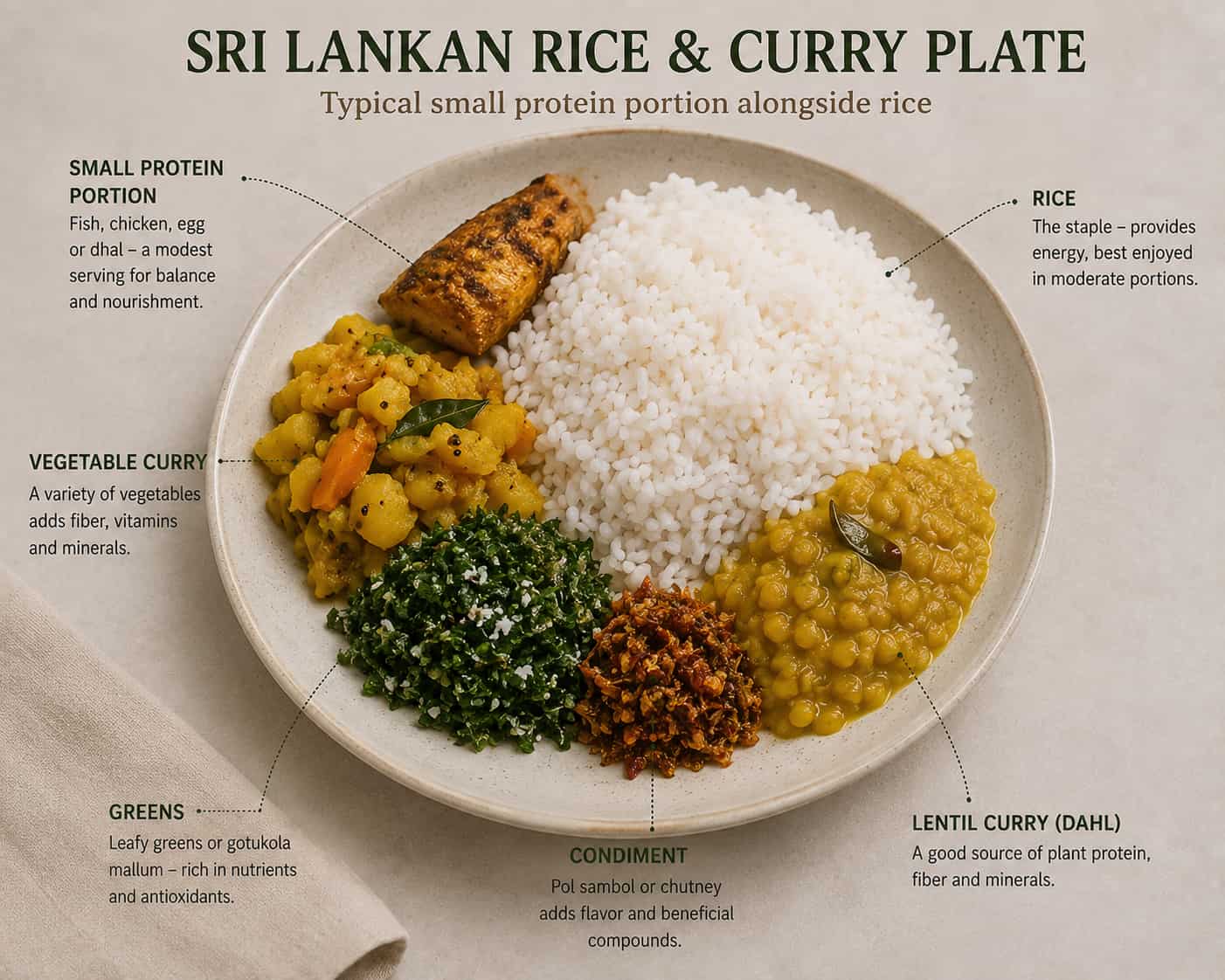
Rice and curry is built around carbohydrates by design — three-quarters of the plate is rice, with a small portion of curry and an even smaller piece of fish or meat alongside it. National surveys confirm what this looks like in practice: the average serving of meat or fish on a Sri Lankan plate is around 15g, and only about a third of adults meet even the minimum recommended protein intake. This article breaks down where protein actually comes from in the current Sri Lankan diet, why it falls short even when the numbers look "adequate" on paper, how much you actually need, and practical ways to close the gap — including between-meal options and a full comparison chart across food sources.
Quick Summary
- →National average protein intake sits close to the bare minimum — around 53g/day for men and 40g/day for women, both below the official Sri Lankan RDA of roughly 56g (men) and 47g (women)
- →The bigger problem is quality and distribution, not just the topline number — most dietary protein comes from rice and plant sources with incomplete amino acid profiles, while animal protein portions are small and inconsistent
- →Protein matters directly for longevity — muscle mass is one of the strongest predictors of healthy ageing, and most people underestimate how much protein that actually requires
- →Official Sri Lankan RDA figures: roughly 56g/day for an average adult male, 47g/day for an average adult female — though longevity-focused targets run meaningfully higher
- →Closing the gap doesn't require expensive imported protein — dhal, eggs, dried fish, and textured soy all deliver strong protein density at low cost
Why protein matters, especially for longevity
Protein isn't just a bodybuilding macronutrient — it's the structural and functional material your body is built from and constantly rebuilding: muscle, skin, enzymes, hormones, antibodies, and the collagen holding joints and tissue together. Unlike fat and carbohydrate, the body has no real storage depot for protein, which is why a genuinely adequate daily intake matters rather than "catching up" later.
For longevity specifically, protein's most important role is preserving muscle mass with age. Muscle mass and strength are among the strongest predictors of healthy ageing — low muscle mass (sarcopenia) is linked to frailty, falls, slower recovery from illness, and reduced independence in older age, and this decline starts earlier than most people expect, often in the 30s and 40s if protein intake and resistance training are both inadequate. Beyond muscle, adequate protein supports immune function, wound healing, satiety and weight management, and bone health alongside calcium and vitamin D.
Current protein sources in the Sri Lankan diet
The typical Sri Lankan diet draws protein from a narrow, carbohydrate-adjacent set of sources.
- →Rice — technically contributes some protein simply due to the sheer volume consumed, but at low density and incomplete amino acid quality
- →Dhal and pulses (lentils, green gram, cowpea, chickpea) — the most consistent plant protein source in the average meal, though eaten in small curry portions rather than as a primary protein
- →Fish — particularly dried fish (Maldives fish, dried Skipjack, sprats, anchovy), which are protein-dense but used more as flavouring in small quantities than as a standalone protein source
- →Chicken and eggs — the most accessible complete-protein animal sources, though chicken portions in a typical meal remain small
- →Coconut milk — a dietary staple, but contributes minimal protein relative to its fat and calorie content
- →Dairy — consumption is notably low nationally; over a third of Sri Lankan adults report no dairy intake at all
- →Red meat — eaten far less frequently than chicken or fish for most households, for both cost and cultural reasons
The quality problem, not just the quantity problem
National nutrition surveys report that median protein intake in Sri Lanka is technically "adequate" in raw grams — but this headline number hides two real issues.
First, protein quality is generally low. Most Sri Lankan dietary protein comes from plant sources — primarily rice and pulses — which individually lack one or more essential amino acids in sufficient quantity (rice is low in lysine; most legumes are low in methionine). Combining rice with dhal, as the traditional plate already does, partially solves this — but the small portion sizes involved mean the total complete-protein contribution remains low even when the combination is right in principle.
Second, distribution is uneven. National data shows significantly more men than women meet the minimum protein recommendation (42.6% vs. 32.8%), and roughly a quarter of Sri Lankans report no meat or pulse consumption at all on a given day. A population-level average can look adequate while masking large numbers of individuals — particularly women, older adults, and lower-income households — who are meaningfully short.
Why protein intake falls short in practice
- →The plate is built carbohydrate-first — with rice occupying roughly three-quarters of the average plate, there's limited physical space left for a meaningful protein portion; the average serving of meat or fish is around 15g, a fraction of what's needed per meal
- →Protein is treated as a flavouring, not a food group — dried fish, in particular, is used in small quantities to season curries rather than eaten as a standalone protein source, despite its high protein density
- →Cost — animal protein (chicken, fish, eggs, dairy) is more expensive per meal than rice, and economic pressure pushes households toward carbohydrate-heavy, protein-light meals
- →Low awareness of actual requirements — nutrition education in Sri Lanka has historically focused more on avoiding undernutrition in children than on optimising protein intake in adults, leaving many people unaware their day-to-day intake is below recommended levels
- →Dairy is underused — over a third of adults consume no dairy at all, removing a normally reliable, complete-protein, low-effort source from the diet entirely
Daily protein requirements for Sri Lankan adults
The Sri Lankan Medical Research Institute's 2022 Dietary Reference Intakes set the official adult RDA at 0.83g of protein per kilogram of body weight per day, using reference body weights of roughly 68kg for men and 57kg for women. In practical terms:
| Reference weight | Baseline RDA (g/day) | Longevity-Focused Target (g/day) | |
|---|---|---|---|
| Average adult male | ~68kg | ~56g/day | ~95–150g/day (1.4–2.2g/kg) |
| Average adult female | ~57kg | ~47g/day | ~80–125g/day (1.4–2.2g/kg) |
The baseline RDA is the minimum needed to avoid deficiency in a sedentary adult — it is not optimised for longevity, muscle preservation, or an active lifestyle. The longevity-focused range reflects intake levels associated with better muscle preservation, generally cited as 1.0–1.6g/kg/day for adults prioritising muscle maintenance, rising to 1.6–2.2g/kg/day for those doing regular resistance training.
Current national data suggests the average Sri Lankan man consumes around 52.8g/day and the average woman around 40g/day — both below even the baseline RDA, and well short of longevity-oriented targets.
Why distribution across the day matters as much as the daily total
Muscle protein synthesis is triggered meal by meal, not by a single daily total. There's a practical per-meal threshold — roughly 25–40g of protein, or about 2.5–3g of the amino acid leucine — needed to meaningfully switch on that response. This means two people eating the same 90g/day can get very different results: spread across three meals of 25–30g each, that intake does real work maintaining muscle; loaded almost entirely into one large dinner, most of it beyond what a single meal can use for that purpose is simply used for energy or other needs instead. In practice, this means a boiled egg or a small glass of milk at breakfast is doing more for long-term muscle health than it looks like on paper, and skipping protein at breakfast or lunch isn't something a large dinner portion fully makes up for.
Older adults need more protein per meal, not less
A well-established finding in aging research is anabolic resistance — with age, the same amount of protein per meal produces a smaller muscle-building response than it would in a younger adult. Practically, this means the 25–30g per-meal threshold that works for a younger adult is often closer to 35–40g per meal for adults over roughly 65, even though total daily protein needs don't rise by nearly as much. This runs directly against the common pattern of older adults eating less protein per meal — smaller appetites, softer foods, and less varied diets all push in the wrong direction at exactly the point in life when more is needed per sitting, not less.
For a deeper look at why muscle mass matters so heavily for long-term health — and how directly modifiable it remains at almost any age — see our Muscle Mass and Longevity article, which also covers how protein intake and resistance training work together; protein alone, without a training stimulus, has a much smaller effect on preserving muscle mass with age.
How to increase protein intake
- →Make protein the first thing on the plate, not the last — serve the fish, egg, or dhal portion first and build the rest of the meal around it, rather than defaulting to a large rice base with protein added as an afterthought
- →Double the usual curry portion of dhal or fish — going from a token 15g serving to 30–40g is a simple, low-cost way to meaningfully shift the day's total
- →Add an egg — a boiled or fried egg alongside a meal adds roughly 6–7g of complete protein at very low cost
- →Use dried fish as a real portion, not just a seasoning — a proper serving of Maldives fish or dried Skipjack, rather than a token pinch, adds meaningful protein density
- →Bring dairy back into the daily pattern — a glass of milk (fresh or reconstituted powder) or a serving of curd adds protein without requiring any change to how meals are cooked
- →Spread protein across the day rather than concentrating it at one meal — the body uses protein more effectively for muscle maintenance when it's distributed across breakfast, lunch, and dinner rather than loaded entirely into one
Alternative & concentrated protein sources available locally
Beyond the everyday staples, several protein-dense options are available in the Sri Lankan market and worth incorporating.
- →Textured soy protein (soya meal) — widely available, inexpensive, and roughly 50g of protein per 100g dry weight, making it one of the most protein-dense and affordable options in local shops
- →Tofu — increasingly available in supermarkets, a complete plant protein at roughly 8g per 100g
- →Paneer / cottage cheese — a straightforward way to add dairy protein to a meal, roughly 18g per 100g
- →Quinoa — a complete plant protein, useful for varying the carbohydrate base of a meal while adding protein quality
- →Whey protein powder — genuinely available locally through multiple retailers and both international and Sri Lankan brands, delivering roughly 24g of protein per standard scoop with fast absorption, useful particularly around exercise
- →Plant-based protein powders (soy or pea-based blends) — also available locally for those avoiding dairy-based whey
- →Greek yogurt — less traditional locally but increasingly stocked, at roughly 10g of protein per 100g, notably higher than regular curd
Between meals: snacks, shakes & other protein options
Protein doesn't have to be confined to main meals.
- →Boiled eggs — portable, cheap, and roughly 6–7g of protein each
- →Roasted chickpeas or peanuts — a protein-containing alternative to purely carbohydrate snacks
- →Curd with a spoon of peanuts or seeds — combines dairy and plant protein in one snack
- →A protein shake (whey or plant-based) mixed with milk or water — a fast, low-effort way to add 20–25g of protein without cooking, particularly useful around workouts or for anyone consistently falling short at meals
- →Dried fish or anchovy sprats as a standalone snack, rather than only as a curry ingredient
- →Milk or curd-based drinks — a glass of milk between meals adds protein without displacing appetite for the next meal significantly
Protein content across common food sources
| Food | Protein (per 100g) | Typical Serving | Protein per Serving |
|---|---|---|---|
| Dried Skipjack tuna (උම්බලකඩ) | 63.8g | 15g | 9.6g |
| Maldives fish (උම්බලකඩ) | 61.3g | 15g | 9.2g |
| Whey protein powder | ~78g | 1 scoop (30g) | ~24g |
| Skimmed milk powder (යොදේ ඉවත් කළ කිරි) | 37.6g | 30g | 11.3g |
| Textured soy protein / Soya Meat (dry) | ~50g | 30g | 15g |
| Anchovy sprats (හාල්මැස්සන්) | 51.2g | 15g | 7.7g |
| Chicken breast, skinless | 23.1g | 30g (cooked, varies) | 6.9g |
| Beef | 23.3g | 30g | 7.0g |
| Seer fish (තෝර මාළු) | 22.2g | 30g | 6.7g |
| Pistachio nuts | 23.6g | 30g | 7.1g |
| Groundnut / peanuts | 22.4g | 30g | 6.7g |
| Whole cow's milk powder | 26.6g | 30g | 8.0g |
| Paneer / cottage cheese | ~18g | 50g | 9g |
| Whole egg | 13.6g | 60g (1 egg) | 8.2g |
| Green gram dhal | 23.4g (raw) | 20g raw / 3 tbsp cooked | 4.68g |
| Lentil dhal | 23.1g (raw) | 20g raw / 3 tbsp cooked | 4.62g |
| White cowpea | 21.3g (raw) | 20g raw / 3 tbsp cooked | 4.26g |
| Tofu | ~8g | 100g | 8g |
| Greek yogurt | ~10g | 100g | 10g |
| Quinoa, cooked | 4.4g | 100g | 4.4g |
| Regular curd/yogurt | ~3.5g | 100g | 3.5g |
| Whole milk | 3.2g | 100ml | 3.2g |
| White rice, cooked | 2.7g | 100g | 2.7g |
Values for local foods (dried fish, dhal varieties, nuts, milk powder, eggs) are drawn from the Sri Lankan Medical Research Institute's 2022 Dietary Reference Intakes; other values are standard international nutrition data.
Practical notes
- →Complete vs. incomplete protein matters most when plant-based sources dominate the diet — if animal protein or dairy features regularly, amino acid completeness becomes less of a concern since gaps in one food are filled by another across the day
- →Combine rice with dhal or another legume at the same meal — this is the traditional pairing for a reason, and it genuinely does improve amino acid completeness, even if portion size is the bigger issue to fix
- →Dried fish is a protein source, not just a seasoning — treating it as a proper portion rather than a garnish changes its contribution meaningfully
- →If using a protein powder, check for third-party testing or a reputable brand, particularly with imported supplements, since quality control varies
- →Higher protein intake is not a kidney risk for people with normal kidney function. This is a common concern, but the evidence for it applies specifically to people who already have chronic kidney disease, where protein intake genuinely does need to be managed under medical guidance. For someone with healthy kidneys, intakes well above the baseline RDA — including the longevity-focused ranges above — are not associated with kidney damage
- →Caloric deficit without adequate protein accelerates muscle loss, not just fat loss. Any period of eating less than you burn — whether for weight loss or otherwise — pulls energy from both fat and muscle tissue. Insufficient protein during a deficit means a larger share of that loss comes from muscle rather than fat, which is part of why crash dieting so often leaves people lighter but weaker rather than genuinely healthier. Prioritising protein intake during any deliberate calorie reduction is one of the most effective ways to protect muscle mass while still losing weight
- →How to tell if your intake is genuinely adequate: beyond tracking grams, a few practical signals are worth watching — unintentional strength loss or difficulty building strength despite consistent training, slow recovery from minor wounds, and unusually brittle hair or nails can all point to inadequate protein intake. Grip strength (a simple, low-cost measure many gyms and clinics can check) is a widely used practical proxy for overall muscle health and is worth tracking over time rather than just at a single point
Protein is one of the more fixable gaps in the typical Sri Lankan diet — the shift doesn't require abandoning rice and curry, just rebalancing what sits alongside it. For more on how legumes, grains, and dairy each fit into a longevity-focused diet, see our Legumes, Grains, and Fresh Milk vs Powdered Milk articles, and for the fuller picture on why muscle mass matters so much for healthy ageing, see Muscle Mass and Longevity. If you'd like to know exactly where your own protein intake and muscle health stand, our Longevity Doctors offer a free longevity assessment as a starting point.
Curious where your own
protein intake stands today?
Take the free Aevum Protocol assessment to see how your nutrition & metabolism and 6 other longevity domains are performing — and get a personalised 90-day plan.
Take the Free Assessment →Related articles
Nutrition & Metabolism
Vegetarian Protein in the Sri Lankan Diet: Sources, Gaps & How to Get It Right
Nutrition & Metabolism
Fats in the Sri Lankan Diet: Types, Functions, Sources & What to Change
Movement & Strength