Nutrition & Metabolism
Protein Powders:
Whey Concentrate, Whey Isolate, Soy, Pea and Others Compared
Protein powders are concentrated protein extracted from foods such as milk, soy, peas, rice or eggs. They aren't magic: they're simply a convenient way to add protein when it's hard to get enough from meals. The main types differ in how they're processed and what they're made from. Whey concentrate is the least processed form of milk whey, typically around 80% protein with some fat and lactose. Whey isolate is filtered further to around 90% protein with very little lactose, making it a better choice if you're lactose intolerant. Whey hydrolysate is pre-digested for faster absorption. Casein digests slowly. Soy isolate is the highest-quality plant protein, and pea, rice and blended plant proteins are good alternatives when matched for amount and leucine. A meta-analysis of 49 trials found that protein supplements modestly increased muscle and strength gains from resistance training, with little extra benefit once total daily protein reached about 1.6 g per kg of body weight. In a 12-week trial, vegans using soy and omnivores using whey built muscle equally well when protein intake was matched. The main concerns are quality and contamination: a 2025 Consumer Reports test found more than two-thirds of protein powders exceeded its strict daily lead limit in a single serving, with plant-based powders highest. This article compares the main types and explains who needs them and how to choose one.
Key numbers
| Finding | Detail |
|---|---|
| Protein content | Whey concentrate about 80%; whey isolate about 90% |
| Protein supplements with resistance training (49 trials, 1,863 people) | +0.3 kg lean mass and +2.5 kg strength (1-rep max) |
| Extra benefit plateau | Around 1.6 g protein per kg body weight per day |
| Vegan soy vs omnivore whey (38 men, 12 weeks) | Similar muscle and strength gains at 1.6 g/kg/day |
| Muscle building after exercise (young men) | Whey about 31% higher than soy and 122% higher than casein |
| Pre-sleep casein (40 g, 16 young men) | Overnight muscle protein synthesis about 22% higher |
| Lead in protein powders (Consumer Reports, 23 products) | Over two-thirds above its 0.5 µg daily limit per serving; plant-based about 9 times dairy |
What protein powders are and how they're made
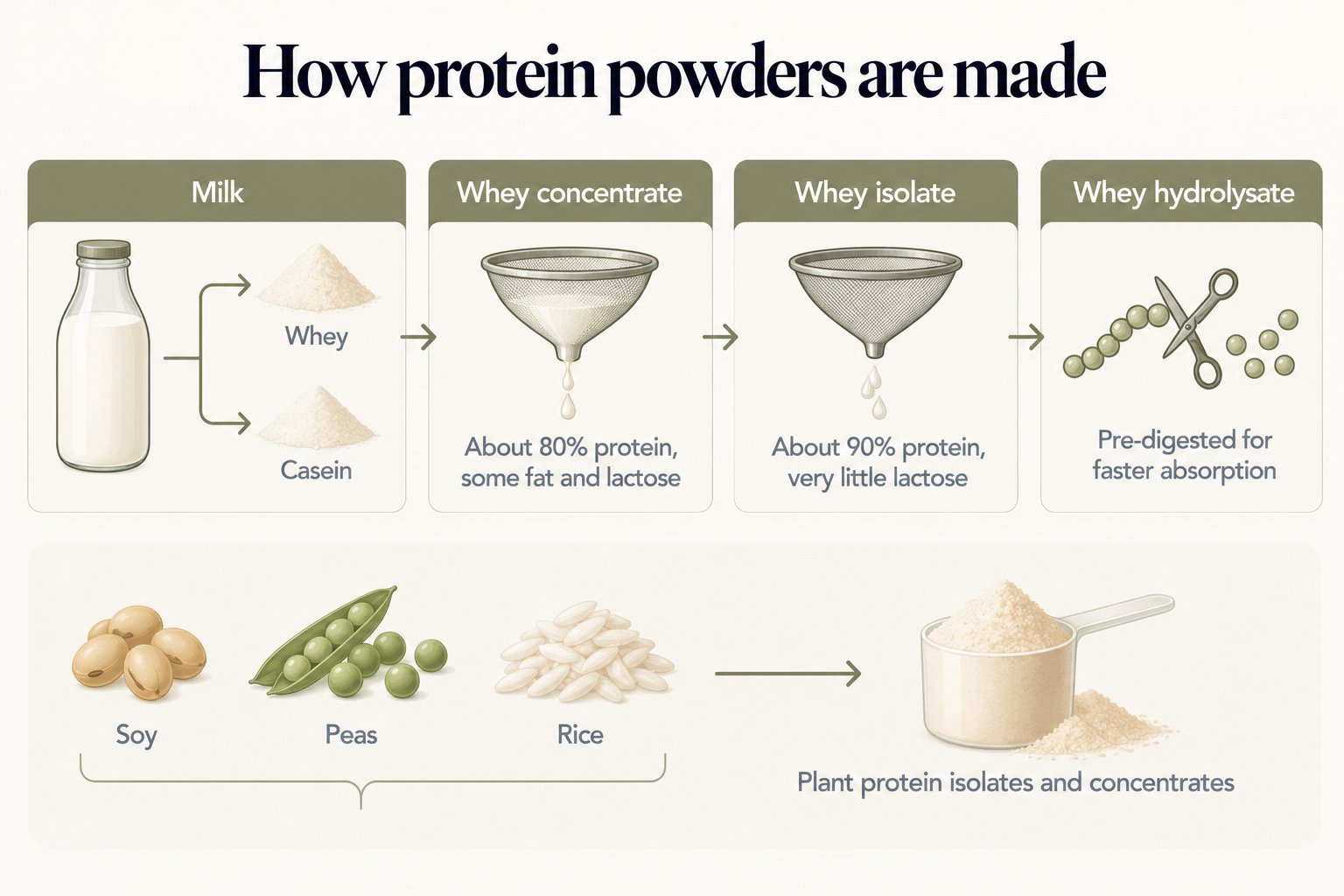
Most protein powders start as a liquid by-product of food processing:
- Whey is the watery part of milk left after cheese-making. Milk protein is about 20% whey and 80% casein.
- Casein is the main protein in milk curds.
- Soy and pea protein are extracted from defatted soybeans or yellow split peas.
- Rice, hemp and other plant proteins are extracted from the grain or seed.
The liquid is then filtered and dried. The degree of filtering determines the type:
- Concentrate: filtered once, keeping more fat, carbohydrate and lactose. Whey concentrate is commonly sold as about 80% protein.
- Isolate: filtered further, often by crossflow microfiltration, to remove most fat and lactose, reaching about 90% protein or more.
- Hydrolysate: protein partly broken down into smaller fragments by enzymes, for faster absorption. It tends to taste more bitter and costs more.
Protein quality: why not all protein is equal
Protein quality depends on how many essential amino acids a protein contains, how well they're digested, and how much leucine it provides. Leucine is the amino acid that switches on muscle protein synthesis (see Protein Timing and Resistance Training).
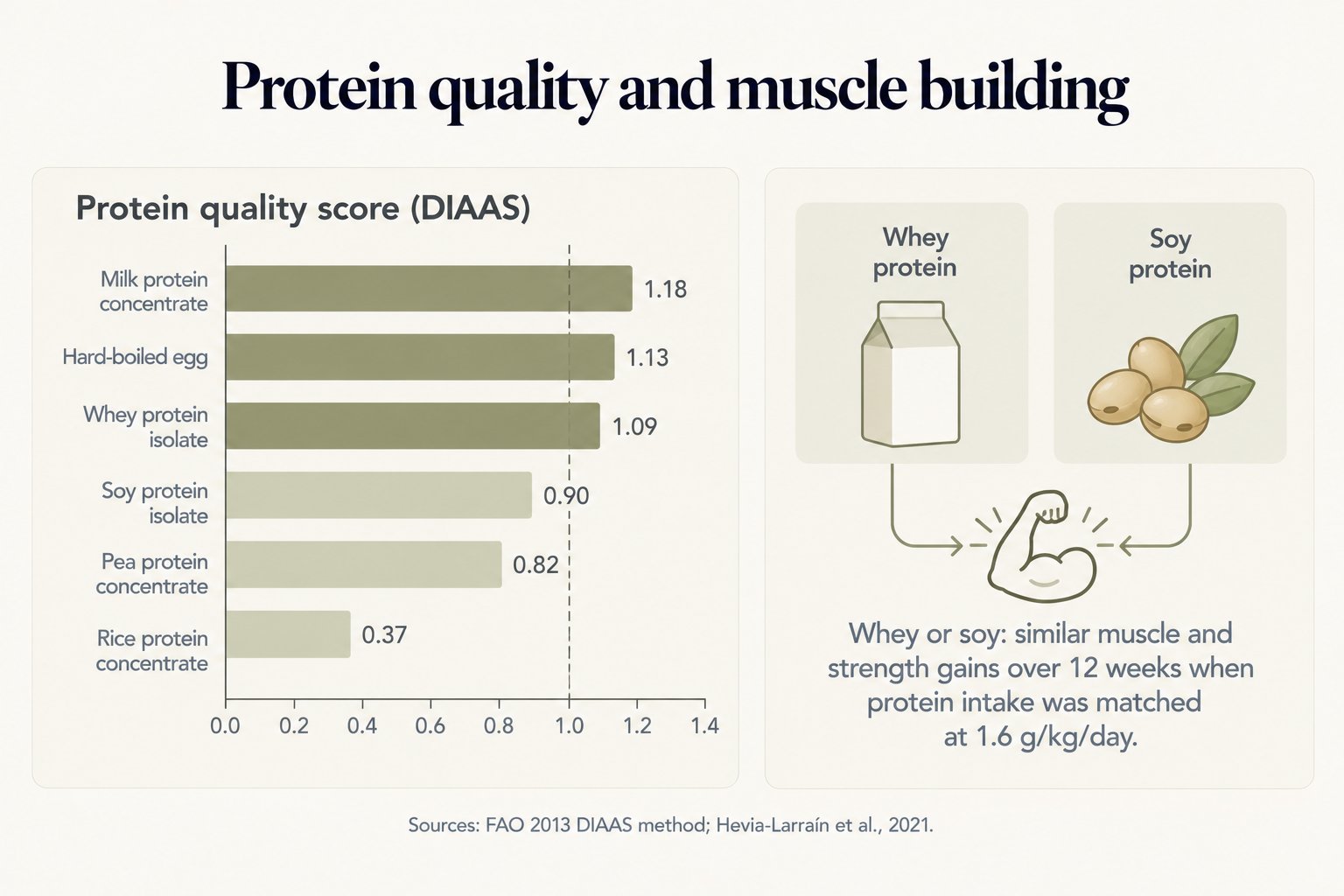
Scientists rate protein quality using scores such as DIAAS (Digestible Indispensable Amino Acid Score), recommended by the UN Food and Agriculture Organization in 2013. Unlike the older PDCAAS score, which is capped at 1.0, DIAAS can exceed 1.0 for very high-quality proteins. Published DIAAS values (for young children's requirements) include:
- Milk protein concentrate: 1.18
- Whey protein isolate: 1.09
- Hard-boiled egg: 1.13
- Soy protein isolate: 0.90
- Pea protein concentrate: 0.82
- Rice protein concentrate: 0.37, limited by low lysine
Plant proteins tend to be lower in one or more essential amino acids, for example methionine in pea and soy and lysine in rice. Blending pea and rice, or simply taking a slightly larger serving, largely closes the gap.
The main types compared
| Type | Protein per 100 g powder | Digestion | Lactose | Best for | Drawbacks |
|---|---|---|---|---|---|
| Whey concentrate | About 70 to 80 g | Fast | Some | Most people; good value | Not ideal with lactose intolerance |
| Whey isolate | About 90 g or more | Fast | Very little | Lactose intolerance; lower calories | Costs more |
| Whey hydrolysate | About 80 to 90 g | Very fast | Very little | Sensitive digestion; medical nutrition | Bitter; expensive; little proven advantage |
| Casein | About 80 g | Slow | Some | Before sleep; long gaps between meals | Thick texture; not for milk allergy |
| Milk protein blend | About 80 to 90 g | Medium | Some | Combined fast and slow release | Not for milk allergy |
| Egg white protein | About 80 g | Medium | None | Dairy-free animal protein | Egg allergy; cost |
| Soy isolate | About 90 g | Medium | None | Vegans and vegetarians; good quality | Soy allergy |
| Pea protein | About 80 g | Medium | None | Dairy- and soy-free | Lower methionine; earthy taste |
| Rice protein | About 80 g | Medium | None | Allergy-friendly | Low lysine; best blended |
| Plant blends (e.g. pea plus rice) | About 70 to 80 g | Medium | None | Vegans wanting a complete profile | Higher lead risk in testing |
| Collagen peptides | About 90 g | Fast | None | Not a complete protein for muscle | Lacks tryptophan; low leucine |
Figures are typical values; check the label of any specific product.
What the research shows
Building muscle with resistance training. A 2018 meta-analysis in the British Journal of Sports Medicine pooled 49 randomised trials with 1,863 people doing resistance training. Protein supplements increased gains in lean mass by about 0.3 kg and in one-rep max strength by about 2.5 kg, compared with training alone. The benefit was larger in people who were already trained and smaller with increasing age. Extra protein beyond a total daily intake of about 1.6 g/kg didn't further increase lean mass gains, though the upper estimate was as high as 2.2 g/kg. In other words, protein powder helps mainly by filling a gap in total daily intake, not through anything special about the powder itself (see Muscle Mass and Longevity).
Whey vs soy vs casein. In a 2009 study in young men, whey hydrolysate stimulated muscle protein synthesis after exercise about 31% more than soy isolate and 122% more than casein, with soy 69% higher than casein. Whey is rapidly digested and high in leucine, which explains its short-term advantage. But short-term muscle building doesn't always translate into long-term differences.
Plant vs animal protein over time. In a 2021 trial in Sports Medicine, 38 young men, half long-term vegans and half omnivores, trained their legs twice a week for 12 weeks. Both groups reached 1.6 g/kg/day of protein, using soy protein for vegans and whey for omnivores. Muscle size and strength increased similarly in both groups, with no significant differences. When total protein is adequate, plant proteins can support muscle gains as well as animal proteins, at least in young men.
Casein before sleep. In a 2012 study, 16 young men who drank 40 g of casein 30 minutes before sleep, after evening exercise, had about 22% higher overnight muscle protein synthesis than those given a protein-free drink, and a positive rather than negative overnight protein balance. This supports pre-sleep protein as one way of spreading intake, particularly for older adults or people who train in the evening.
What the expert guidance says. The International Society of Sports Nutrition's 2017 position stand recommends 1.4 to 2.0 g/kg/day of protein for most exercising people, about 0.25 g/kg or 20 to 40 g per serving, spread every 3 to 4 hours, with 700 to 3,000 mg of leucine per serving. It notes that whole foods can meet these needs, and supplements are a practical way to ensure adequate amount and quality.
Safety: what to watch for
Heavy metals. In 2025, Consumer Reports tested 23 protein powders and shakes. More than two-thirds contained more lead in one serving than its own strict daily limit of 0.5 micrograms, based on California's Proposition 65 standard, and some had more than 10 times that amount. Plant-based products averaged about nine times the lead of dairy-based ones and twice that of beef-based products. Experts note these levels are far below those that cause immediate harm, and the industry argues the threshold is overly strict, but repeated daily exposure adds up. There are no enforceable heavy metal limits for supplements in many countries, including the US.
Contamination with banned substances. A 2004 international study of 634 supplements from 13 countries found that about 15% contained anabolic steroids not listed on the label. Products from companies that also sold hormone supplements were about twice as likely to be contaminated (21% vs 10%). Choosing products certified by independent testing programmes reduces this risk, particularly for athletes subject to drug testing.
Other considerations.
- Kidneys: in healthy people, higher-protein diets haven't been shown to damage the kidneys. If you have chronic kidney disease, discuss protein intake with your doctor before using supplements (see Kidney Health and Cardiometabolic Risk).
- Lactose intolerance: whey isolate, egg or plant proteins are usually better tolerated than whey concentrate or casein.
- Milk, soy or egg allergy: avoid the corresponding protein completely.
- Acne: small case series have linked whey supplements to acne, particularly on the trunk, in young men. If acne flares after starting whey, try a plant protein.
- Soy and hormones: a 2021 meta-analysis in Reproductive Toxicology concluded that neither soy nor isoflavone intake affects male reproductive hormones.
- Added ingredients: many powders contain sweeteners, thickeners or added "boosters". Simpler ingredient lists are usually better.
Who actually needs protein powder?
Most people can meet their protein needs from food. Powders are useful when:
- You're training and struggling to reach your daily target, typically 1.4 to 2.0 g/kg for active people.
- You're older: older adults need more protein per meal to stimulate muscle building, about 30 g or more, but often eat less (see Nutrition by Life Stage).
- You're losing weight: higher protein helps preserve muscle during calorie restriction, including with weight-loss medicines.
- You're vegan or vegetarian: a soy or blended plant powder can make reaching your target easier (see Vegetarian Protein in the Sri Lankan Diet).
- You're recovering from illness or surgery, or have a poor appetite, under medical advice.
How to use protein powder
- Work out your daily target first, then use powder only to fill the gap left by your meals.
- Serving size: 20 to 40 g of protein, or about 0.25 to 0.4 g/kg. Older adults should aim for the higher end per serving.
- Timing: any time that helps you spread protein across 3 to 4 meals or snacks. Within a few hours of exercise is sensible, but total daily intake matters more than exact timing.
- Plant proteins: use a slightly larger serving or a blend to match the leucine content of whey.
- Mix with food: blend into milk, curd, oats or smoothies with fruit to add nutrients.
- Check the label: protein per serving, ingredient list, added sugar, and independent testing or certification.
- Rotate or limit if concerned about heavy metals, and prefer dairy-based products if you use powder daily.
Evidence strength
- Protein supplements improving muscle and strength gains with resistance training: strong, though the effect is modest.
- Whey stimulating muscle building faster than casein or soy in the short term: strong.
- Plant proteins matching whey for long-term muscle gains when intake is adequate: moderate, mainly in young men.
- Casein before sleep improving overnight muscle building: moderate.
- Benefits beyond adequate total protein intake: limited.
- Hydrolysates or "premium" blends being meaningfully better for most people: not supported.
Why this matters for longevity
Muscle mass and strength are among the strongest predictors of healthy ageing, independence and survival. Adequate protein, combined with resistance training, is the foundation for maintaining them, particularly after 50. Protein powders can help people who struggle to eat enough protein, especially older adults, vegetarians and those losing weight. But they're a supplement to good food, not a replacement for it, and quality matters.
Recommendations by situation
- Healthy adults eating varied meals: you probably don't need powder; focus on protein at each meal from eggs, fish, chicken, dhal, milk and curd (see Protein in the Sri Lankan Diet).
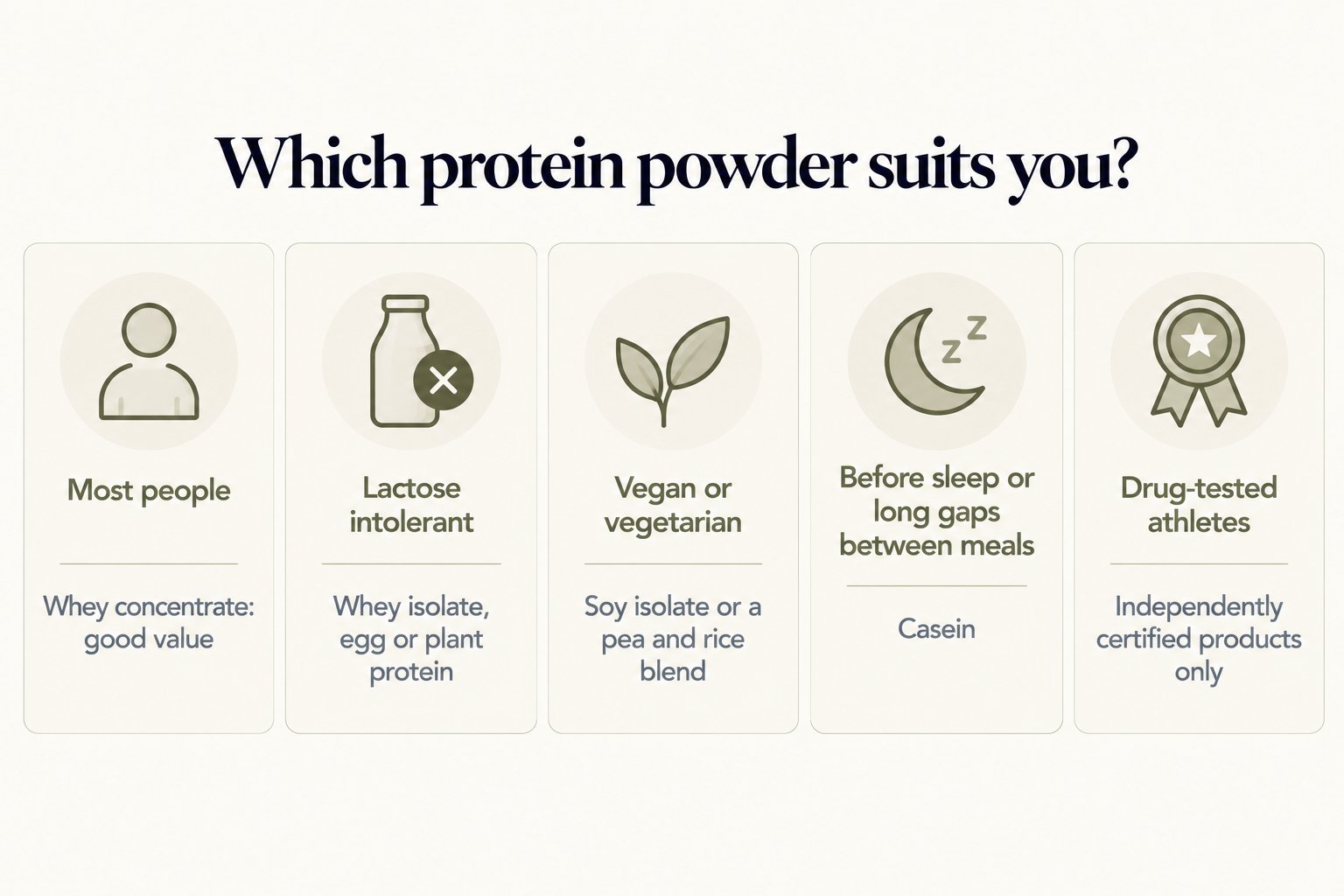
- Regular resistance training: use powder if needed to reach 1.4 to 2.0 g/kg/day; whey concentrate is good value.
- Lactose intolerant: choose whey isolate or a plant protein.
- Vegan or vegetarian: soy isolate or a pea and rice blend; check for independent heavy metal testing.
- Over 60: aim for about 30 g of protein per meal; a powder can help at breakfast, which is often low in protein, and can be combined with resistance training.
- Kidney disease, liver disease or a medical diet: speak to your doctor or a dietitian first.
- Competitive athletes: use only independently certified products to avoid accidental doping.
Practical notes
In Sri Lanka, imported protein powders can be expensive, and quality varies. Buy from reputable sellers, check that the seal and labelling are intact, and look for independent testing or certification. Food sources remain the best value: eggs, fish, chicken, dhal, chickpeas, soya meat, milk and curd can provide plenty of protein. If you do use powder, whey concentrate suits most people, whey isolate or plant protein suits those who are lactose intolerant, and soy isolate is the strongest plant option. Use it to fill gaps rather than replace meals, and don't exceed what you need. Our Longevity Doctors can assess your protein needs, muscle mass and kidney function, and help you plan nutrition and exercise to protect your strength as you age, starting with the free longevity assessment.
- Morton RW, et al. A systematic review, meta-analysis and meta-regression of the effect of protein supplementation on resistance training-induced gains in muscle mass and strength in healthy adults. British Journal of Sports Medicine, 2018;52(6):376-384.
- Tang JE, et al. Ingestion of whey hydrolysate, casein, or soy protein isolate: effects on mixed muscle protein synthesis at rest and following resistance exercise in young men. Journal of Applied Physiology, 2009;107(3):987-992.
- Hevia-Larraín V, et al. High-protein plant-based diet versus a protein-matched omnivorous diet to support resistance training adaptations: a comparison between habitual vegans and omnivores. Sports Medicine, 2021;51(6):1317-1330.
- Res PT, et al. Protein ingestion before sleep improves postexercise overnight recovery. Medicine and Science in Sports and Exercise, 2012;44(8):1560-1569.
- Jäger R, et al. International Society of Sports Nutrition position stand: protein and exercise. Journal of the International Society of Sports Nutrition, 2017;14:20.
- Food and Agriculture Organization of the United Nations. Dietary protein quality evaluation in human nutrition. FAO Food and Nutrition Paper 92, 2013.
- Consumer Reports. Protein powders and shakes lead testing, October 2025.
- Geyer H, et al. Analysis of non-hormonal nutritional supplements for anabolic-androgenic steroids: results of an international study. International Journal of Sports Medicine, 2004;25(2):124-129.
- Reed KE, et al. Neither soy nor isoflavone intake affects male reproductive hormones: an expanded and updated meta-analysis of clinical studies. Reproductive Toxicology, 2021;100:60-67.
- Cengiz FP, et al. Acne located on the trunk, whey protein supplementation: is there any association? Health Promotion Perspectives, 2017;7(2):106-108.
Free longevity assessment
Not sure how much protein
you really need?
Take the free Aevum Protocol assessment to see how your nutrition & metabolism and 6 other longevity domains are performing — and get a personalised 90-day plan.
Take the free assessmentKeep reading
Related articles
Nutrition & Metabolism
Protein in the Sri Lankan Diet: Sources, Quality, Requirements & How to Close the Gap
Movement & Strength
Protein Timing and Resistance Training: Does the "Anabolic Window" Actually Exist?
Movement & Strength