Movement & Strength
Protein Timing and Resistance Training:
Does the "Anabolic Window" Actually Exist?
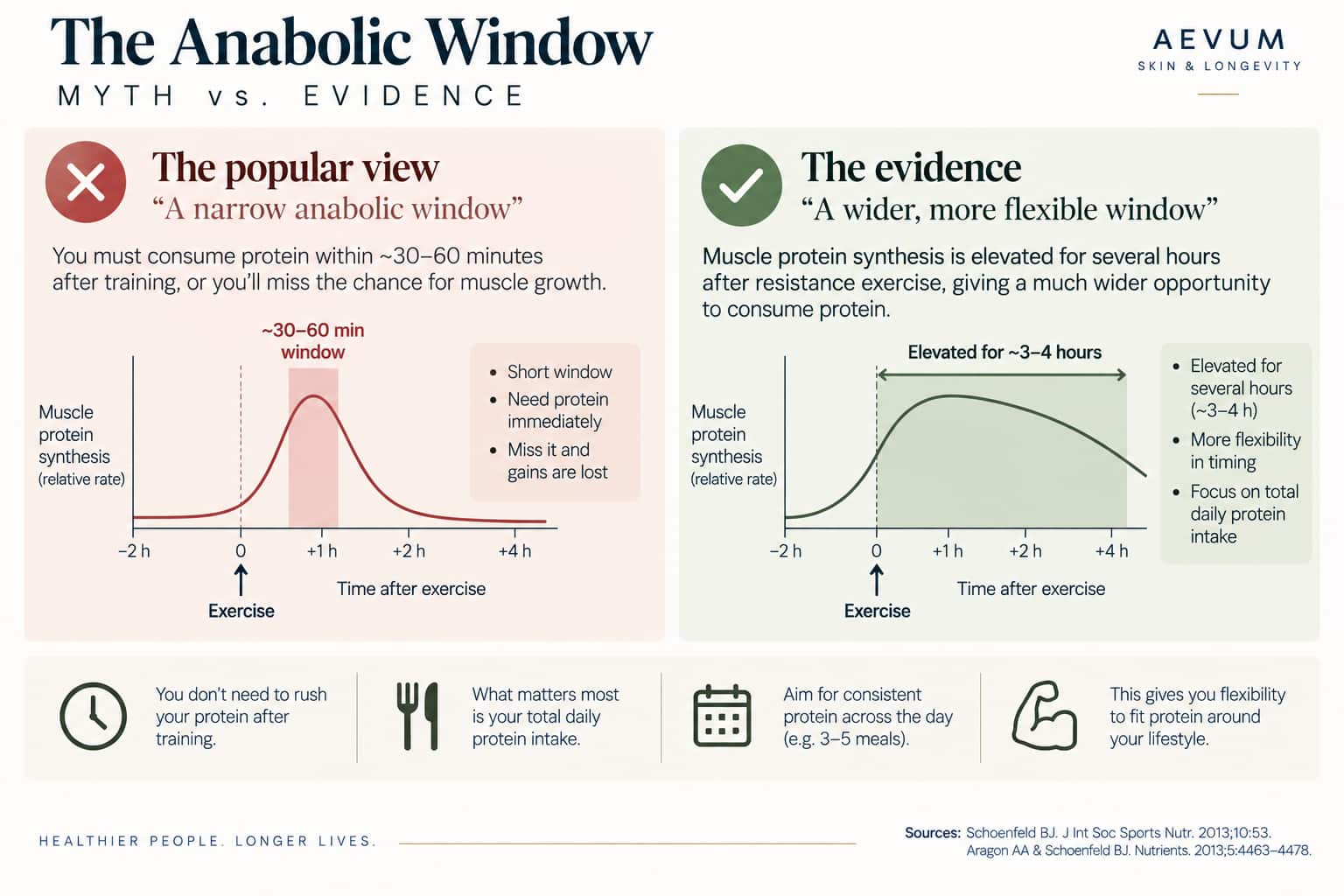
For years, gym culture has treated the 30-45 minutes after a workout as a narrow, closing "anabolic window" — miss it, and you supposedly leave gains on the table. The actual research tells a more relaxed story: total daily protein intake and how it's distributed across the day matter far more than precise post-workout timing. This article covers what the evidence actually shows about timing, the leucine threshold that determines whether a meal meaningfully stimulates muscle protein synthesis, and how to structure protein intake around training in a way that's backed by data rather than gym folklore.
Key numbers
| Finding | Detail |
|---|---|
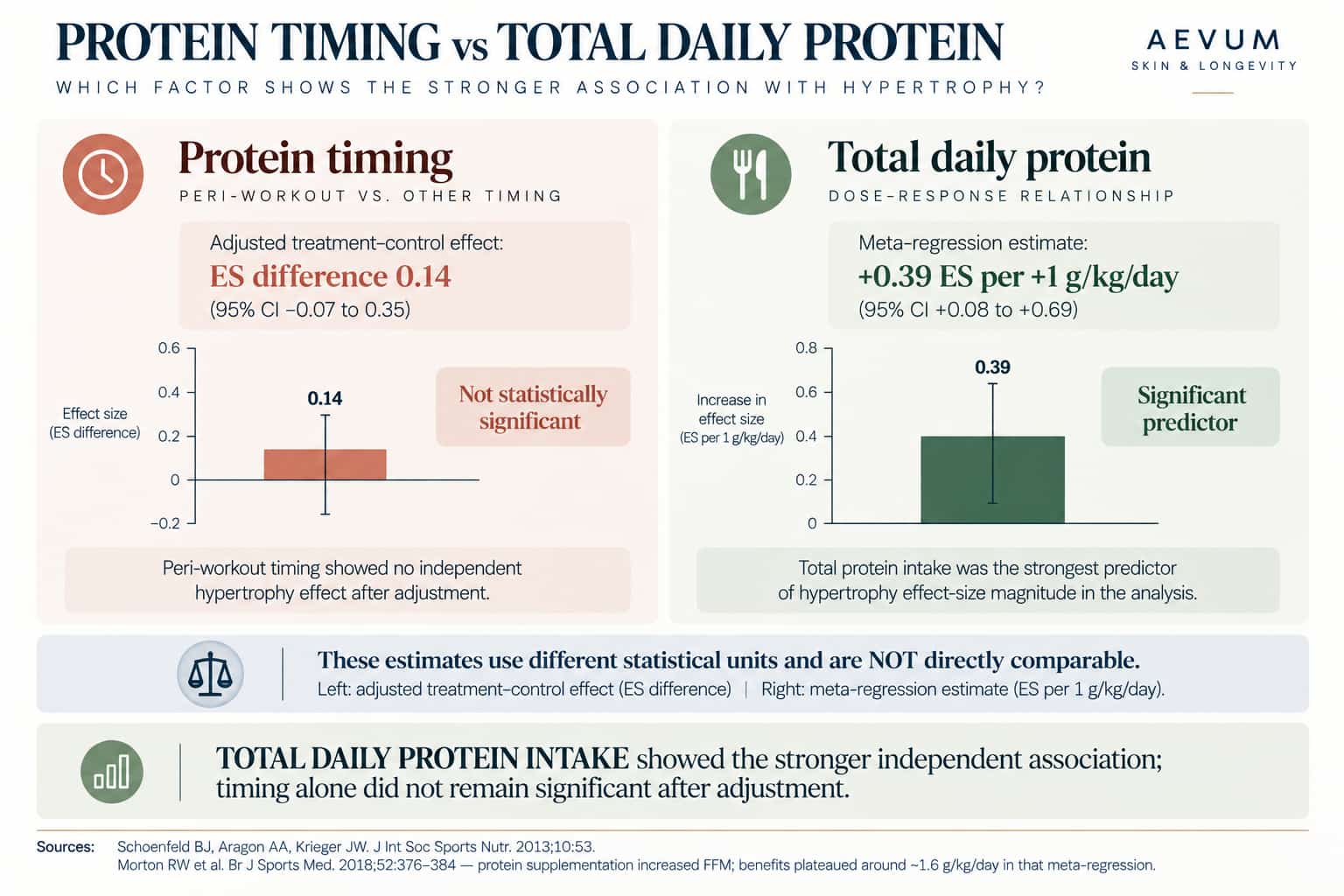
| Protein timing's effect on hypertrophy | Small effect in basic analysis (ES 0.24, P=0.02) that disappeared after controlling for total daily protein (P=0.18) |
| Protein timing's effect on strength | No significant difference between timing and control groups |
| Strongest predictor of hypertrophy outcome | Total daily protein intake — not when it was consumed |
| Leucine threshold, adults under ~60 | Meaningful MPS response across a range of protein doses |
| Leucine threshold, adults over ~60 | ~2.5-3g leucine (~25-30g high-quality protein) needed per meal to maximally stimulate MPS |
How it works
What actually triggers muscle protein synthesis. Muscle protein synthesis (MPS) is stimulated by two things acting together: mechanical tension from resistance training (covered in our Progressive Overload article) and amino acid availability, particularly the amino acid leucine, which acts as a direct trigger for the mTORC1 signalling pathway responsible for building new muscle protein.
This is a threshold response, not a linear one. Below a certain leucine dose, a meal doesn't meaningfully activate MPS regardless of how much protein it contains overall. Above that threshold, MPS is triggered — and consuming more leucine beyond the threshold doesn't proportionally increase the response further within a single meal. This is why "how much protein, in one sitting, is enough to count" is a more useful question than "how many grams of protein did I eat today," at least at the level of any single meal.
The threshold rises with age. The leucine threshold isn't fixed across the lifespan. Younger adults typically reach a maximal MPS response from a wide range of protein doses. Older adults show a phenomenon consistent with the anabolic resistance discussed in our Anabolic Resistance article — the same blunted signalling that requires more mechanical stimulus to trigger hypertrophy also requires more leucine per meal to trigger MPS. The commonly cited figure is roughly 2.5-3g of leucine, corresponding to around 25-30g of high-quality protein, needed per meal for older adults to reliably cross that threshold — noticeably more than what's typically needed at younger ages.
Debunking the anabolic window
What the pooled evidence actually shows. A widely cited meta-analysis pooling 23 studies (525 subjects for hypertrophy outcomes, 478 for strength) examined whether consuming protein specifically around the workout window produced better outcomes than consuming the same protein at other times of day. The basic analysis found a small effect favouring peri-workout timing for hypertrophy — but this effect disappeared once the researchers statistically controlled for total daily protein intake. For strength gains, there was no significant timing effect at any point in the analysis.
The meta-regression identified total daily protein intake as the strongest predictor of outcomes — not timing. In practical terms: two people eating the same total daily protein, one concentrating intake around their workout and one spreading it evenly through the day without regard for training time, would be expected to see essentially the same results, all else being equal. This doesn't mean post-workout nutrition is irrelevant — eating protein at some point after training is still a reasonable, evidence-consistent practice — but the "closing window" framing, where missing a narrow post-workout timeframe meaningfully costs you gains, isn't supported by the pooled data once total intake is accounted for.
Comparing protein distribution patterns
| Pattern | Description | What the evidence shows |
|---|---|---|
| Skewed toward one meal (e.g., 10g / 20g / 60g) | Typical of many Western eating patterns — light breakfast, heavier dinner | Lower net 24-hour MPS compared to balanced distribution in controlled comparisons |
| Balanced across meals (e.g., ~30g / 30g / 30g) | Roughly even protein at each main meal | Associated with greater net 24-hour MPS than skewed distribution |
| Below-threshold meals | Protein spread so thin that individual meals fall under the leucine threshold | Each meal below threshold may not fully trigger MPS, even if the daily total is adequate |
How to actually eat around training
- →Hit your daily total first. This is the variable the research consistently points to as mattering most — the dose-response findings for resistance training itself exist within a nutritional context where total protein intake is the baseline requirement
- →Aim for roughly 25-40g of protein per main meal, adjusted upward toward the higher end for older adults, to reliably clear the leucine threshold at each sitting rather than concentrating most protein into one meal
- →Don't stress about a narrow post-workout window. Eating a protein-containing meal within a few hours of training, before or after, is entirely adequate — there's no evidence of a meaningful penalty for training fasted and eating protein an hour or two later, as long as total daily intake is met
- →Prioritize protein at breakfast if it's typically your lightest meal. Given how common the "light breakfast, heavy dinner" pattern is, this is often the easiest single change to improve distribution without changing total daily intake
Recommendations by group
- 1Younger trainees (under ~40) with adequate total daily protein
Timing precision isn't a meaningful lever — focus on consistent training and hitting your daily total; distribute protein across 3-4 meals for convenience rather than optimization.
- 2Older adults (60+)
Pay closer attention to per-meal protein amount specifically — aim for ~30g or more of high-quality protein at each main meal to reliably clear the higher leucine threshold, on top of the general case for resistance training made in our Muscle Mass article.
- 3Those training fasted (e.g., early morning)
No evidence of a meaningful disadvantage as long as protein is consumed adequately later in the day — the "you must eat immediately after lifting" framing isn't supported once daily totals are matched.
Practical notes
The larger lesson across this series' training-protocol articles is consistent: precision on the variables that matter (total training volume, load progression, total daily protein, adequate protein per meal) beats precision on variables that don't move the needle much once the fundamentals are in place (exact rep tempo, exact post-workout minute count). Protein timing is a clear example of a popular rule that sounds rigorous but doesn't hold up once the confounding variable — total intake — is properly accounted for.
How is your protein intake
distributed across the day?
Take the free Aevum Protocol assessment to see how your movement & strength and 6 other longevity domains are performing — and get a personalised 90-day plan.
Take the Free Assessment →