Movement & Strength
Anabolic Resistance:
Why Older Muscle Needs More Stimulus to Grow
Our Protein article already covered the practical dosing side of anabolic resistance — older adults needing roughly 35-40g of protein per meal to trigger muscle protein synthesis, compared to 25-30g in younger adults. This article goes underneath that number, into the actual physiological mechanisms causing the blunted response in the first place — and reveals that anabolic resistance isn't just about protein at all. It affects the muscle's response to exercise too, through a genuinely specific, well-mapped set of mechanisms with a real, elegant workaround.
Quick Summary
- →Anabolic resistance describes a blunted muscle protein synthesis response to both dietary protein and resistance exercise in older muscle — not just a need for more protein, but a genuinely reduced response to the exercise stimulus itself
- →Reduced blood flow to muscle tissue is a major, distinct mechanism — ageing reduces microvascular perfusion, limiting how much amino acid and insulin actually reaches muscle after a meal, even when enough is consumed
- →A controlled trial found that pharmacologically improving blood flow to muscle in older adults directly improved insulin-stimulated muscle protein synthesis — genuine, causal evidence that the delivery problem, not just a signalling problem, is real
- →Resistance exercise activates muscle protein synthesis through a different biological route than amino acids do — one that appears to bypass the specific impairment affecting the nutrient-sensing pathway, which is part of why exercise remains so effective even in anabolically resistant muscle
- →Physical inactivity itself actively worsens anabolic resistance, creating a genuine vicious cycle — particularly risky during periods of enforced inactivity like illness, injury, or hospitalisation in older adults
Key numbers at a glance
| Measure | Figure |
|---|---|
| Primary intracellular pathway integrating anabolic signals | mTORC1 |
| Signalling pathways activated by resistance exercise + EAA in young adults | Both mTOR and ERK1/2 |
| Signalling pathways activated by resistance exercise + EAA in older adults | mTOR only, with delayed response |
| Interventions shown to restore anabolic response in older men | Resistance exercise + essential amino acid supplementation |
How it works: a delivery problem and a signalling problem, together
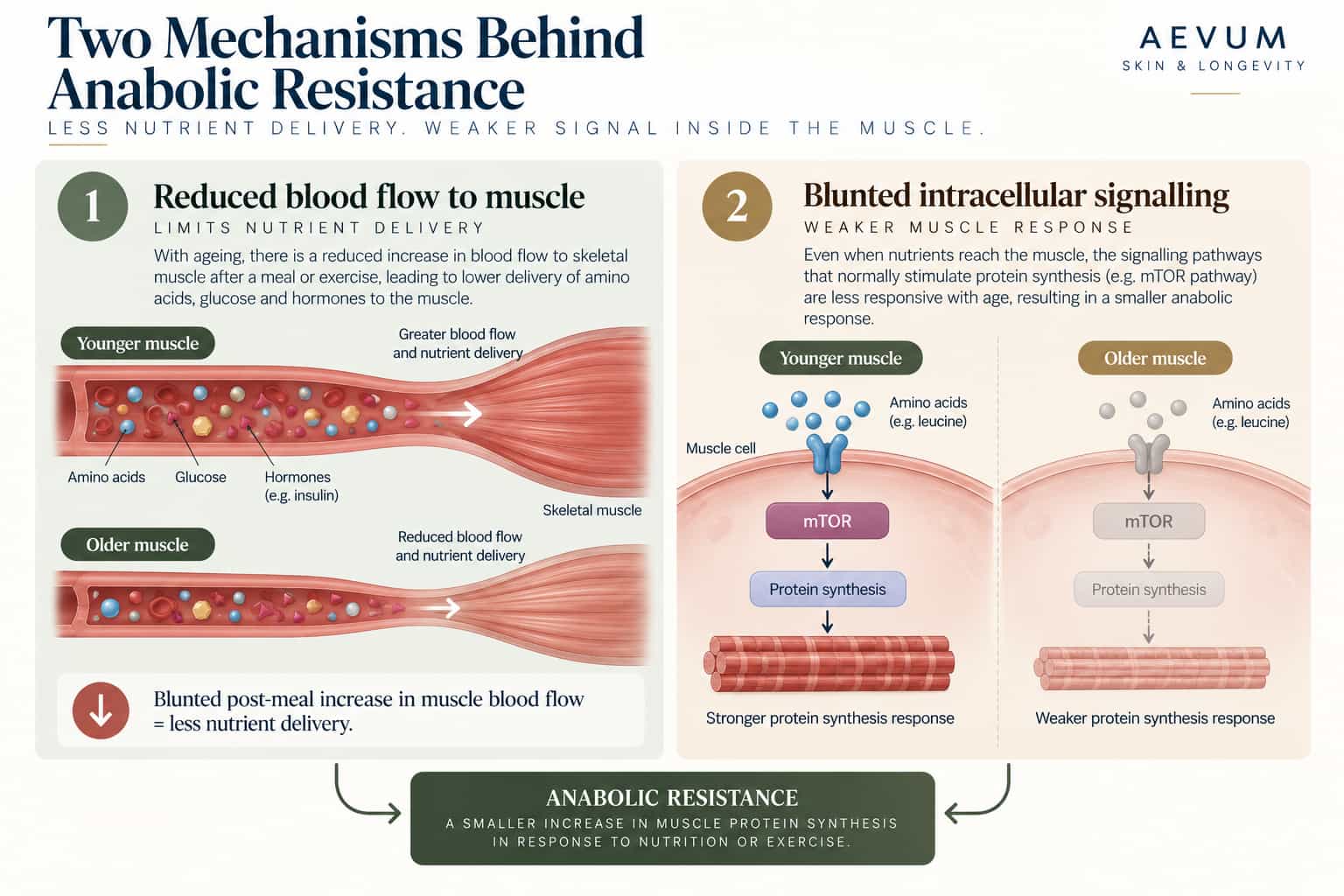
Anabolic resistance is broader than a need for extra protein — it describes a genuinely blunted response to both dietary amino acids and resistance exercise itself. The regulation of muscle protein synthesis (MPS) is governed by nutrient- and exercise-sensitive signalling pathways, with mTORC1 serving as the central point where these anabolic signals converge. Research has identified at least two distinct, compounding mechanisms behind why this system becomes less responsive with age.
The first is a genuine delivery problem, not just a signalling one. Ageing is associated with reduced muscle blood flow and microvascular perfusion, which limits how effectively amino acids and insulin — both needed to stimulate muscle protein synthesis and suppress protein breakdown — actually reach muscle tissue following a meal. This compromised capillary dilation may be driven partly by elevated levels of endothelin-1, a vasoconstricting compound. Genuinely compelling evidence that this delivery mechanism matters causally, not just correlationally, comes from a controlled trial that used pharmacological vasodilation in older adults and found it directly improved insulin-stimulated muscle protein anabolism — a real intervention proving the blood-flow bottleneck is a genuine, fixable part of the problem, not simply a marker of ageing.
The second is an intracellular signalling problem. Even when amino acids do reach muscle tissue, older muscle shows blunted activation of the mTORC1 pathway and reduced sensitivity to amino acids, including leucine specifically. A particularly precise finding illustrates this: research comparing young and older adults after resistance exercise combined with essential amino acid ingestion found that younger subjects activated both the mTOR and a second pathway (ERK1/2), producing a full protein synthesis response, while older subjects activated only the mTOR pathway, with a delayed response — a specific, dual-pathway signalling gap that may help explain the blunted overall response to exercise, not just to nutrition.
What the research shows
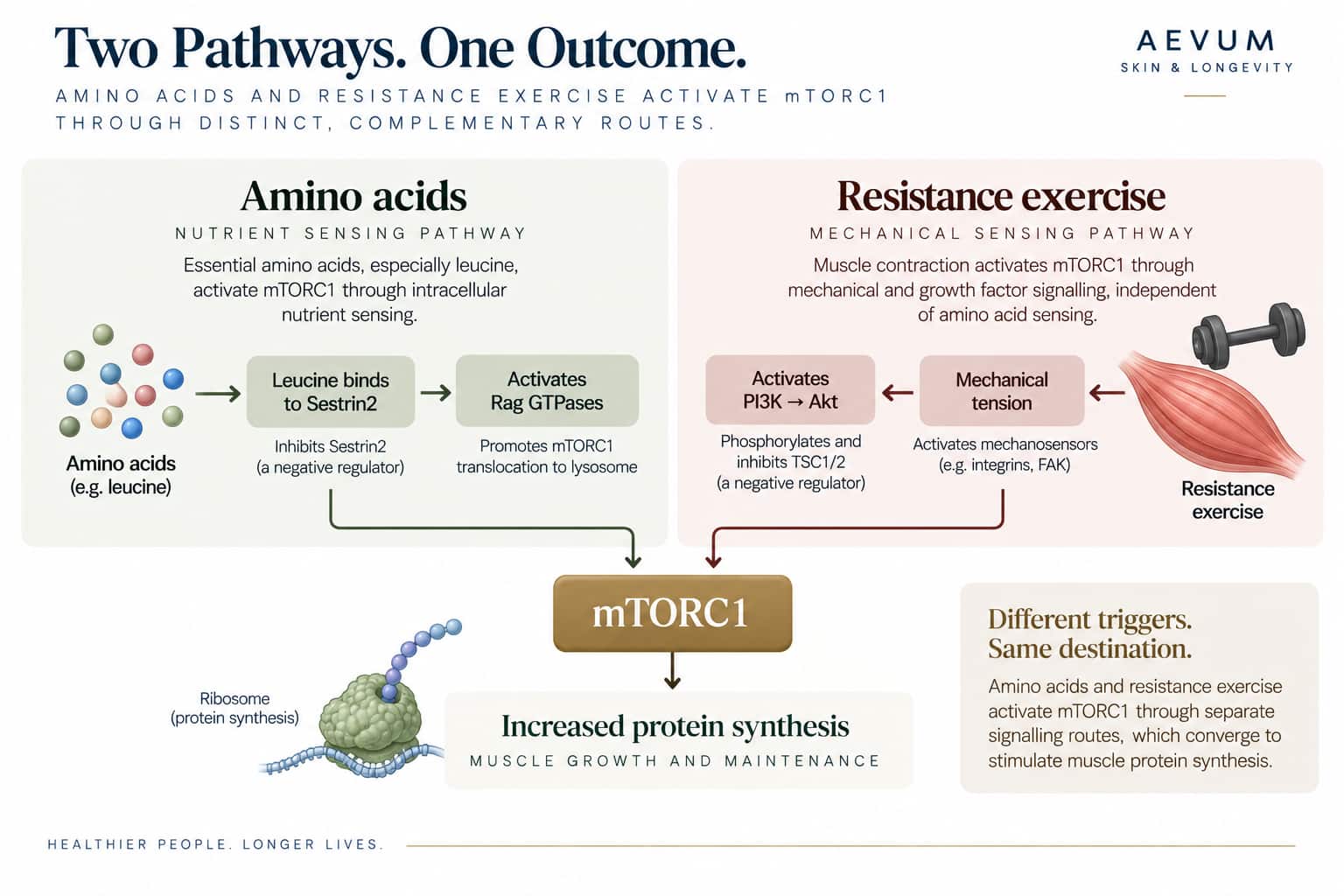
Resistance exercise appears to use a genuinely different route into the same signalling system — one that bypasses part of the impairment. This is arguably the most encouraging, practically important finding in this area. Where dietary amino acids stimulate mTORC1 primarily through nutrient-sensing pathways (the ones shown to be blunted with age), resistance exercise activates mTORC1 through direct mechanical stimulation — mechanical tension and stretch on muscle tissue activating the pathway through a distinct cascade involving focal adhesion kinase and PI3K/Akt signalling. Because this mechanical activation route doesn't rely on the same amino-acid-sensing machinery that becomes less responsive with age, it offers an alternative way into the same downstream pathway — genuinely different biological "wiring" for essentially the same destination, which is part of why exercise remains so effective even in muscle that's become resistant to protein alone.
Exercise also directly improves the delivery problem, not just the signalling problem. Beyond its mechanical signalling effect, resistance exercise acutely increases muscle blood flow and, with consistent training, produces chronic improvements in capillary density — directly addressing the microvascular delivery bottleneck described above. Research has found that chronic resistance training improves leg blood flow responses to meals in older adults and ameliorates the normal age-related decline in nutritive blood flow, alongside enhancing the expression of amino acid transporters for up to 24 hours following a single exercise session. This means resistance exercise addresses anabolic resistance through at least three separable mechanisms simultaneously — direct mechanical signalling, improved acute blood flow, and longer-term vascular adaptation.
Reduced mechanical stress from inactivity makes mTOR signalling even less sensitive, decreased blood flow from inactivity further limits amino acid delivery and uptake, and prolonged inactivity triggers inflammatory responses that further compromise anabolic signalling — creating a vicious cycle where each element worsens the others. This carries particular, practical significance for older adults facing periods of enforced inactivity due to illness, injury, or hospitalisation, where this cycle can accelerate rapidly and compound existing anabolic resistance.
Combining exercise and adequate protein together restores what neither fully achieves alone. Research has directly tested this combination and found that resistance exercise combined with essential amino acid supplementation restores the muscle protein anabolic response in older men — a finding that reframes the practical takeaway from our Protein article: adequate protein intake and resistance exercise aren't two independent, separately-helpful habits for older adults, but a genuinely synergistic pairing where the combination meaningfully outperforms either one in isolation. For those with limited capacity for traditional resistance training, research has also found light resistance exercise performed during blood flow restriction successfully overcomes some of the anabolic resistance to exercise — a specialised rehabilitation technique worth knowing about, though one requiring proper guidance to use safely.
Recommendations by goal
- 1Older adults generally
The research here reframes the practical goal — rather than treating protein intake and resistance exercise as separate strategies, combining them deliberately is what the evidence most strongly supports; see our Protein article for the specific per-meal protein targets.
- 2Anyone facing planned or unplanned inactivity (surgery recovery, illness, injury)
Given how directly inactivity itself worsens anabolic resistance, maintaining whatever light activity or resistance exercise is safely possible during recovery periods is genuinely protective, not merely "better than nothing" — this is a real, mechanistically-understood risk window worth discussing with a doctor or physiotherapist proactively.
- 3Anyone who has tried increasing protein intake alone without seeing expected results
This article's findings suggest why — protein alone doesn't address the blood flow delivery bottleneck or provide the mechanical signalling route that resistance exercise offers; the combination, not protein alone, is what the evidence supports most strongly.
- 4Anyone with limited capacity for traditional resistance training
Blood flow restriction training is a genuine, evidence-supported technique worth discussing with a qualified professional, rather than assuming meaningful anabolic stimulus requires heavy, high-capacity training.
- 5General / longevity-focused
Anabolic resistance is a good example of how "ageing" processes are often more mechanistically specific and more modifiable than they first appear — a delivery problem and a signalling problem, both with genuine, evidence-backed workarounds rather than being simply accepted as inevitable decline.
Practical notes
- →Anabolic resistance affects the response to exercise, not just to protein — a genuinely broader phenomenon than the nutrition-focused framing often suggests
- →Reduced blood flow to muscle is a real, causally-demonstrated part of the problem, not just reduced signalling sensitivity — proven directly through a pharmacological vasodilation trial
- →Resistance exercise activates the same downstream pathway as protein, through a different, mechanical route — part of why it remains effective even in anabolically resistant muscle
- →Inactivity actively worsens this condition through multiple reinforcing mechanisms — a genuine vicious cycle, particularly relevant during illness or injury-related inactivity
- →Protein and resistance exercise work better together than either alone — the combination, not either strategy in isolation, is what the research most directly supports
Anabolic resistance is a genuinely well-mapped, multi-mechanism phenomenon — part delivery problem, part signalling problem — with a real, evidence-backed solution in the specific combination of resistance exercise and adequate protein intake. For the practical protein dosing this connects to, see our Protein and Vegetarian Protein articles, and for how this shapes an effective training approach, see our Muscle Mass article. If you'd like a clearer picture of your own muscle health and a personalised nutrition-and-training plan, our Longevity Doctors offer a free consultation as a starting point.
How does your muscle mass
score on your longevity assessment?
Take the free Aevum Protocol assessment to see how your movement & strength and 6 other longevity domains are performing — and get a personalised 90-day plan.
Take the Free Assessment →Related articles
Movement & Strength
Muscle Mass and Longevity: Why Sarcopenia Is an Aging Problem, Not Just a Bodybuilding One
Nutrition & Metabolism
Protein in the Sri Lankan Diet: Sources, Quality, Requirements & How to Close the Gap
Nutrition & Metabolism