Nutrition & Metabolism
Vegetarian Protein in the Sri Lankan Diet:
Sources, Gaps & How to Get It Right
Sri Lanka is, culturally, one of the more vegetarian-friendly countries in the world — a Buddhist majority observing regular meat-free Poya days, a significant Hindu Tamil population with its own vegetarian tradition, and rice and curry that's already built around lentils, coconut, and vegetables by default. But being surrounded by vegetarian food isn't the same as a vegetarian diet reliably meeting protein needs. This article covers where vegetarian protein actually comes from in a Sri Lankan context, which popular "protein" foods are more myth than substance, what genuinely needs watching nutritionally, and how to structure a vegetarian diet that meets both baseline and longevity-focused protein targets.
Quick Summary
- →Sri Lanka's food culture makes vegetarian eating unusually easy — Poya day observance, Hindu vegetarian tradition, and a rice-and-curry structure already centred on lentils and vegetables all help
- →The "protein combining" rule most people learned is outdated. Modern nutrition science shows plant proteins don't need to be combined at the same meal — a varied diet across the day is what actually matters
- →Not every popular "meat substitute" is actually protein-dense. Jackfruit (kos), a very common vegetarian substitute in Sri Lankan cooking, is genuinely low in protein — its value is texture, not protein content
- →A handful of nutrients need specific attention on a vegetarian diet: vitamin B12, iron, zinc, and omega-3, none of which are absent from a vegetarian diet, but all of which require more deliberate sourcing than on an omnivorous one
- →Locally available options cover the gap well — dhal, soy (including textured soy meat), dairy, eggs (for those who include them), nuts, and increasingly tofu are all accessible and affordable in the Sri Lankan market
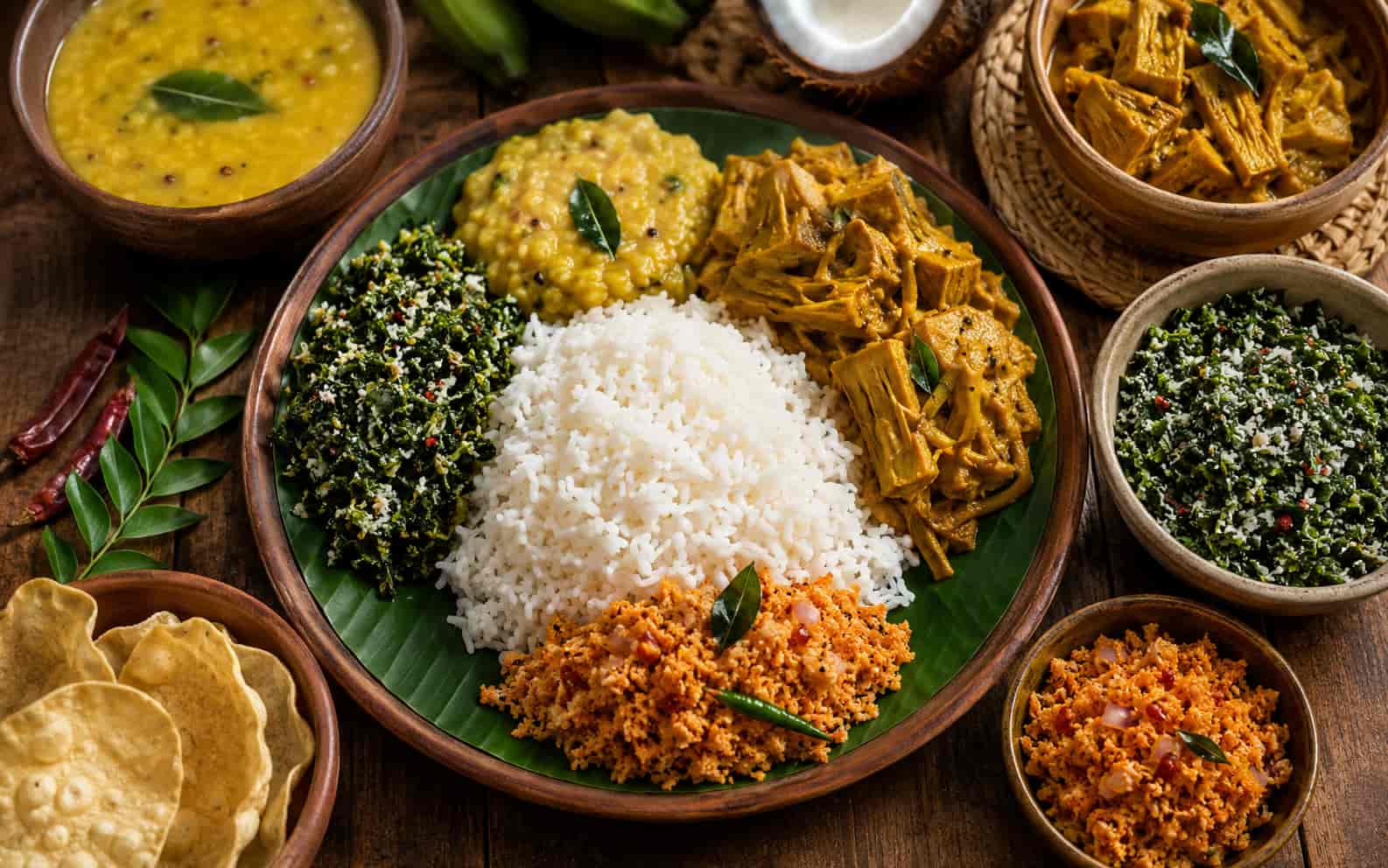
Vegetarianism in the Sri Lankan context
Vegetarianism in Sri Lanka doesn't map onto a single tradition. Buddhist practice, followed by the majority of the population, doesn't mandate vegetarianism, but many Buddhists observe meat-free eating on Poya (full moon) days, and some practise it more consistently. The Hindu Tamil community, a significant minority, has its own established vegetarian tradition rooted in the concept of ahimsa (non-harm), and genuinely vegetarian households and restaurants are common in Hindu areas. Beyond religious observance, a smaller but growing number of Sri Lankans — particularly in urban areas — are adopting vegetarian or vegan diets for health, environmental, or ethical reasons, independent of religious practice.
One practical point worth flagging: "vegetarian" means different things to different people here. Some vegetarian Sri Lankans exclude eggs (lacto-vegetarian); others include them (lacto-ovo-vegetarian). Ghee, a dairy product, is a normal part of many "vegetarian" diets but is sometimes a point of confusion for anyone strictly avoiding all animal products. This article covers protein sources across that spectrum — pure plant-based, and vegetarian diets that include dairy and/or eggs — flagging clearly which sources fall into which category.
The protein combining myth — what actually matters
For decades, vegetarian nutrition advice centred on protein combining: the idea that because most individual plant foods are "incomplete" (low in one or more essential amino acids), they needed to be eaten together in the same meal — rice with dhal, for example — to form a "complete" protein.
This turns out not to be true, and it's worth correcting directly. The body maintains a pool of free amino acids and constantly recycles its own protein, meaning amino acids from different meals across the day are available together, not just within a single meal. Current nutritional consensus is that a varied vegetarian diet eaten across the day — not necessarily paired at each individual meal — provides all essential amino acids for most people, as long as overall calorie and protein intake is adequate.
This doesn't make the traditional Sri Lankan pairing of rice and dhal pointless — it's still a genuinely good combination nutritionally, and there's no downside to eating them together. It simply means the rule "you must combine proteins at every single meal" is outdated, and vegetarians don't need to carefully engineer every plate to hit amino acid completeness. Eating a reasonably varied diet of legumes, grains, dairy or soy, and nuts across the week does the job.
Vegetarian protein sources available in Sri Lanka
Legumes and pulses — the foundation
Dhal (පරිප්පු) and other legumes remain the backbone of vegetarian protein in the Sri Lankan diet, and for good reason — they're inexpensive, widely available, and reasonably protein-dense.
- 1Red lentils / lentil dhal
The most common dhal curry base, roughly 23g protein per 100g raw (roughly 9g per 100g once cooked, since dhal absorbs water and roughly doubles to triples in weight during cooking).
- 2Green gram (මුං ඇට)
Used in curries and traditional sweets (mun kavum), similar protein density to lentils.
- 3Chickpeas (කඩල)
Used in curries and snacks, a good source of both protein and fibre.
- 4Cowpea (මෑ ඇට)
A traditional Sri Lankan legume, comparable protein density to lentils.
- 5Soybeans and soy products
The most protein-dense legume by a clear margin, covered in more detail below.
Legumes are also a genuinely complete-enough protein source over a normal varied diet — their main amino acid shortfall (methionine) is easily covered by grains, dairy, nuts, or eggs eaten elsewhere across the day.
Soy — the most concentrated plant protein available locally
- 1Textured soy protein ("soya meat")
Widely available, inexpensive, and roughly 50g of protein per 100g dry weight (roughly 18g per 100g once rehydrated/cooked, since it absorbs significant water), making it one of the most protein-dense foods in the local market, vegetarian or otherwise. Used as a direct meat substitute in curries.
- 2Tofu
Increasingly available in supermarkets, a genuinely complete plant protein at roughly 8g per 100g, though still a relatively niche ingredient in traditional Sri Lankan cooking compared to textured soy.
- 3Soy milk
Available, though less commonly consumed than dairy milk; a reasonable dairy-free option at roughly 3g protein per 100ml.
Soy is worth highlighting specifically because, unlike most plant proteins, it's genuinely a complete protein on its own — all nine essential amino acids in adequate amounts, without needing to be paired with anything else.
Dairy (for lacto-vegetarians)
- 1Milk (fresh or reconstituted powder)
Around 3.2g protein per 100ml, a reliable, low-effort complete protein.
- 2Curd
A Sri Lankan staple, particularly buffalo curd, contributing protein alongside its more well-known role in the diet.
- 3Paneer / cottage cheese
Roughly 18g protein per 100g, one of the more protein-dense vegetarian options available.
- 4Yoghurt (including Greek yoghurt where available)
Regular curd/yoghurt is lower in protein (~3.5g/100g) than Greek yoghurt (~10g/100g), which is increasingly stocked in supermarkets.
Dairy is a particularly valuable protein source for lacto-vegetarians because, like soy, it's a complete protein and requires no combining or planning to be nutritionally adequate on its own.
Eggs (for ovo-vegetarians)
A single egg provides roughly 6–7g of complete, high-quality protein at very low cost, and remains one of the most efficient protein sources available to anyone who includes eggs in their diet. For lacto-ovo-vegetarians, eggs and dairy together make hitting daily protein targets considerably easier than a strictly plant-based approach.
Nuts and seeds
Cashews, peanuts, and sesame all contribute meaningful protein alongside healthy fat, typically in the range of 20–25g protein per 100g. These work well as snacks or additions to meals rather than primary protein sources, given the smaller portions typically eaten.
Mushrooms
Mushrooms are often assumed to be a strong protein source because of their savoury, "meaty" character, but their actual protein content is modest — roughly 3–4g per 100g, closer to a vegetable than a legume in protein terms. They're a reasonable addition for variety, umami flavour, and other nutrients (B vitamins, some vitamin D when sun-exposed), but shouldn't be relied on as a primary protein source.
Jackfruit (කොස්) — a genuine myth worth correcting
Young/green jackfruit curry (කොස් කරි) is one of the most iconic vegetarian "meat substitute" dishes in Sri Lankan cooking, prized for its fibrous, pulled-meat-like texture. It is not, however, a meaningful protein source — raw jackfruit contains only around 1.5–2.5g of protein per 100g, closer to a starchy vegetable than a protein food. Its appeal is genuinely about texture and its ability to absorb curry flavours, not nutrition. This isn't a reason to avoid jackfruit curry — it's a valuable, traditional, low-calorie dish — but it shouldn't be counted as a protein source when planning a vegetarian meal, and ideally should be paired with a genuine protein source (dhal, soy, egg, or dairy) at the same meal rather than treated as a like-for-like meat replacement.
On the calorie and carbohydrate side, jackfruit is a genuinely favourable food, with an important ripeness distinction. Per 100g, jackfruit is around 95 calories with roughly 23g of carbohydrate and 1.5–3g of fibre. Young/green jackfruit (the form used in curry) has most of its carbohydrate as starch and resistant fibre rather than sugar, giving it a low-to-moderate glycaemic index of roughly 40–50. Ripe jackfruit, eaten as a sweet fruit, has converted much of that starch into natural sugar and carries a meaningfully higher GI of roughly 60–70 — the savoury curry form is the more blood-sugar-friendly one.
Quinoa
Quinoa is a genuinely complete plant protein at around 4.4g per 100g cooked — lower in density than legumes or soy, but useful for varying the carbohydrate base of a meal while adding protein quality. It remains an imported, relatively premium ingredient rather than an everyday staple in most Sri Lankan households.
Nutrients vegetarians need to watch
Protein quantity is genuinely achievable on a vegetarian diet in Sri Lanka — the bigger, less-discussed issue is a handful of specific nutrients that are harder to get without animal products, or without deliberate planning.
- →Vitamin B12 — found reliably only in animal products (meat, fish, eggs, dairy). Lacto-vegetarians and lacto-ovo-vegetarians can get adequate B12 from dairy and eggs; strictly plant-based vegetarians and vegans genuinely cannot reliably meet B12 needs from unfortified plant foods alone, and should use a fortified food source or supplement. This is not a minor or optional point — B12 deficiency can cause serious, sometimes irreversible neurological effects if left uncorrected
- →Iron — plant-based (non-heme) iron is less efficiently absorbed than the heme iron found in meat and fish. Pairing iron-rich plant foods (dhal, green leafy vegetables) with vitamin C-rich foods (citrus, tomato) at the same meal genuinely does improve absorption — this is one case where meal-pairing still matters, unlike the protein-combining myth above
- →Zinc — similarly less bioavailable from plant sources; legumes, nuts, and dairy all contribute, but intake is worth being mindful of, particularly for strict vegans
- →Omega-3 (EPA/DHA specifically) — plant sources (flaxseed, walnuts) provide ALA, which the body converts to EPA/DHA only inefficiently. Vegetarians who eat fish get this covered directly; strict vegetarians and vegans may want to consider an algae-based DHA/EPA supplement
None of these are reasons to avoid a vegetarian diet — they're simply the specific points that need deliberate attention rather than happening automatically, the way they might on a diet that includes meat and fish.
Daily protein targets for vegetarians
The baseline and longevity-focused protein targets apply equally to vegetarians — there's no vegetarian-specific RDA. However, some nutrition guidance suggests a modest upward adjustment for anyone getting the majority of their protein from plant sources, since plant proteins are, on average, somewhat less digestible and efficiently used by the body than animal protein (measured via DIAAS, a digestibility-adjusted protein quality score). Where this adjustment is applied, it's typically in the range of 10–20% above the standard target — a modest, not dramatic, increase.
| Baseline RDA | Longevity-Focused Target | Plant-Predominant Adjustment | |
|---|---|---|---|
| Average adult male (~68kg) | ~56g/day | ~95–150g/day | Add ~10–20% if protein is mostly plant-based |
| Average adult female (~57kg) | ~47g/day | ~80–125g/day | Add ~10–20% if protein is mostly plant-based |
This adjustment becomes less relevant for lacto-ovo-vegetarians whose protein mix includes dairy and eggs, since those are complete, highly digestible proteins in their own right — it matters most for those eating a largely or entirely plant-based diet.
Structuring a vegetarian day for adequate protein
A practical example of how this could look across a day, using accessible Sri Lankan ingredients.
- →Breakfast: String hoppers or roti with dhal curry, plus a glass of milk or curd — roughly 15–20g protein
- →Lunch: Rice and curry with a doubled dhal portion, a piece of soy meat curry or tofu, and mallum — roughly 25–35g protein
- →Snack: A handful of roasted chickpeas or peanuts, or curd with seeds — roughly 8–10g protein
- →Dinner: Roti or rice with paneer or another soy-based curry, plus a side of dhal — roughly 25–30g protein
This kind of structure, without requiring any exotic or imported ingredients, comfortably reaches 75–95g of protein across the day for most adults — already within or close to the longevity-focused range, particularly once portion sizes are genuinely adequate rather than token.
Protein content across vegetarian food sources
| Food | Protein (per 100g) | Typical Serving | Protein per Serving | Complete? |
|---|---|---|---|---|
| Textured soy protein (dry / ~18g rehydrated) | ~50g | 30g dry | 15g | Yes |
| Paneer / cottage cheese | ~18g | 50g | 9g | Yes (dairy) |
| Whey / soy protein powder | ~24g per scoop | 1 scoop (30g) | ~24g | Yes |
| Skimmed milk powder | 37.6g | 30g | 11.3g | Yes (dairy) |
| Greek yoghurt | ~10g | 100g | 10g | Yes (dairy) |
| Cashews | ~18g | 30g | 5.4g | No |
| Peanuts | 22.4g | 30g | 6.7g | No |
| Chickpeas (raw / ~9g cooked) | ~19g | 20g raw | 3.8g | No |
| Green gram dhal (raw / ~7g cooked) | 23.4g | 20g raw | 4.68g | No |
| Lentil dhal (raw / ~9g cooked) | 23.1g | 20g raw | 4.62g | No |
| White cowpea (raw / ~8g cooked) | 21.3g | 20g raw | 4.26g | No |
| Whole egg | 13.6g | 60g (1 egg) | 8.2g | Yes |
| Tofu | ~8g | 100g | 8g | Yes |
| Soy milk | ~3g | 100ml | 3g | Yes |
| Regular curd/yoghurt | ~3.5g | 100g | 3.5g | Yes (dairy) |
| Whole milk | 3.2g | 100ml | 3.2g | Yes (dairy) |
| Quinoa, cooked | 4.4g | 100g | 4.4g | Yes |
| Mushrooms | ~3.5g | 100g | 3.5g | No |
| Jackfruit (young/green) | ~1.5–2.5g | 100g | ~2g | No — texture substitute |
| White rice, cooked | 2.7g | 100g | 2.7g | No |
Values for local staples (dhal varieties, dairy, jackfruit) draw on standard Sri Lankan and international nutrition data; "complete protein" indicates whether the food alone contains all nine essential amino acids in adequate proportion. Legumes and soy are listed by raw/dry weight, since that's how they're typically measured before cooking — cooked protein-per-100g figures are lower simply because water absorbed during cooking increases weight without adding protein; the "protein per serving" column already accounts for this and reflects the raw/dry portion actually used.
Recommendations by population group
- 1Pregnancy
Vegetarian pregnancy is entirely workable with attention to B12, iron, and omega-3 specifically — this is the life stage where these three nutrients matter most, and where a doctor-guided supplement plan (particularly for B12 and DHA) is worth discussing proactively rather than waiting for a deficiency to show up on bloodwork.
- 2Children
A well-planned vegetarian diet can meet a growing child's protein needs, but portion sizes need to be genuinely adequate — children have smaller stomachs and higher relative protein needs per kilogram than adults, so protein-dense foods (dairy, eggs where included, soy) matter more than volume of food alone.
- 3Older age
The anabolic resistance effect — needing more protein per meal to trigger the same muscle-building response — applies equally to vegetarians, and is worth compensating for with concentrated protein sources (paneer, soy, eggs) rather than relying on volume from lower-density plant foods alone.
- 4Vegetarian athletes / resistance training
Meeting higher protein targets on a vegetarian diet is genuinely more achievable through concentrated sources — soy, dairy, protein powder — than through legumes alone, given the volume of food legumes would require to hit the same protein numbers.
- 5General / longevity-focused
The core principle doesn't change from the general population — protein quality (via complete or well-varied sources) and adequate daily quantity both matter, and a vegetarian diet done properly in the Sri Lankan context has no shortage of accessible ways to achieve both.
Practical notes
- →The traditional Sri Lankan vegetarian plate is already closer to correct than most people realise — rice, dhal, and vegetables cover a meaningful protein base; the main gap is usually portion size, not food choice
- →Soy is the single most useful addition for vegetarians trying to close a protein gap — it's inexpensive, widely available, complete in amino acid profile, and far more protein-dense than most traditional plant options
- →Don't mistake texture for protein. Jackfruit, and to a lesser extent some other fibrous vegetables used as meat substitutes, satisfy the "meaty" eating experience without providing meaningful protein — plan the protein separately
- →B12 is the one nutrient that genuinely cannot be reliably obtained from unfortified plant foods alone. For strict vegetarians and vegans specifically, this is worth addressing directly with a doctor rather than assuming a varied diet covers it — unlike protein, it doesn't
- →The "must combine proteins at every meal" advice is outdated — a varied diet across the week matters far more than precisely engineering each individual plate
Vegetarian protein in Sri Lanka isn't a gap that requires imported specialty foods to close — dhal, soy, dairy, and eggs (where included) already provide what's needed, and mostly at lower cost than meat or fish. The main shifts worth making are treating protein as a deliberate part of each meal rather than an afterthought, and paying specific attention to the handful of nutrients — B12 above all — that genuinely do need planning on a vegetarian diet. For the fuller picture on protein requirements, muscle mass, and how fat and grains fit alongside this, see our Protein in the Sri Lankan Diet, Fats in the Sri Lankan Diet, Legumes, and Grains articles. If you'd like a clearer picture of your own nutrient status and protein needs, our Longevity Doctors offer a free longevity assessment as a starting point.
Curious where your own
protein intake stands today?
Take the free Aevum Protocol assessment to see how your nutrition & metabolism and 6 other longevity domains are performing — and get a personalised 90-day plan.
Take the Free Assessment →