Nutrition & Metabolism
Vitamins in the Sri Lankan Diet: The
Sunshine Paradox and Other Gaps
Sri Lanka sits just under 7° north of the equator, with sunshine essentially year-round. By most assumptions, vitamin D deficiency shouldn't be a Sri Lankan problem at all. It is — and understanding why is a useful entry point into the wider vitamin picture, where several genuine gaps exist despite a food culture rich in some of the very foods that could close them.
Quick Summary
- →Vitamin D deficiency is startlingly common in Sri Lanka despite abundant sunshine — one 2024 Colombo study found over 90% of urban adults had low vitamin D status, with two-thirds meeting the threshold for outright deficiency
- →Vitamins split into two functional groups — fat-soluble (A, D, E, K, absorbed with dietary fat and stored in the body) and water-soluble (the B-complex and vitamin C, not stored in meaningful amounts and needed more continuously)
- →B12 is the clearest dietary vitamin gap for vegetarians specifically — it's found reliably only in animal products
- →Folate deficiency risk is particularly relevant around pregnancy, given its direct link to neural tube defects, and Sri Lankan legumes are a genuinely strong local source
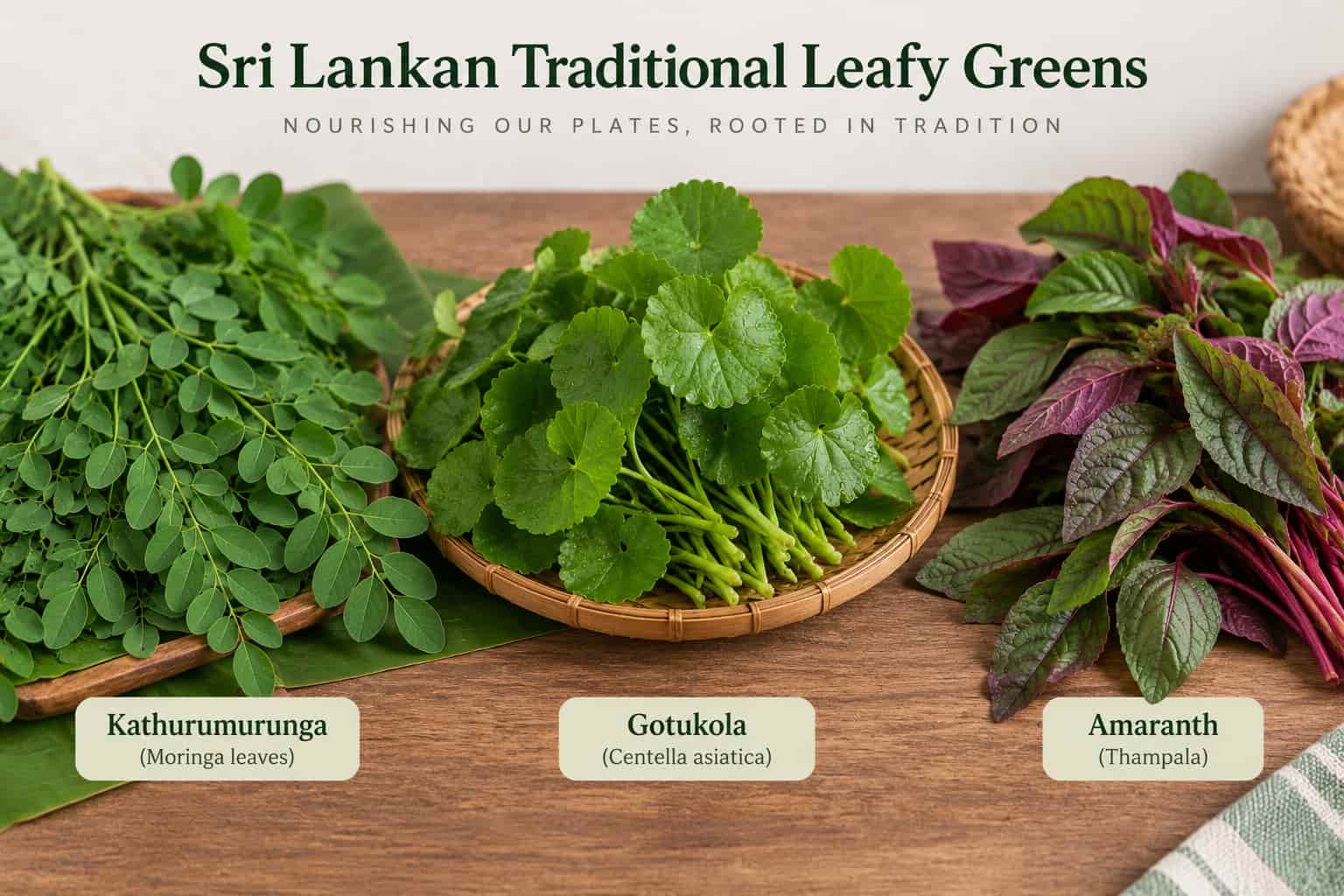
- →Sri Lanka's own traditional greens — kathurumurunga, gotukola, drumstick leaves, amaranth — are excellent, often underused sources of several key vitamins, meaning the fix for some of these gaps is closer to home than it might seem
Fat-soluble vs. water-soluble — why the distinction matters
Vitamins fall into two broad categories based on how the body absorbs, stores, and uses them, and the distinction has real practical consequences.
- 1Fat-soluble vitamins (A, D, E, K)
Absorbed alongside dietary fat and can be stored in the body's fat tissue and liver for extended periods — sometimes months. This means deficiency tends to develop slowly, but it also means excess intake (typically from high-dose supplements, not food) can build up to harmful levels over time, unlike water-soluble vitamins.
- 2Water-soluble vitamins (the B-complex and vitamin C)
Dissolve in water, aren't meaningfully stored by the body, and are excreted in urine when intake exceeds what's needed. This makes toxicity from food sources essentially a non-issue, but it also means these vitamins need more consistent, regular intake — a single very poor day matters less for vitamin A than it does for vitamin C or the B vitamins, where the body's reserves are much smaller.
This article focuses on the vitamins most relevant to a Sri Lankan diet specifically — where genuine gaps exist, and where the local food culture already offers strong solutions once the gap is understood.
Vitamin D: the sunshine paradox
Adult AI: 15µg/day (600 IU/day)
This is the standout finding, and worth explaining properly because it genuinely surprises most people. Vitamin D is unusual among vitamins in that the body can synthesise it directly from sunlight exposure on skin — which is exactly why a tropical country with sunshine essentially every day of the year would seem like the last place to expect widespread deficiency.
The data says otherwise. A 2024 population-based study of over 1,260 adults in Colombo found that 93.9% had low vitamin D status, with 67.5% meeting the threshold for outright deficiency and a further 26.4% insufficient. Other Sri Lankan studies, across different regions and age groups — including children as young as 10 — have found broadly similar patterns, and a regional systematic review placed Sri Lanka's deficiency prevalence at around 48%, among the higher rates in South Asia.
Why this happens despite the sunshine comes down to modern lifestyle factors rather than climate.
- 1Reduced outdoor time
Increasingly indoor-oriented work, study, and leisure patterns mean less actual skin exposure to sunlight, regardless of how much sun is available outside.
- 2Sun avoidance behaviour
Deliberate avoidance of direct sun exposure (clothing choices, sunscreen, seeking shade) is common and, while reasonable for skin cancer and photoaging prevention, directly reduces vitamin D synthesis.
- 3Limited dietary vitamin D sources
Very few foods naturally contain meaningful vitamin D, and Sri Lankan dietary staples aren't strong natural sources, making sunlight exposure the dominant source for most people rather than diet.
What this means practically: for most people, moderate, unprotected sun exposure of the arms and legs for roughly 15–20 minutes around midday, a few times a week, is generally sufficient for adequate synthesis — though individual factors (skin tone, age, and time of day) affect this considerably, and this should be balanced against skin cancer risk rather than treated as unlimited. Where sun exposure is genuinely limited, dietary sources and supplementation become more relevant, and this is a reasonable thing to discuss with a doctor and confirm with a blood test rather than assume either way.
| Food | Vitamin D (µg per 100g) | Vitamin D (IU per 100g) | Typical Serving | Per Serving |
|---|---|---|---|---|
| Mackerel, cooked (ලින්නා) | ~8–16µg | ~320–640 IU | 30g | ~3–5µg (~120–200 IU) |
| Sardines (සලායා) | ~10–14µg | ~400–560 IU | 30g | ~3–4µg (~120–160 IU) |
| Tuna | ~3–7µg | ~120–280 IU | 30g | ~1–2µg (~40–80 IU) |
| Egg, whole | ~1–3µg | ~40–120 IU | 1 egg | ~1–3µg (~40–120 IU) |
| Sprats (හාල්මැස්සන්) | ~5–10µg | ~200–400 IU | 30g | ~1.5–3µg (~60–120 IU) |
| Seer fish / Kelawalla (තෝර මාළු) | ~4–8µg | ~160–320 IU | 30g | ~1.2–2.4µg (~48–96 IU) |
| Mushrooms (only if UV-exposed) | Negligible unless UV-treated | Negligible unless UV-treated | 100g | Varies significantly |
Note the wide ranges above — vitamin D content varies considerably by cooking method, whether fish is wild or farmed, and (for eggs) how much sun exposure the hens themselves get; these are general ranges rather than exact Sri Lanka-specific lab values. Even a strong day of these food sources typically falls well short of the daily target — this is precisely why sunlight exposure (or supplementation, where advised by a doctor) matters more for vitamin D than for almost any other vitamin.
Vitamin B12: the vegetarian-relevant gap
Adult AI: 4µg/day
B12 deserves a mention here too because it's one of the cleanest examples of a vitamin found reliably only in animal products — meat, fish, eggs, and dairy. Plant foods do not reliably contain usable B12, regardless of how varied or well-planned the diet is. Deficiency, if prolonged, can cause serious and sometimes irreversible neurological damage, which is why this is treated as a genuinely important gap to close deliberately for anyone eating a largely or entirely plant-based diet, rather than a minor nutritional footnote.
| Food | B12 (µg per 100g) | Typical Serving | B12 per Serving |
|---|---|---|---|
| Beef liver | 83.2µg | 30g | ~25µg |
| Tuna | 10.9µg | 30g | ~3.3µg |
| Milk, liquid (2% fat) | 0.7µg | 240ml | ~1.68µg |
| Egg, boiled | 0.6µg | 1 egg | ~0.5µg |
| Maldive fish / dried fish (උම්බලකඩ) | ~2.8µg | 10g | ~0.28µg |
| Crab | ~9µg | 60g | ~5.4µg |
| Cuttlefish / squid (දැල්ලා) | ~1.3µg | 60g | ~0.78µg |
| Prawns | ~1.1µg | 60g | ~0.66µg |
For lacto-ovo-vegetarians, dairy and eggs comfortably cover this; for strict vegetarians and vegans, a fortified source or supplement is genuinely necessary, not optional. Crab, cuttlefish, and prawns round out the everyday seafood picture better than liver or dried fish alone, since they're eaten far more regularly.
Folate (Vitamin B9): especially relevant around pregnancy
Adult AI: 330µg/day, rising to 600µg/day in pregnancy
Folate is essential for DNA synthesis and cell division, which is why it becomes particularly critical during early pregnancy — inadequate folate status is directly linked to neural tube defects in the developing fetus, one of the more serious and preventable outcomes in maternal nutrition. Deficiency more broadly causes a specific type of anaemia (megaloblastic anaemia) and is associated with fatigue, irritability, and difficulty concentrating.
The encouraging part: Sri Lankan legumes are genuinely strong folate sources, meaning the traditional dhal-heavy diet already does real work here.
| Food | Folate, raw (per 100g) | Folate, cooked (per 100g) | Typical Serving | Per Serving |
|---|---|---|---|---|
| Cowpea (කව්පි) (black-eyed pea) | ~633µg | ~208µg | 20g raw / ¼ cup cooked | ~126.6µg |
| Green gram (mung dhal) | ~625µg | ~159µg | 20g raw / ¼ cup cooked | ~125µg |
| Chickpea (කඩල) | ~557µg | ~172µg | 20g raw / ¼ cup cooked | ~111.4µg |
| Lentil dhal (පරිප්පු) | ~479µg | ~181µg | 20g raw / ¼ cup cooked | ~95.8µg |
| Gingelly seeds (තල ඇට) (sesame) | ~97µg | n/a (eaten raw/roasted) | 15g | ~14.6µg |
| Kangkung / water spinach | ~57µg | ~57µg | 80g | ~45.6µg |
| Okra / bandakka (බණ්ඩක්කා) | ~60µg | ~36µg | 80g | ~48µg |
The rising requirement in pregnancy is a meaningful increase that usually requires more than diet alone, which is why folic acid supplementation is standard medical advice during pregnancy planning and early pregnancy specifically, not just general good eating. Kangkung and okra add reliable leafy-green and vegetable folate sources alongside the legumes above.
Vitamin A: where local greens genuinely excel
Adult AI: 750µg RE / male (2,500 IU), 650µg RE / female (2,165 IU) per day
Vitamin A is essential for vision, immune function, and cell growth, and deficiency remains a recognised public health concern in parts of South Asia, particularly among children. This is one area where Sri Lankan traditional greens are a real strength rather than a gap.
| Food | Vitamin A (µg RE per 100g) | Vitamin A (IU per 100g) | Typical Serving | Per Serving |
|---|---|---|---|---|
| Amaranth leaves, green (තම්පලා) | 1,474µg | ~4,910 IU | 50g | ~737µg (~2,455 IU) |
| Amaranth leaves, red (රතු තම්පලා) | 1,409µg | ~4,695 IU | 50g | ~708µg (~2,357 IU) |
| Drumstick leaves (Murunga kola) | 2,664µg | ~8,875 IU | 20g | ~532µg (~1,772 IU) |
| Kathurumurunga (hummingbird leaves) | 2,097µg | ~6,985 IU | 25g | ~524µg (~1,745 IU) |
| Carrot | 1,240µg | ~4,130 IU | 50g | ~620µg (~2,065 IU) |
| Pumpkin (වට්ටක්කා) | 426µg | ~1,420 IU | 100g | ~426µg (~1,420 IU) |
| Sweet potato, orange-fleshed | ~250–1,750µg (varies by cultivar) | ~830–5,830 IU | 100g | ~250–1,750µg |
| Mango, ripe | 54µg | — | 100g | ~54µg |
| Papaya, ripe | ~47µg | — | 100g | ~47µg |
IU figures use the standard food-label conversion of 1µg RE ≈ 3.33 IU; this is a simplified approximation rather than a precise bioavailability measure, since provitamin-A carotenoids (as found in all the plant sources above) convert to usable vitamin A less efficiently than preformed animal-source retinol, even at equal RE values.
A single serving of amaranth or drumstick leaves can cover the majority of a day's requirement — genuinely one of the stronger nutritional arguments for keeping these traditional greens in regular rotation rather than treating them as an occasional dish. Orange-fleshed sweet potato is also a genuinely major source, though its exact content varies considerably by variety.
Vitamin C: also a local strength
Adult AI: 110mg (male), 95mg (female) per day
Vitamin C supports collagen synthesis, immune function, and — relevantly, given the iron-absorption point from our Vegetarian Protein and Fibre articles — enhances non-heme iron absorption from plant foods when eaten in the same meal.
| Food | Vitamin C (mg per 100g) | Typical Serving | Per Serving |
|---|---|---|---|
| Guava, pink flesh | 244mg | 50g | ~122mg |
| Guava, white flesh | 212mg | 50g | ~106mg |
| Nelli / Indian gooseberry (නෙල්ලි) | ~300–450mg (varies by cultivar) | 20g | ~60–90mg |
| Amaranth, red (රතු තම්පලා) | 86mg | 100g | ~86mg |
| Mango, green | 91.6mg | 50g | ~45.8mg |
| Papaya | ~60mg | 100g | ~60mg |
| Orange (දොඩම්) | ~53mg | 100g | ~53mg |
| Pineapple (අන්නාසි) | ~48mg | 100g | ~48mg |
| Lemon | ~53mg | 50g | ~26.5mg |
| Ambarella (embul) | ~30–45mg | 100g | ~30–45mg |
| Star fruit / kamaranga | ~34mg | 100g | ~34mg |
| Passion fruit | ~30mg | 50g | ~15mg |
| Lime (දෙහි) | ~30mg | 10g (typical squeeze) | ~3mg |
Guava and nelli, both genuinely common and inexpensive local options, can meet most or all of a day's vitamin C needs in a single small serving. Citrus fruits, despite their reputation, aren't the strongest vitamin C sources in a Sri Lankan context — orange and lemon are moderate, and lime specifically ranks lower than expected here mainly because it's typically consumed in small squeezed quantities rather than eaten as a full serving, unlike guava or papaya.
Vitamin K: leafy greens again
Adult AI: 70µg/day
Vitamin K is essential for blood clotting and plays a role in bone mineralisation. As with vitamin A, Sri Lankan leafy greens are strong sources.
| Food | Vitamin K (µg per 100g) | Typical Serving | Per Serving |
|---|---|---|---|
| Amaranth (තම්පලා) | 441µg | 50g | ~220µg |
| Malabar spinach (නිවිති) | 351µg | 50g | ~175µg |
| Colocasia leaves (කිරි අල කොළ) | 390µg | 25g | ~97µg |
| Drumstick leaves (Murunga kola) | 350µg | 25g | ~87µg |
| Broccoli | ~102µg | 80g | ~82µg |
| Cabbage (ගෝවා) | ~76µg | 80g | ~61µg |
Comfortably covered by a single serving of most traditional Sri Lankan leafy greens. Cabbage is a reliable, verified, and widely available addition alongside the more distinctly local greens above.
The other vitamins, briefly
The remaining vitamins — thiamine (B1), riboflavin (B2), niacin (B3), pantothenic acid (B5), B6, biotin, vitamin E, and choline — are less commonly deficient in the general Sri Lankan population, though specific groups (heavy alcohol use for B1, restrictive diets for several others) can be at risk. Whole grains, legumes, and organ meats cover most of these reasonably well within a typical varied diet, and they haven't been given dedicated sections here simply because the evidence for widespread population-level gaps is weaker than for the vitamins covered above.
Recommendations by population group
- 1Pregnancy
Folate is the standout priority here, typically requiring supplementation alongside diet given the substantially higher requirement. Vitamin D is also worth monitoring, given how common insufficiency already is in the general adult population.
- 2Children
Vitamin D deficiency and rickets have been documented in Sri Lankan children specifically, often linked to reduced outdoor time — a relevant consideration in an era of more indoor-oriented schooling and screen time. Vitamin A remains relevant for immune function and vision during growth.
- 3Older age
Vitamin D becomes more clinically significant with age, given its role in calcium absorption and bone health, and older adults often have both reduced sun exposure and reduced skin synthesis efficiency — a doctor-guided blood test is a reasonable way to check status directly rather than assume.
- 4Vegetarians and vegans
B12 is the clear priority, alongside attention to vitamin D given its limited dietary sources generally.
- 5General / longevity-focused
Given how common vitamin D insufficiency is even in a sun-abundant country, it's a reasonable candidate for population-wide attention rather than an issue assumed to be someone else's problem — a simple blood test is the most direct way to know individual status rather than guessing from lifestyle alone.
Practical notes
- →Sri Lanka's vitamin D deficiency despite abundant sunshine is a genuinely well-documented, somewhat counterintuitive finding — worth knowing rather than assuming tropical living automatically solves this
- →Traditional Sri Lankan greens — kathurumurunga, gotukola, amaranth, drumstick leaves — are strong, underused sources of vitamin A, vitamin K, and vitamin C specifically; the fix for several vitamin gaps may already exist in local food culture rather than requiring anything imported
- →B12 and folate deserve deliberate attention for vegetarians and anyone planning a pregnancy respectively — these are the two cases where "eat a varied diet" isn't sufficient advice on its own
- →A blood test is the only reliable way to know actual vitamin D status — sun exposure habits and dietary intake are useful context, but don't substitute for measurement given how common deficiency is even among people who assume they get "enough sun"
The vitamin picture in Sri Lanka is a genuine mix — real strengths in vitamin A, C, and K thanks to a food culture built around leafy greens, alongside a real and well-documented gap in vitamin D that has little to do with the amount of sunshine actually available. For the related picture on minerals, protein, and fibre, see our Vegetarian Protein, Protein, and Fibre articles. If you'd like a clearer picture of your own vitamin status, including vitamin D, our Longevity Doctors offer a free longevity assessment as a starting point.
Curious where your own
vitamin status stands today?
Take the free Aevum Protocol assessment to see how your nutrition & metabolism and 6 other longevity domains are performing — and get a personalised 90-day plan.
Take the Free Assessment →