Nutrition & Metabolism
Minerals in the Sri Lankan Diet:
The Complete Guide
Minerals are inorganic elements the body can't manufacture on its own — everything from the calcium in bone to the iron carrying oxygen through blood has to come from food. This article covers seven minerals worth understanding in real depth — iron, iodine, zinc, calcium, selenium, copper, and a broader look at magnesium, potassium, and sodium — how each works in the body, where global food science says to find them, and how Sri Lanka's own picture compares to that global backdrop, including one genuine public health success story and several ongoing, well-documented gaps.
Quick Summary
- →Iron deficiency is the single most common nutritional deficiency in the world, affecting an estimated two billion people — Sri Lanka's own gap sits within this global pattern, particularly pronounced among children, adolescent girls, and pregnant women
- →Iodine deficiency in Sri Lanka is a genuine public health success story. A national salt iodization program launched in 1995 dropped the childhood goiter rate from 20.9% in 2000 to just 1.8% by 2016 — one of the more effective nutrition interventions in the country's history
- →Zinc has no storage system in the body, unlike iron — this makes consistent daily intake more important than it might seem, and it's one of the more common gaps in cereal-heavy, lower-animal-protein diets
- →Calcium isn't just about bone strength today — the body quietly pulls calcium from bone to maintain blood levels whenever dietary intake falls short, meaning chronic under-intake can deplete bone density for years before any test would catch it
- →Selenium's Sri Lankan story is uniquely geographic — linked to goiter risk in the wet zone and implicated in chronic kidney disease of uncertain aetiology (CKDu) in the dry zone, mirroring how selenium content in food depends almost entirely on local soil, worldwide
- →Copper works closely with iron in the body and is worth knowing about even though it's rarely deficient on its own — particularly relevant for anyone taking long-term zinc supplements, which can interfere with copper absorption
- →Magnesium is involved in over 300 enzymatic reactions, yet is easy to under-consume on a diet heavy in refined grains, which strip most of it out during processing
- →Potassium and sodium work as a pair, not independent numbers — the ratio between them matters as much as either one alone, and most modern diets run far more sodium-heavy and potassium-light than is ideal
- →Sodium is the one mineral in this article where the concern runs backwards — nearly everyone would benefit from eating less of it, not more, and Sri Lanka's dried-fish-and-added-salt cooking style tends to push intake well above recommended limits
Iron: the most widespread gap
Adult AI (Adequate Intake): ~11mg/day (men), ~16mg/day (premenopausal women)
Iron is essential for haemoglobin, the protein that carries oxygen through the blood, and its deficiency is the most common nutritional deficiency in the world. Beyond anaemia, low iron impairs cognitive development in children, reduces energy and physical performance at any age, and is genuinely relevant to longevity — even mild, undiagnosed iron deficiency in older adults is linked to fatigue, reduced physical function, and a higher risk of frailty, often mistaken for normal ageing rather than a fixable nutritional gap. Plant-based (non-heme) iron absorbs far less efficiently than the heme iron in meat and fish, which is why vegetarian diets need meaningfully more total iron intake to reach the same absorbed amount.
In Sri Lanka, national survey data shows iron deficiency affects roughly a third of young children and a fifth of pregnant women, with adolescent girls and women affected most due to menstrual loss not being offset by intake.
| Food | Iron (per 100g) | Typical Serving | Iron per Serving |
|---|---|---|---|
| Clams (බෙල්ලන්) | ~28mg | 60g | ~16.8mg |
| Gingelly seeds (තල ඇට) | ~14.6mg | 15g | ~2.2mg |
| Dark chocolate (70%+) | ~11.9mg | 30g | ~3.6mg |
| Kathurumurunga (hummingbird leaves) | ~9–11mg (commonly cited) | 25g | ~2.25–2.75mg |
| Pumpkin seeds | ~8.8mg | 30g | ~2.64mg |
| Cowpea (කව්පි), raw | ~8.3mg | 20g raw | ~1.66mg |
| Mukunuwenna | ~4–9mg (commonly cited) | 30g | ~1.2–2.7mg |
| Kurakkan (finger millet), raw | ~4–9mg (varies) | 40g | ~1.6–3.6mg |
| Oysters (බෙල්ලන්) | ~6.7mg | 60g | ~4mg |
| Beef liver | ~6.5mg | 30g | ~1.95mg |
| Lentil dhal (පරිප්පු), raw | ~6.5mg | 20g raw | ~1.3mg |
| Chickpea (කඩල), raw | ~6.2mg | 20g raw | ~1.24mg |
| Tofu | ~5.4mg | 100g | ~5.4mg |
| Dried fish / sprats | ~3–5mg | 15g | ~0.45–0.75mg |
| Spinach, cooked | ~3.6mg | 80g | ~2.9mg |
| Beef, lean | ~2.6mg | 60g | ~1.56mg |
| Egg | ~1.2mg | 1 egg | ~0.7mg |
| Jaggery / kithul treacle | ~1–4mg (varies) | 15g | ~0.15–0.6mg |
Pairing plant iron sources with vitamin C-rich foods meaningfully improves absorption; tea and coffee do the opposite, so are best spaced apart from iron-rich meals. Kathurumurunga and mukunuwenna figures reflect commonly cited ranges rather than independently verified lab values, given the lack of consistent published data for these specific local greens.
Iodine: a genuine public health success story
Adult AI: ~150µg/day
Iodine is essential for thyroid hormones, which regulate metabolism and are critical for fetal and childhood brain development — iodine deficiency is the world's leading preventable cause of intellectual disability. Sri Lanka's own story here is a genuine success: a national salt iodization program launched in 1995 dropped childhood goiter rates from over 18% to under 2% today, one of the country's more effective public health interventions.
By 2016, iodine intake had actually climbed into the "more than adequate" range in some regions, a reminder that iodine has an upper bound too. For most people eating normally iodized salt, extra supplementation isn't necessary and could tip toward excess rather than correct a deficiency — a genuinely different picture from the other minerals in this article. The longevity angle here is thyroid function itself: subclinical hypothyroidism, often driven by suboptimal iodine status, becomes more common with age and affects metabolic rate, energy, cognition, and cardiovascular health — worth confirming with a thyroid panel rather than guessing from symptoms alone as you get older.
| Food | Iodine (per 100g) | Typical Serving | Iodine per Serving |
|---|---|---|---|
| Seaweed (kelp/nori) (මුහුදු පැළෑටි) | Highly variable, often 500µg+ | 5g | Can exceed daily needs in one serving |
| Iodized salt | ~1,500–2,500µg | 5g (~1 tsp) | ~75–125µg |
| Cod | ~110µg | 100g | ~110µg |
| Prawns / shrimp | ~30–90µg (varies) | 60g | ~18–54µg |
| Dairy (milk, yoghurt) | ~30–75µg | 240ml | ~72–180µg |
| Tuna | ~20–40µg | 100g | ~20–40µg |
| Egg | ~24µg | 1 egg | ~14µg |
| Marine fish (general) | ~10–40µg | 100g | ~10–40µg |
Seaweed is included for global context, not as a traditional Sri Lankan food — for most Sri Lankans, iodized salt and marine fish remain the practical, culturally relevant sources.
Zinc: the nutrient with no storage system
Adult AI: ~9.4mg/day (men), ~7.5mg/day (women)
Zinc supports immune function, wound healing, and cell division — and unlike iron, the body has no long-term storage system for it, making consistent daily intake more important than its small requirement might suggest. It's genuinely relevant to longevity through its role in immune resilience, which tends to decline with age (a pattern called immunosenescence) — low zinc status in older adults is associated with slower wound healing, weaker vaccine response, and higher infection risk. An estimated 30% of South Asians are at risk of inadequate zinc intake, and readily absorbable zinc comes mainly from animal foods and seafood — directly relevant to the vegetarian population.
Sri Lankan studies show a wide range of zinc deficiency estimates — from around 5% nationally to over 50% in some regional studies of children — a reminder that regional and dietary variation can matter more than a single national figure suggests.
| Food | Zinc (per 100g) | Typical Serving | Zinc per Serving |
|---|---|---|---|
| Oysters (බෙල්ලන්) | ~78mg (richest known source) | 60g | ~47mg |
| Pumpkin seeds | ~7.6mg | 30g | ~2.3mg |
| Gingelly seeds (තල ඇට) | ~2.5–7.75mg (varies) | 15g | ~0.4–1.2mg |
| Beef | ~4–6mg | 60g | ~2.4–3.6mg |
| Cheese | ~3–4mg | 30g | ~0.9–1.2mg |
| Cashews | ~5.6mg | 30g | ~1.68mg |
| Crab | ~3.5mg | 60g | ~2.1mg |
| Cowpea (කව්පි), raw | ~3.4mg | 20g raw | ~0.68mg |
| Chickpea, raw | ~2.85mg | 20g raw | ~0.57mg |
| Egg | ~1.3mg | 1 egg | ~0.78mg |
| Lentil dhal, raw | ~1.27mg | 20g raw | ~0.25mg |
Gingelly/sesame seed zinc figures vary notably between sources — the range reflects genuine measurement variation rather than a single settled value. As with iron, zinc from plant sources is less bioavailable, and phytates in legumes and grains reduce absorption further — soaking or sprouting legumes before cooking measurably helps.
Calcium: a surprisingly high national gap
Adult AI: ~950mg/day
Calcium is best known for bone and teeth structure — about 99% of the body's calcium is stored in the skeleton — but the remaining 1% in blood is essential for muscle contraction, nerve signalling, and clotting. The body tightly regulates blood calcium by pulling from bone when intake falls short, which is exactly why chronic under-intake can quietly deplete bone density for years before it shows up anywhere — the core reason osteoporosis is a lifetime accumulation problem and a genuine longevity concern, not a sudden one. Sri Lankan survey data has found calcium deficiency in as many as half of young children, though estimates vary by study and diagnostic marker used.
| Food | Calcium (per 100g) | Typical Serving | Calcium per Serving |
|---|---|---|---|
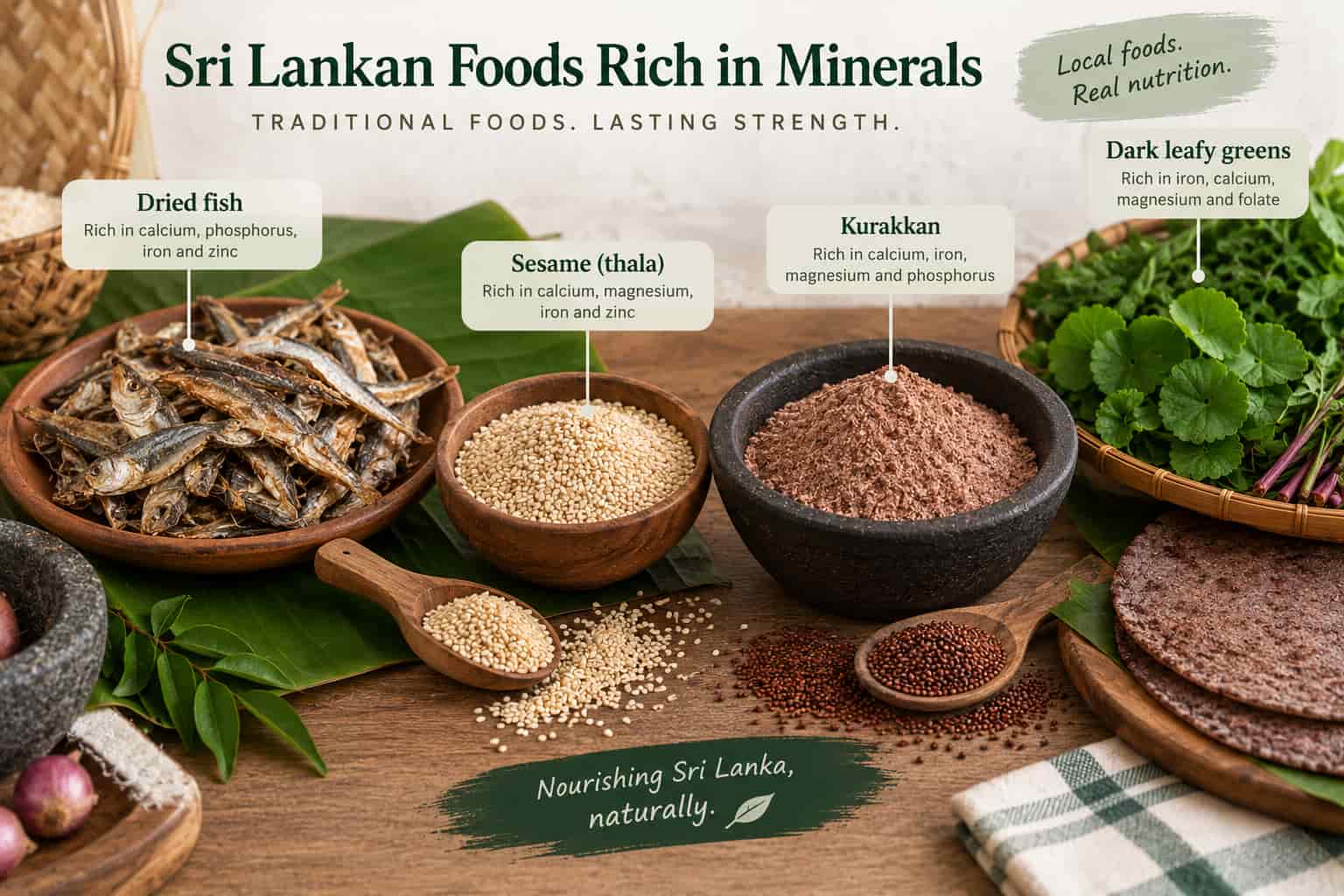
| Sprats / dried fish, whole with bones (හාල්මැස්සන්) | ~2,000mg+ (highly variable) | 15g | ~300mg+ |
| Cheese (hard, e.g. parmesan) | ~1,180mg | 30g | ~354mg |
| Gingelly seeds (තල ඇට) | ~975mg | 15g | ~146mg |
| Tofu (set with calcium sulphate) | ~350mg | 100g | ~350mg |
| Drumstick leaves (Murunga kola) | ~440mg | 20g | ~88mg |
| Kurakkan (finger millet), raw | ~344mg | 40g | ~138mg |
| Amaranth (තම්පලා) | ~215mg | 50g | ~108mg |
| Milk | ~120mg | 240ml | ~288mg |
| Curd | ~120mg | 100g | ~120mg |
| Cowpea (කව්පි), raw | ~110mg | 20g raw | ~22mg |
| Almonds | ~269mg | 30g | ~81mg |
Small dried fish eaten whole, bones included, are a genuinely underappreciated calcium source — most of a fish's calcium is in the bones, which is why this only applies when eaten whole rather than filleted. Not all tofu qualifies as a strong source — content depends on whether it was set with a calcium-based coagulant.
Selenium: a uniquely Sri Lankan double story
Adult AI: ~70µg/day (men), ~55µg/day (women)
Selenium is a trace mineral involved in antioxidant defence and thyroid hormone metabolism. Its role in activating glutathione peroxidase — one of the body's core antioxidant enzymes — ties it directly to the oxidative stress theory of ageing, and some research links low selenium status to accelerated cognitive decline in older adults, though this remains an active area of study rather than settled fact. Its content in food is determined almost entirely by local soil, which is why status varies so much by geography worldwide (the Brazil nut, grown in selenium-rich South American soil, is the classic global example — just one or two a day can approach the daily limit).
In Sri Lanka, selenium deficiency has been linked to goiter in the wet zone and studied as a possible contributing factor in chronic kidney disease of uncertain cause (CKDu) among dry-zone farmers — a condition that has drawn significant international research attention. Neither connection is fully settled, but both are worth knowing.
| Food | Selenium (per 100g) | Typical Serving | Selenium per Serving |
|---|---|---|---|
| Brazil nuts | ~1,900µg (extraordinarily high; not local) | 1–2 nuts (~5g) | ~95–190µg (can exceed daily needs) |
| Tuna | ~90µg | 100g | ~90µg |
| Sardines | ~53µg | 100g | ~53µg |
| Chicken | ~20–24µg | 100g | ~20–24µg |
| Sunflower seeds | ~53µg | 15g | ~8µg |
| Mushrooms | ~13.4µg | 80g | ~10.7µg |
| Egg | ~15µg | 1 egg | ~9µg |
Brazil nuts are included for global context, not as a Sri Lankan food — worth knowing given how easy it is to over-consume selenium from just that one food. For most Sri Lankans, fish and eggs are the practical, culturally-available sources; selenium doesn't have the same simple "eat more of X" fix as the other minerals here, since it's largely determined by regional soil.
Copper: the overlooked iron partner
Adult AI: ~1.6mg/day (men), ~1.3mg/day (women)
Copper works closely alongside iron in the body — it's required to mobilise stored iron and incorporate it into new red blood cells, which means severe copper deficiency can actually produce anaemia that looks like iron deficiency but doesn't respond to iron supplementation alone. Copper also supports connective tissue formation, nervous system function, and antioxidant defence — the enzyme copper activates for collagen cross-linking is directly relevant to skin elasticity and vascular wall integrity, both of which decline with age, making copper one of the more overlooked minerals in a longevity-focused diet despite rarely being deficient outright.
Genuine copper deficiency is uncommon globally in people eating a varied diet. The one Sri Lankan study to measure it found no significant deficiency in preschool children — a reassuring, if limited, data point. It's worth noting alongside iron and zinc mainly because the three minerals interact: excessive zinc supplementation, in particular, can interfere with copper absorption over time, a genuine consideration for anyone taking zinc supplements long-term rather than getting zinc through food alone.
| Food | Copper (per 100g) | Typical Serving | Copper per Serving |
|---|---|---|---|
| Beef liver | ~9.8mg | 30g | ~2.94mg |
| Gingelly seeds (තල ඇට) | ~4.1mg | 15g | ~0.62mg |
| Oysters (බෙල්ලන්) | ~4.5mg | 60g | ~2.7mg |
| Cashews | ~2.2mg | 30g | ~0.66mg |
| Dark chocolate (70%+) | ~1.8mg | 30g | ~0.54mg |
| Crab | ~0.8–1.2mg | 60g | ~0.48–0.72mg |
| Chickpea, raw | ~0.85mg | 20g raw | ~0.17mg |
| Lentil dhal, raw | ~0.75mg | 20g raw | ~0.15mg |
Magnesium, potassium & sodium: the everyday electrolytes
These three minerals are grouped together because they work as an interdependent system regulating fluid balance, nerve signalling, and muscle function (including the heart) — and because, unlike the minerals above, Sri Lanka-specific deficiency survey data is limited for the first two, while the concern with the third runs in the opposite direction entirely.
Magnesium (Adult AI: ~350mg men / ~300mg women) is involved in over 300 enzymatic reactions in the body, including energy production, protein synthesis, and blood sugar regulation. It's one of the more consistently studied minerals in longevity research specifically — observational studies link higher magnesium intake to better insulin sensitivity, cardiovascular health, and sleep quality, alongside lower all-cause mortality in some population studies, though as with most single-nutrient longevity findings, this is an association worth taking seriously rather than a guaranteed cause-and-effect. Global surveys suggest a meaningful share of adults in many countries fall short of magnesium targets, particularly with diets heavy in refined grains (which lose most of their magnesium during processing) and low in legumes, nuts, and leafy greens. Sri Lanka doesn't have the same depth of national survey data here as it does for iron, zinc, and calcium, but the underlying dietary pattern — a legume- and whole-grain-friendly food culture — is generally favourable, provided rice consumption doesn't crowd out these other food groups.
| Food | Magnesium (per 100g) | Typical Serving | Magnesium per Serving |
|---|---|---|---|
| Gingelly seeds (තල ඇට) | ~351mg | 15g | ~53mg |
| Almonds | ~270mg | 30g | ~81mg |
| Cashews | ~292mg | 30g | ~88mg |
| Pumpkin seeds | ~262mg | 30g | ~79mg |
| Dark chocolate (70%+) | ~228mg | 30g | ~68mg |
| Kurakkan (finger millet), raw | ~146mg | 40g | ~58mg |
| Lentil dhal, raw | ~122mg | 20g raw | ~24mg |
| Chickpea, raw | ~115mg | 20g raw | ~23mg |
| Spinach, cooked | ~87mg | 80g | ~70mg |
| Avocado | ~29mg | 100g | ~29mg |
Potassium (Adult AI: ~3,500mg/day) helps regulate blood pressure and works in balance with sodium — the ratio between the two matters as much as either number alone, and this ratio is one of the more consistently evidence-backed dietary levers for reducing stroke and cardiovascular disease risk over a lifetime, making it directly relevant to healthy longevity rather than just short-term blood pressure numbers. Bananas are the most commonly cited potassium source globally, but they're far from the richest; legumes, leafy greens, and coconut water are all comparably or more potassium-dense and more central to everyday Sri Lankan eating.
| Food | Potassium (per 100g) | Typical Serving | Potassium per Serving |
|---|---|---|---|
| Cowpea (කව්පි), raw | ~561mg | 20g raw | ~112mg |
| Avocado | ~485mg | 100g | ~485mg |
| Spinach, cooked | ~466mg | 80g | ~373mg |
| Potato, with skin | ~425mg | 100g | ~425mg |
| Kurakkan (finger millet), raw | ~408mg | 40g | ~163mg |
| Lentil dhal, cooked | ~369mg | 100g cooked | ~369mg |
| Coconut, fresh kernel | ~356mg | 30g | ~107mg |
| Banana | ~358mg | 100g | ~358mg |
| Sweet potato | ~337mg | 100g | ~337mg |
| Coconut water | ~250mg | 240ml | ~600mg |
| Yoghurt/curd | ~155mg | 100g | ~155mg |
A diet naturally higher in potassium and lower in sodium is one of the more consistently evidence-backed dietary levers for blood pressure management — worth reading alongside the sodium table below rather than in isolation.
Sodium is the one mineral in this entire article where the concern runs the opposite direction — Sri Lanka's dietary pattern, heavy on dried fish, Maldive fish, and seasoning salt, tends to run high on sodium intake rather than low. This matters for longevity specifically because chronic excess sodium intake is one of the more direct, modifiable drivers of hypertension, which in turn accelerates cardiovascular ageing and stroke risk over decades — arguably making sodium reduction one of the higher-leverage dietary changes in this entire article, not just a minor tweak. Rather than a "good sources" table, sodium is more useful shown as which everyday foods contribute the most, since the goal for most people is moderation, not increase.
| Food | Sodium (per 100g) | Typical Serving | Sodium per Serving |
|---|---|---|---|
| Table salt | ~38,758mg | 1 tsp (~5g) | ~1,938mg |
| Maldive fish / dried fish (උම්බලකඩ) | ~5,000–8,000mg (varies) | 10g (seasoning quantity) | ~500–800mg |
| Soy sauce | ~5,493mg | 15ml | ~824mg |
| Papadam | ~800–1,750mg (varies) | 30g (1–2 pieces) | ~240–525mg |
| Cheese | ~620mg | 30g | ~186mg |
| Bread | ~490mg | 60g | ~294mg |
| Milk | ~44mg | 240ml | ~106mg |
Unlike iron, zinc, calcium, and (in Sri Lanka's case) selenium, sodium is a mineral most people would benefit from eating less of, not more — the WHO recommends under 2,000mg/day, a figure the average Sri Lankan diet comfortably exceeds mainly through salt added during cooking and dried fish used as seasoning.
Other minerals, briefly
- 1Phosphorus
Deficiency is rare in any diet with adequate protein intake, given how widely distributed it is across protein-containing foods, and isn't considered a practical concern for most people.
- 2Chloride
Almost always consumed alongside sodium as part of ordinary table salt, essentially never runs short in a diet with normal salt intake, and isn't tracked separately from sodium in practical terms for most people.
- 3Fluoride
Plays a genuinely important and geographically specific role in Sri Lanka — groundwater fluoride levels vary considerably across the country, with some dry zone areas carrying naturally elevated fluoride linked to dental and skeletal fluorosis, an issue distinct from dietary intake and tied more to regional water sources than food choice.
Recommendations by population group
- 1Pregnancy
Iron is the clear priority here, given both the elevated requirement during pregnancy and the national data showing meaningful deficiency rates even before pregnancy-related demands are factored in — iron supplementation is standard antenatal care in Sri Lanka for good reason. Calcium and iodine are also worth monitoring given their roles in fetal development.
- 2Children
The national data showing high rates of both iron and calcium deficiency in children under five makes this the highest-priority group across this entire article — deliberate attention to iron-rich and calcium-rich foods during this window has outsized long-term developmental relevance.
- 3Adolescent girls
Consistently the most affected subgroup for iron specifically across nearly every study reviewed, largely due to the onset of menstruation without a corresponding increase in dietary iron intake — a genuinely actionable, specific gap to address at this life stage.
- 4Vegetarians
Zinc and iron both warrant more deliberate attention given the lower bioavailability of plant-based sources.
- 5Dry zone farming communities
Given the ongoing CKDu research connecting selenium status to this regionally concentrated condition, this is a population where medical guidance specific to local water and soil conditions is more relevant than generic national dietary advice.
- 6General / longevity-focused
Iodine is the one mineral in this article where the population-level problem has genuinely been solved — a reasonable reminder that Sri Lanka's public health interventions have a real track record of working when properly implemented, which is worth keeping in mind when thinking about the remaining gaps in iron, zinc, and calcium.
Practical notes
- →Iodine's success story is worth knowing as context — it shows a population-wide mineral deficiency can be meaningfully solved through a well-run intervention, unlike iron, zinc, and calcium, which remain genuinely unresolved gaps in Sri Lanka
- →Iron deficiency deserves the same level of everyday attention typically given to protein or vitamin gaps — it's genuinely common, not a rare or minor issue
- →Small dried fish eaten whole, bones included, are an underused calcium source — inexpensive, widely available, and easy to overlook
- →Selenium's link to both goiter and CKDu doesn't have a simple dietary fix, since it's determined largely by regional soil rather than food choice alone
- →Minerals interact with each other more than most people realise — iron and copper depend on each other, zinc supplementation can affect copper status, and sodium and potassium function as a balanced pair rather than independent numbers
Minerals work as an interconnected system more than most people realise — iron and copper depend on each other, zinc supplementation can affect copper status, and sodium and potassium function as a balanced pair rather than independent numbers. Sri Lanka's own picture within that global system is a genuine study in contrasts — a real public health win in iodine sitting alongside persistent gaps in iron, zinc, and calcium. For the related picture on vitamins, protein, and fibre, see our Vitamins, Vegetarian Protein, Protein, and Fibre articles. If you'd like a clearer picture of your own mineral status, our Longevity Doctors offer a free longevity assessment as a starting point.
Curious where your own
mineral status stands today?
Take the free Aevum Protocol assessment to see how your nutrition & metabolism and 6 other longevity domains are performing — and get a personalised 90-day plan.
Take the Free Assessment →