Nutrition & Metabolism
Hydration and Longevity: How Much
Water You Actually Need
Hydration rarely gets the same attention as protein, fibre, or vitamins in nutrition conversations, yet a landmark 2023 NIH study found it may directly influence how fast a person biologically ages. This article covers how much water the body actually needs, what happens when it falls short, and why hydration deserves a more central place in a longevity-focused diet than it usually gets.
Quick Summary
- →The "8 glasses a day" rule isn't based on strong evidence, and total water needs vary considerably by body size, climate, and activity level — official guidance (EFSA) sets adequate intake at around 2.5 litres/day for men and 2.0 litres/day for women, from all sources combined, not just plain water
- →A more personalised target can be estimated from body weight — roughly 30–35mL per kilogram per day as a baseline, adjusted upward for exercise, heat, or pregnancy — rather than relying on one fixed number for everyone
- →A landmark 2023 NIH study found that hydration status in mid-life predicted biological aging and premature mortality over a 25-year follow-up — one of the more direct pieces of evidence connecting a simple, modifiable habit to measurable ageing outcomes
- →Roughly 20% of daily water intake normally comes from food, not drinks — meaning fluid needs aren't just about how much you drink, but what you eat alongside it
- →The ability to sense thirst declines with age, making older adults more vulnerable to chronic mild dehydration without ever feeling noticeably thirsty
- →More water isn't always better — overhydration (hyponatremia) is a real, if less common, risk, particularly relevant for endurance athletes and anyone on fluid-restricted medical advice
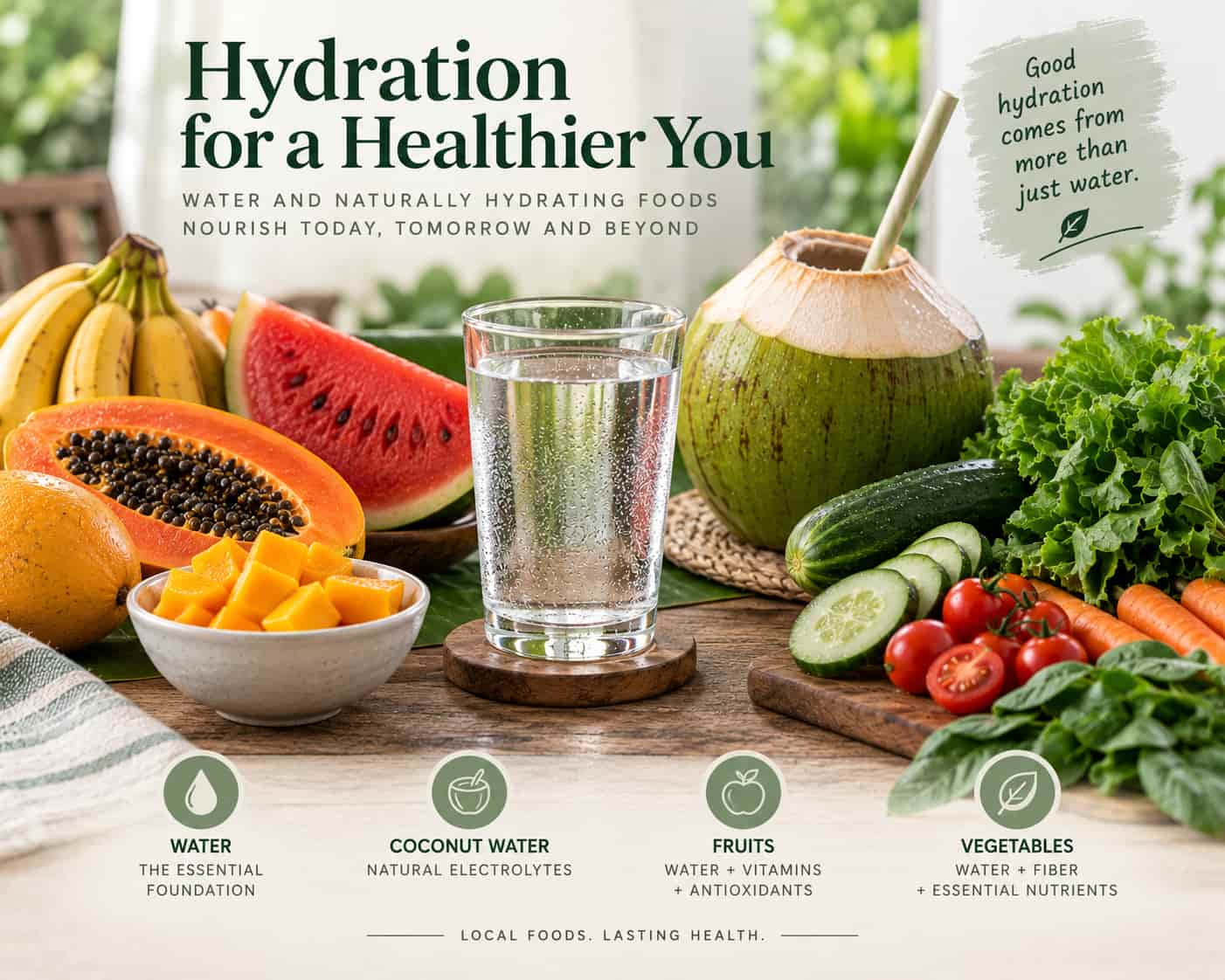
How much water do you actually need
The "drink eight glasses of water a day" rule is one of the most repeated pieces of health advice, and it doesn't have a strong scientific origin — it isn't based on a specific study, and major health bodies have moved away from prescribing one fixed number for everyone.
The European Food Safety Authority (EFSA) sets an adequate intake of around 2.5 litres/day for men and 2.0 litres/day for women — a figure that includes water from all sources, not just glasses of plain water. Roughly 20–30% of total water intake normally comes from food, particularly fruits and vegetables, meaning someone eating a produce-rich diet needs to drink somewhat less plain water to hit the same total. The Institute of Medicine's figures run higher (around 3.7 litres/day for men, 2.7 for women), largely because they're based on median intake in a population that includes people in hot climates and with high activity levels — a reminder that these numbers are population averages, not a single correct target for every individual.
These are genuinely just reference points. Individual water needs vary considerably based on body size, climate, physical activity, and diet — there's no single number correct for everyone, and thirst remains a reasonably reliable guide for most healthy adults under normal conditions.
A practical way to estimate your own target
Rather than relying on a single population-average figure, a body-weight-based formula — endorsed by the Institute of Medicine and commonly used in clinical practice — gives a more personalised starting point, before adjusting for activity and climate.
30–35mL per kilogram of body weight per day. For example, a 70kg adult would land at roughly 2.1–2.45 litres/day as a resting baseline in a temperate climate — genuinely close to the EFSA figure above, but scaled to actual body size rather than a fixed number applied to everyone regardless of how much they weigh.
From that baseline, add for the following.
- 1Exercise
Add roughly 350–700mL for every 30–60 minutes of moderate activity. A practical, more precise method for anyone exercising regularly is to weigh yourself before and after a session — each kilogram lost during exercise represents roughly a litre of fluid to replace, at a rate of about 1.2–1.5 litres of fluid per kilogram lost (replacing slightly more than what was lost accounts for ongoing losses afterward).
- 2Heat and humidity
Add roughly 10–20% to the baseline, or 500mL–1 litre, in consistently hot or humid conditions — genuinely relevant in a tropical climate, and substantially more during heavy outdoor activity in heat, where sweat losses can exceed 1–2 litres per hour.
- 3Pregnancy and breastfeeding
Add roughly 300mL during pregnancy and 700mL while breastfeeding, reflecting the additional fluid needs of both.
This formula is a genuinely useful personal starting point, not a precise prescription — the honest answer is that hydration needs are individual enough that thirst, urine colour, and how a person actually feels remain necessary real-world checks alongside any calculation.
The landmark study connecting hydration to ageing itself
In January 2023, researchers at the US National Institutes of Health published findings from a 25-year study following over 11,000 adults, using serum sodium levels as a proxy for hydration status (serum sodium concentration rises when fluid intake is lower, since there's less water to dilute it).
The finding was striking: adults with serum sodium at the higher end of the normal range in midlife were significantly more likely to show signs of accelerated biological ageing, develop chronic diseases including heart failure, dementia, diabetes, and stroke, and die at a younger age than those with sodium levels in the mid-range. People with serum sodium at or above 142 mmol/L had roughly 50% higher odds of measuring biologically older than their actual age.
The researchers were careful to note this shows an association, not proof that mild dehydration directly causes faster ageing — establishing that would require a randomised controlled trial, which hasn't been done. But the finding lines up with earlier animal research showing that lifelong water restriction in mice shortens lifespan and accelerates organ degeneration, giving the human association a plausible biological mechanism behind it. As the lead researcher put it, the results suggest proper hydration may help slow ageing and extend disease-free life — a genuinely rare thing to say about a simple, free, daily habit.
What dehydration actually does to the body
Even mild dehydration — as little as 1–2% of body weight lost as fluid — measurably affects the body before obvious thirst kicks in.
- →Cognitive performance drops. Concentration, short-term memory, and alertness all decline with even mild fluid deficits, an effect demonstrated repeatedly in controlled studies
- →Physical performance suffers. Endurance, strength, and reaction time all decline as hydration status worsens, since blood volume and thermoregulation are both affected
- →Kidney function is directly affected. Concentrated urine from insufficient fluid intake raises the risk of kidney stones, since minerals like calcium and oxalate are more likely to crystallise in less diluted urine
- →Blood pressure regulation becomes less stable, since fluid balance is closely tied to blood volume and the hormonal systems (like the renin-angiotensin system) that manage blood pressure
None of these effects require severe dehydration to appear — they show up well before the point of feeling obviously thirsty, which is part of why chronic, low-grade under-hydration can go unnoticed for years.
Hydration and the ageing body specifically
Two age-related changes make hydration a genuinely bigger concern for older adults than younger ones.
Thirst sensation becomes less reliable with age. The brain's thirst mechanism becomes less sensitive over time, meaning older adults can be meaningfully dehydrated without feeling thirsty at all — making "just drink when thirsty" poor advice for this age group specifically.
Kidney function changes reduce the ability to conserve water and regulate sodium. Ageing kidneys become less efficient at concentrating urine, which cuts both ways — older adults are at higher risk of both dehydration and overhydration compared to younger adults, making fluid balance a more delicate issue requiring more deliberate attention rather than less.
This combination is part of why dehydration in older adults is linked in multiple studies to higher rates of confusion, and some research has found dehydrated older adults carry a higher risk of dementia, while people with existing dementia are more prone to dehydration — a relationship that likely runs in both directions rather than a single cause and effect.
Electrolytes: hydration isn't just about water
Water alone doesn't tell the whole story — sodium and potassium work alongside water to regulate fluid balance throughout the body. Drinking large amounts of plain water without adequate electrolyte intake, particularly during prolonged heat exposure or intense exercise, can lead to hyponatremia — dangerously diluted blood sodium — which is a genuine medical emergency, not a minor imbalance. This is most relevant to endurance athletes and anyone doing hard physical labour in hot conditions, where sweat losses are substantial and replacing fluid without replacing electrolytes can actually make things worse rather than better.
Coconut water is a naturally occurring option that provides both fluid and a meaningful potassium content in one package, making it a reasonable choice after heavy sweating — though it's not a complete substitute for medical oral rehydration solutions in cases of significant fluid loss from illness such as diarrhoea, where sodium replacement specifically matters more than coconut water alone provides.
Climate and activity change the numbers significantly
Heat and physical activity both increase water needs substantially beyond the baseline reference figures above — sweat losses during intense exercise or heavy heat exposure can reach 1–2 litres per hour, far beyond what the standard daily intake guidelines account for. This is particularly relevant in consistently hot, humid climates, where outdoor manual labour raises genuine heat-stress and dehydration risk. In Sri Lanka specifically, this connects directly to dry-zone farming communities, where chronic heat exposure and hydration status are among the factors being studied as possible contributors to chronic kidney disease of uncertain aetiology (CKDu) — underscoring that hydration in hot climates isn't just a comfort issue, but a genuine occupational health consideration.
Signs of hydration status
Urine colour remains one of the simplest, most practical everyday indicators — pale yellow generally suggests adequate hydration, while noticeably dark yellow suggests it's time to drink more. This isn't a precise clinical measure, but it's a reasonable, free, always-available proxy for most healthy people without kidney or liver conditions that affect urine concentration independent of hydration status.
Recommendations by population group
- 1Older adults
Given reduced thirst sensation, a proactive drinking schedule — rather than waiting to feel thirsty — is genuinely more appropriate than for younger adults.
- 2Pregnancy and breastfeeding
Fluid needs increase meaningfully during both, given the additional physiological demands of supporting a pregnancy or milk production.
- 3Athletes and outdoor manual workers
Both fluid and electrolyte replacement matter, particularly in hot conditions — plain water alone during prolonged heavy sweating can risk diluting sodium levels rather than solving the problem.
- 4Those with heart failure or kidney disease
This is the one group where the general advice in this article may not apply — fluid restriction is sometimes medically necessary for these conditions, and any change to fluid intake should be guided by a treating doctor rather than general population guidelines.
- 5General / longevity-focused
Given the NIH findings on serum sodium and biological ageing, hydration is a reasonable, low-cost, evidence-supported habit worth taking seriously as part of a broader longevity strategy — not a minor afterthought compared to diet and exercise.
Practical notes
- →The "8 glasses a day" rule is a reasonable rough guide, but not a precise or universally correct target — total needs vary by body size, climate, diet, and activity level
- →Roughly a fifth of daily water intake normally comes from food, so a diet rich in fruits and vegetables genuinely contributes to hydration, not just what's drunk directly
- →The single most actionable finding from recent research is this: serum sodium levels, checked via a standard blood test, may offer a more objective window into hydration status and its long-term health implications than most people realise — worth asking about at a routine check-up
- →Older adults should drink proactively rather than relying on thirst, given the well-documented decline in thirst sensitivity with age
- →More water isn't automatically better — electrolyte balance matters alongside total fluid intake, particularly during heavy sweating or heat exposure
Hydration is one of the simplest, most overlooked levers in a longevity-focused lifestyle — not because the science is complicated, but because it's easy to assume it's already handled. The emerging research connecting hydration status to biological ageing itself suggests it deserves more deliberate attention than habit and thirst alone typically provide. For the related picture on how sodium and potassium function in the body, see our Minerals article, and for the broader nutrient picture, our Fats and Fibre articles. If you'd like a clearer picture of your own hydration and metabolic health, our Longevity Doctors offer a free longevity assessment as a starting point.
Curious where your own
hydration and metabolic health stands?
Take the free Aevum Protocol assessment to see how your nutrition & metabolism and 6 other longevity domains are performing — and get a personalised 90-day plan.
Take the Free Assessment →