Movement & Strength
Progressive Overload:
The Only Principle That Actually Builds Strength
Of everything written about how to train — rep ranges, tempo, supersets, "muscle confusion," training splits — one principle sits underneath all of it: progressive overload. Muscle and strength adapt to a demand that keeps exceeding what the tissue has already adapted to. Remove that principle and the rest of the plan is decoration. This article covers what actually drives the adaptation (mechanical tension, not hormones or "the pump"), the cellular machinery that translates a hard set into new tissue, why that machinery gets harder to switch on with age, and what this means practically for how you should progress your training.
Key numbers
| Finding | Detail |
|---|---|
| Primary hypertrophy driver | Mechanical tension — not acute hormone spikes, not metabolite ("pump") accumulation |
| Load progression vs. rep progression | Comparable hypertrophy and strength gains in controlled 8-week trial (n=43) |
| Ribosome biogenesis in older muscle | Impaired response to mechanical loading specifically; response to electrical stimulation preserved |
| Historical grounding | Progressive overload principle traces to the Milo of Croton legend; first formalized experimentally by Morpurgo, 1897 |
How it works
Mechanical tension is the trigger, not hormones or "the pump." For years, gym folklore held that the testosterone and growth hormone spike after a hard set, or the swollen, blood-filled "pump" feeling, were what actually built muscle. Neither holds up. A 2025 review in the Journal of Sport and Health Science examining load-induced hypertrophy mechanisms concluded that acute post-exercise hormonal spikes are not a meaningful driver of muscle growth, and that the pump — transient fluid and metabolite accumulation — is not a primary hypertrophy mechanism either. What actually matters is mechanical tension: the force a muscle fibre experiences while producing or resisting movement, particularly under load and through a full range of motion.
This matters for how you should think about training. It's not about how sore you got, how "pumped" you felt, or how depleted you feel afterward — it's about how much genuine mechanical tension the muscle was exposed to, and whether that tension exceeded what the tissue has already adapted to.
From tension to tissue: the mTORC1 cascade. Mechanical tension doesn't build muscle directly — it triggers a signalling cascade. Force on a muscle fibre is detected through mechanotransduction, principally via focal adhesion kinase (FAK) and PI3K/Akt signalling, which converges on a central regulatory hub called mTORC1 (mechanistic target of rapamycin complex 1). Once activated, mTORC1 drives two processes central to hypertrophy: increased muscle protein synthesis, and — critically for sustained growth — ribosome biogenesis, the manufacturing of more of the cellular machinery (ribosomes) that actually builds new proteins. Without more ribosomes, a muscle fibre hits a ceiling on how much new protein it can synthesize, however strong the initial signal. This cascade also recruits satellite cells — muscle stem cells that donate additional nuclei to growing fibres (myonuclear accretion), effectively expanding a fibre's capacity to support more contractile protein over time. This is the same mTORC1/protein-synthesis machinery discussed in our Anabolic Resistance article — progressive overload is the training input that has to clear a higher activation threshold as that resistance develops with age.
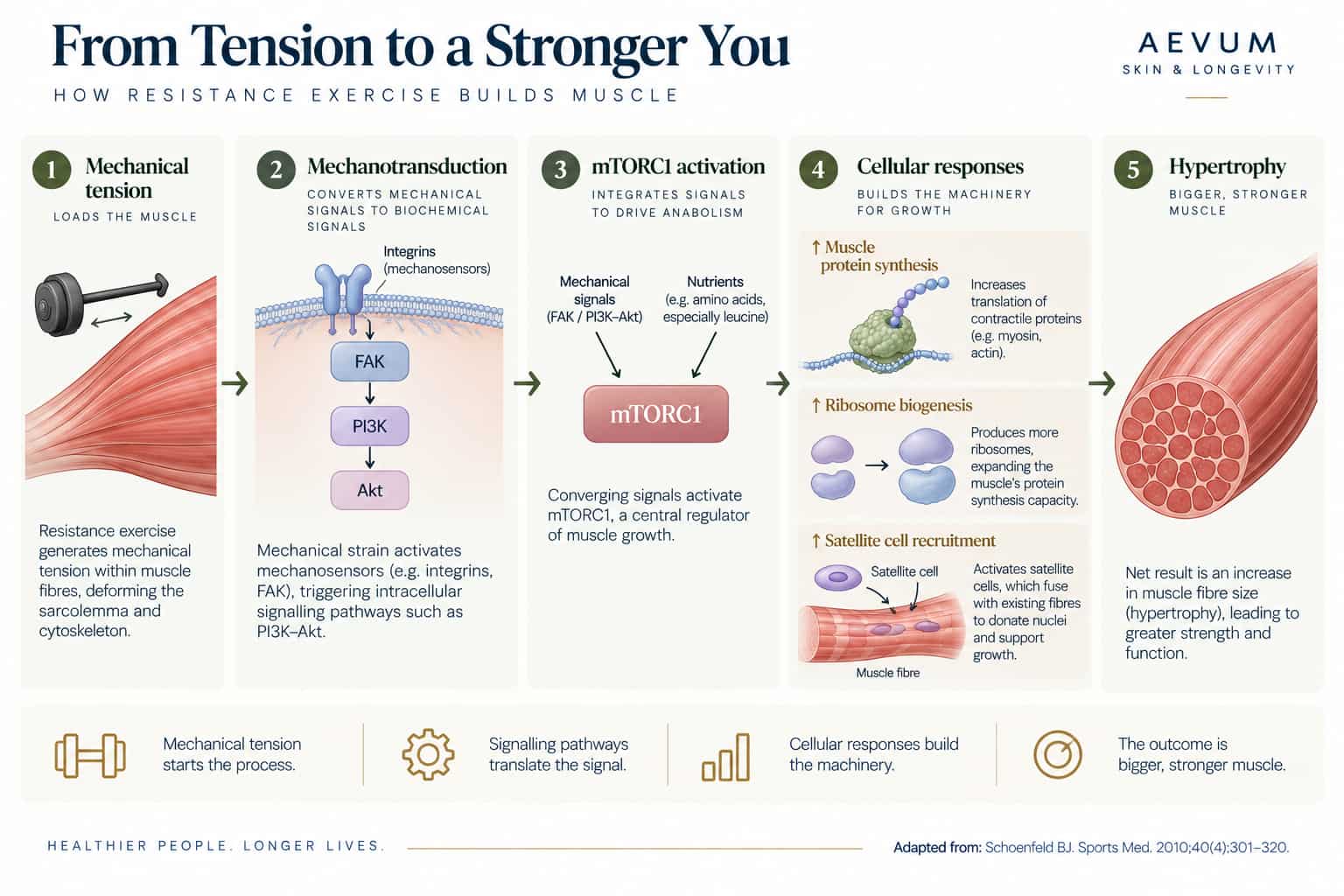
A 2023 mini-review examined why ribosome biogenesis becomes impaired in aging muscle, and the finding adds a layer of nuance to the anabolic resistance picture: aged muscle shows a blunted ribosome biogenesis response specifically to mechanical loading — impaired RNA Polymerase I-mediated transcription of ribosomal RNA, alongside blunted Akt/mTOR signalling — but this impairment was not observed in response to electrical stimulation. In other words, the aging deficit isn't a wholesale inability to build new ribosomes; it's specifically a dulled response to the mechanotransduction pathway itself. The practical read is not that electrical stimulation should replace training — it can't replicate voluntary, loaded, full-range movement — but that the finding underscores just how central mechanical tension, applied deliberately and progressively, is to overcoming age-related anabolic resistance.
Comparing methods of progressive overload
"Progressive overload" isn't one specific protocol — it's a principle that can be applied through several different variables. A controlled trial (n=43, 8 weeks) directly compared two of the most common approaches and found both produced meaningful and statistically comparable gains in hypertrophy and strength.
| Method | How it works | Best suited for |
|---|---|---|
| Load progression | Add weight to the bar over time, holding reps roughly constant | Straightforward tracking; works well once form is established |
| Rep progression | Add reps at a fixed load until hitting a rep-range ceiling, then increase load | Useful when equipment increments are large, or during technique-building phases |
| Density progression | Same load and reps, less rest between sets | Time-efficient; adds a metabolic overload dimension alongside mechanical |
| Range-of-motion progression | Deepen the range through which a lift is performed | Often overlooked; increases time under tension without adding load |
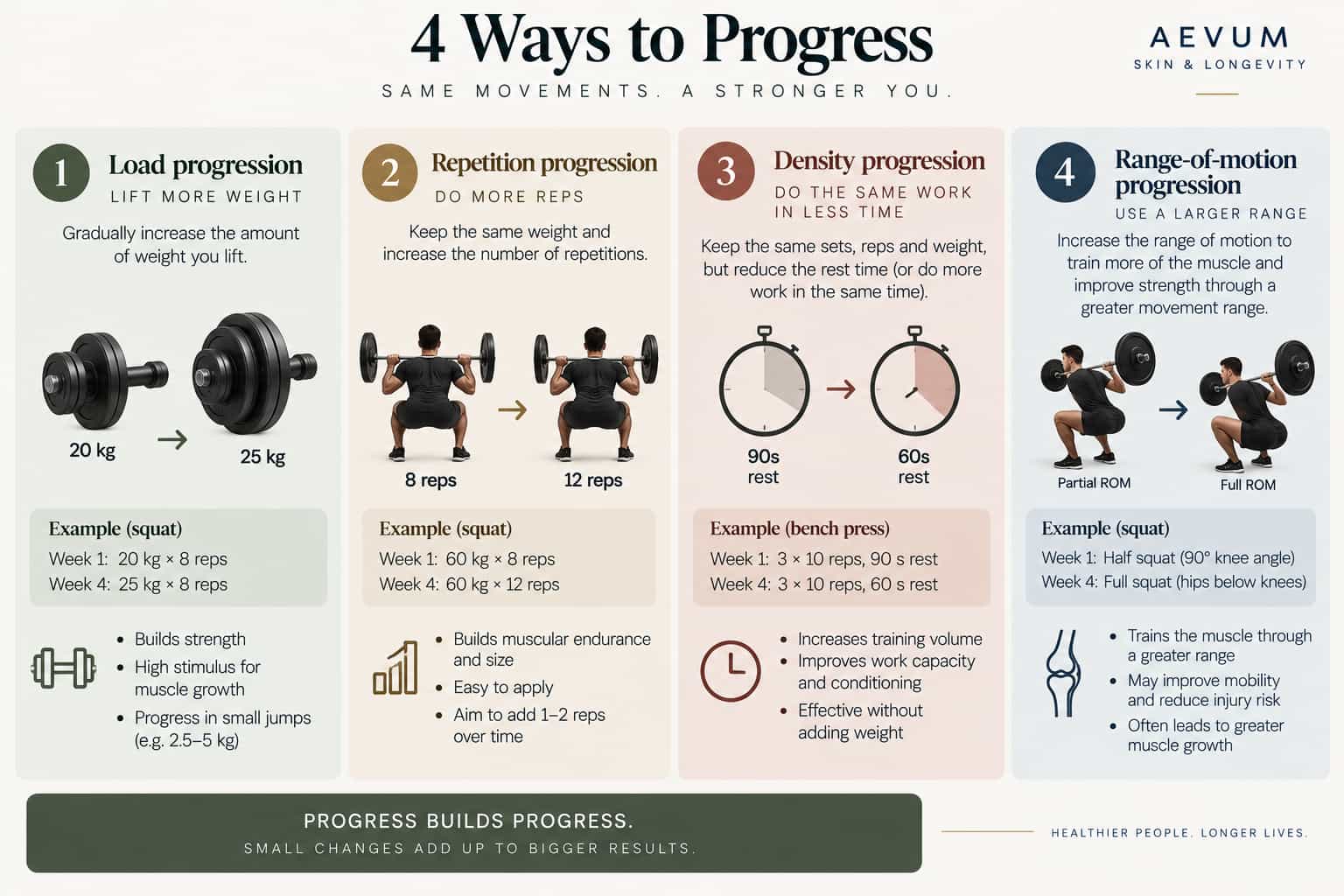
Additional supporting evidence comes from resistance-training research in animal models, where the magnitude of load-progression over a training block correlated directly with the degree of muscle hypertrophy achieved — reinforcing that it's the progressive nature of the stimulus, not any single method of applying it, that predicts the outcome.
How to actually train
- →Track something, every session. It doesn't need to be complicated — a simple log of weight × reps × sets for your main lifts is enough to know whether you're actually progressing or just repeating the same session indefinitely
- →Progress in small increments. The oldest mistake in resistance training is trying to add too much too fast. A rule of thumb used across strength programming: once you can complete all prescribed sets and reps with good form and 1-2 reps still in reserve, it's time to add load — often as little as 2.5-5% for upper body lifts, slightly more for lower body
- →Rotate which variable you progress. If load progression stalls (a plateau is normal, not a failure), switch to rep progression, tighten your range of motion, or reduce rest periods for a few weeks before returning to adding load
- →Don't confuse fatigue with progress. Training to the point of extreme soreness or exhaustion isn't the same as progressive overload, and it isn't a proxy for it. The tension on the muscle during the lift, not the soreness afterward, is what drives adaptation
Recommendations by training level
- 1New to resistance training
Focus on learning correct movement patterns before prioritizing load. Rep progression (adding reps within a target range before adding weight) is often the safer starting point.
- 2Intermediate (6 months-2 years consistent training)
Load progression on your primary compound lifts (squat, hinge, press, pull patterns) becomes the main driver; expect progress to slow and require more deliberate planning.
- 3Experienced/older trainees
Progress may come more slowly and plateaus more often, consistent with the anabolic resistance and blunted mechanotransduction signalling discussed above — but the underlying principle doesn't change. Smaller, more consistent increments, and rotating between load, rep, and range-of-motion progression, tend to work better than large jumps.
Practical notes
It's worth noting that the fundamental principle of progressive overload applies across the full spectrum of trainees, including those using performance-enhancing substances such as anabolic steroids or testosterone replacement therapy — elevated androgen levels allow for a faster rate of progression and greater ultimate capacity, but they don't change the underlying mechanism; progressive mechanical tension is still what's driving the adaptation. Similarly, relative (proportional) strength and hypertrophy gains from a well-structured progressive program are broadly comparable between men and women, even though absolute numbers differ. Progressive overload is also the training-side counterpart to our Anabolic Resistance article — it's the mechanical input that has to work harder against the biological resistance described there.
How are you currently
progressing your training?
Take the free Aevum Protocol assessment to see how your movement & strength and 6 other longevity domains are performing — and get a personalised 90-day plan.
Take the Free Assessment →