Movement & Strength
Functional Fitness:
Training for the Movements Real Life Actually Demands
"Functional fitness" gets used loosely in gym marketing, but the underlying idea is genuinely useful: training the fundamental movement patterns — squatting, hinging, pushing, pulling, carrying, and rotating — that daily life and long-term independence actually depend on, rather than training muscles in isolation. This guide breaks down what those patterns are, a striking piece of evidence on how a simple floor-based test predicts mortality, and how to prioritize functional training differently depending on your life stage.
Key numbers at a glance
| Finding | Detail |
|---|---|
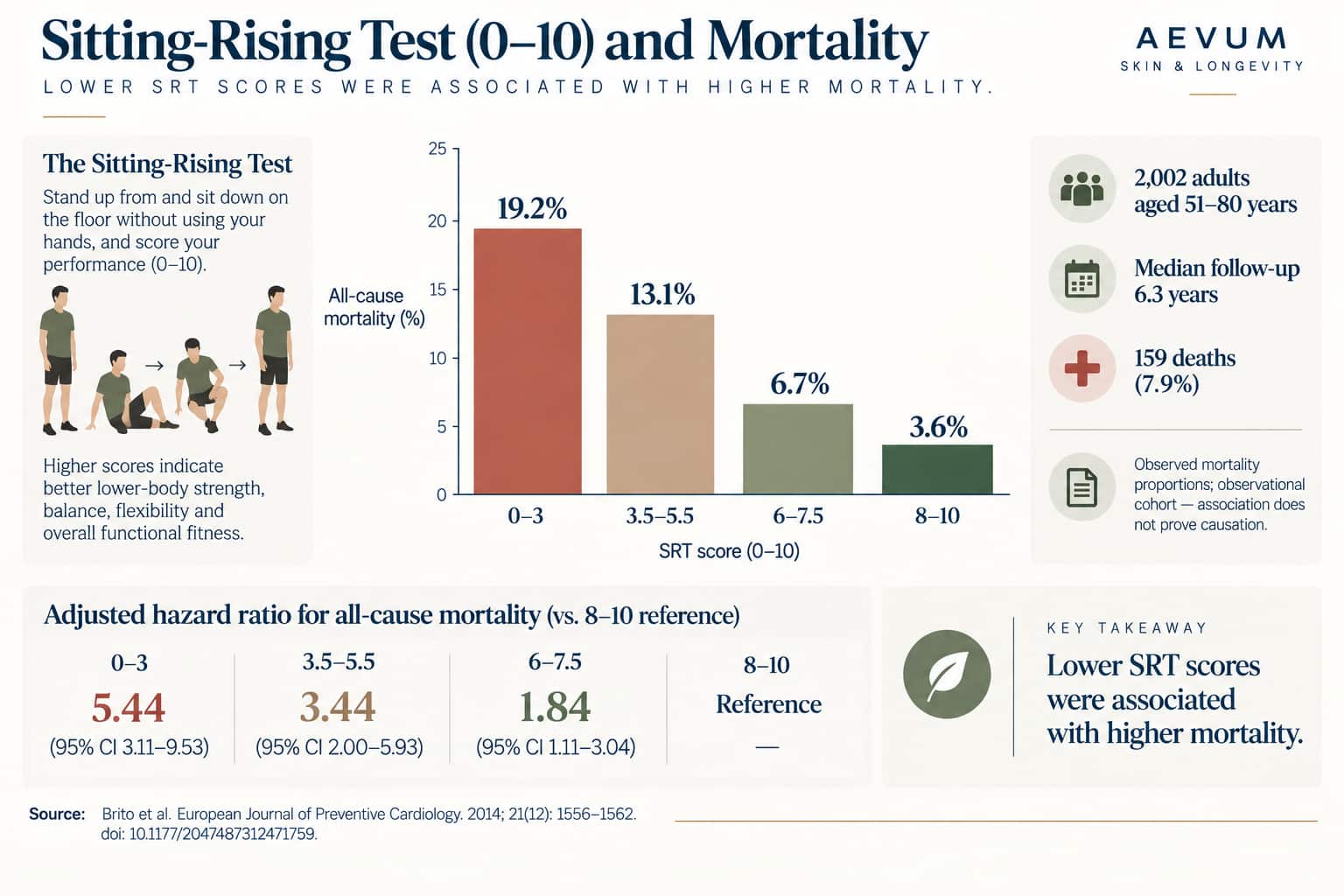
| Sitting-rising test (SRT), lowest vs. highest score group | Mortality risk 5.44x higher (adjusted hazard ratio), 19.2% vs. 3.6% mortality over median 6.3-year follow-up |
| Per-point SRT improvement | Each 1-point increase in SRT score associated with a 21% reduction in all-cause mortality |
| Sample size | 2,002 adults, ages 51-80, followed for up to 13.9 years |
What functional fitness actually means
Functional training centers on a small set of fundamental movement patterns that underpin nearly all real-world physical tasks:
- 1Squat
Sitting down and standing up, lifting something from the floor.
- 2Hinge
Bending at the hips (picking something up, loading a dishwasher).
- 3Push
Pushing a door open, pushing yourself up from the floor.
- 4Pull
Pulling a drawer, pulling yourself up, rowing a bag onto a shelf.
- 5Carry
Walking while holding weight (groceries, a suitcase, a child).
- 6Rotate/anti-rotate
Twisting to reach something, resisting a twisting force while carrying an uneven load.
- 7Single-leg/gait
Walking, stair climbing, stepping over an obstacle — anything requiring one-leg stability and control.
The case for training these patterns directly, rather than only isolating individual muscles, is that they transfer more directly to the physical demands of daily life and to the specific capacities — getting up off the floor, carrying groceries up stairs, catching yourself on a stumble — that actually determine independence as you age.
What the evidence shows
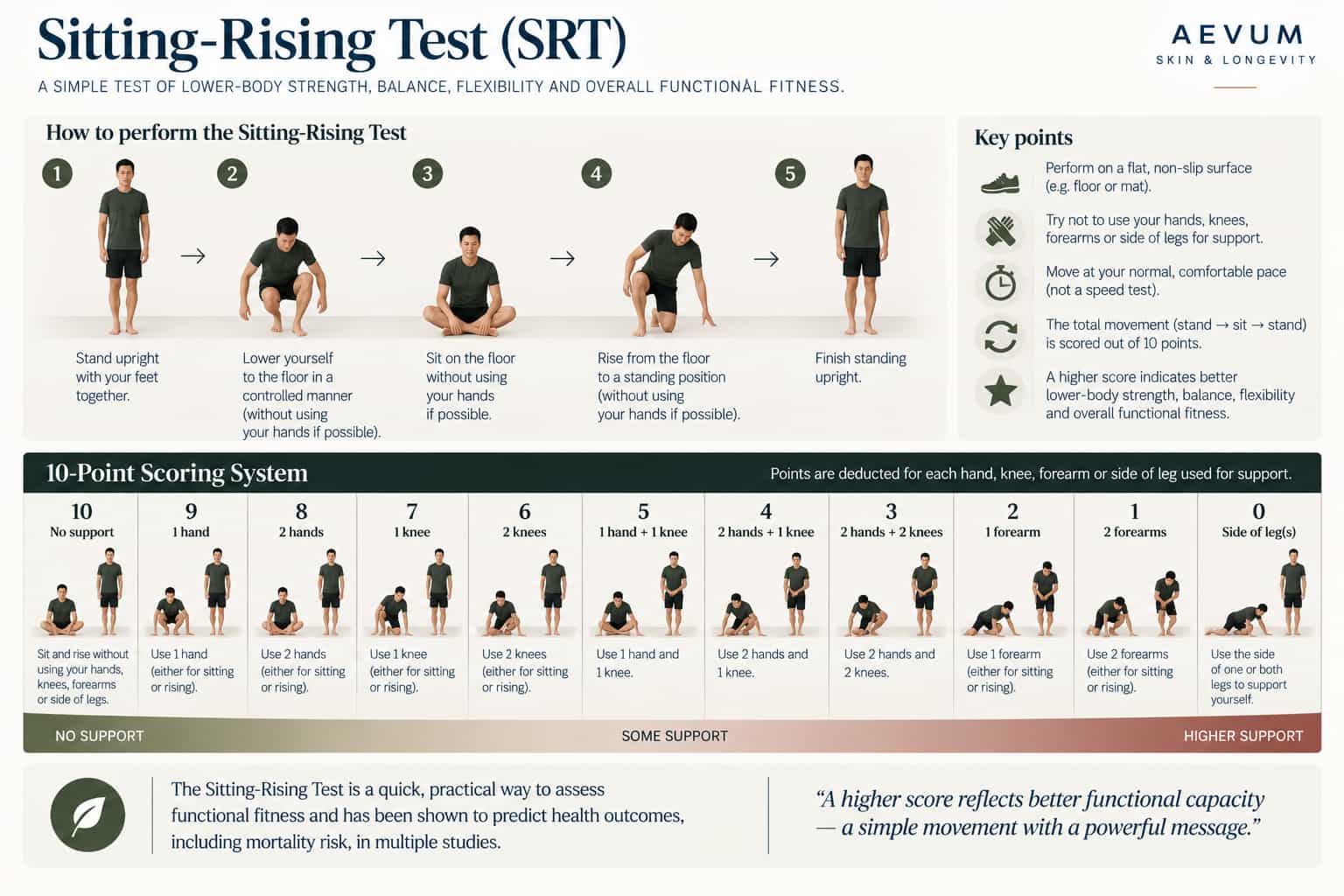
The sitting-rising test: a striking, low-tech predictor. One of the clearest pieces of evidence in this space comes from a study of 2,002 adults (ages 51-80) who performed the sitting-rising test (SRT): sitting down from standing, then rising back up, using the fewest possible points of support (hands, knees, forearms) along the way, scored out of 10 total points.
Followed for a median of 6.3 years, those in the lowest scoring band (0-3 out of 10) had a mortality rate more than five times higher than those in the highest band (8-10) — 19.2% vs. 3.6% — even after adjusting for age, sex, and BMI. Each single point of improvement on the SRT scale was independently associated with a 21% reduction in all-cause mortality risk. Like the single-leg balance test covered in our Balance and Fall Prevention article, this is very likely a marker of broader combined strength, balance, flexibility, and coordination — but as a five-minute, zero-equipment self-assessment, it's a genuinely useful one.
Functional training and real-world transfer. Beyond the SRT specifically, the broader case for functional training is more about task transfer than any single dramatic statistic: training a loaded carry builds the specific strength and postural control that directly maps onto carrying groceries or luggage; training a floor-to-standing sequence directly maps onto recovering from a fall or playing on the floor with grandchildren. This is a genuinely different training emphasis from bodybuilding-style isolation work, even though both approaches build real strength — functional training specifically prioritizes movements that mirror life's actual physical demands.
Recommendations by life stage and scenario
- 1Young adults building a training foundation
Functional movement patterns are a sensible organizing framework for general strength training at any age — squats, hinges (deadlifts), pushes, pulls, and carries cover most of what a well-rounded strength program needs anyway. There's no need to specifically brand this "functional training" at this stage; it largely overlaps with good general strength programming.
- 2Midlife (40s-50s): start testing and addressing gaps directly
This is a good window to self-test with the sitting-rising test and take the result seriously if it's low — a poor score here is an early, actionable signal rather than something to wait on. If getting up and down from the floor smoothly is already difficult, it's worth training that specific movement pattern directly (practicing controlled floor transitions, working on hip and ankle mobility alongside strength) rather than assuming general fitness will fix it incidentally.
- 3Older adults (60+): prioritize the patterns that preserve independence
At this stage, functional training deserves explicit priority over more isolated or aesthetic-focused training goals. The specific patterns worth emphasizing: sit-to-stand practice (directly training the movement behind getting out of a chair or off the floor), loaded carries (grip and postural endurance for groceries and daily tasks), and step-ups or stair-focused work (the movement pattern behind one of the most common daily fall-risk scenarios). Pairing this with the balance-specific training in our Balance and Fall Prevention article covers the two areas with the strongest independence-preserving evidence behind them.
- 4Anyone who struggles with a specific daily task
If a specific movement — getting off the floor, carrying groceries upstairs, standing up from a low chair — is genuinely difficult in daily life, the most direct fix is practicing a regressed, safer version of that exact movement pattern regularly, rather than assuming unrelated general exercise will transfer to it. Specificity matters more here than in general fitness goals.
Practical notes
The sitting-rising test above is worth doing right now, not just reading about — it takes under a minute and gives an immediate, concrete sense of where you stand. If the score is lower than you'd like, that's a more useful starting point for this article's advice than any general recommendation: practice the sit-to-rise pattern itself, a few times a week, alongside the general strength and balance training covered elsewhere in this series.
How does your functional fitness
score on your longevity assessment?
Take the free Aevum Protocol assessment to see how your movement & strength and 6 other longevity domains are performing — and get a personalised 90-day plan.
Take the Free Assessment →Related articles
Movement & Strength
The floor rise test: what getting up from the ground reveals about your longevity
Movement & Strength
Balance and Fall Prevention: A Life-Stage Guide to Staying On Your Feet
Movement & Strength