Movement & Strength
Balance and Fall Prevention:
A Life-Stage Guide to Staying On Your Feet
Balance training rarely gets the attention resistance and cardio training do, but the data behind it is striking: a simple 10-second single-leg stance test predicts mortality risk in middle-aged and older adults, and structured balance exercise is one of the few interventions with high-certainty evidence for actually reducing falls. This guide walks through why balance declines with age, what a genuinely predictive balance test looks like, and what to actually do about it — organised by life stage, since the right approach and urgency differ meaningfully depending on where you are.
Key numbers at a glance
| Finding | Detail |
|---|---|
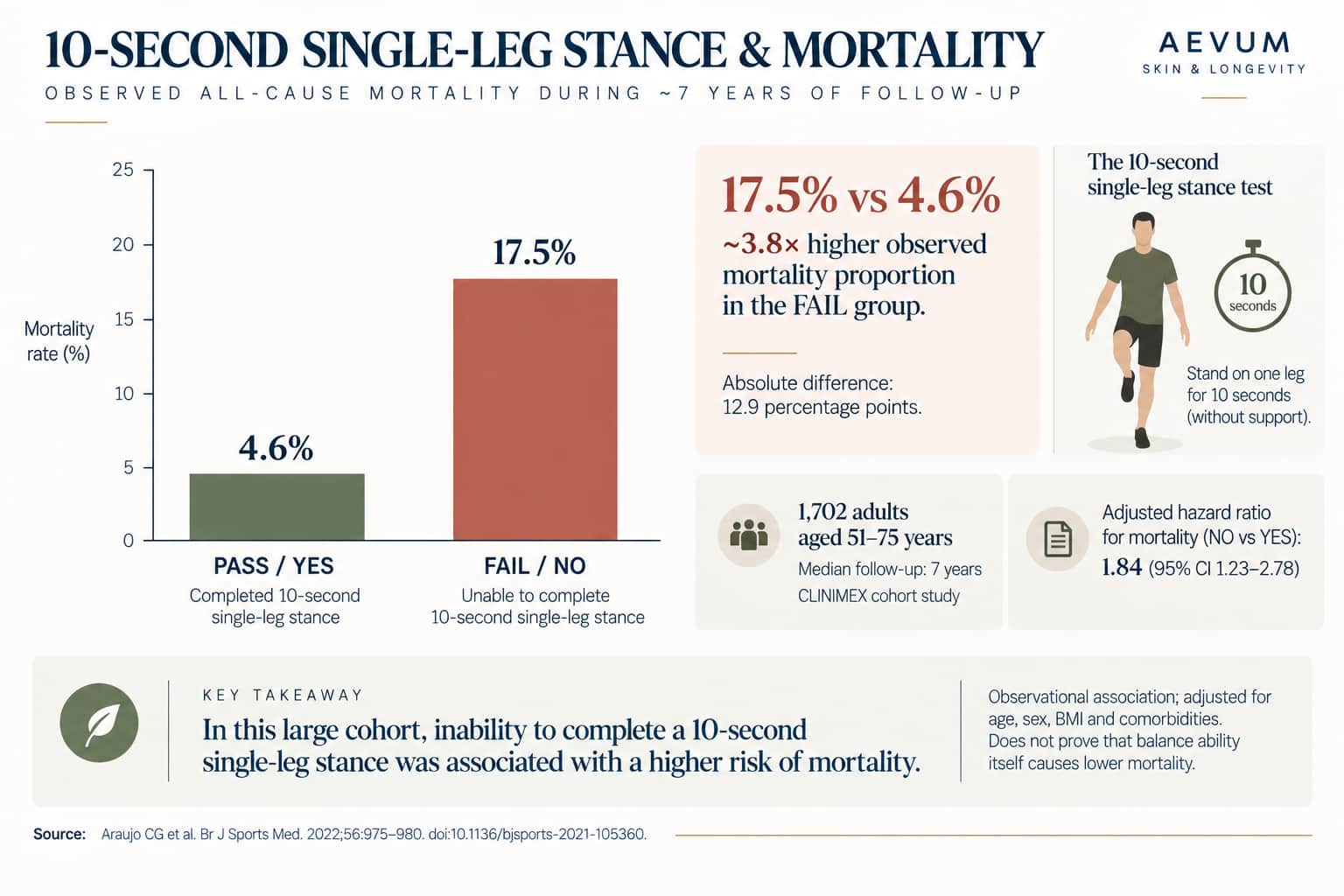
| 10-second single-leg stance test, failure rate | 20.5% of a 1,702-person cohort (ages 51-75) failed the test |
| Mortality association | Test failure associated with an 84% higher risk of all-cause mortality over ~7 years follow-up, adjusted for age, sex, and health conditions |
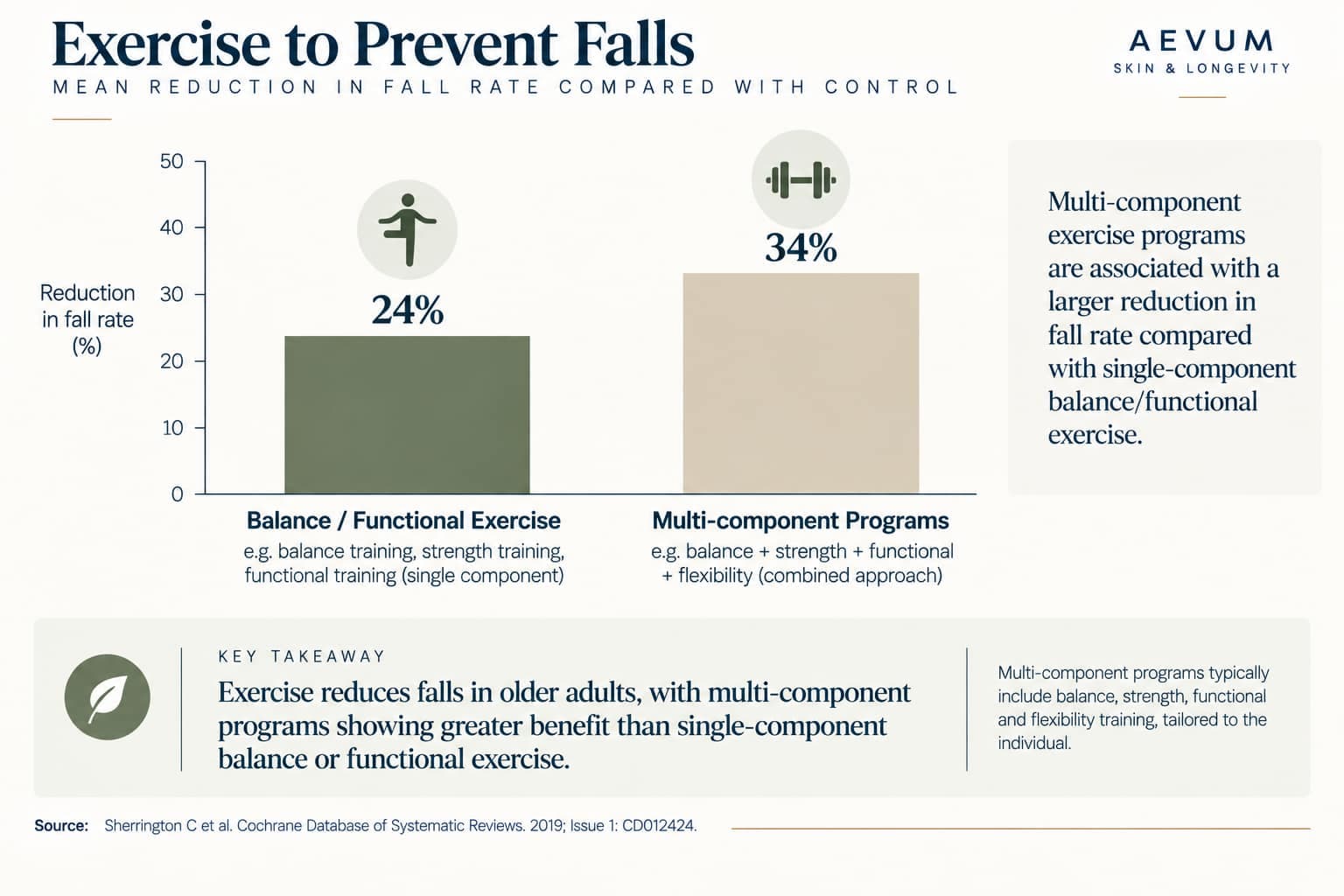
| Balance/functional exercise and fall rate (Cochrane, 108 RCTs, 23,407 participants) | 24% reduction in fall rate (high-certainty evidence) |
| Multi-component programs (balance + functional + resistance) | ~34% fall rate reduction (moderate-certainty evidence) |
Why balance declines with age
Balance depends on the integration of three sensory systems — vision, the vestibular system (inner ear), and proprioception (position sense from muscles, joints, and skin) — combined with fast, coordinated muscular responses to correct sway before it becomes a fall. Each of these inputs degrades somewhat with age: proprioceptive sensitivity declines, vestibular function weakens, and the neuromuscular speed needed to correct a stumble slows. This compounds with the muscle loss covered in our Muscle Mass article — weaker stabilising muscles mean a smaller margin for error when balance is challenged.
Unlike strength or cardiorespiratory fitness, balance is a specific, trainable skill that doesn't automatically improve just because you're doing resistance training or cardio — it needs its own deliberate practice.
What the research shows
A simple test with real predictive power. A 2022 study published in the British Journal of Sports Medicine followed 1,702 adults aged 51-75 in Brazil for an average of 7 years, testing their ability to balance on one leg, unassisted, for 10 seconds. Just over one in five participants (20.5%) failed the test. After adjusting for age, sex, and underlying health conditions, failing the test was associated with an 84% higher risk of death from any cause over the following decade — a striking finding for such a simple, zero-equipment assessment.
This doesn't mean poor balance directly causes death — it's more likely a marker of broader physiological decline (reduced muscle strength, impaired neuromuscular coordination, underlying health conditions) that also independently raises mortality risk. But as a quick, practical screening tool, it's hard to beat for simplicity.
Exercise genuinely reduces falls — but the type matters. A major Cochrane review pooling 108 randomised controlled trials (23,407 participants, average age 76, 77% women) found high-certainty evidence that balance and functional exercise programs reduce fall rates by 24%. Programs combining balance, functional, and resistance training together showed an even larger effect (~34% reduction), though with moderate rather than high certainty. Notably, the review found resistance training alone, walking programs alone, and dance programs alone lacked sufficient evidence to draw firm conclusions — the protective effect is specifically tied to programs that include a genuine balance-training component, not just general physical activity.
Test your own balance
- Stand near a wall or sturdy surface for safety (not to hold onto during the test itself)
- Lift one foot off the ground, without touching the other leg, and start timing
- Hold the position without putting your foot down, hopping, or needing to grab support
- Try both legs. If you can't comfortably hold 10 seconds on each side without support, this is a genuine signal to start balance-specific training — not just something to note and move past
Recommendations by life stage
- 1Under 40: build the habit early
Balance training isn't urgent at this age from a fall-risk standpoint, but establishing it as a regular habit — even 5-10 minutes a few times a week — builds a skill and body awareness that pays off decades later. Single-leg exercises incorporated into a regular strength routine (single-leg deadlifts, split squats, step-ups) serve double duty for strength and balance simultaneously.
- 240-60: this is where decline often starts, unnoticed
Balance typically begins a measurable decline in this range, often before it's subjectively noticeable in daily life. This is a good window to start testing yourself periodically (the 10-second test above) and to add dedicated balance work — single-leg standing variations, tandem walking, controlled instability work — alongside ongoing resistance training.
- 360+: balance training becomes a genuine priority
Given the Cochrane review's findings, this is the age range where structured balance and functional exercise programs have the strongest evidence behind them for actually preventing falls, not just improving balance test scores. A program combining balance work with resistance training (multi-component, per the ~34% reduction finding) is well supported over any single approach in isolation. Tai Chi is a reasonable, lower-certainty-but-plausible option for those who prefer a structured, low-impact format.
- 4Anyone with a recent fall or near-fall
A fall or near-fall at any age is worth treating as a genuine signal rather than dismissing as a one-off — it often indicates an underlying balance, strength, or vision issue worth addressing directly, and for older adults in particular, formal fall-risk assessment through a doctor or physiotherapist is a reasonable next step rather than self-directed training alone.
Practical notes
Balance training works best as a complement to the resistance and cardiovascular training covered elsewhere in this series, not a replacement for either — the Cochrane data specifically found the strongest effects from programs that combined balance work with other exercise types. If you failed the 10-second stance test above, that's a more useful immediate action item than any single statistic in this article: start there, and build from it.
How does your balance
score on your longevity assessment?
Take the free Aevum Protocol assessment to see how your movement & strength and 6 other longevity domains are performing — and get a personalised 90-day plan.
Take the Free Assessment →