Movement & Strength
Bone Density and Resistance Training:
Why Lifting Heavy Protects Your Skeleton
Bone is living tissue that responds to mechanical demand the same way muscle does: load it enough, and it adapts by getting denser and stronger; leave it unloaded, and it quietly resorbs itself. After menopause and through the decades of aging, bone loss accelerates — but the best-studied countermeasure isn't calcium supplements or walking, it's heavy resistance training. This article covers the mechanism behind bone adaptation, what a landmark trial in postmenopausal women with low bone mass actually found, and how to train for bone density specifically.
Key numbers at a glance
| Finding | Detail |
|---|---|
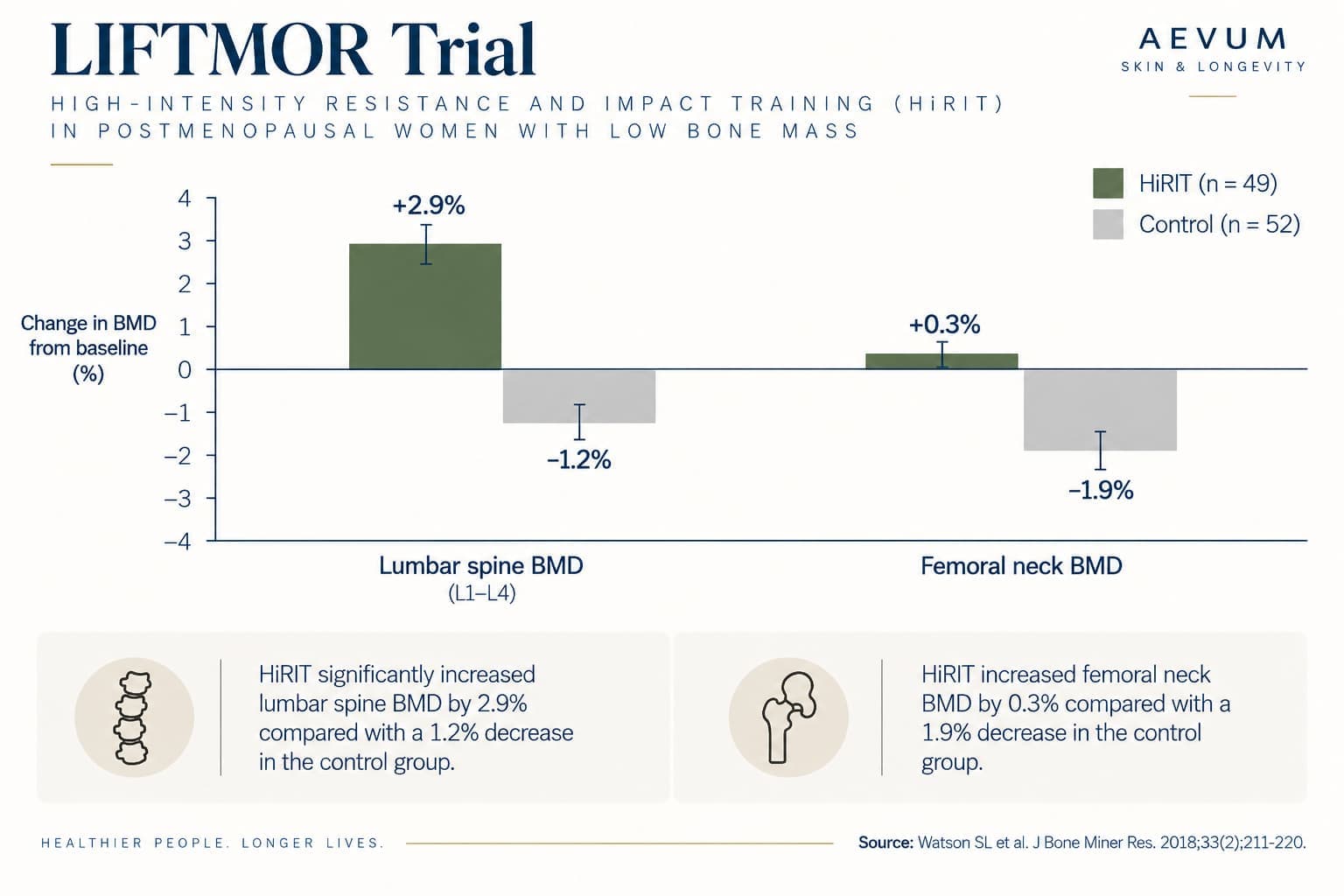
| LIFTMOR trial, lumbar spine BMD | +2.9% (HiRIT group) vs. -1.2% (control) over 8 months |
| LIFTMOR trial, femoral neck BMD | +0.3% (HiRIT group) vs. -1.9% (control) over 8 months |
| LIFTMOR trial, safety | 1 mild muscle strain across 2,600+ training sessions; no fractures, no serious injuries |
| Meta-analysis (17 RCTs, 690 women) | Largest effects at ≥70% 1RM intensity, training 3x/week, programs ≥48 weeks |
How it works
Bone is a living, load-responsive tissue. Bone remodels constantly through the coordinated activity of osteoclasts (which resorb old bone) and osteoblasts (which build new bone). This process is governed by what's often called the "mechanostat" — a regulatory system, first described by Harold Frost, in which osteocytes embedded within bone sense mechanical strain and signal whether to add or remove bone mass accordingly. Below a certain strain threshold, bone is resorbed faster than it's replaced. Above that threshold, bone formation is favoured. This is the physiological basis of Wolff's Law: bone adapts its structure to the loads placed on it.
The practical implication is that not all physical activity loads bone the same way. Walking and most steady-state cardio produce relatively low peak forces on the skeleton. Resistance training — particularly heavy, compound, weight-bearing lifts — produces substantially higher peak mechanical strain, which is what pushes bone past the threshold needed to trigger new bone formation rather than simply maintaining the status quo.
Why this matters more after menopause. Estrogen has a protective, brake-like effect on osteoclast activity. Its decline after menopause removes that brake, and bone resorption accelerates relative to formation — the reason postmenopausal women are the population most studied, and most at risk, in bone density research. This doesn't mean resistance training for bone health is only relevant after menopause; peak bone mass, built during younger adulthood, sets the starting point that later decades draw down from.
What the research shows
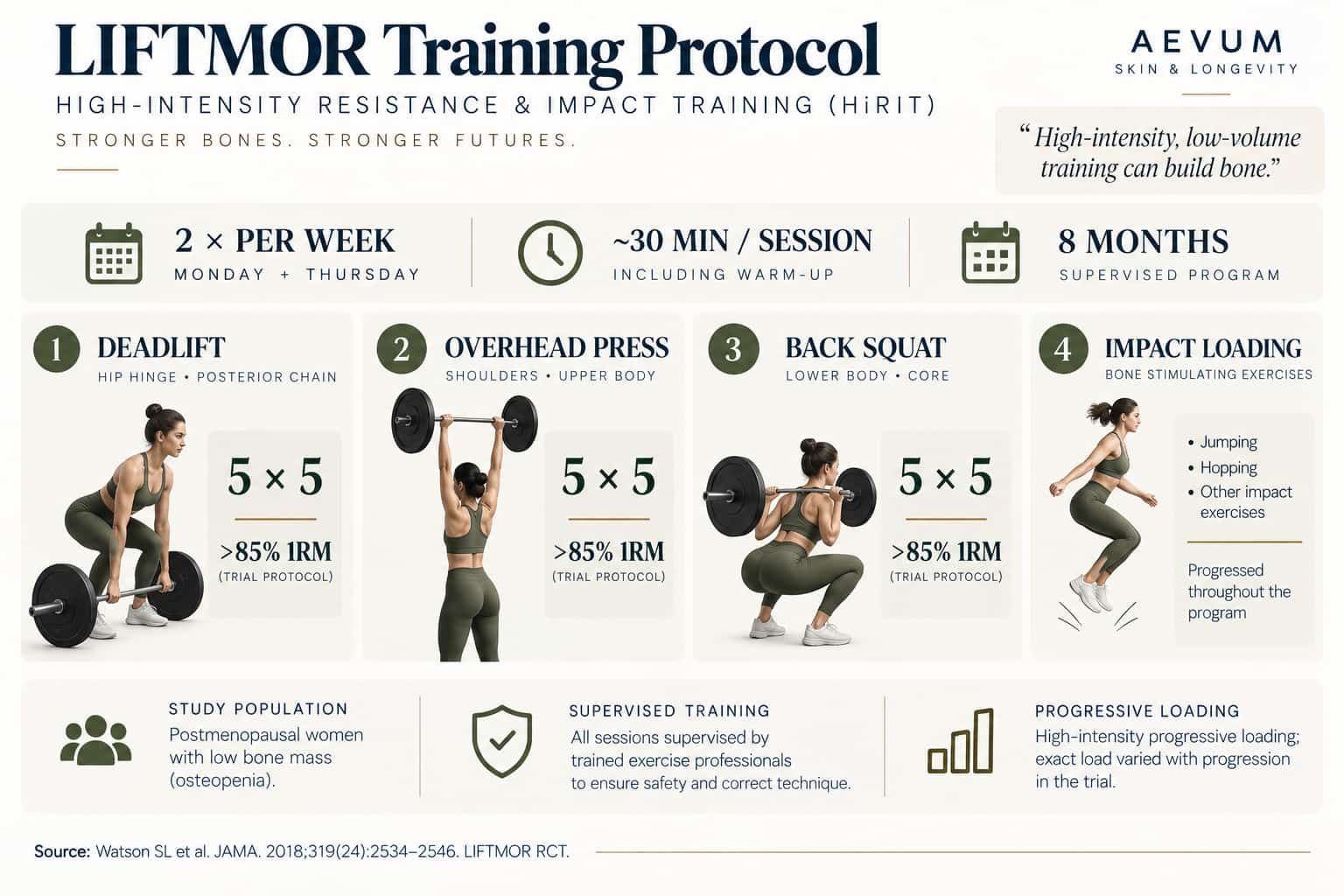
The LIFTMOR trial. The most influential trial in this space is LIFTMOR (High-Intensity Resistance and Impact Training), which randomized 101 postmenopausal women with low bone mass (osteopenia or osteoporosis) to either 8 months of twice-weekly, supervised high-intensity resistance and impact training (HiRIT) or a home-based low-intensity exercise control.
The HiRIT protocol used compound, heavy-loaded lifts — deadlifts, overhead presses, and back squats — performed at over 85% of one-repetition maximum (1RM) for 5 sets of 5 repetitions, alongside jumping and drop-landing impact exercises. This is meaningfully heavier and more demanding than the light-resistance, high-repetition programs often recommended to older adults out of caution.
The results: lumbar spine BMD increased by 2.9% in the HiRIT group versus a decrease of 1.2% in controls, and femoral neck BMD increased by 0.3% versus a decrease of 1.9% in controls — both statistically significant differences. The HiRIT group also gained height on average (+0.2cm vs. -0.2cm in controls), consistent with improved vertebral integrity and posture.
Critically for a population often steered away from heavy lifting out of fracture fear: across more than 2,600 individual training sessions, only one adverse event was recorded — a mild low-back strain that resolved within a week. No fractures and no serious injuries occurred in the trial.
What intensity and frequency work best. A more recent systematic review and meta-analysis pooling 17 randomized controlled trials (690 postmenopausal women) found that training at ≥70% of 1RM, performed three times per week, over programs lasting at least 48 weeks, produced the largest and most consistent bone density gains — particularly at the femoral neck and total hip. Lower-intensity programs showed smaller, less consistent effects. This reinforces the LIFTMOR finding: bone specifically responds to genuinely heavy loading, not light resistance work.
Comparing approaches
| Approach | Effect on bone density | Notes |
|---|---|---|
| Walking / light cardio | Minimal to none | Low peak mechanical strain; good for cardiovascular health, not a bone-loading stimulus |
| Light-resistance, high-rep training | Small | Below the intensity threshold most strongly associated with bone gains in the research above |
| Heavy resistance training (≥70-80% 1RM) | Meaningful, measurable | The intensity range used in LIFTMOR and identified as optimal in pooled trial data |
| Resistance + impact training | Largest effect observed | LIFTMOR combined heavy lifting with jumping/impact work |
How to actually train
- →Prioritise compound, loaded lifts. Deadlifts, squats, and overhead presses load the spine and hips directly — the sites most relevant to fracture risk — more effectively than isolation exercises or machines
- →Train genuinely heavy. The research consistently points to ≥70% of 1RM as the threshold that matters for bone, not just muscle. This is a meaningfully different intensity than the light-band, high-repetition programs sometimes prescribed for older adults
- →Be consistent for the long term. Programs of 48 weeks or longer showed the clearest effects at the hip; bone remodels slowly, and shorter programs are less likely to show measurable change on a DEXA scan
- →Get supervised instruction if you're new to heavy lifting or have low bone mass. The LIFTMOR protocol's safety record was achieved under close professional supervision with careful technique coaching — not an argument against heavy training, but a case for learning it properly first, especially with an existing osteoporosis or osteopenia diagnosis
Recommendations by risk level
- 1Healthy adults building peak bone mass (20s-30s)
Include heavy compound lifts as a standing part of training; this is the window where peak bone mass is established and later decades draw down from it.
- 2Perimenopausal/postmenopausal women without a diagnosis
Heavy resistance training 2-3x/week is a reasonable, well-supported preventive strategy; a baseline DEXA scan can help track change over time.
- 3Existing osteopenia or osteoporosis diagnosis
The LIFTMOR protocol specifically demonstrated safety and benefit in this population, but supervised instruction and, ideally, physician clearance are appropriate first steps given individual fracture risk factors.
Practical notes
Resistance training for bone density works alongside, not instead of, the other training principles covered in this series: bone, like muscle, needs a mechanical demand that increases over time to keep adapting, and because muscle and bone respond to loading through related but distinct mechanisms, the muscle-preserving case for resistance training made in our Muscle Mass article reinforces the same underlying prescription — consistent, adequately heavy resistance training, sustained over years, not weeks.
How does your bone health
score on your longevity assessment?
Take the free Aevum Protocol assessment to see how your movement & strength and 6 other longevity domains are performing — and get a personalised 90-day plan.
Take the Free Assessment →Related articles
Movement & Strength
Muscle Mass and Longevity: Why Sarcopenia Is an Aging Problem, Not Just a Bodybuilding One
Movement & Strength
The floor rise test: what getting up from the ground reveals about your longevity
Movement & Strength