Nutrition & Metabolism
Know Your Rice: Understanding White,
Brown, Red & Black Rice in the Sri Lankan Context
Rice (හාල් / බත්) is the most eaten food in Sri Lanka, yet the terminology around it confuses most people — including many of us who eat it daily. Is "brown rice" a variety, or just white rice left unmilled? Is red rice the same thing as brown rice with a different name? Can red rice ever become white rice? This article answers those questions properly, then walks through the actual rice varieties and types available locally — with nutrition profiles and Sinhala names for each.
Quick Summary
- →"Brown," "red," and "black" describe bran colour, not separate crops — brown rice is any ordinary variety left unmilled; red and black rice come from genetically distinct, specially bred varieties
- →Nadu and Samba are parboiled by market default; Kekulu is never parboiled — that's the real distinction behind these trade names, more than colour
- →Rice colour doesn't reliably predict glycaemic index — a variety's amylose content matters more. Basmati is white rice with a low-to-medium GI (50–58) purely because of its starch composition
- →Parboiled red rice is the best-evidenced option for blood sugar management, backed by a Sri Lanka-specific study — but portion size still matters as much as rice type
- →Cooling and reheating cooked rice, and pairing it with protein or fibre, lowers its glycaemic impact regardless of which type you're eating
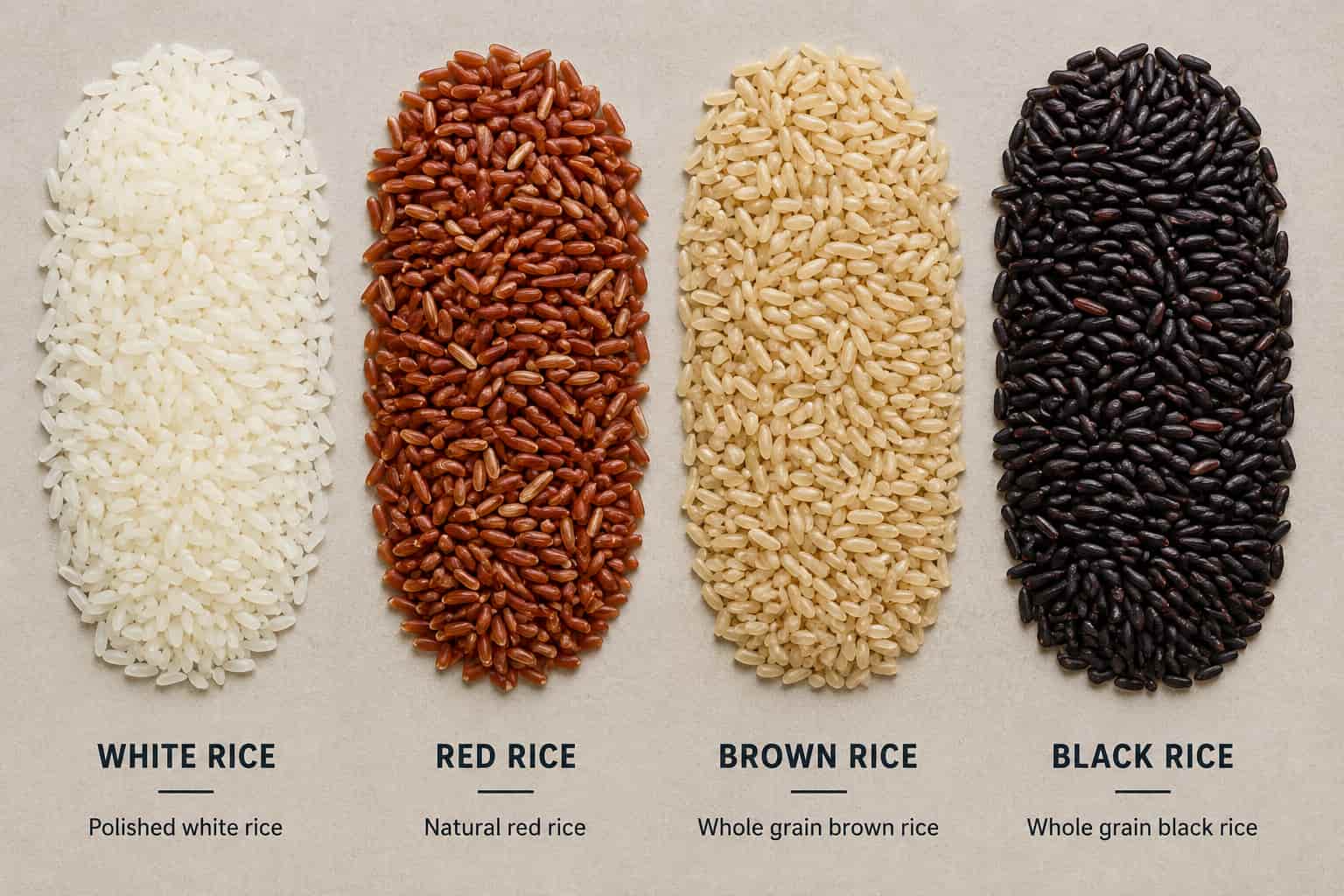
Understanding white, brown, and red rice
1. The structure of a rice grain
- 1Hull (husk)
The hard, inedible outer covering.
- 2Bran
The edible outer layer, rich in fibre, vitamins, minerals, and antioxidants.
- 3Germ
The nutrient-rich embryo, containing healthy fats, vitamin E, and B vitamins.
- 4Endosperm
The large inner portion, mostly starch with some protein.
2. How rice is processed
- 1Step 1 — Paddy rice
Contains the hull, bran, germ, and endosperm, exactly as harvested.
- 2Step 2 — Whole-grain rice (hull removed)
The grain retains its bran, germ, and endosperm. What you call it from here depends on the colour of the bran — brown bran gives brown rice, red bran gives red rice, black/purple bran gives black rice.
- 3Step 3 — White rice (bran and germ milled away)
Only the white endosperm remains — this is white rice, regardless of what colour the grain started as.
3. Where the colour actually comes from
The colour lives entirely in the bran, not the endosperm. Every rice grain starts as paddy: an inedible outer hull, a bran layer, a small germ, and the starchy white endosperm at the centre. Removing just the hull gives you brown rice — but this isn't a separate variety the way red or black rice are, it's simply what you get from dehusking any ordinary rice (Nadu, Samba, Kekulu) and leaving the bran on.
Red and black rice are genuinely different: these come from specific varieties bred over generations for pigmented bran — reddish in red rice varieties like Red Kekulu and Rathu Heenati, dark anthocyanins in black rice. Milling isn't a single on/off step either — bran comes off progressively, from brown (hull removed only) through semi-milled or undermilled rice (bran partially removed, some fibre and colour retained) to fully polished white rice (bran and germ entirely gone).
Because colour lives in the bran, milling any variety — red, black, or ordinary brown — down to fully white removes that colour along with most of the fibre and micronutrients, leaving the same white endosperm underneath regardless of where you started. Yes, red rice can become white rice if its bran and germ are fully milled away — the red pigment disappears along with the bran, and what's left is indistinguishable in colour from any other white rice.
Types and varieties of rice
White rice (සුදු හාල්)
Any ordinary rice variety, fully milled — bran and germ removed, fastest cooking, lowest fibre.
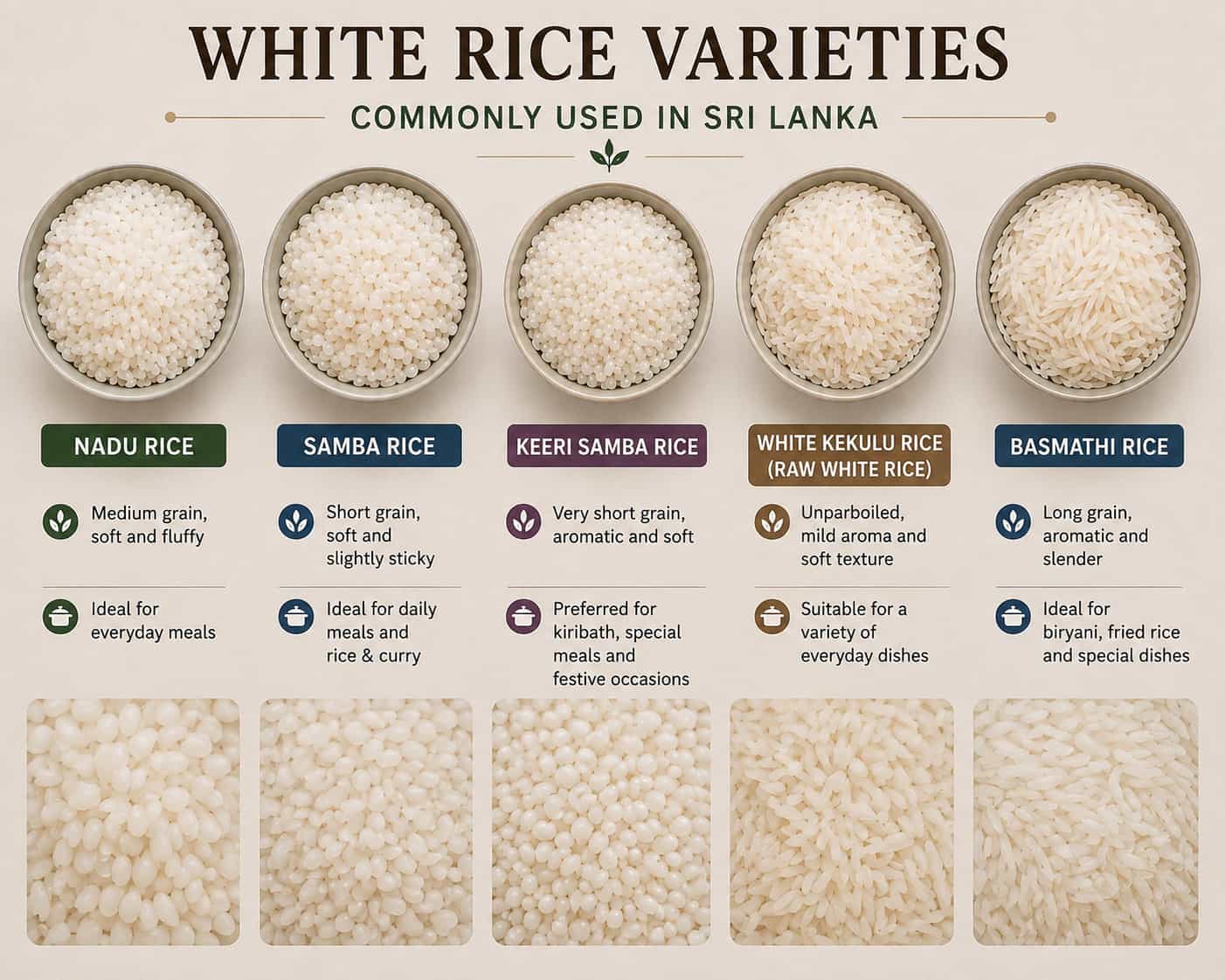
In the Sri Lankan market, white rice isn't really sold by single variety names — Nadu, Samba, and Kekulu are trade categories, each covering multiple government-bred cultivars released by the Rice Research and Development Institute (identified by codes like Bg 352, Bg 358, Bg 360, At 306, At 354, Ld 356). What actually separates the three categories is grain size and processing, not a single "variety."
Nadu (නාඩු): Medium-long grain, the single most-consumed rice nationally, especially in rural and estate households. Parboiled by market convention — sold as "Raw" instead if unparboiled. Available in both white and red forms (White Nadu is the single most-consumed rice type nationally; Red Nadu is also sold, though less dominant than Red Kekulu).
Kekulu (කැකුළු): The same grain as Nadu, but never parboiled — the name itself means "raw rice." Sold in white, red, and even brown forms; Red Kekulu is the most-consumed red rice nationally.
A common point of confusion worth clearing up: White Kekulu and Red Kekulu are genetically distinct paddy varieties, not the same grain milled to different degrees. White Kekulu comes from a non-pigmented paddy variety, milled fully — bran and germ removed, exactly like any other white rice. Red Kekulu comes from a separately bred variety with red-pigmented bran, left unmilled. White Kekulu isn't "bran intact with transparent colour" — the bran is genuinely removed during milling, just like any white rice; ordinary unpigmented bran is actually a light tan colour, which is exactly what you see in Brown Kekulu — the same non-pigmented variety as White Kekulu, simply left unmilled rather than polished.
Why farmers don't just fully mill red varieties and sell them as white rice: it comes down to economics, not technical possibility. Red rice varieties — especially the traditional heirloom ones — are generally lower-yielding and slower to mature (often 4–6 months, versus roughly 100–110 days for modern high-yield white varieties). Red rice is also marketed and priced as a premium, health-positioned product both locally and for export, specifically because of its antioxidant and fibre content. Milling that bran away would destroy the entire value proposition that justifies the higher price, while also giving up the yield advantage a proper white variety would have delivered instead. So farmers grow white varieties for the white market and red varieties for the red market — there's no economic reason to cross the two.
Samba (සම්බා): Short, hard, ovular grain, also typically parboiled before milling, favoured especially in urban households. Available in white and red. Keeri Samba (Bg 360) is a specific, well-known fragrant small-grain variety within this category, traditionally used for kiribath.
Basmati: A long-grain, aromatic imported variety, not Sri Lankan-grown, but commonly used locally for biryani and similar dishes — typically sold raw (unparboiled). Jasmine is also available on a similarly imported, niche basis, though far less commonly used locally than Basmati.
Nutrition (per 100g cooked): ~130 kcal, 2.7g protein, 0.3g fat, 28g carbs, under 1g fibre. Lower in magnesium and B vitamins than any of the whole-grain forms below, and with a comparatively high glycaemic index (roughly 70–90 depending on variety).
Brown rice
Not a separate variety — any of the white-rice varieties above (Nadu, Samba, Kekulu) with the bran left on rather than milled away. "Brown" is simply the natural colour of ordinary, unpigmented bran.
This principle applies to any variety, including Samba — "Brown Samba" would be just as valid conceptually as Brown Kekulu, since the same bran-intact rule applies regardless of trade name. In practice, though, Brown Kekulu is the established, commonly sold brown rice product locally, while Brown Samba isn't a prominent commercial item — likely because Samba is positioned as a guest/special-occasion parboiled rice, so there's less market demand for an unmilled version, whereas Kekulu's whole identity as the "raw" category makes a brown version a natural fit.
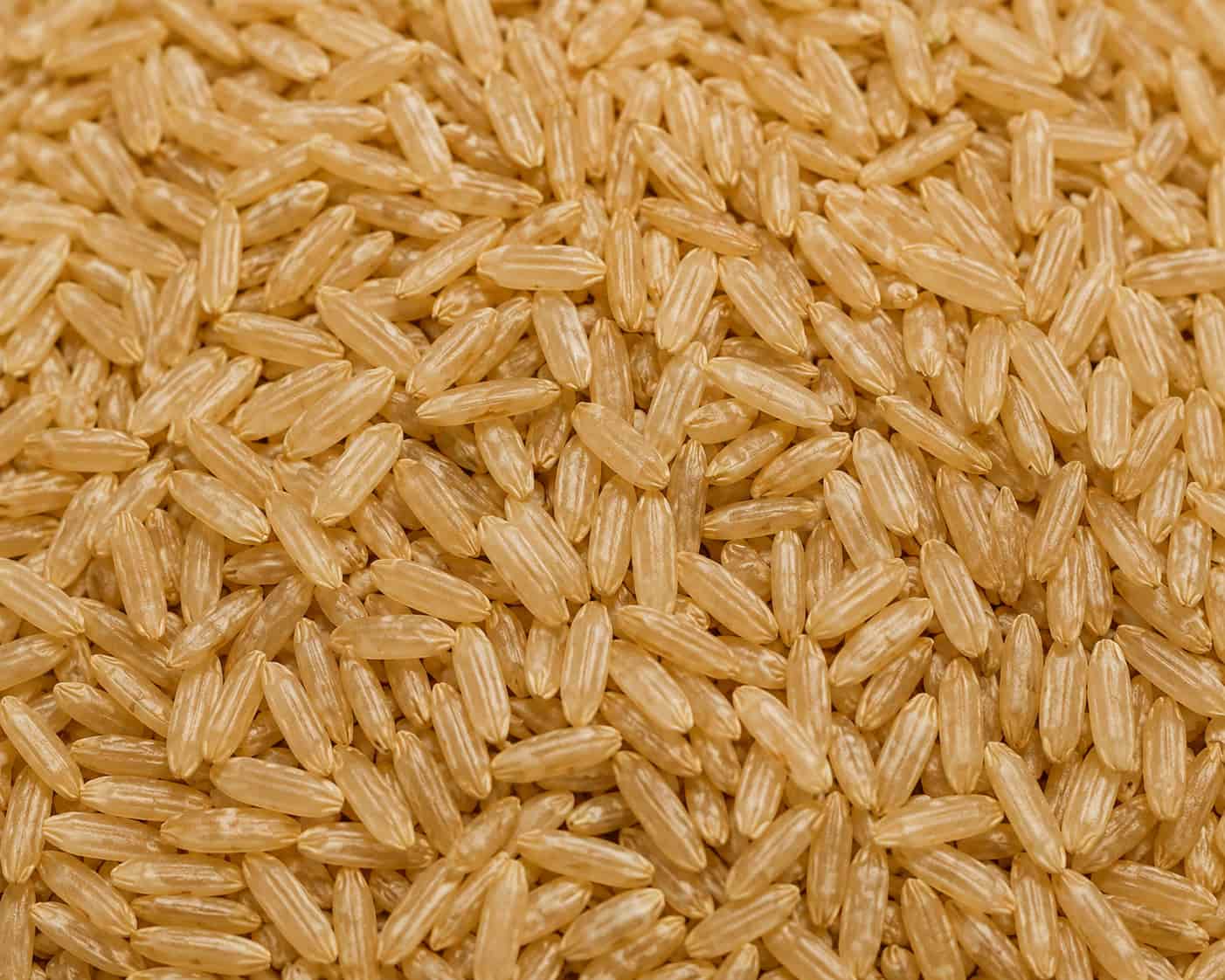
Nutrition (per 100g cooked): ~112 kcal, 2.6g protein, 0.9g fat, 24g carbs, 1.8g fibre, meaningfully higher in magnesium, manganese, and B vitamins than white rice from the same variety. Glycaemic index is moderately lower than the fully milled version, roughly 50–55.
Red rice (රතු හාල්)
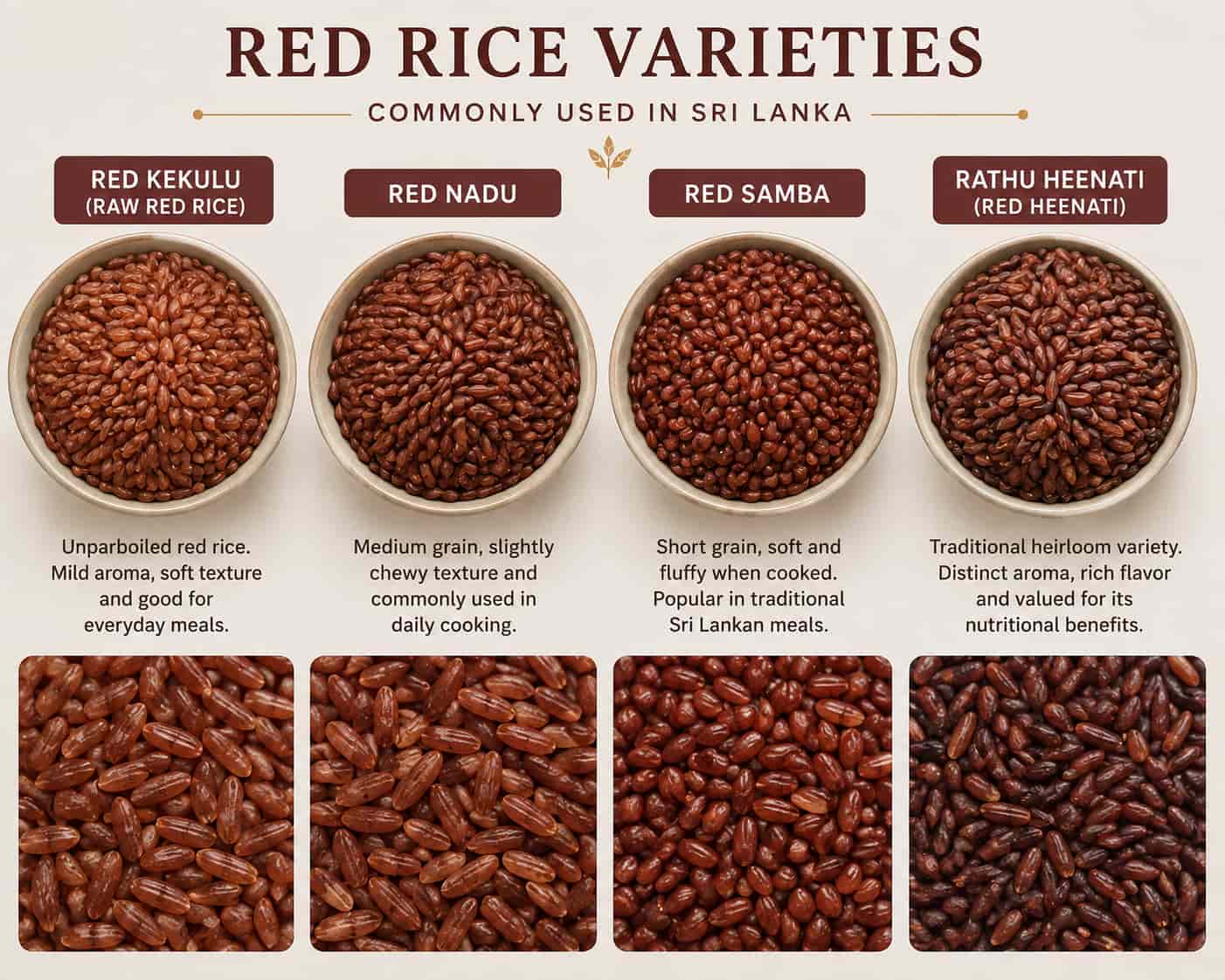
Specific varieties bred for bran containing extra reddish pigment (proanthocyanidins) — genetically distinct from their white counterparts, not simply "unmilled" versions of them. This applies across trade categories: Red Nadu, Red Samba, and Red Kekulu are each their own separately bred, pigmented varieties, distinct from White Nadu, White Samba, and White Kekulu respectively — not the same paddy left unmilled.
Red Kekulu (රතු කැකුළු) is by far the most consumed red rice in the country — the second most-consumed rice type nationally after white Nadu, and a genuine everyday staple rather than a specialty item. Red versions of Nadu and Samba are also sold (Red Nadu, Red Samba), though at meaningfully smaller volumes than Red Kekulu. Traditional heirloom varieties like Rathu Heenati (රතු හීනටි) are also available, typically at a premium, and are valued for their deeper flavour and cultural significance in traditional Ayurvedic and heritage cooking.
By definition, any rice sold as "red rice" must have at least some of its pigmented bran intact — the colour comes entirely from that layer, so fully milling it away would leave the same white endosperm underneath, no longer distinguishable as red rice at all. That said, milling degree still varies within red rice itself: some red rice is lightly milled, keeping a thicker bran layer, a deeper colour, and more fibre, while other red rice on the shelf — including some "polished" or "double-polished" red Kekulu — is more heavily milled, leaving a thinner bran layer, a lighter reddish tint, and somewhat less fibre. Both are legitimately red rice; it's a spectrum of how much bran survives milling, not a single fixed standard.
Nutrition (per 100g cooked): ~110 kcal, 2.5g protein, 0.8g fat, ~23g carbs, 1.5–2g fibre, plus antioxidant compounds (proanthocyanidins) not present in white or ordinary brown rice. Glycaemic index similar to brown rice, roughly 50–55 — a meaningful step down from white rice.
Black / purple rice
The same principle as red rice, but with dark anthocyanin pigments in the bran instead of red ones. Not a traditional Sri Lankan staple, but common elsewhere in Asia, sometimes marketed as "forbidden rice."
Nutrition (per 100g cooked): ~114 kcal, comparable protein and fibre to red and brown rice, but with the highest anthocyanin antioxidant content of any rice type — the pigment responsible for the deep purple-black colour is the same antioxidant family found in blueberries and dark grapes.
Parboiled rice (තම්බපු හාල්)
A separate, additional processing step that can be applied to any variety, not a colour or a bran-related category — before milling, the paddy is soaked and steamed, which pushes some nutrients from the bran into the starchy endosperm before the bran is then removed as usual.
In the Sri Lankan market specifically: Nadu and Samba are both typically sold parboiled. Kekulu, by definition and by name, is never parboiled — it's the "raw" counterpart within the same grain-size categories. So when choosing between white rice types locally, Kekulu is your go-to if you specifically want unparboiled rice, while Nadu and Samba will almost always be parboiled unless labelled otherwise.
"Raw" rice is never parboiled — that's what the label means. Nadu, by contrast, is parboiled by default; if a bag doesn't say "Raw," assume it's parboiled.
Nutrition: Retains somewhat more of the bran's original nutrients than standard white rice of the same variety, despite ending up visually similar to white rice once milled. It also has a notably lower glycaemic index than regular white rice (roughly 38–48), because the steaming process changes the starch structure — this makes parboiled rice a practical middle-ground option for anyone who prefers white rice's texture but wants a gentler blood sugar response.
Benefits: Beyond the lower GI, parboiling retains more B vitamins and minerals than fully milled white rice (pushed from the bran into the endosperm before milling), is generally easier to digest, and — like white rice — stores for years without the rancidity issues that limit brown rice to 6–12 months. A Sri Lankan study on traditional local varieties specifically found parboiled rice produced a lower glycaemic response than either raw unpolished or raw polished versions of the same rice.
Downsides: Parboiled rice is still meaningfully less nutritious than true whole-grain rice (brown, red, or black with bran intact) — it improves on white rice, but doesn't replace what's lost once the bran is physically removed. The evidence on arsenic is mixed rather than settled: some studies show parboiling reduces arsenic content, while others note it can increase arsenic uptake if contaminated water is used during processing — this depends more on water quality at the processing stage than on parboiling itself. Texture is also firmer and less sticky than raw white rice, with a mild odour during cooking that some people (particularly with Samba) find off-putting.
Glycaemic index: why rice colour doesn't tell the whole story
This isn't an abstract nutrition detail. Research has specifically linked high white rice consumption to increased risk of type 2 diabetes in Asian populations, where rice is the dominant carbohydrate source in the diet — making rice choice one of the more meaningful, everyday levers available for long-term metabolic health in a country where rice is eaten at most meals.
Glycaemic index (GI) measures how quickly a food raises blood sugar compared to a reference food — lower GI means a slower, gentler rise. It's one of the most practically useful numbers for anyone managing diabetes or general blood sugar health, and rice is a major contributor to daily glycaemic load for most Sri Lankans. But GI doesn't map onto rice colour as neatly as people assume.
The evidence, specifically for Sri Lankan rice: a study on locally grown varieties found that parboiled red rice had a significantly lower GI than raw red rice — a real, statistically significant difference (p = 0.005), not a marginal one. The same study made a more surprising finding: some red raw rice varieties showed no meaningful GI difference from ordinary white raw rice. Its conclusion was direct — glycaemic index cannot be predicted from the colour of the grain alone — and it specifically recommended red parboiled rice for people managing diabetes.
Why colour and GI don't line up perfectly: GI is driven mainly by a rice variety's amylose-to-amylopectin ratio in the starch itself — high-amylose rice digests slowly (lower GI), high-amylopectin rice gelatinises and digests fast (higher GI). This is a trait of the endosperm's starch structure, largely independent of whether the bran is pigmented or removed. Bran and fibre do help lower GI somewhat, but that effect is smaller than the impact of the underlying starch type — which is why a particular white variety can occasionally match or beat a red variety on GI, and why milling degree (how much bran survives) also shifts the number within the same variety.
The Department of Agriculture's own grain quality records for locally bred varieties list amylose content (categorised as low, intermediate, or high) alongside pericarp (bran) colour for each release — confirming these are tracked as two separate, independent traits. A red-pericarp variety with intermediate or high amylose content will generally have a gentler blood sugar response than a red variety with low amylose, regardless of how much bran either retains — which is exactly why colour alone is an unreliable guide, and amylose content (where available) is the more precise indicator to look for.
- →Parboiling lowers GI on top of whatever rice you started with — it isn't that any parboiled rice beats any raw red rice. General evidence suggests parboiled white rice still tends to sit above red rice (raw or parboiled) on the GI scale, since it misses out on the additional benefit red rice's bran contributes
- →If choosing between two red rice options, the parboiled one wins on GI — Red Nadu or Red Samba over Red Kekulu, specifically for blood sugar management
- →Don't assume "red" automatically means "low GI" — check the specific variety where possible, since some red raw rice performs no better than ordinary white rice on this measure
| Category | Typical GI Range | Notes |
|---|---|---|
| White raw rice | 70–90 | Highest, most variable by variety |
| Parboiled white rice | ~55–68 (estimated) | Lower than white raw, but generally still above red rice due to lacking red rice's bran-driven advantage |
| Red raw rice | 56–73 | Wide range — some varieties barely differ from white |
| Basmati (white raw) | 50–58 | Exception — high amylose keeps GI low despite being fully milled white rice |
| Parboiled red rice | ~38–48 (estimated) | Lowest — best-evidenced option for blood sugar management |
Note on estimated ranges: the Sri Lanka-specific study cited above confirms parboiled red rice is significantly lower than raw red and raw white rice, and that colour alone doesn't predict GI, but its published abstract doesn't report exact GI numbers. The parboiled white and parboiled red figures above are estimates drawn from general international parboiled rice research rather than that specific study.
White raw > Parboiled white > Red raw ≈ Basmati (white raw) > Parboiled red. This is the typical pattern from general (non-Sri-Lanka-specific) rice literature — parboiling lowers GI relative to that same rice's own raw form, but usually not enough to drop below red rice's bran-driven advantage. In practice this means something like parboiled Keeri Samba, despite being an improvement over raw white rice, would generally still sit above red raw rice on GI, not below it.
Two caveats worth keeping in mind: this ordering comes from general literature, not the Sri Lanka-specific study cited above (which only tested red rice, raw vs. parboiled, and didn't include parboiled white rice at all). And since the same study found some red raw varieties don't differ meaningfully from white raw rice, this ordering is a general tendency rather than a fixed rule — a specific variety's amylose content can shift its position within this sequence.
Basmati is a clear real-world example of exactly this exception. Despite being fully milled white rice — no bran, no parboiling — Basmati is naturally high in amylose, which gives it a GI of roughly 50–58, placing it in the low-to-medium range. That's well below "standard" white rice (roughly 70–72) and lands in the same range as red raw rice, or better. So a plain white Basmati can genuinely outperform some red rice on blood sugar impact, purely because of its starch composition — the clearest illustration in this article of why colour and processing category are unreliable shortcuts, and amylose content is what actually determines the outcome.
Portion size matters more than GI alone
GI only measures how fast a fixed amount of carbohydrate raises blood sugar — it says nothing about how much you actually eat. Glycaemic load (which factors in portion size) is often the more practically useful number: a small serving of white rice can have a lower total glycaemic load than a large serving of red or parboiled rice. In other words, switching rice type without also paying attention to portion size only gets you part of the benefit. For most adults, a reasonable everyday serving is roughly half to one cup of cooked rice (about 100–150g) alongside protein and vegetables filling the rest of the plate — rice type is a genuine lever, but it works best combined with portion awareness, not as a substitute for it.
Lowering rice's glycaemic impact, regardless of type
- →Cool and reheat cooked rice — refrigerating cooked rice for several hours before reheating increases resistant starch formation, which can lower its GI by roughly 10–15 points; this works for white rice too, not just red or parboiled
- →Pair rice with protein, fat, or fibre — eating rice alongside dhal, fish, chicken, or a generous portion of vegetables slows gastric emptying and flattens the resulting blood sugar curve; a curry-and-rice meal structure already does much of this naturally, and the effect scales with how much protein and fibre are actually on the plate relative to rice
- →Don't cook rice into mush — overcooking breaks down starch structure further and tends to raise GI slightly compared to rice cooked to a firmer texture
Quick reference
| Type | Sinhala | Fibre (per 100g cooked) | GI (approx.) | Standout Feature |
|---|---|---|---|---|
| White rice | සුදු හාල් | <1g | 70–90 (high) | Fastest cooking |
| Basmati (white raw) | — | <1g | 50–58 | High amylose despite being fully milled white rice |
| Brown rice | — | 1.8g | 50–55 | B vitamins, magnesium |
| Red rice | රතු හාල් | 1.5–2g | 56–73 | Proanthocyanidin antioxidants |
| Black rice | — | ~1.8g | 42–55 | Highest anthocyanin content |
| Parboiled white rice | තම්බපු හාල් (සුදු) | Slightly more than white | 55–68 (est.) | Lower GI than raw white, still above red |
| Parboiled red rice | තම්බපු හාල් (රතු) | 1.5–2g | 38–48 (est.) | Lowest GI — best for blood sugar management |
Practical notes
- →"Brown" isn't a variety name — if a bag says "Brown Nadu" or "Brown Samba," that's genuinely just Nadu or Samba with the bran intact, not a different crop
- →Red and black rice are true varieties, bred specifically for their pigmented bran — not something you get by simply under-milling an ordinary white rice variety
- →Cooking time increases as more bran is retained — white rice cooks fastest, red and brown rice take noticeably longer, and often benefit from a short soak beforehand
- →If blood sugar response matters to you, red, brown, or parboiled rice are all meaningfully better choices than fully milled white rice — even partially mixing white rice with red or brown rice in the same pot is a reasonable middle step
- →Storage: whole-grain rice (red, brown, black) contains natural oils in the bran and germ, which means it can turn rancid faster than white rice — buy in smaller quantities and store in a cool, dry place
- →Arsenic exposure applies to rice generally, not just one type. Rice absorbs arsenic from soil and water more readily than most staple crops, and this isn't limited to parboiled rice specifically. Rinsing rice thoroughly before cooking and using a higher water-to-rice ratio (draining excess water after cooking) can reduce arsenic content somewhat. Rotating between rice and other grains, rather than eating rice at every meal, is a simple way to limit cumulative exposure
Recommendations by population group
- 1Diabetics / prediabetes
Prioritise red rice (raw or parboiled) or Basmati over ordinary white rice, with parboiled red rice as the strongest evidence-backed option. Portion control matters as much as rice type — pair rice with protein and vegetables, and consider the cooling-and-reheating technique above for an easy additional reduction in glycaemic impact.
- 2Pregnancy
No rice type needs to be avoided during pregnancy — the earlier caution around unpasteurised dairy doesn't apply here, since all commercially milled rice is safe when properly cooked. Red or brown rice offers a modest folate and iron advantage over white rice, useful alongside other dietary sources during pregnancy.
- 3Children
White rice remains a reasonable staple for young children, since higher-fibre whole-grain rice can be filling before enough calories are consumed, given children's smaller stomach capacity. Introducing red or brown rice gradually as children get older is a reasonable way to build the habit without restricting intake early on.
- 4Older age
Fibre intake becomes more important for digestive health and satiety with age, making red, brown, or black rice a better default than white rice where tolerated. If chewing or digestion is a concern, well-cooked parboiled rice offers a middle ground — softer texture with more nutrition retained than plain white rice.
- 5Resistance training / athletes
Total carbohydrate intake and timing matter more than rice type for this group — white rice's faster digestion can actually be useful around workouts for quicker glycogen replenishment, while red or brown rice suits more sedentary parts of the day better.
- 6General population / longevity-focused eating
Rotating between red, brown, and parboiled rice rather than defaulting to white rice at every meal is a reasonable, low-effort habit shift — consistent with the broader pattern in longevity research linking whole-grain intake to lower rates of cardiovascular disease and all-cause mortality.
For more on how rice fits into a broader whole-grain rotation, see our Grains article, and for how legumes pair with rice to round out amino acid intake across a meal, see Legumes.
Rice sits at the centre of most meals in Sri Lanka, and understanding what's actually different between a bag of white Samba and a bag of Rathu Heenati changes how you can use rice choice as a genuine, low-effort lever for blood sugar management — without giving up rice altogether. If you'd like to know how your current diet and metabolic markers are tracking, our Longevity Doctors offer a free longevity assessment as a starting point.
Curious where your own
nutrition stands today?
Take the free Aevum Protocol assessment to see how your nutrition & metabolism and 6 other longevity domains are performing — and get a personalised 90-day plan.
Take the Free Assessment →