Cognitive Longevity
The MIND Diet and Brain Health:
What the Evidence Shows
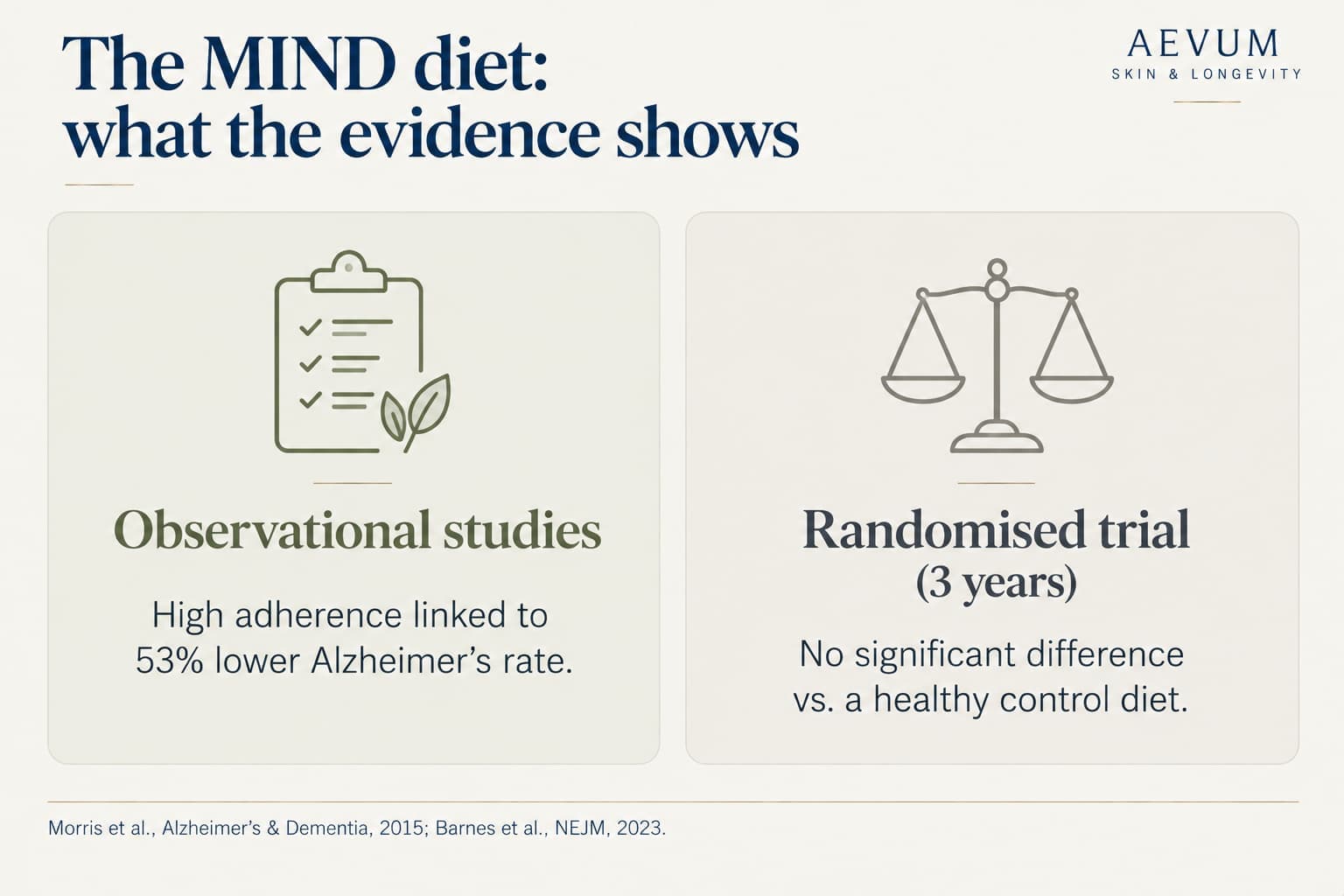
The MIND diet was designed specifically for brain health. It combines the Mediterranean diet with the DASH diet for blood pressure, then emphasises foods that research has linked to slower cognitive ageing, such as leafy greens, berries, nuts, beans and fish. In the large observational studies that launched it, people who followed it closely had about half the rate of Alzheimer's disease, and their thinking declined as slowly as that of people seven and a half years younger. But when the diet was finally tested in a three-year randomised trial, the MIND group did no better than a control group that also ate a calorie-reduced diet with dietitian support. Both groups lost weight, and cognition improved in both. This article covers what the MIND diet is, what the evidence does and doesn't show, and how to apply it sensibly, including in a Sri Lankan kitchen.
Key numbers
| Finding | Detail |
|---|---|
| Original cohort, Alzheimer's risk (923 people aged 58-98, 4.5 years) | 53% lower with high adherence (HR 0.47); 35% lower with moderate adherence (HR 0.65) |
| Original cohort, cognitive decline (960 people, 4.7 years) | Top vs. bottom third: slower decline, equivalent to being 7.5 years younger |
| REGARDS cohort (14,145 people, US) | Higher adherence linked to modestly lower odds of cognitive impairment (OR 0.96); seen in women (OR 0.92), not men |
| Brain autopsy study (581 people) | Higher adherence linked to less Alzheimer's-type pathology, especially amyloid |
| MIND diet trial (604 people, 3 years) | No significant difference vs. control diet: cognition improved in both groups (0.205 vs. 0.170 units) |
What the MIND diet is
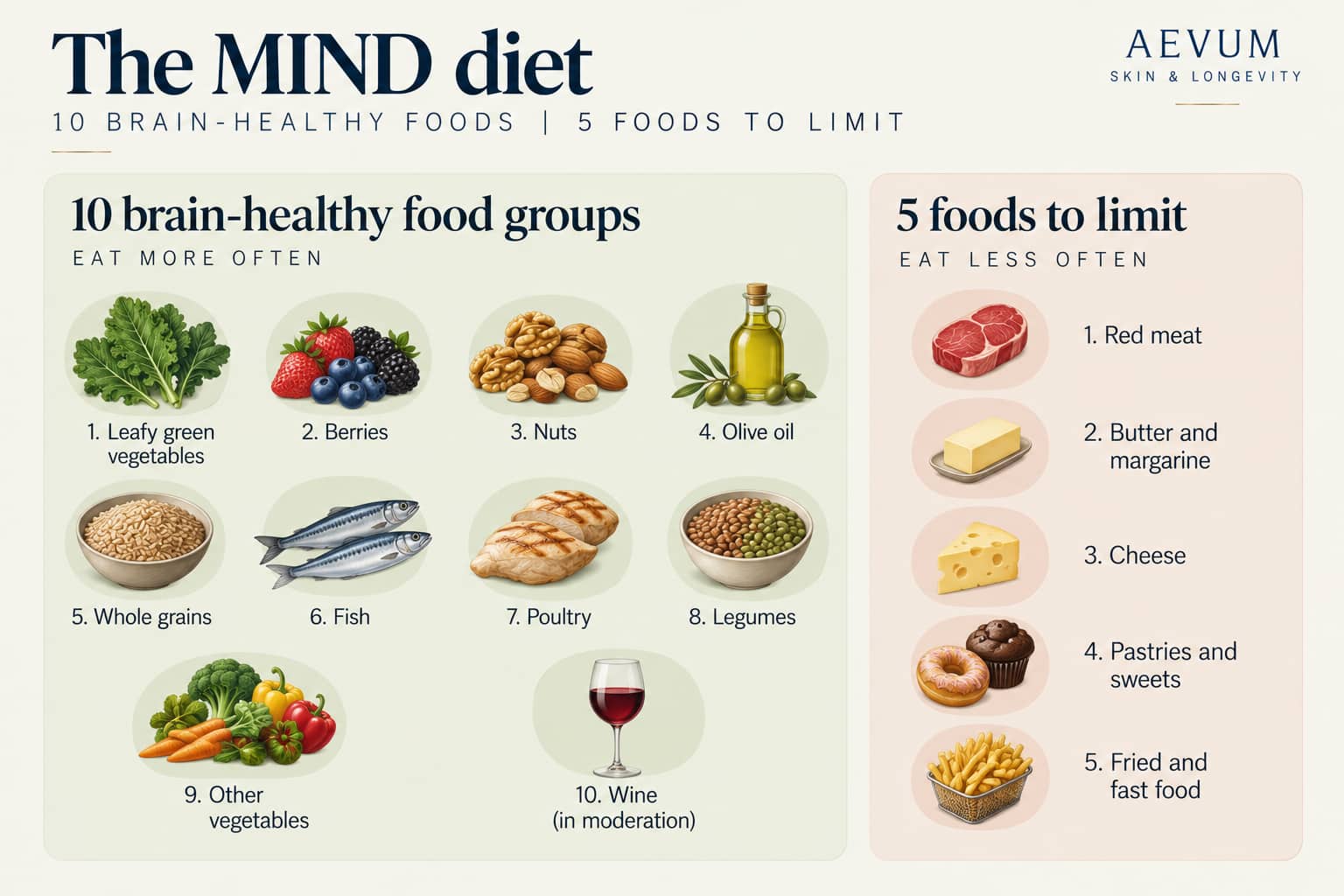
MIND stands for Mediterranean-DASH Intervention for Neurodegenerative Delay. It was developed by researchers at Rush University in Chicago, who built it from foods that earlier studies had linked to brain health. It scores 15 food groups: 10 to eat more of and 5 to limit.
Brain-healthy foods (target intake in the original scoring):
| Food group | Target |
|---|---|
| Green leafy vegetables | 6 or more servings a week |
| Other vegetables | 1 or more servings a day |
| Berries | 2 or more servings a week |
| Nuts | 5 or more servings a week |
| Beans and legumes | More than 3 meals a week |
| Whole grains | 3 or more servings a day |
| Fish (not fried) | 1 or more meals a week |
| Poultry (not fried) | 2 or more meals a week |
| Olive oil | Main cooking oil |
| Wine | 1 glass a day (see note below) |
Foods to limit:
| Food group | Limit |
|---|---|
| Red meat | Fewer than 4 meals a week |
| Butter and margarine | Less than 1 tablespoon a day |
| Cheese | Less than 1 serving a week |
| Pastries and sweets | Fewer than 5 servings a week |
| Fried or fast food | Less than once a week |
Compared with the Mediterranean diet, MIND puts particular weight on leafy greens and berries, and doesn't insist on high fruit, dairy or potato intake. It doesn't require perfect adherence, and in the original research even moderate adherence was linked to lower risk.
A note on wine. Wine was included because of earlier observational links, but the evidence that light drinking protects the brain has weakened considerably, and alcohol carries other risks. If you don't drink, don't start for brain health.
Evidence strength
Consistent, but observational: people who eat this way do better. The MIND diet came out of the Rush Memory and Aging Project, a long-running study of older adults in the Chicago area. Two 2015 papers made its name:
- →Alzheimer's risk. Among 923 people aged 58-98 followed for an average of 4.5 years, 144 developed Alzheimer's disease. Those with the highest MIND scores had a 53% lower rate (HR 0.47), and those in the middle third had a 35% lower rate (HR 0.65). High adherence to the Mediterranean and DASH diets was also protective, but moderate adherence to those diets was not.
- →Cognitive decline. Among 960 people followed for an average of 4.7 years, higher MIND scores went along with slower decline in every area of thinking tested. The gap between the top and bottom thirds was equivalent to being 7.5 years younger.
Later research has added support. In the REGARDS study of 14,145 people across the US, followed for about 10 years, higher MIND adherence was linked to modestly lower odds of cognitive impairment (OR 0.96). The link was seen in women (OR 0.92) but not in men. And in a study of 581 people who donated their brains after death, those who had followed MIND or Mediterranean diets more closely had less Alzheimer's-type pathology, particularly amyloid. People who ate the most green leafy vegetables had the least.
These findings are consistent, but they are observational. People who eat this way also tend to exercise more, smoke less and have more education and income, and researchers can adjust for these factors only partly. Diet is also measured by questionnaire, which is imprecise. And the original studies were mostly in older, white Americans, so they may not apply equally to everyone. The authors of the 2015 papers themselves said that a trial was needed.
Tested in a trial: no difference vs. a healthy control diet. That trial was published in 2023. It enrolled 604 people aged 65 to 84 in Chicago and Boston who had no cognitive impairment but did have a family history of dementia, were overweight and had a less-than-ideal diet. Half were assigned to the MIND diet and half to a control diet. Both groups were asked to cut calories slightly and got regular dietitian counselling. After three years, global cognition scores had improved in both groups, by 0.205 units on MIND and 0.170 units on the control diet. The difference was small and not statistically significant. Brain MRI measures, including hippocampal volume and white-matter damage, were also similar.
The researchers offered several explanations. Both groups lost about 5 kg, and weight loss itself may have helped cognition. The control group already ate a relatively healthy diet, and intensive coaching improved everyone's habits, which narrowed the difference between groups. Three years may also be too short to show an effect on brain ageing.
These are plausible explanations, but the plain result stands. In the best test so far, the MIND diet didn't outperform a calorie-controlled diet with good support.
Related evidence: the Mediterranean diet in a trial. A smaller Spanish trial within the larger PREDIMED study gave a more encouraging result. Among 447 healthy older adults (average age 67), those assigned to a Mediterranean diet with extra olive oil or nuts held their cognitive scores better over about four years than a control group advised to follow a low-fat diet. It had limits: only 334 people had final cognitive tests, and the parent PREDIMED trial had problems with randomisation at some sites, which led to its main 2013 results being retracted and reanalysed in 2018. Still, it's some of the better randomised evidence that a whole dietary pattern might affect cognition.
Why the gap between observation and trial?
This is the same pattern seen with omega-3s and B vitamins (see Omega-3s and Cognitive Function and B Vitamins, Homocysteine, and Brain Aging): strong observational links that shrink or vanish in trials. Some likely reasons:
- →Diet travels with other healthy habits. Observational studies can't fully separate the diet from everything else about people who eat well.
- →The trial compared two good options. The MIND diet was tested against a healthier-than-usual diet with the same weight loss and support, not against an unhealthy diet.
- →Timing. Diet may shape brain health over decades. A three-year trial in people over 65 can only test a narrow window.
- →Diet may work mainly through the body. Much of the brain benefit of healthy eating may come through weight, blood pressure, blood sugar and blood vessels, which are covered in Vascular Health and the Brain.
Applying it in Sri Lanka
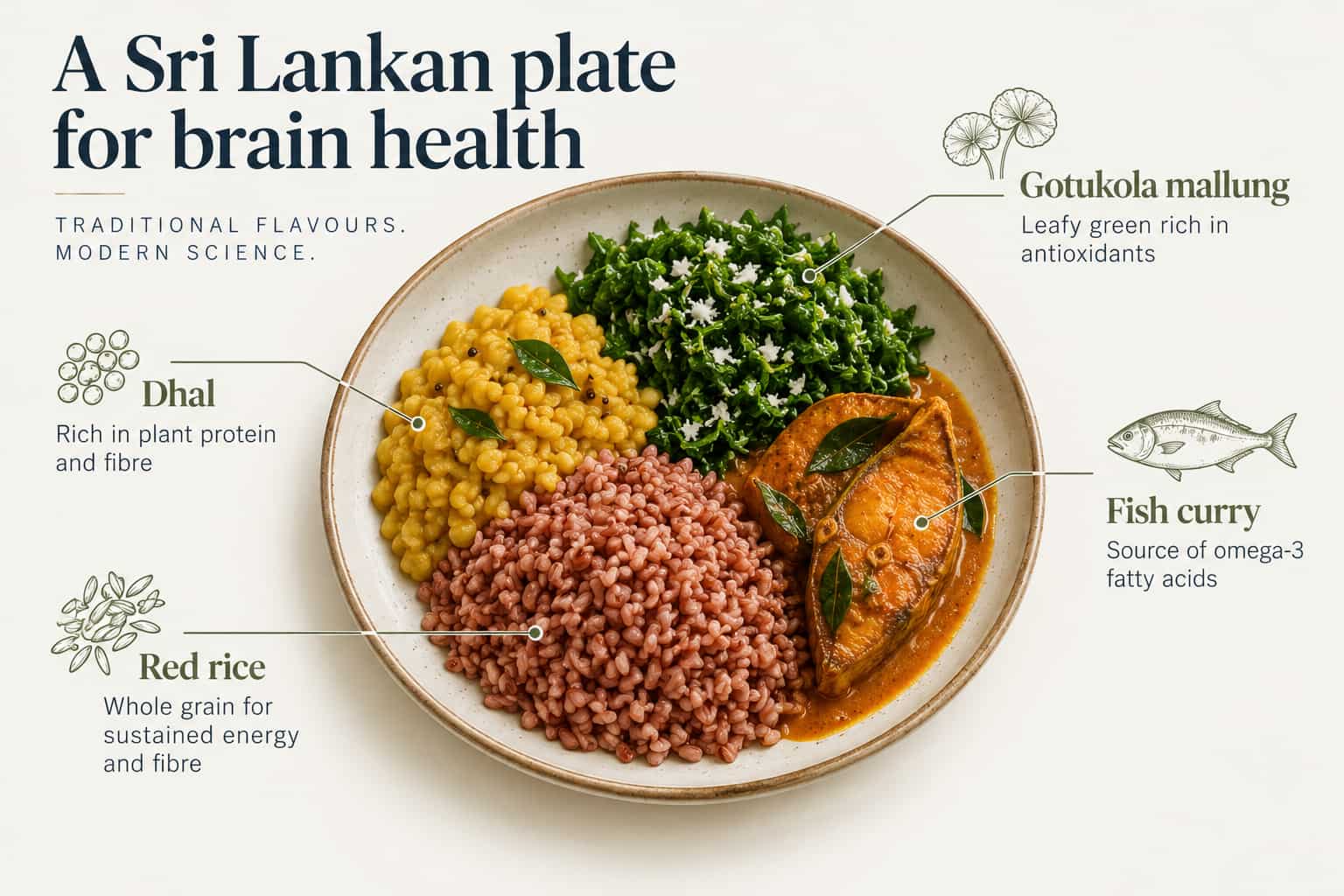
The MIND diet was designed around American foods, but its principles translate well to Sri Lankan eating.
- 1Leafy greens
Mallung made with gotukola, mukunuwenna, kankun or other local leaves counts. Six or more servings a week is achievable with a daily mallung or leafy curry.
- 2Beans and legumes
Dhal (parippu), mung beans, cowpeas and chickpeas are everyday staples and fit the "more than 3 meals a week" target easily.
- 3Whole grains
Choose red or brown rice, kurakkan (finger millet) and whole-grain breads over white rice and white flour where you can.
- 4Fish
Oily fish such as sardines (salaya / sudaya), Indian mackerel (kumbalawa) and tuna (balaya, kelawalla), cooked in curries or grilled rather than deep-fried.
- 5Nuts
Unsalted peanuts, cashews and other nuts as snacks.
- 6Berries
Classic berries are less common and costly here. No research has tested whether local fruits give the same benefit, so treat fruit as part of a generally healthy diet rather than a like-for-like swap.
- 7Cooking oil
The MIND research is built around olive oil. Coconut oil, the usual Sri Lankan cooking fat, wasn't tested and is high in saturated fat, so using it in moderation and mixing in other oils is sensible.
- 8Limit
Fried short eats, sweets and sugary drinks, which fall into the MIND diet's "limit" groups.
Recommendations by situation
- →Generally healthy adult wanting to protect long-term brain health. The MIND diet is a reasonable, low-risk pattern to follow, as long as you see it as one part of an overall healthy lifestyle rather than a proven dementia treatment.
- →Overweight or with high blood pressure or diabetes. Focus on weight, blood pressure and blood sugar control. The MIND trial suggests a calorie-controlled healthy diet with good support may be what matters most.
- →Family history of dementia. A MIND-style diet is sensible, but it works best alongside exercise, blood pressure control, hearing care and social connection (see Alzheimer's Disease: Risk Factors You Can Actually Change).
- →Mild cognitive impairment. Healthy eating supports overall health, but get a proper medical assessment rather than relying on diet alone (see Mild Cognitive Impairment).
- →You don't drink alcohol. Leave out the wine. There's no reason to start drinking for brain health.
Practical notes
The MIND diet is a sensible, evidence-informed way of eating. It's built on foods with plausible brain benefits, it overlaps heavily with diets that protect the heart, and it's easy to adapt to local cuisines. But it isn't a proven way to prevent dementia. The best trial so far found it did no better than another healthy, calorie-controlled diet. The practical message is to eat a MIND-style diet for its overall health benefits, keep your weight and blood pressure in a healthy range, and treat food as one part of a broader brain-health plan rather than a cure on its own.
- Morris MC, et al. MIND diet associated with reduced incidence of Alzheimer's disease. Alzheimer's & Dementia, 2015;11(9):1007-1014.
- Morris MC, et al. MIND diet slows cognitive decline with aging. Alzheimer's & Dementia, 2015;11(9):1015-1022.
- Sawyer RP, et al. Association of Adherence to a MIND-Style Diet With the Risk of Cognitive Impairment and Decline in the REGARDS Cohort. Neurology, 2024;103(8):e209817.
- Agarwal P, et al. Association of Mediterranean-DASH Intervention for Neurodegenerative Delay and Mediterranean Diets With Alzheimer Disease Pathology. Neurology, 2023;100(22):e2259-e2268.
- Barnes LL, et al. Trial of the MIND Diet for Prevention of Cognitive Decline in Older Persons. New England Journal of Medicine, 2023;389:602-611.
- Valls-Pedret C, et al. Mediterranean Diet and Age-Related Cognitive Decline: A Randomized Clinical Trial. JAMA Internal Medicine, 2015;175(7):1094-1103.
How many days a week does
your plate include leafy greens?
Take the free Aevum Protocol assessment to see how your cognitive longevity and 6 other longevity domains are performing — and get a personalised 90-day plan.
Take the Free Assessment →