Nutrition & Metabolism
Blueberries and Other Berries:
What the Evidence Shows for Brain, Heart and Longevity
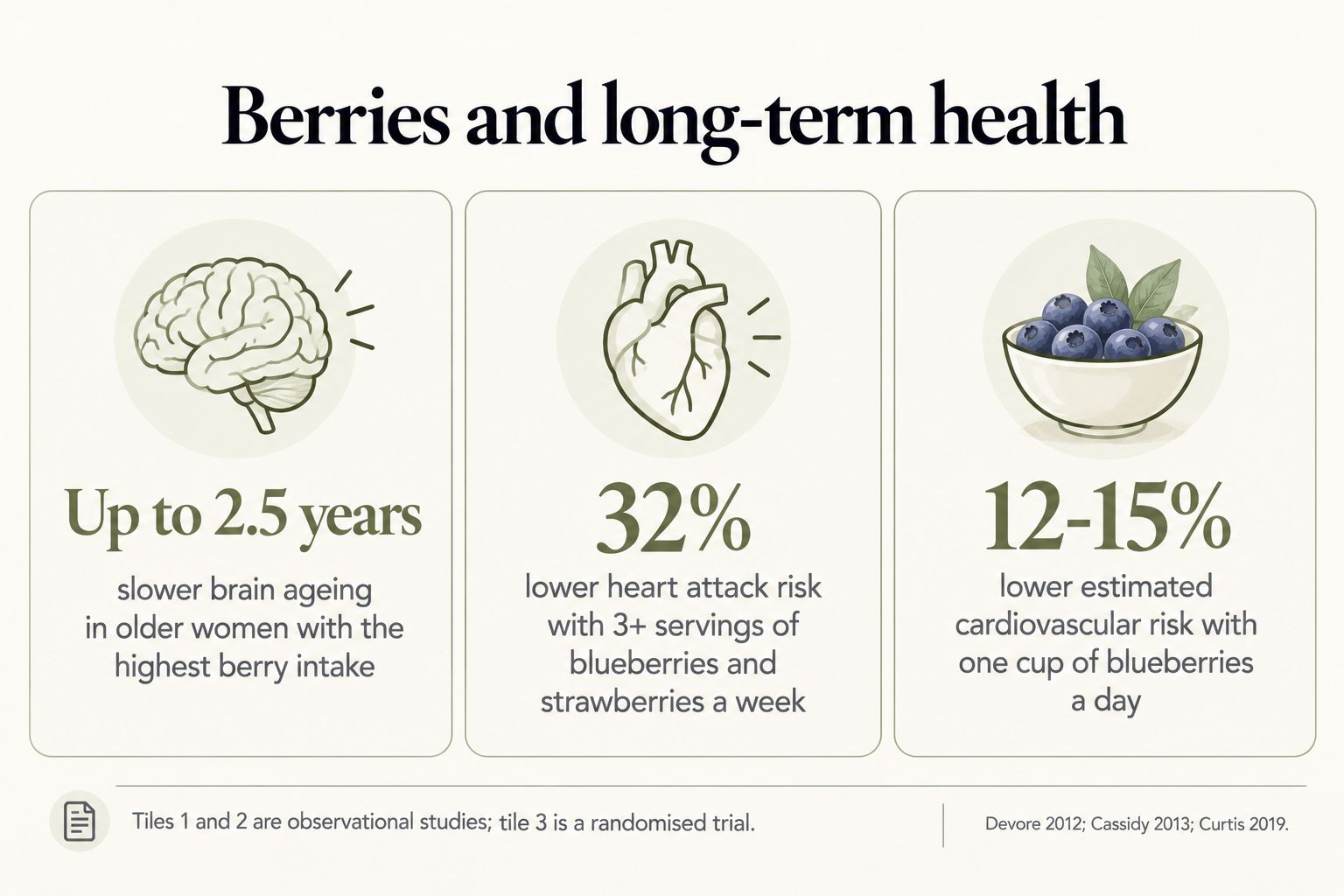
Berries are among the most studied fruits in longevity research. They're low in sugar and calories, high in fibre and vitamin C, and rich in polyphenols, especially anthocyanins, the pigments that give blueberries, blackberries and jamun their deep blue-purple colour. Large long-term studies link regular berry eating with healthier ageing. In 16,010 older women in the Nurses' Health Study, those who ate the most blueberries and strawberries had slower memory decline, equivalent to delaying cognitive ageing by up to 2.5 years. In 93,600 younger women, eating three or more servings of blueberries and strawberries a week was linked to a 32% lower risk of heart attack. In nearly 190,000 adults, three servings of blueberries a week was linked to a 26% lower risk of type 2 diabetes, while fruit juice was linked to higher risk. Randomised trials support some of these findings: one cup (150 g) of blueberries a day for six months improved blood vessel function in adults with metabolic syndrome, and 12 weeks of wild blueberry powder lowered blood pressure and improved some memory measures in healthy older adults. Cranberries reduce urinary tract infections in some groups. Berries aren't a miracle food, and most evidence is observational. But they're one of the easiest, safest additions to a longevity diet. This article explains what's in berries, what the evidence shows, which berries are available in Sri Lanka, and how to eat more of them.
Key numbers
| Finding | Detail |
|---|---|
| Brain ageing (16,010 women over 70) | Highest berry intake linked to cognitive ageing delayed by up to 2.5 years |
| Heart attack (93,600 women aged 25-42, 18 years) | 3+ servings of blueberries and strawberries a week: 32% lower risk |
| Type 2 diabetes (187,382 adults) | 3 servings of blueberries a week: 26% lower risk; fruit juice: 8% higher |
| Blood vessel function (138 adults with metabolic syndrome, 6 months) | One cup of blueberries a day: 12-15% lower estimated cardiovascular risk |
| Older adults (61 aged 65-80, 12 weeks) | Wild blueberries: 24-hour systolic blood pressure 3.6 mmHg lower |
| Urinary tract infections (50 trials, 8,857 people) | Cranberry products: about 30% fewer UTIs overall |
What's in berries
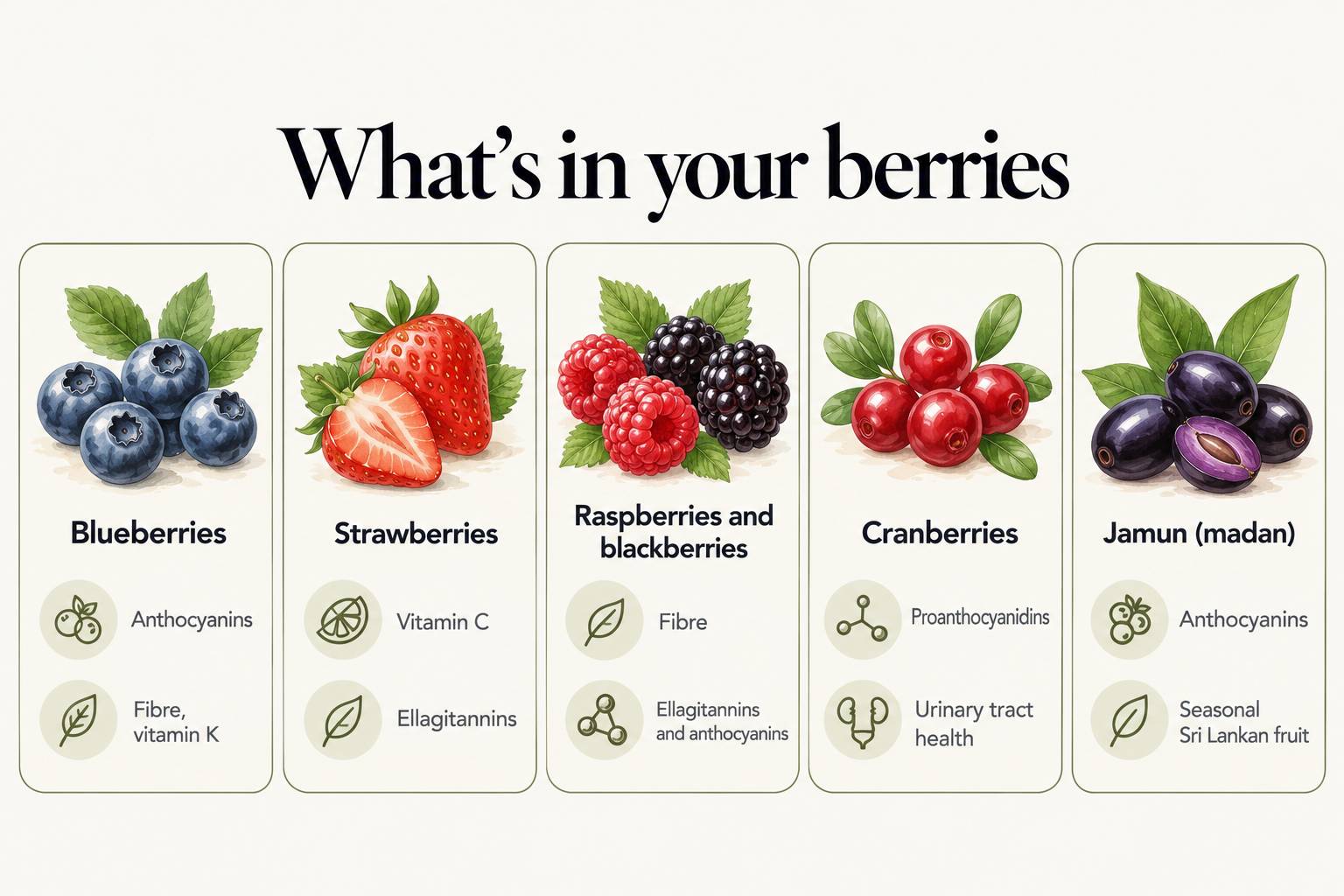
Nutrients. Berries are naturally low in sugar and calories compared with many fruits, and provide:
- Fibre, which supports gut health and steadier blood sugar (see The Gut Microbiome and Fermented Foods).
- Vitamin C, especially in strawberries.
- Vitamin K and manganese, especially in blueberries and blackberries.
- Water, making them filling for few calories.
Polyphenols: the key compounds. The main interest in berries comes from their polyphenols, plant compounds with antioxidant and anti-inflammatory effects:
- Anthocyanins: blue, purple and red pigments found in blueberries, blackberries, blackcurrants, jamun and red raspberries. They're the most studied berry compounds for brain and heart health.
- Ellagitannins: found in strawberries, raspberries and blackberries. Gut bacteria convert these to urolithins, including urolithin A (see Urolithin A).
- Proanthocyanidins: found in cranberries, linked to preventing bacteria from sticking to the bladder wall.
- Flavonols such as quercetin: found in many berries.
Only small amounts of berry polyphenols are absorbed intact. Many are broken down by gut bacteria into smaller compounds that may be responsible for much of their effect.
How they may work.
- Blood vessels: anthocyanins improve the function of the endothelium, the lining of blood vessels, helping them relax and widen, which lowers blood pressure.
- Brain: improved blood flow to the brain, reduced inflammation and oxidative stress, and possibly better signalling between brain cells.
- Blood sugar: fibre and polyphenols may slow sugar absorption and improve insulin sensitivity.
- Gut: berry fibre and polyphenols feed beneficial gut bacteria.
What the evidence shows
Brain health. In a 2012 study in the Annals of Neurology, Elizabeth Devore and colleagues followed 16,010 women aged over 70 from the Nurses' Health Study, who completed diet questionnaires from 1980 and memory tests every two years from 1995 to 2001. Women who ate the most blueberries and strawberries had slower cognitive decline, equivalent to delaying cognitive ageing by up to 2.5 years. Higher intakes of anthocyanins and total flavonoids were also linked to slower decline. As an observational study in female nurses, it can't prove berries caused the difference.
Trials are smaller but encouraging. In a 2023 study in the American Journal of Clinical Nutrition, 61 healthy adults aged 65-80 took freeze-dried wild blueberry powder, equivalent to 178 g of fresh wild blueberries, or a matched placebo daily for 12 weeks. The blueberry group had better blood vessel function, 3.6 mmHg lower 24-hour systolic blood pressure, and better immediate word recall and task-switching, though most other cognitive measures didn't differ. Berries are also a key part of the MIND diet, which recommends at least two servings a week (see The MIND Diet and Brain Health).
Heart health. In a 2013 study in Circulation, Aedín Cassidy and colleagues followed 93,600 women aged 25-42 for 18 years. Women who ate three or more servings of blueberries and strawberries a week had a 32% lower risk of heart attack than those who ate them once a month or less. The benefit wasn't explained by eating more fruit and vegetables in general.
In a 2019 randomised trial in the American Journal of Clinical Nutrition, Peter Curtis and colleagues gave 138 overweight or obese adults aged 50-75 with metabolic syndrome freeze-dried blueberries equivalent to one cup (150 g) or half a cup (75 g) a day, or a placebo, for six months. One cup a day produced sustained improvements in blood vessel function and arterial stiffness, which the authors estimated could reduce cardiovascular risk by 12-15%. Half a cup had no benefit. The trial was part-funded by the US Highbush Blueberry Council.
Blood sugar and diabetes. In a 2013 study in the BMJ, Isao Muraki and colleagues followed 187,382 adults from three large US cohorts, during which 12,198 developed type 2 diabetes. Each three servings a week of blueberries was linked to a 26% lower risk, the strongest effect of any fruit. Grapes and raisins (12% lower) and apples and pears (7% lower) were also protective, while each three servings a week of fruit juice was linked to an 8% higher risk. Whole fruit is far better than juice (see Sugar and Refined Carbohydrates).
Overall longevity. Berries are among the main sources of flavonoids, a large family of polyphenols. In a 2025 study in Nature Food of 124,805 UK Biobank participants, people with the highest flavonoid intakes, about 500 mg a day, had a 16% lower risk of death. Eating a wide variety of flavonoid-rich foods, such as tea, berries, apples, oranges and grapes, was linked to a further 6-20% lower risk of conditions including type 2 diabetes, cancer and neurodegenerative disease, independent of the total amount.
Cranberries and urinary tract infections. A 2023 Cochrane review of 50 trials and 8,857 people found that cranberry products reduced urinary tract infections (UTIs) by about 30% overall. The clearest benefits were in women with recurrent UTIs (26% fewer), children (54% fewer) and people at risk after bladder procedures (53% fewer). There was no clear benefit in older people living in care homes, pregnant women, or people with bladder emptying problems. Cranberry products are an option for prevention, not a treatment for an active infection.
Evidence strength
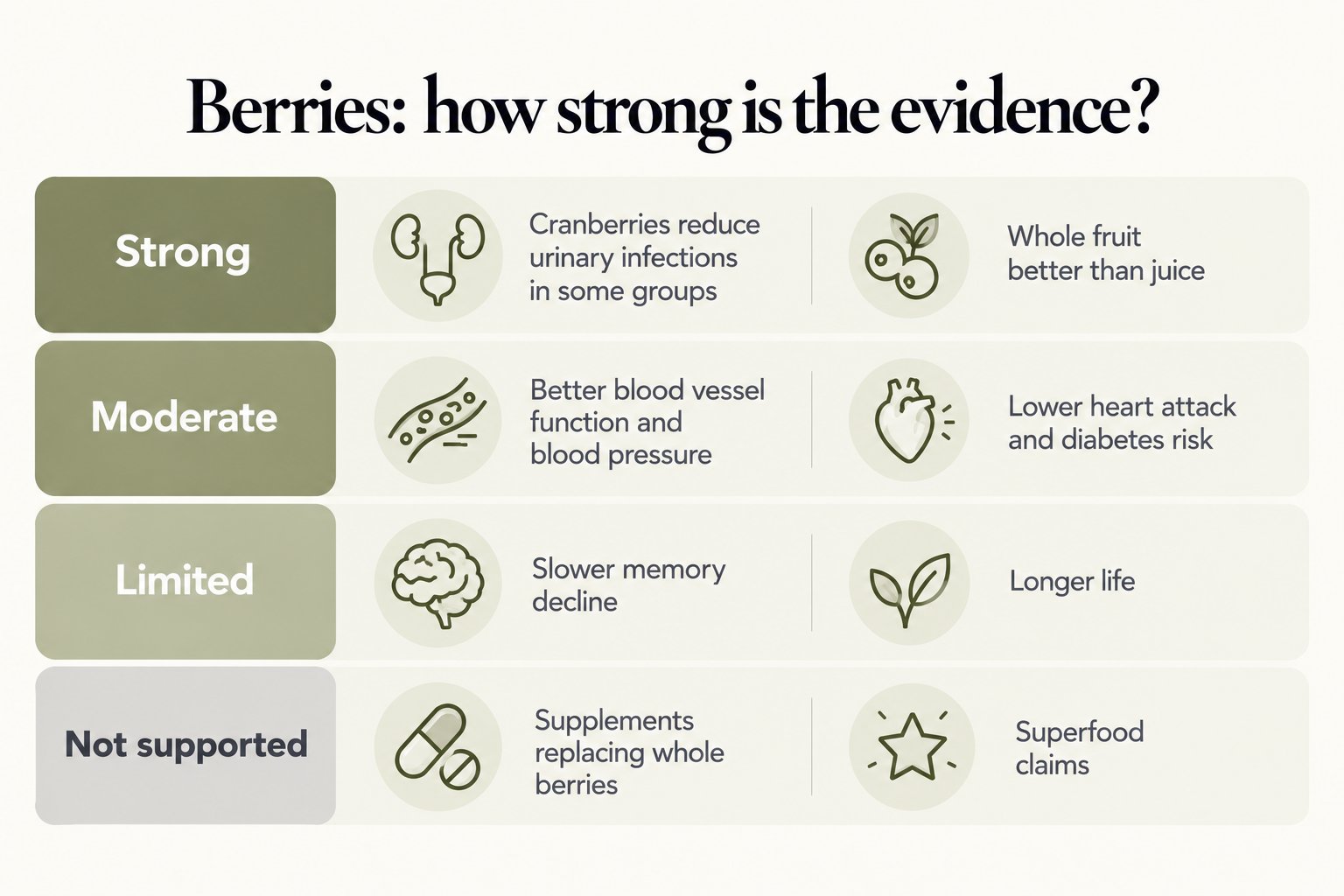
Strong.
- Cranberries reduce UTIs in women with recurrent infections, children and after bladder procedures.
- Whole fruit is better than juice for diabetes risk.
Moderate.
- Blood vessel function and blood pressure: improvements in several randomised trials.
- Lower risk of heart attack and type 2 diabetes: consistent large observational studies.
Limited.
- Slower cognitive decline: strong observational links, but trials are small and short, with mixed results.
- Longer life: linked to higher flavonoid intake, but berry-specific mortality data is limited.
Not supported.
- Berry supplements or extracts as a replacement for whole berries: most evidence comes from whole berries or freeze-dried berry powder.
- "Superfood" claims that one food prevents disease: berries work as part of an overall healthy diet.
Important limitations.
- Most large studies are observational in mostly white, health-conscious US or UK populations, so berry eaters may be healthier in other ways.
- Several trials were funded by berry industry groups.
- Benefits in trials sometimes required fairly large amounts, such as a cup a day.
- There's little data from South Asian populations or on local berries.
Berries in Sri Lanka
Many of the berries studied in research, such as blueberries, blackberries and cranberries, aren't grown widely in Sri Lanka and can be expensive. Good options include:
- Frozen berries: frozen blueberries, mixed berries and strawberries are increasingly available in supermarkets, are usually cheaper than fresh imported berries, and keep their polyphenols well.
- Strawberries: grown in the hill country, around Nuwara Eliya.
- Jamun (madan): a deep purple seasonal fruit rich in anthocyanins.
- Mulberries: grown in some home gardens; dark varieties are rich in anthocyanins.
- Other colourful local fruits: guava, nelli (Indian gooseberry), ketembilla and lovi provide vitamin C, fibre and polyphenols, though they've been far less studied.
- Dried berries: cranberries and other dried berries are often sweetened with added sugar, so check labels and eat them in small amounts.
How to eat more berries
- Aim for at least three servings a week, ideally more. A serving is about half a cup (75 g); trials showing benefits often used up to a cup a day.
- Choose whole berries over juice, smoothies with added sugar or berry-flavoured products.
- Use frozen berries, which are convenient and nutritious; add them to oats, yoghurt or curd.
- Mix colours: combine blueberries, strawberries, jamun and other fruits for a range of polyphenols.
- Eat them with protein or fat, such as yoghurt or nuts, for a filling snack (see Building a Longevity Plate).
- Wash fresh berries well before eating.
- Be careful with sweetened products: berry jams, cordials, flavoured yoghurts and dried berries often contain a lot of added sugar.
- Medication note: if you take warfarin, keep your intake of cranberry products steady and tell your doctor if you're taking large amounts.
Why this matters for longevity
The biggest gains in longevity come from overall eating patterns rich in plant foods (see Eating Patterns for Longevity). Berries fit these patterns perfectly: they're low in sugar, high in fibre and polyphenols, and linked to healthier blood vessels, steadier blood sugar and a sharper brain with age. They're safe, easy to add and enjoyable, which makes them one of the simplest upgrades to a daily diet. They work best as part of a varied diet with plenty of vegetables, legumes, nuts and whole grains, not as a standalone fix.
Recommendations by situation
| Situation | What to consider |
|---|---|
| Healthy adult wanting to eat for longevity | At least 3 servings of berries a week; mix colours |
| Concerned about memory or brain ageing | Berries at least twice a week as part of a MIND-style diet |
| High blood pressure or metabolic syndrome | Up to a cup of berries a day; continue other lifestyle and medical treatment |
| Prediabetes or type 2 diabetes | Choose whole berries over other fruit and juice; pair with protein |
| Recurrent urinary tract infections (women) | Cranberry products may reduce recurrences; talk to your doctor |
| On a tight budget | Frozen berries, seasonal jamun, local fruit such as guava and nelli |
| Taking warfarin | Keep cranberry intake steady; discuss large amounts with your doctor |
| Children | Fresh or frozen whole berries; avoid sweetened berry drinks |
Practical notes
Try adding a handful of berries to your breakfast most days: blueberries or mixed frozen berries on oats, curd or yoghurt, or fresh strawberries and seasonal jamun as a snack. Choose whole fruit over juice and watch for added sugar in dried berries and berry products. If berries are expensive, frozen and local fruit are good alternatives. Remember that no single food determines how well you age; berries are one helpful part of an overall healthy diet. Our Longevity Doctors review diet alongside metabolic, heart and brain health in every assessment, starting with the free longevity assessment.
- Devore EE, et al. Dietary intakes of berries and flavonoids in relation to cognitive decline. Annals of Neurology, 2012;72(1):135-143.
- Cassidy A, et al. High anthocyanin intake is associated with a reduced risk of myocardial infarction in young and middle-aged women. Circulation, 2013;127(2):188-196.
- Curtis PJ, et al. Blueberries improve biomarkers of cardiometabolic function in participants with metabolic syndrome: results from a 6-month, double-blind, randomized controlled trial. American Journal of Clinical Nutrition, 2019;109(6):1535-1545.
- Wood E, et al. Blueberries and cardiovascular disease prevention. Wild blueberry (poly)phenols improve vascular function and cognitive performance in healthy older individuals: a double-blind randomized controlled trial. American Journal of Clinical Nutrition, 2023;117(6):1306-1319.
- Muraki I, et al. Fruit consumption and risk of type 2 diabetes: results from three prospective longitudinal cohort studies. BMJ, 2013;347:f5001.
- Parmenter BH, et al. High diversity of dietary flavonoid intake is associated with a lower risk of all-cause mortality and major chronic diseases. Nature Food, 2025.
- Williams G, et al. Cranberries for preventing urinary tract infections. Cochrane Database of Systematic Reviews, 2023;11:CD001321.
Free longevity assessment
Want help building
a longevity diet?
Take the free Aevum Protocol assessment to see how your nutrition & metabolism and 6 other longevity domains are performing — and get a personalised 90-day plan.
Take the free assessmentKeep reading