Nutrition & Metabolism
Sugar and Refined Carbohydrates:
What They Do to Your Metabolism and How to Cut Back
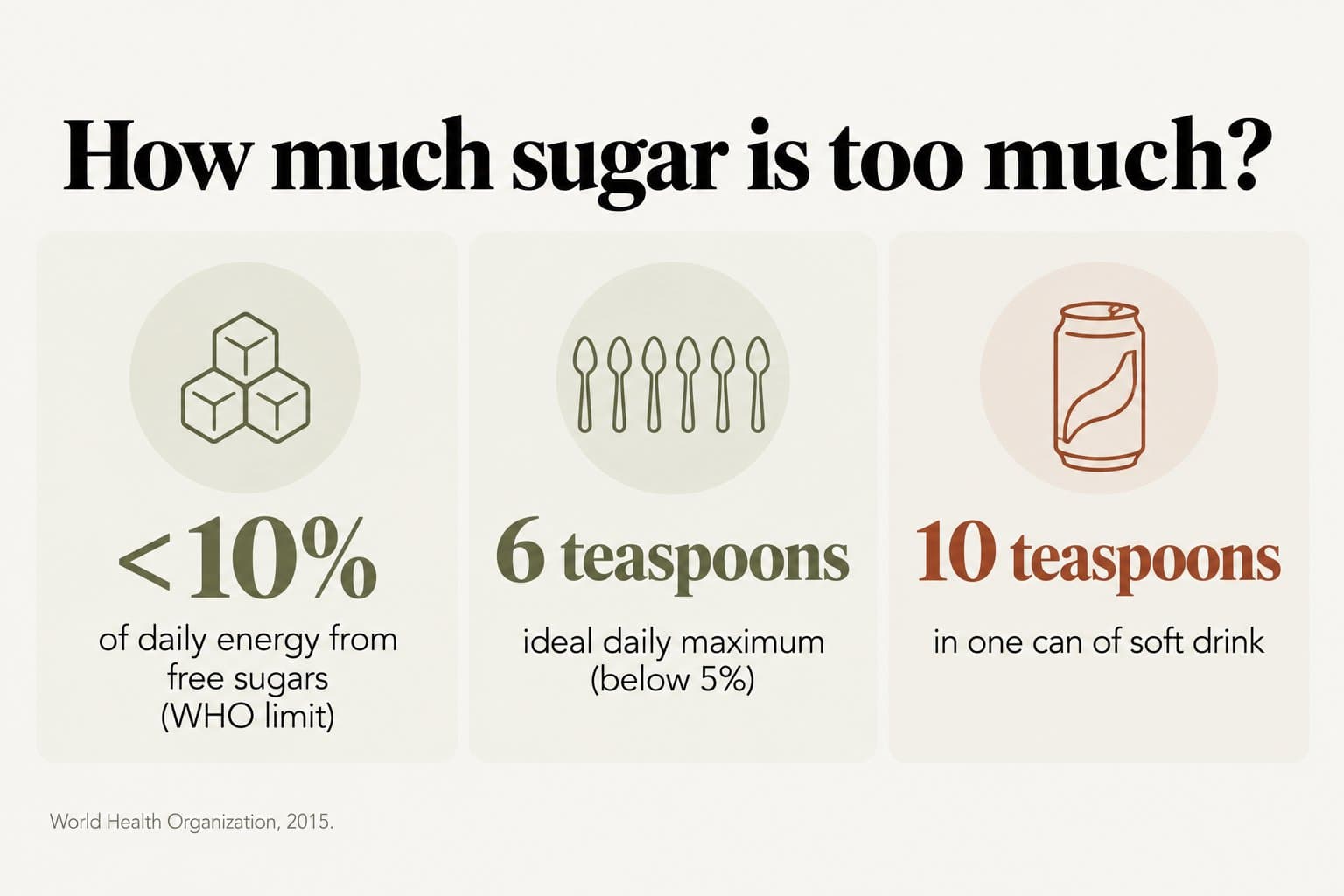
Carbohydrates aren't the enemy, but their quality matters enormously. Whole grains, legumes, vegetables and whole fruit provide fibre and nutrients, while added sugars and refined starches deliver fast-acting glucose with little else. The World Health Organization recommends keeping "free sugars", meaning sugar added to food and drinks plus the sugars in honey, syrups and fruit juice, below 10% of daily energy, and ideally below 5%, about 6 teaspoons a day. A single can of soft drink contains about 10. Refined starches matter too. In a meta-analysis of over 350,000 people, those in Asian countries who ate the most white rice had a 55% higher risk of type 2 diabetes than those who ate the least, and each extra daily serving raised risk by about 11%. By contrast, a major review commissioned by WHO found that people eating the most fibre had a 15-30% lower risk of death and chronic disease. This matters greatly in Sri Lanka, where almost 1 in 4 adults has diabetes and another 1 in 3 has raised blood sugar. This article explains how sugars and refined carbohydrates affect your body and how to improve the quality of carbohydrates you eat.
Key numbers
| Finding | Detail |
|---|---|
| WHO free sugar limit | Below 10% of daily energy; ideally below 5%, about 6 teaspoons |
| Sugar in a can of soft drink (WHO) | About 10 teaspoons |
| White rice and type 2 diabetes (352,384 people) | 55% higher risk with the highest vs lowest intake in Asian populations; 11% higher per daily serving |
| Fibre and health (185 cohort studies, 58 trials) | 15-30% lower risk of death and chronic disease with the highest intakes |
| Diabetes in Sri Lanka (over 6,000 adults, 2019) | 23% have diabetes; 31% have pre-diabetes; 38% of those with diabetes are undiagnosed |
Not all carbohydrates are equal
Carbohydrates range from intact whole foods to highly processed sugars:
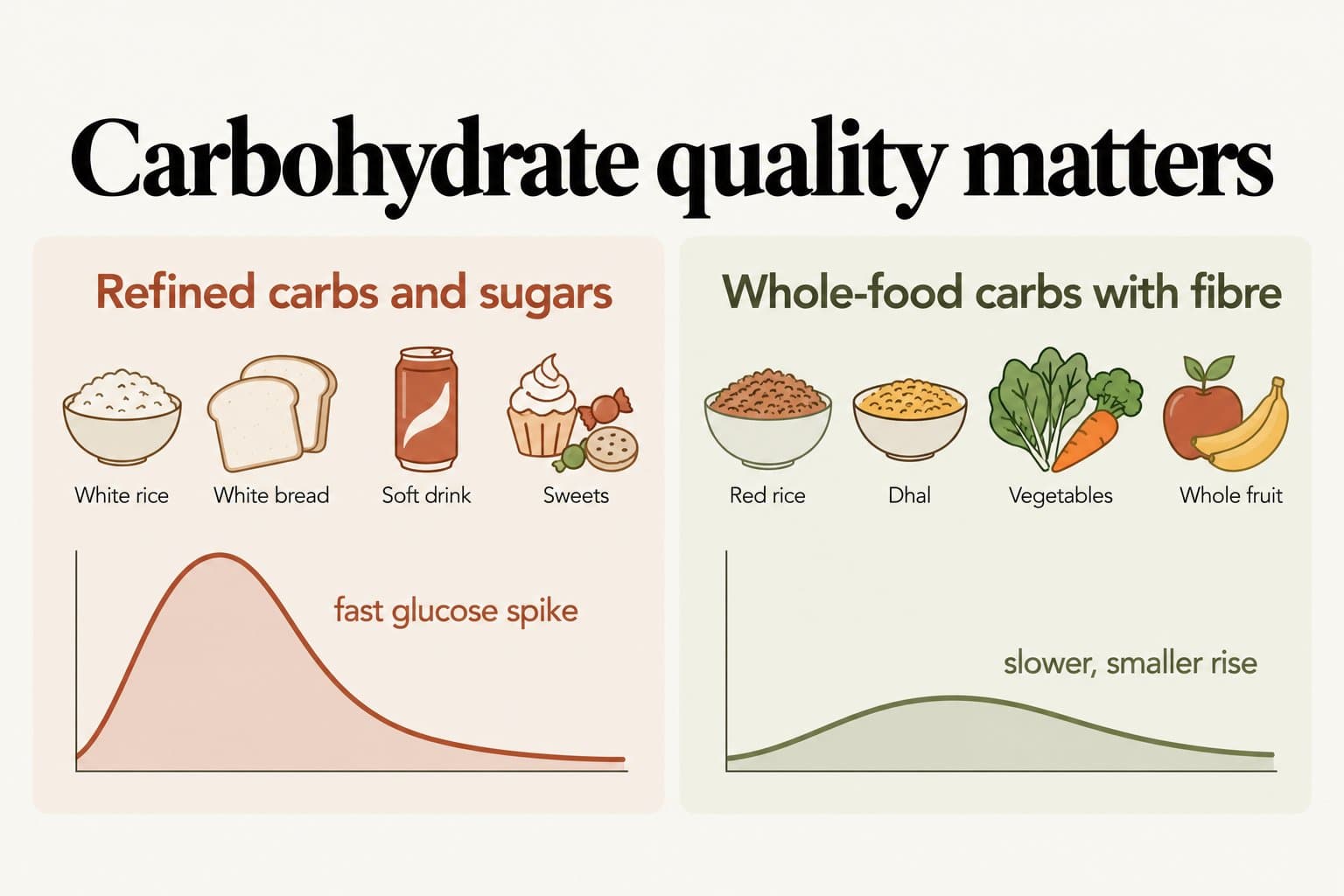
- Whole and minimally processed: vegetables, legumes, whole fruit, whole grains such as red rice, kurakkan and oats. Fibre slows digestion, so glucose enters the blood gradually.
- Refined starches: white rice, white bread, string hoppers and hoppers made from white flour, many biscuits and short eats. Milling removes the bran and germ, leaving starch that's digested quickly.
- Free sugars: sugar added to tea, sweets and soft drinks, plus honey, treacle, syrups and fruit juice. These provide energy with no fibre and few nutrients.
Two measures describe how foods raise blood sugar. The glycaemic index (GI) compares how quickly a carbohydrate raises blood sugar, while the glycaemic load (GL) also accounts for the amount eaten. A small portion of a high-GI food may have less effect than a large plate of a moderate-GI food. Portion size, cooking, and what you eat alongside, such as fibre, protein and fat, all change the response.
What happens in the body
When refined carbohydrates and sugars are eaten in large amounts, blood glucose rises quickly and the pancreas releases a surge of insulin. Over time, frequent spikes, especially with excess weight and inactivity, contribute to insulin resistance, fat build-up in the liver and type 2 diabetes (see Insulin Resistance and Fatty Liver Disease (MASLD)). Fructose from added sugars and sugary drinks is processed mainly in the liver, where excess is turned into fat. Sugary drinks are particularly problematic because liquid calories don't fill you up, so people don't eat less food to compensate.
What the research shows
Free sugars. In 2015, the WHO strongly recommended that adults and children reduce free sugars to less than 10% of total energy, with further benefits below 5%, roughly 6 teaspoons a day. It found that people eating less sugar had lower body weight, children with high intakes of sugary drinks were more likely to be overweight, and tooth decay rose when free sugars exceeded 10% of energy. Much sugar is hidden: a tablespoon of ketchup contains about a teaspoon, and a can of soft drink about 10.
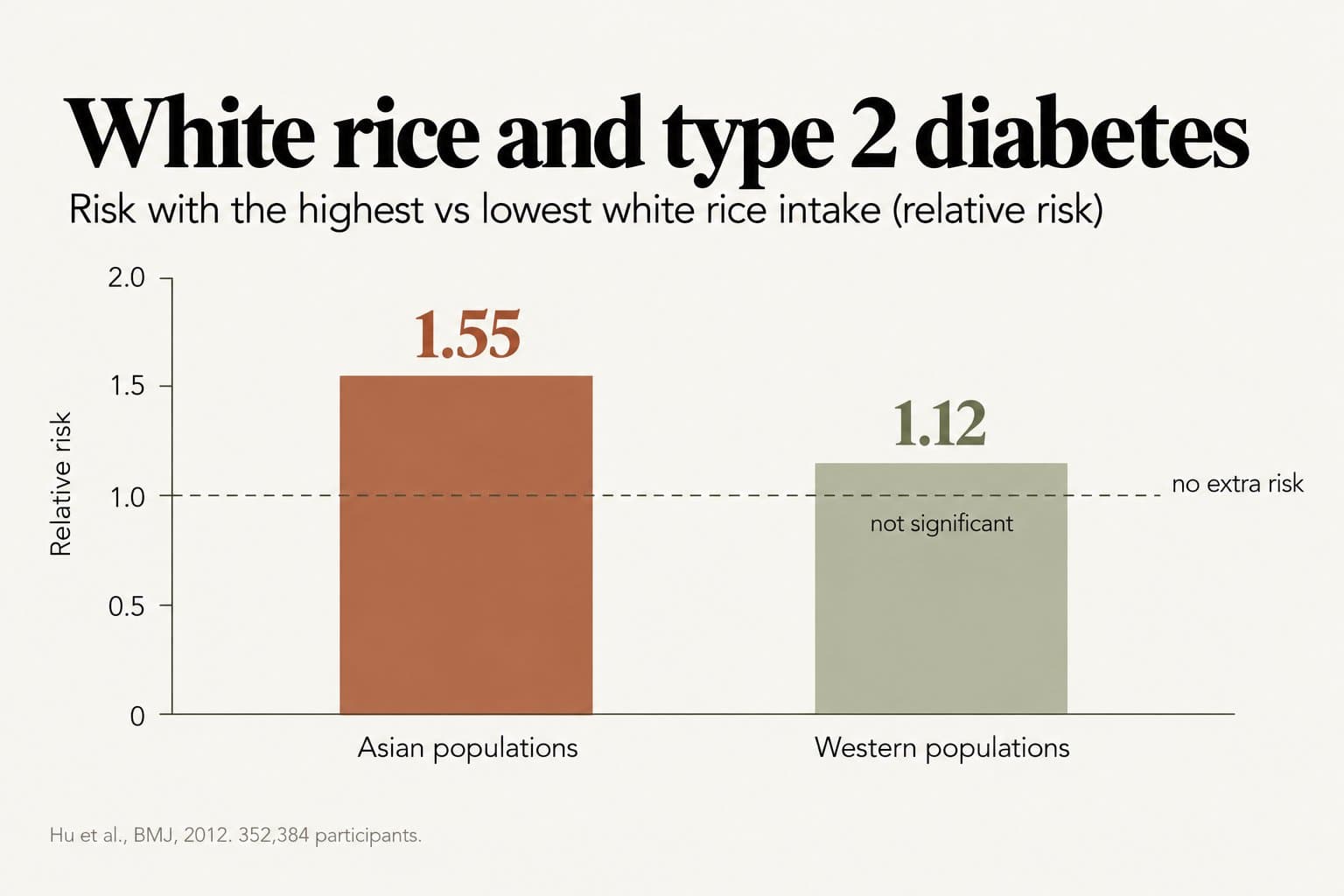
White rice and diabetes risk. A 2012 BMJ meta-analysis of prospective cohort studies with 352,384 participants found that, in Asian populations (China and Japan), people who ate the most white rice had a 55% higher risk of type 2 diabetes than those who ate the least (RR 1.55). In Western populations, who eat far less rice, the link wasn't significant (RR 1.12). Overall, each extra daily serving was linked to an 11% higher risk. Experts cautioned that this can't prove cause and effect, as obesity, inactivity and income may contribute, but the findings are highly relevant to rice-based diets (see Know Your Rice).
Carbohydrate quality: fibre and whole grains. A WHO-commissioned review in The Lancet analysed 185 cohort studies and 58 clinical trials. People eating the most fibre had a 15-30% lower risk of death and of coronary heart disease, stroke, type 2 diabetes and bowel cancer than those eating the least. The authors recommended at least 25-29 grams of fibre a day; most people eat less than 20. Whole grain intake showed similar benefits. In contrast, low-GI or low-GL diets showed only limited benefit, partly because some low-GI foods contain added sugars, fat or salt. The lesson is that carbohydrate quality is best judged by fibre and whole-food content, not GI alone (see Fibre in the Sri Lankan Diet).
The Sri Lankan picture. The Sri Lanka Health and Ageing Survey, which tested over 6,000 adults in 2019, found that almost 1 in 4 adults (23%) had diabetes and another 1 in 3 (31%) had raised blood sugar, and that 38% of those with diabetes didn't know it. Large portions of white rice, sweetened tea, sweets and refined-flour foods are part of the picture, alongside rising weight and inactivity.
Why this matters for longevity
High intakes of sugar and refined carbohydrates drive many of the processes that shorten healthspan: weight gain, insulin resistance, fatty liver, type 2 diabetes and heart disease. Improving carbohydrate quality, by swapping refined grains for whole ones, cutting sugary drinks and adding fibre, is one of the most effective dietary changes for long-term metabolic health (see Eating Patterns for Longevity).
Practical notes
- Cut sugary drinks first: soft drinks, sweetened fruit juices, energy drinks and heavily sweetened tea and coffee. Gradually reduce sugar in tea.
- Shrink the rice portion and fill half the plate with vegetables, greens and dhal.
- Choose whole grains: red or less-polished rice, kurakkan, oats and wholemeal bread.
- Eat fruit whole, not as juice.
- Pair carbohydrates with protein, fibre and healthy fats to slow the rise in blood sugar.
- Read labels: look for added sugars under names such as glucose syrup, sucrose and dextrose. For more, see Ultra-Processed Foods.
- Get tested: because many people with diabetes don't know they have it, check your fasting glucose or HbA1c regularly, especially if you have risk factors.
- World Health Organization. Guideline: sugars intake for adults and children. 2015. Reported by PAHO/WHO, 4 March 2015.
- Hu EA, et al. White rice consumption and risk of type 2 diabetes: meta-analysis and systematic review. BMJ, 2012;344:e1454.
- Reynolds A, et al. Carbohydrate quality and human health: a series of systematic reviews and meta-analyses. The Lancet, 2019;393(10170):434-445.
- Rannan-Eliya RP, et al. Prevalence of diabetes and pre-diabetes in Sri Lanka: a new global hotspot - estimates from the Sri Lanka Health and Ageing Survey 2018/2019. BMJ Open Diabetes Research & Care, 2023;11(1):e003160.
Free longevity assessment
How many teaspoons of sugar
are in your day?
Take the free Aevum Protocol assessment to see how your nutrition & metabolism and 6 other longevity domains are performing — and get a personalised 90-day plan.
Take the free assessment