Nutrition & Metabolism
Urolithin A:
The Gut-Made Compound That Recycles Your Mitochondria
Urolithin A is a compound your gut bacteria make from ellagitannins, plant polyphenols found in pomegranates, walnuts and berries. It has attracted attention in longevity medicine because it switches on mitophagy, the process cells use to clear out worn-out mitochondria (the "power plants" inside cells). Mitophagy declines with age, and damaged mitochondria build up, especially in muscle. In a 2016 study in Nature Medicine, urolithin A extended the lifespan of tiny C. elegans worms by more than 45% and improved running endurance in elderly mice by 42%. The catch is that not everyone can make it: in a US study of 100 healthy adults, only about 40% converted pomegranate juice into meaningful amounts of urolithin A, and only 12% had detectable levels at the start. That's why it's now sold as a purified supplement, usually 500-1,000 mg a day. Small human trials, all funded by the company that makes the main product, have found improvements in leg strength and muscle endurance, lower markers of inflammation, and signs of better mitochondrial and immune function. But some key outcomes, such as walking distance in older adults, haven't consistently improved, and there are no long-term studies on disease or lifespan. Urolithin A looks safe in short-term studies and is one of the more promising longevity supplements, but it's still early. This article explains how it's made, what it does, what the evidence shows and who might reasonably consider it.
Key numbers
| Finding | Detail |
|---|---|
| Worm lifespan (Ryu 2016) | More than 45% longer with urolithin A |
| Elderly mice (Ryu 2016) | 42% better running endurance |
| People who produce it from food (100 US adults) | About 40% convert pomegranate juice well; 12% had detectable levels at baseline |
| Supplement vs pomegranate juice | 500 mg dose gave about 6 times higher blood levels than 240 ml of juice |
| Middle-aged adults (88, 4 months) | About 12% improvement in leg muscle strength |
| Usual supplement dose in trials | 500-1,000 mg a day |
| Human safety data | Single doses up to 2,000 mg; daily use up to 4 months |
What urolithin A is
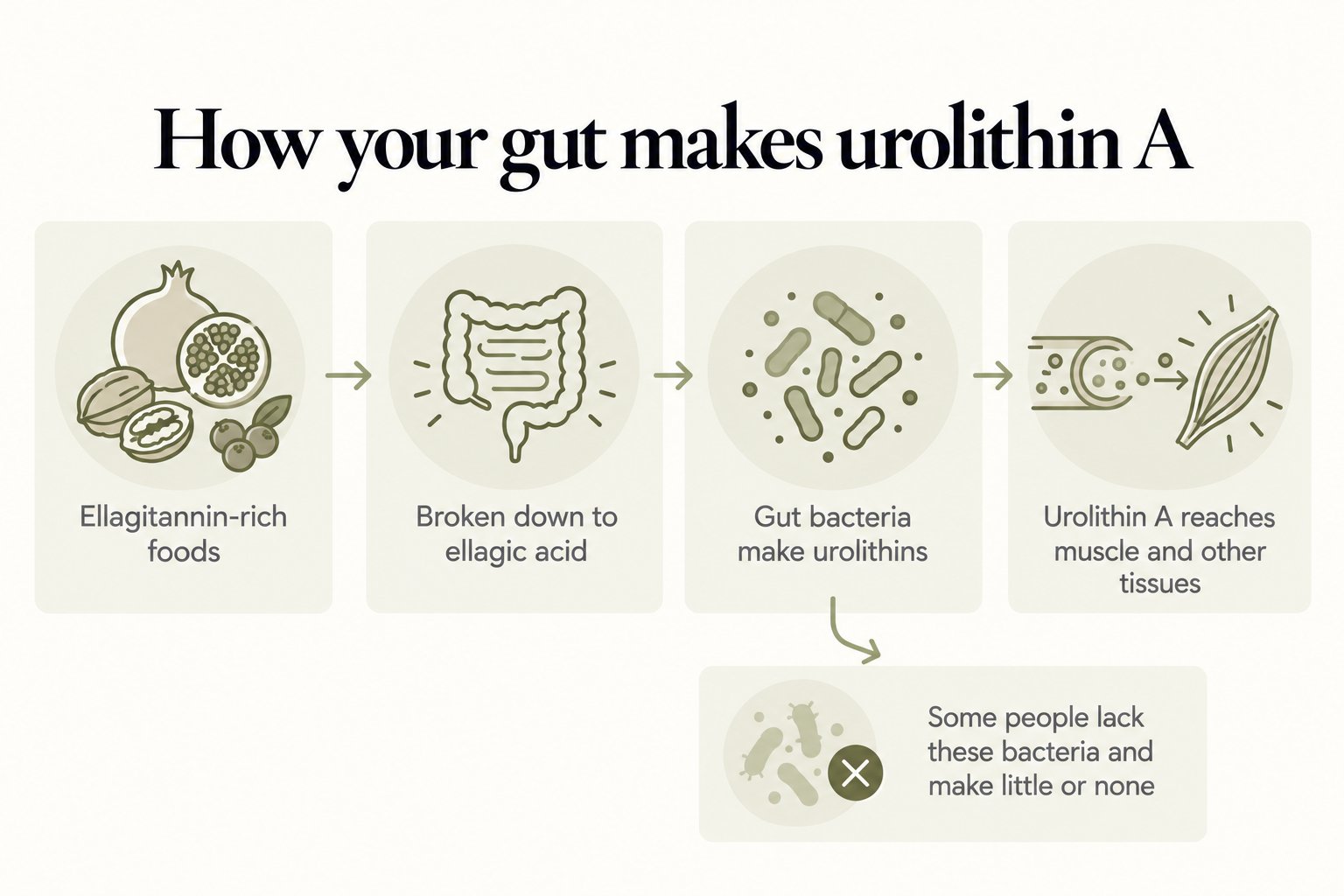
Urolithin A isn't found in food itself. It's a postbiotic, a compound made by gut bacteria from something we eat.
From food to urolithin A.
- 1. You eat ellagitannins. These polyphenols are found in pomegranates, walnuts, pecans, strawberries, raspberries and blackberries. Some Sri Lankan fruits, such as guava, nelli (Indian gooseberry) and madan (jamun), also contain ellagitannins or ellagic acid.
- 2. They're broken down to ellagic acid in the gut. Very little ellagitannin or ellagic acid is absorbed directly.
- 3. Gut bacteria convert ellagic acid step by step into a family of compounds called urolithins, ending with urolithin A (and, in some people, urolithin B and isourolithin A).
- 4. Urolithin A is absorbed and circulates in the blood, mainly in a modified (glucuronide) form, reaching tissues such as muscle.
Why some people make it and others don't. Researchers group people into three "urolithin metabotypes" depending on their gut bacteria:
- Metabotype A: produce mainly urolithin A.
- Metabotype B: produce urolithin A plus isourolithin A and urolithin B.
- Metabotype 0: produce no final urolithins at all.
The bacteria involved belong to a small group of gut microbes, including the family Eggerthellaceae. How much urolithin A you make depends on your microbiome, which is shaped by diet, age, body weight and health. In a 2018 study of 839 people aged 5 to 90, age was the main factor determining metabotype. In the US study of 100 adults, those who produced urolithin A had more diverse gut bacteria. This means two people eating the same bowl of pomegranate can get very different amounts (see The Gut Microbiome and Fermented Foods).
What urolithin A does
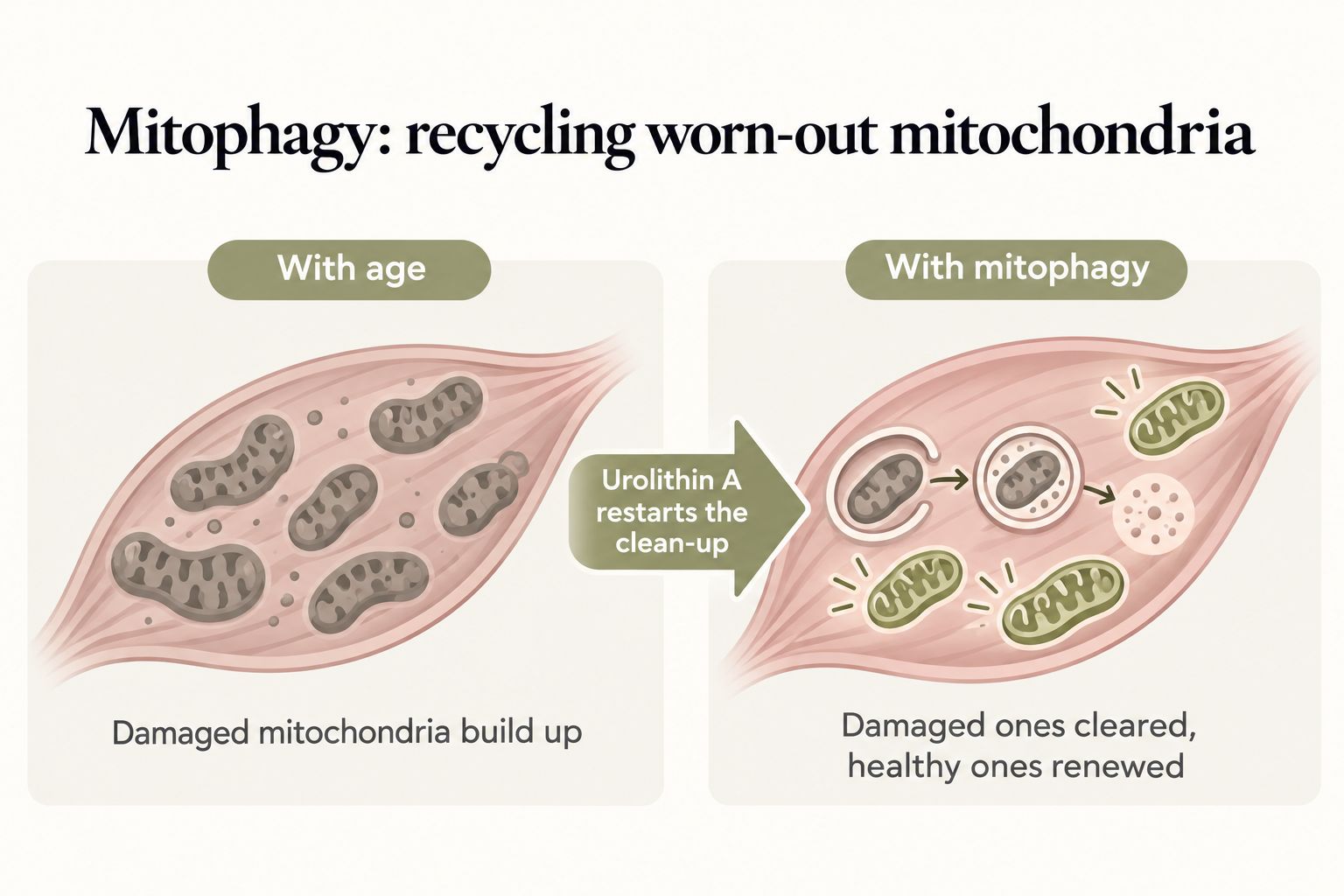
Mitophagy: clearing out damaged mitochondria. Mitochondria produce most of the energy our cells use. Over time they become damaged and less efficient, producing less energy and more harmful by-products. Healthy cells constantly remove damaged mitochondria through mitophagy, a specialised form of autophagy, and replace them with new ones (see Autophagy). Mitophagy slows with age, and damaged mitochondria accumulate. This mitochondrial dysfunction is one of the recognised hallmarks of ageing (see Mitochondria and Ageing and The Hallmarks of Ageing).
Urolithin A is one of the few dietary compounds shown to stimulate mitophagy in animals and in human muscle. In muscle biopsies from human trials, it increased proteins involved in mitophagy and mitochondrial function.
Other effects being studied.
- Muscle: better strength and endurance in small trials.
- Inflammation: lower C-reactive protein (CRP) and some inflammatory cytokines (see Inflammaging).
- Immune ageing: more "younger" (naive) immune T cells in a 2025 trial.
- Animal studies only: effects on joints, brain, gut lining and heart are being studied, but haven't been confirmed in people.
What the human trials show
Almost all human studies so far have used Mitopure, a purified urolithin A product, and have been funded by Amazentis (now Timeline), the company that developed it. Several authors work for or advise the company. That doesn't make the results wrong, but independent confirmation is still needed.
First safety trial (2019). In the first human trial, published in Nature Metabolism, healthy, sedentary older adults took single doses of 250-2,000 mg, then 250, 500 or 1,000 mg daily or placebo for 28 days. Urolithin A was well tolerated with no safety concerns, reached the blood at all doses, and at 500 and 1,000 mg changed blood markers of mitochondrial fat-burning (acylcarnitines) and the activity of mitochondrial genes in muscle.
Older adults: early endurance gains, no walking benefit (2022). In a trial published in JAMA Network Open, 66 adults aged 65-90 took 1,000 mg a day or placebo for four months. At two months, those taking urolithin A had significantly better muscle endurance in the hand and leg than those on placebo, but by four months the placebo group had also improved and the difference was no longer significant. Urolithin A did lower acylcarnitines, ceramides and CRP. But the 6-minute walk distance, a key measure of physical function, improved in both groups with no difference between them, and direct measures of mitochondrial energy production didn't change.
Middle-aged adults: leg strength up about 12% (2022). In the ATLAS trial, published in Cell Reports Medicine, 88 overweight, inactive adults aged 40-64 took 500 mg, 1,000 mg or placebo for four months. Both doses improved leg muscle strength by about 12%. The higher dose also improved some measures of endurance and physical performance. The trial's main outcome, peak power output, didn't significantly change, and grip strength and peak oxygen uptake only trended upwards. CRP and acylcarnitines fell, and muscle samples showed more mitophagy and mitochondrial proteins.
Immune ageing (2025). In a trial published in Nature Aging, 50 healthy middle-aged adults took 1,000 mg a day or placebo for four weeks. Urolithin A increased the proportion of naive-like, less "exhausted" CD8 T cells, which normally decline with age, and improved their ability to burn fat for fuel and make new mitochondria. It also boosted some other immune cell types and their function. These are early, short-term changes in immune markers, not proof of fewer infections or better health.
Young athletes. A small eight-week trial in young men who did resistance training found no significant difference in maximal strength with 1,000 mg a day, suggesting benefits may be greatest in people whose mitochondria have declined with age or inactivity.
Evidence strength
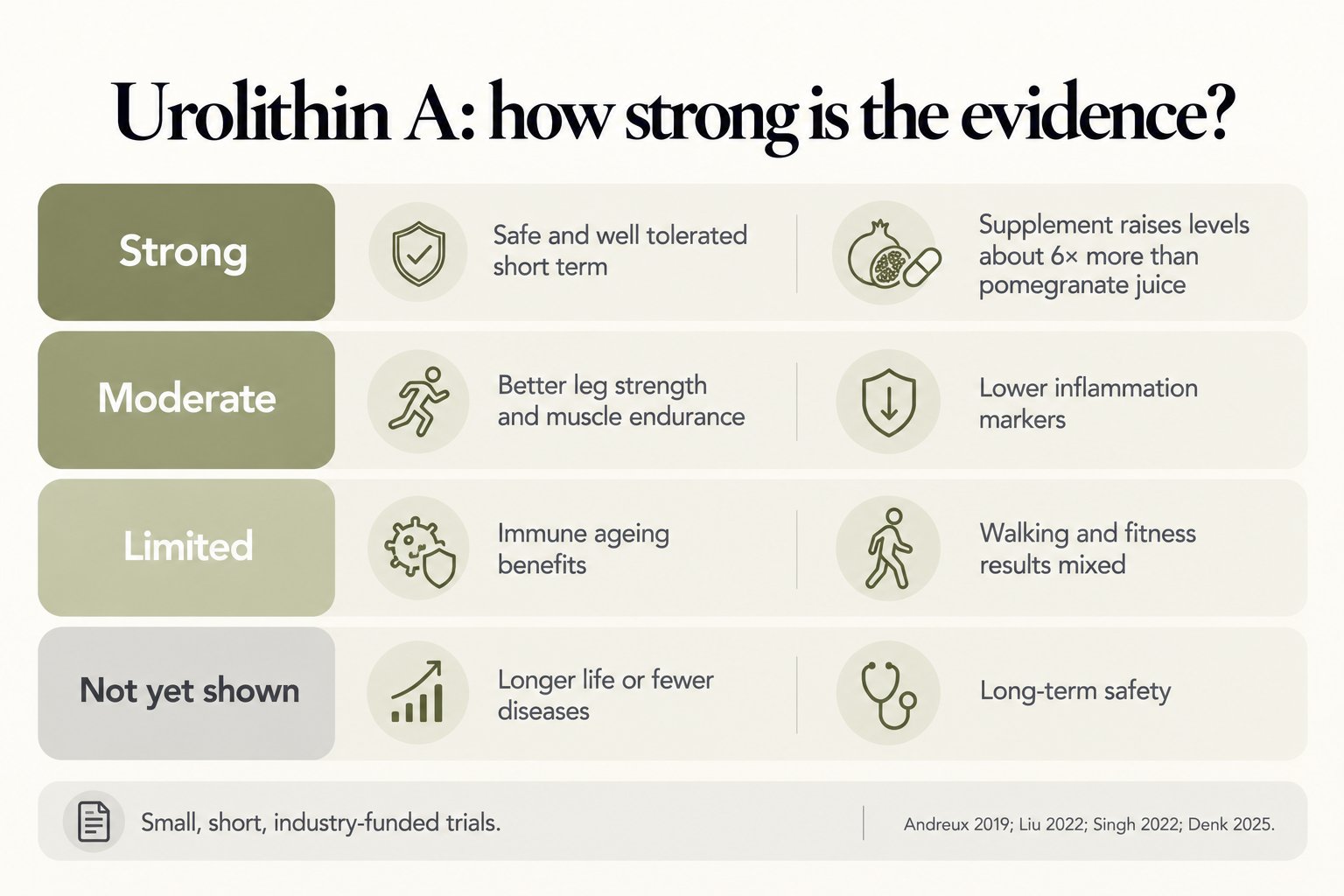
Strong.
- Short-term safety: single doses up to 2,000 mg and daily doses up to 1,000 mg for four months have been well tolerated in trials. Animal toxicology studies found no organ toxicity or genotoxicity. In 2018, the US FDA raised no questions about its use in foods at up to 500-1,000 mg per serving.
- Supplements bypass the microbiome: a 500 mg dose produced about six times higher blood levels than a glass of pomegranate juice, regardless of a person's gut bacteria.
Moderate.
- Muscle strength and endurance: improvements in two trials in middle-aged and older adults, although in the older-adult trial the endurance benefit was significant at two months but not at four.
- Inflammation and mitochondrial markers: lower CRP, acylcarnitines and ceramides; more mitophagy proteins in muscle.
Limited.
- Immune ageing: one four-week trial of 50 people.
- Physical function: walking distance and fitness results are mixed.
- Younger, active people: little evidence of benefit.
Not supported (yet).
- Longer lifespan or fewer age-related diseases in humans: the worm and mouse results haven't been tested in people.
- Brain, joint, heart, skin or gut benefits: mainly animal and laboratory studies.
Important limitations.
- All the main trials were small, short (four weeks to four months) and funded by the manufacturer.
- Most participants were white Europeans or Americans; there's no data from South Asian populations.
- There's no safety data for pregnancy, breastfeeding or children, and little research on interactions with medicines.
- We don't yet have a reliable, widely available test to tell whether you're a natural producer.
Food or supplement?
Food first. Ellagitannin-rich foods such as pomegranate, walnuts, berries and guava are healthy in their own right, providing fibre, polyphenols and healthy fats, whether or not you produce urolithin A. A diet rich in fibre and plant foods also supports a diverse microbiome, which may improve production (see Eating Patterns for Longevity).
But food is unreliable for urolithin A. Many people produce little or none, and even good producers make far less than trial doses.
Supplements provide urolithin A directly:
- Dose: 500-1,000 mg once a day, the doses used in trials. Benefits in trials appeared after about two to four months.
- Form: look for purified, third-party tested urolithin A from a reputable manufacturer. "Pomegranate extract" supplements contain ellagitannins, not urolithin A, so they depend on your gut bacteria.
- Cost: supplements are expensive, so weigh the cost against the modest, still-emerging benefits.
- Combine with exercise: urolithin A isn't a substitute for exercise, which remains the most powerful way to improve mitochondrial health and muscle function.
Why this matters for longevity
Muscle strength and endurance are some of the strongest predictors of healthy ageing and independence, and mitochondrial decline is one of the biological processes behind muscle ageing. Urolithin A is interesting because it targets that process directly, has a plausible mechanism, and has shown early benefits in human trials with a good short-term safety record. That puts it ahead of many longevity supplements (see Longevity Supplements). But its benefits so far are modest, the studies are small and industry-funded, and nobody yet knows whether it helps people live longer or avoid disease. It's best seen as a possible add-on to the proven foundations of exercise, protein, sleep and a healthy diet, not a replacement for them.
Recommendations by situation
| Situation | What to consider |
|---|---|
| Healthy adult, active, good diet | Not necessary; focus on exercise and ellagitannin-rich foods |
| Middle-aged or older, inactive, losing muscle strength | Start with strength training and protein; urolithin A 500-1,000 mg may add a modest benefit |
| Older adult with poor endurance or frailty | Discuss with your doctor; exercise and nutrition first, supplement as an optional add-on |
| Wants to get it from food | Eat pomegranate, walnuts, berries, guava and plenty of fibre; production varies |
| Already taking several supplements | Review the whole list with your doctor before adding another |
| Pregnant, breastfeeding or under 18 | Avoid; no safety data |
| Taking multiple prescription medicines | Ask your doctor first; interaction data is limited |
| Expecting it to slow ageing or extend life | Not yet shown in humans |
Practical notes
If you're curious about urolithin A, start with the basics: regular strength and endurance exercise, enough protein, and a diet with plenty of fruit, nuts and fibre. Enjoy pomegranate, walnuts, guava and berries for their wider benefits. If you're middle-aged or older, inactive, or noticing a decline in strength or stamina, a trial of 500-1,000 mg a day for three to four months is a reasonable option to discuss with your doctor, as long as you continue exercising and judge whether it's worth the cost. Avoid it during pregnancy and breastfeeding. Our Longevity Doctors assess muscle strength, fitness and metabolic health as part of every assessment and can help you decide whether supplements like urolithin A make sense for you, starting with the free longevity assessment.
- Ryu D, et al. Urolithin A induces mitophagy and prolongs lifespan in C. elegans and increases muscle function in rodents. Nature Medicine, 2016;22(8):879-888.
- Andreux PA, et al. The mitophagy activator urolithin A is safe and induces a molecular signature of improved mitochondrial and cellular health in humans. Nature Metabolism, 2019;1(6):595-603.
- Liu S, et al. Effect of urolithin A supplementation on muscle endurance and mitochondrial health in older adults: a randomized clinical trial. JAMA Network Open, 2022;5(1):e2144279.
- Singh A, et al. Urolithin A improves muscle strength, exercise performance, and biomarkers of mitochondrial health in a randomized trial in middle-aged adults. Cell Reports Medicine, 2022;3(5):100633.
- Denk D, et al. Effect of the mitophagy inducer urolithin A on age-related immune decline: a randomized, placebo-controlled trial. Nature Aging, 2025.
- Singh A, et al. Direct supplementation with urolithin A overcomes limitations of dietary exposure and gut microbiome variability in healthy adults to achieve consistent levels across the population. European Journal of Clinical Nutrition, 2022;76(2):297-308.
- Cortés-Martín A, et al. The gut microbiota urolithin metabotypes revisited: the human metabolism of ellagic acid is mainly determined by aging. Food & Function, 2018;9(8):4100-4106.
- Heilman J, et al. Safety assessment of urolithin A, a metabolite produced by the human gut microbiota upon dietary intake of plant derived ellagitannins and ellagic acid. Food and Chemical Toxicology, 2017;108:289-297.
- US Food and Drug Administration. GRAS Notice No. GRN 000791: Urolithin A. 2018.
- Wang M, Yu L. Emerging evidence of urolithin A in sports nutrition: bridging preclinical findings to athletic applications. Frontiers in Nutrition, 2025;12:1585922.
Free longevity assessment
Wondering if urolithin A
is worth it for you?
Take the free Aevum Protocol assessment to see how your nutrition & metabolism and 6 other longevity domains are performing — and get a personalised 90-day plan.
Take the free assessmentKeep reading
Related articles
Longevity Science
Mitochondria and Ageing: Why Your Cells' Power Plants Matter for a Long Life
Nutrition & Metabolism
Longevity Supplements: NMN, Resveratrol, Metformin, Rapamycin and Multivitamins Under the Microscope
Nutrition & Metabolism