Cognitive Longevity
Mild Cognitive Impairment:
The Warning Stage Before Dementia
Mild cognitive impairment (MCI) sits in the space between normal age-related change and dementia: memory or thinking is measurably worse than expected for someone's age and education, but day-to-day independence is still intact. It's often described as "pre-dementia," and that framing is only half right. MCI does raise dementia risk substantially — but a large share of people with MCI stay stable for years, and a meaningful minority return to normal cognition. Where someone ends up depends partly on the underlying cause, and some of those causes are treatable. This article covers what MCI actually is, how often it progresses (and how often it doesn't), and what's worth checking and changing after a diagnosis.
Key numbers
| Finding | Detail |
|---|---|
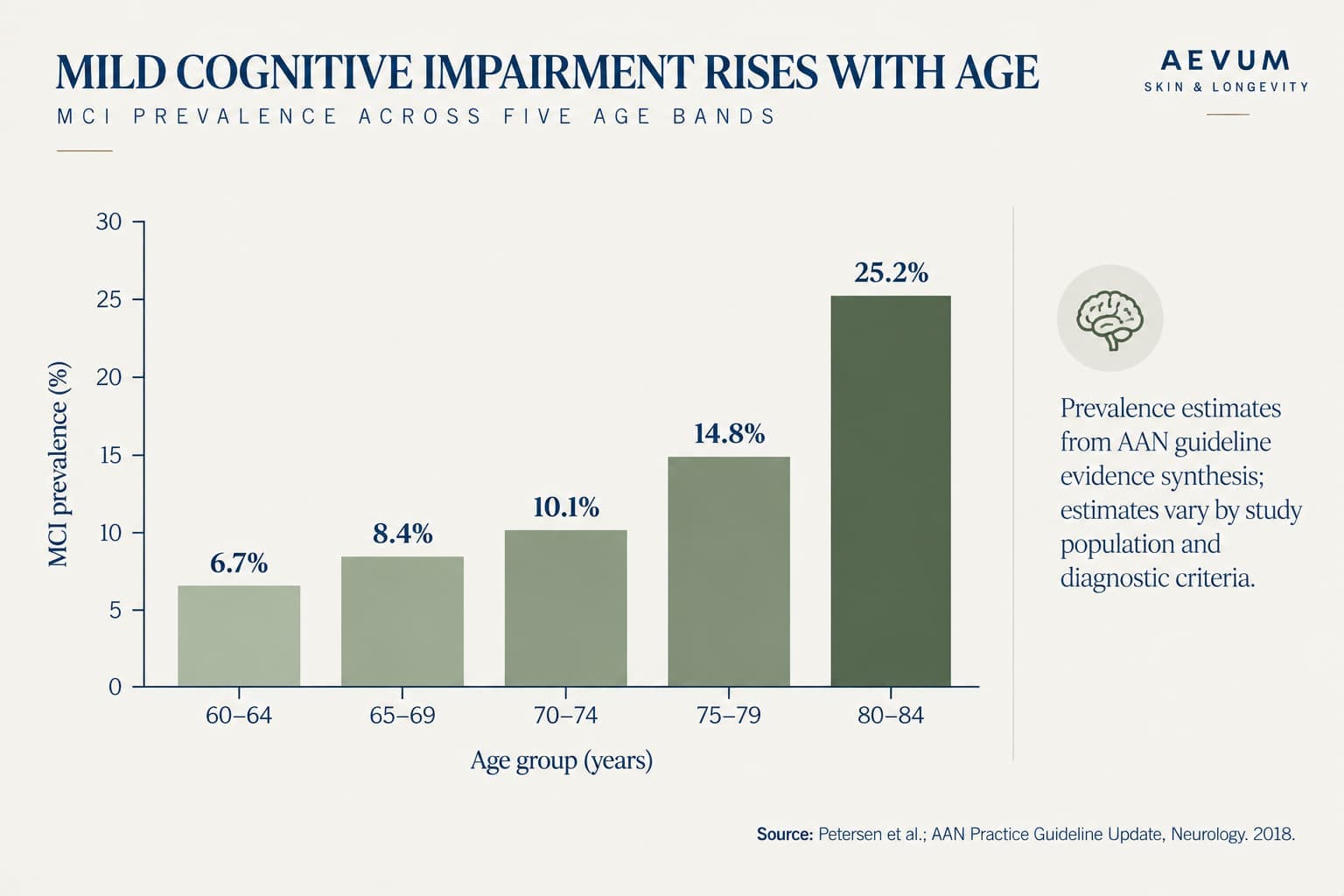
| MCI prevalence by age | 6.7% (60-64) → 8.4% (65-69) → 10.1% (70-74) → 14.8% (75-79) → 25.2% (80-84) |
| Dementia risk with MCI vs. without | Relative risk ~3.3 over 2-5 years |
| Cumulative dementia incidence, MCI patients over 65 | 14.9% over 2 years |
| Progression to dementia (all studies pooled, variable follow-up) | 39% in clinic samples vs. 25% in community samples |
| Reversion to normal cognition (all studies pooled) | 10% in clinic samples vs. 26% in community samples |
| Remained stable (all studies pooled) | 44% clinic / 59% community |
What MCI actually is
A clinical category, not a single disease. MCI is defined by a cluster of features rather than a specific cause: a concern about cognitive change (from the person, a family member, or a clinician), objective evidence of impairment in one or more cognitive domains on testing, largely preserved independence in everyday activities, and not meeting the threshold for dementia. The last two criteria are what separate MCI from dementia — someone with MCI may take longer to manage finances or need more reminders, but can still do these things on their own.
Clinicians usually split MCI into two broad types. Amnestic MCI is dominated by memory impairment and is the subtype most often associated with underlying Alzheimer's pathology. Non-amnestic MCI mainly affects other domains — attention, language, executive function, visuospatial skills — and has a broader range of possible causes, including vascular disease and other neurodegenerative conditions.
Why "MCI" isn't a diagnosis of what's causing it. Because MCI describes a level of impairment rather than a cause, two people with identical MCI labels can have entirely different underlying situations: early Alzheimer's disease, small-vessel vascular damage (covered in Vascular Health and the Brain), untreated depression, sleep apnea, a medication side effect, or a vitamin deficiency. This is the single most important point about MCI, and it explains why outcomes vary so widely.
What shapes where MCI goes
| Factor | Effect on trajectory | Modifiable? | Evidence basis |
|---|---|---|---|
| Underlying Alzheimer's pathology (typically amnestic MCI) | Higher likelihood of progression | Not currently reversible; surrounding risk factors are | Well established |
| Vascular risk factors (blood pressure, diabetes, cholesterol) | Worse trajectory when uncontrolled | Yes | SPRINT MIND: intensive BP control cut incident MCI by 19% |
| Cognitively impairing medications (anticholinergics, benzodiazepines, some sleep aids) | Can cause or worsen MCI-level impairment | Yes — often reversible on withdrawal | AAN guideline (Level B) |
| Depression | Can mimic or compound MCI | Yes — treatable | Standard component of clinical work-up |
| Sleep apnea and other sleep disorders | Can impair attention and memory | Yes — treatable | Standard component of clinical work-up |
| Thyroid dysfunction, B12 deficiency, metabolic abnormalities | Can cause reversible cognitive impairment | Yes | Standard component of clinical work-up |
| Physical inactivity | Associated with worse cognitive outcomes | Yes | AAN recommends regular exercise for MCI (Level B) |
| Genetic risk (e.g., APOE4) | Associated with higher progression risk | No | Well established |
What the research shows
Progression is common, but it isn't the default outcome. The most-cited epidemiological synthesis, from the American Academy of Neurology's 2018 practice guideline update, found MCI prevalence climbs steeply with age — from about 7% in the early 60s to about 25% by the early 80s. The same review estimated that people with MCI carry roughly 3.3 times the dementia risk of cognitively normal peers over 2-5 years, and that about 15% of people with MCI over age 65 develop dementia within two years. (The AAN has since marked this guideline as retired under its standard review cycle, but its epidemiological figures remain widely used.)
A meta-analysis of 59 studies and more than 52,000 people gives a broader view of what actually happens after an MCI diagnosis, and the picture is more mixed than "pre-dementia" implies. Across all studies, roughly a third (34%) progressed to dementia over the follow-up periods studied, but about 45% stayed stable and about 15% reverted to normal cognition. These pooled rates come from different sets of studies with different follow-up lengths, so they don't add up neatly to 100% — but the overall message holds: progression is the single most likely adverse outcome, not the only one.
Where you're diagnosed changes the odds. The same meta-analysis found a meaningful split between people diagnosed in memory clinics and people identified through community screening. In clinic samples, 39% progressed to dementia and 10% reverted. In community samples, only 25% progressed and 26% reverted — more than double the reversion rate. (These clinic and community figures pool all included studies. The headline figures above come from the authors' adjusted analysis, which excluded outlier studies; in that analysis progression was 37% in clinic samples vs. 27% in community samples, and community reversion was 23% — smaller gaps, but the same pattern.)
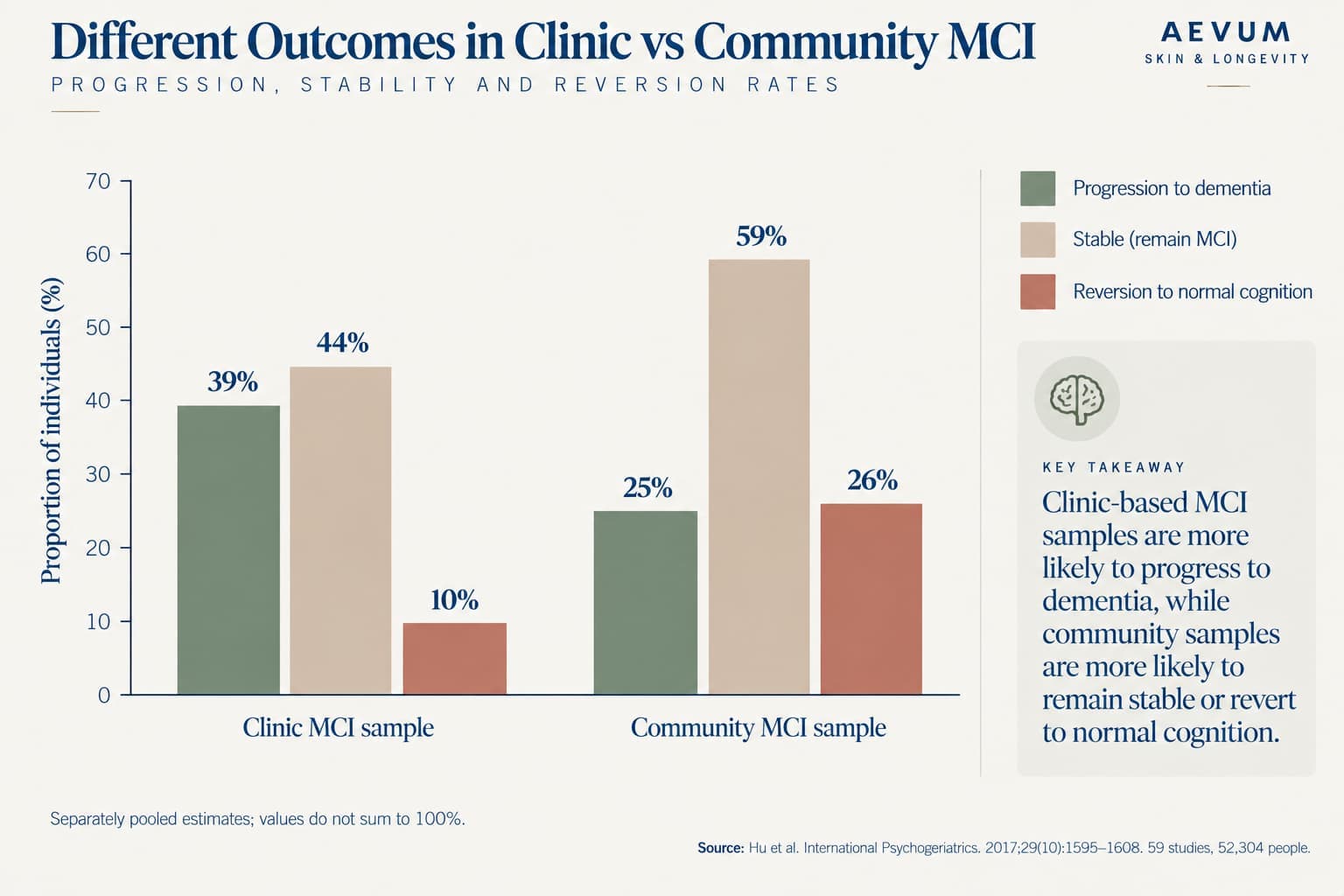
The likely explanation is selection, not a difference in the condition itself. People who reach a memory clinic have usually noticed a problem significant or persistent enough to seek help, and are more likely to have an underlying neurodegenerative cause. Community screening picks up a wider mix, including people whose low scores reflect a temporary cause (poor sleep, illness, stress, a new medication) or ordinary test-to-test variability. This matters for interpreting a diagnosis: an MCI finding from a one-off screening test is less predictive than one confirmed by a specialist over time.
Reversion is real, but not the same as "all clear." Reverting to normal cognition is a good outcome, but longitudinal research has generally found that people who revert remain at higher risk of later decline than people who never met MCI criteria at all. A reverted MCI diagnosis is best read as a reason to keep monitoring and managing risk factors, not a reason to stop.
What you can actually change
- 1Look for reversible and contributing causes first
Clinical guidelines recommend evaluating people with MCI for treatable contributors before attributing the impairment to neurodegeneration. A standard work-up (as outlined by UCSF's Memory and Aging Center, among others) includes blood tests for thyroid function, vitamin B12, blood count, metabolic panel, and calcium; screening for depression, sleep disorders including sleep apnea, and substance use; and a careful medication review. When one of these is found and treated, cognition can improve — sometimes substantially.
- 2Review medications that impair cognition
The AAN guideline recommends discontinuing medications that can contribute to cognitive impairment where possible (Level B). Common culprits include anticholinergic drugs (including some bladder antispasmodics like oxybutynin and older antihistamines like diphenhydramine), benzodiazepines, some sleep medications, tricyclic antidepressants, and opioids. Older adults are often on several of these at once, and their cognitive effects add up. Stopping or switching should always be done with the prescribing doctor, not unilaterally.
- 3Exercise — the one lifestyle intervention the guideline specifically recommends
The AAN guideline recommends regular exercise for people with MCI (Level B), based on evidence that around six months of exercise training likely improves cognitive measures. Cognitive training received a weaker recommendation (Level C) — covered in more detail later in this series.
- 4Control vascular risk factors
Blood pressure, blood sugar, and cholesterol management carry the strongest trial-level evidence of any modifiable factor in this series. For someone already diagnosed with MCI, vascular risk control is one of the clearest ways to protect remaining cognitive reserve.
What doesn't have good evidence. The AAN guideline was notably direct about medication: there's no high-quality evidence that cholinesterase inhibitors (the drug class used for Alzheimer's dementia, such as donepezil) help people with MCI. It advises that clinicians may choose not to offer them (Level B), and that if they do, they must first discuss the lack of evidence with the patient (Level A). Newer anti-amyloid antibody treatments are a separate, evolving area with specific eligibility criteria and risks, and are beyond the scope of this article.
Recommendations
- →If you or a family member receives an MCI diagnosis, ask what's been ruled out. A diagnosis without a work-up for reversible causes — thyroid, B12, depression, sleep apnea, medications — is incomplete.
- →Bring a full medication list, including over-the-counter sleep aids and antihistamines. These are some of the most common and most fixable contributors.
- →Treat a single low screening score with caution. Community-detected MCI reverts far more often than clinic-confirmed MCI. Repeat testing over time gives a much clearer picture than one result.
- →Start or keep up regular exercise. It's the lifestyle intervention with the strongest guideline backing for MCI specifically.
- →Keep monitoring even if cognition improves. Reversion is a good sign, but it doesn't reset risk to baseline.
Practical notes
MCI is best thought of as a signal to investigate and act, not a sentence. Roughly half of people with MCI don't progress over typical follow-up periods, some improve, and a portion of cases have a treatable cause. For people who do have an underlying neurodegenerative process, MCI is also the stage where risk-factor management has the most room to work — which is why the rest of this series focuses on the factors that shape that trajectory.
- Petersen RC, Lopez O, Armstrong MJ, et al. Practice guideline update summary: Mild cognitive impairment. Report of the Guideline Development, Dissemination, and Implementation Subcommittee of the American Academy of Neurology. Neurology, 2018;90(3):126-135.
- Hu C, Yu D, Sun X, Zhang M, Wang L, Qin H. The prevalence and progression of mild cognitive impairment among clinic and community populations: a systematic review and meta-analysis. International Psychogeriatrics, 2017;29(10):1595-1608.
- UCSF Memory and Aging Center. 5-Step Brain Health Work-up.
- SPRINT MIND Investigators. Effect of Intensive vs Standard Blood Pressure Control on Probable Dementia: A Randomized Clinical Trial. JAMA, 2019;321(6):553-561.
Has anyone in your family
been told they have MCI?
Take the free Aevum Protocol assessment to see how your cognitive longevity and 6 other longevity domains are performing — and get a personalised 90-day plan.
Take the Free Assessment →