Cognitive Longevity
Cognitive Testing and Brain Screening:
Who Should Get Tested, and With What
Brain health testing ranges from a 10-minute pen-and-paper test to brain scans and new blood tests that can detect Alzheimer's-related proteins. More testing isn't always better. For people without symptoms, a major US expert panel found there isn't enough evidence to say whether routine memory screening does more good than harm. For people who have noticed changes in their memory or thinking, though, a proper assessment is worthwhile: it can find treatable causes, give a clearer picture of what's happening, and open the door to support and, in some cases, new treatments. This guide explains the main types of test, what each can and can't tell you, and when testing makes sense for your situation.
Key numbers
| Finding | Detail |
|---|---|
| Routine screening of adults 65+ without symptoms (US Preventive Services Task Force, 2020) | Insufficient evidence to recommend for or against |
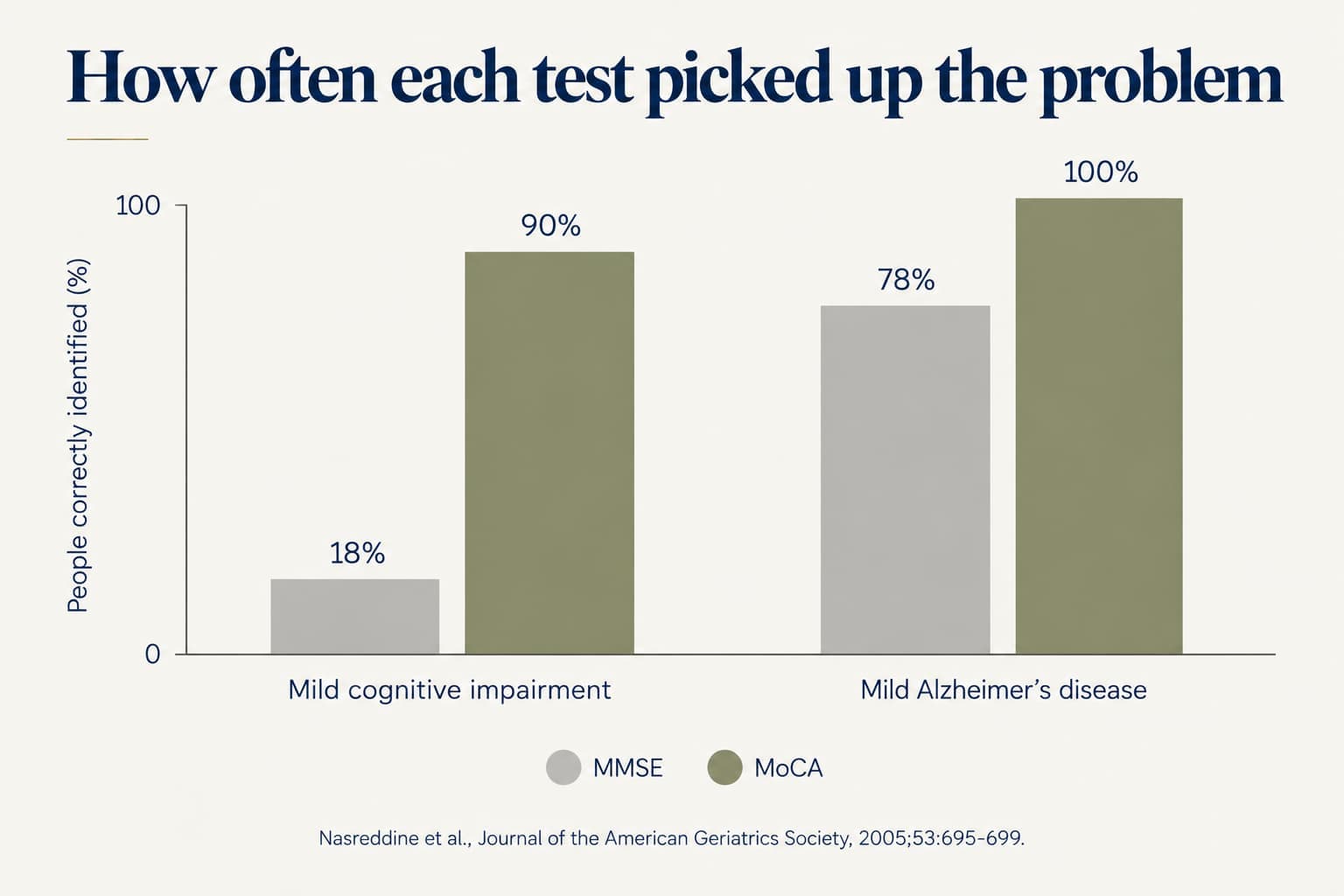
| MoCA vs. MMSE for detecting mild cognitive impairment (original study, 277 people) | MoCA picked up 90%; MMSE picked up 18% |
| MoCA vs. MMSE for mild Alzheimer's disease | MoCA 100%; MMSE 78% |
| Sinhala MoCA for dementia (Sri Lanka, 98 people) | Detected 98% of people with Alzheimer's dementia at a cut-off of 24 |
| First FDA-cleared Alzheimer's blood test (May 2025), in people 55+ with symptoms | 91.7% of positive results confirmed amyloid; 97.3% of negative results confirmed no amyloid |
| Alzheimer's Association blood-test guideline (2025) | For people with cognitive symptoms in specialist care only, and only after a full clinical evaluation |
The main types of test
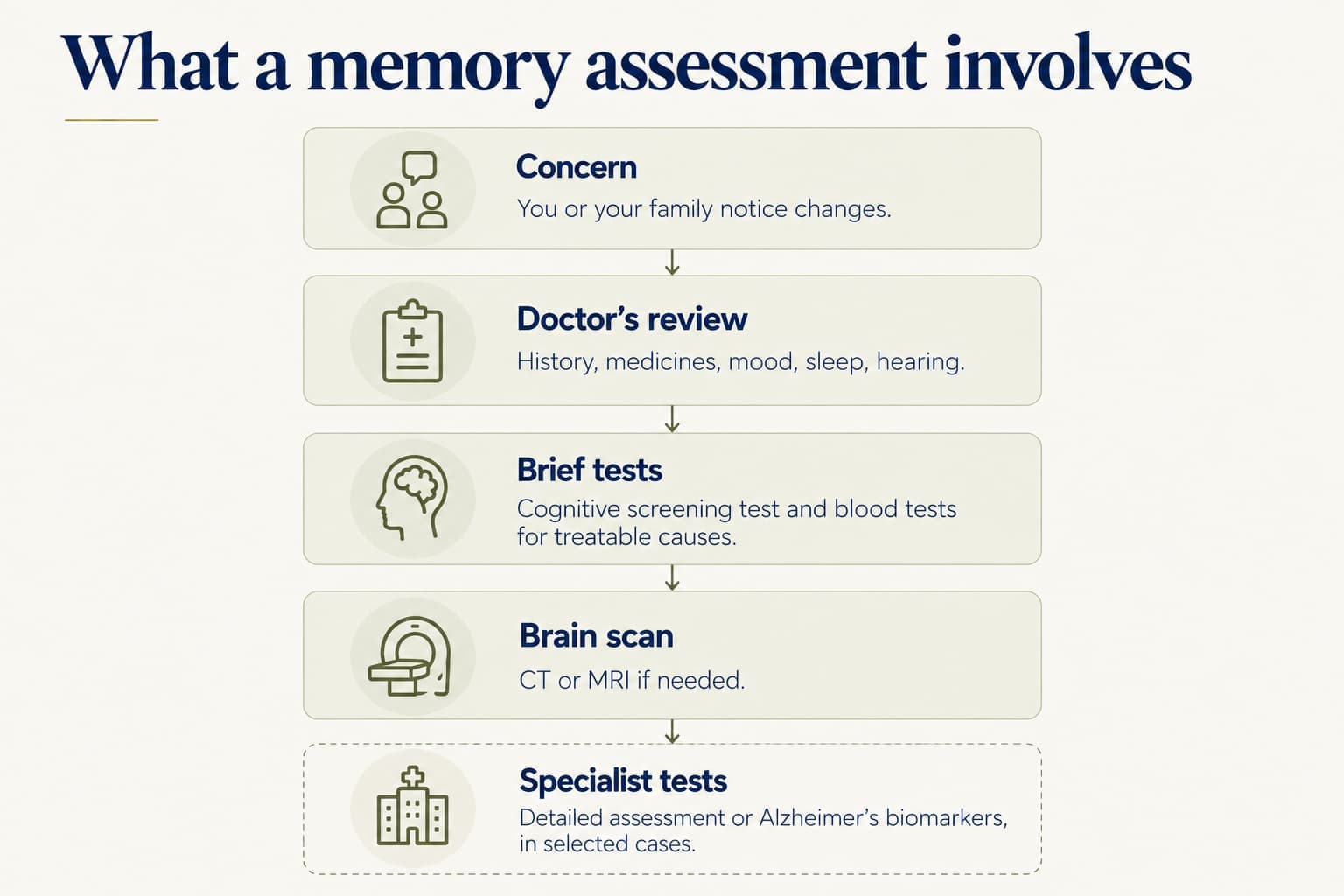
1. Brief cognitive screening tests. These short tests, done in a clinic, check memory, attention, language, orientation and planning.
- →Mini-Mental State Examination (MMSE): one of the oldest and most widely used tests. It's reasonable at detecting established dementia but misses many people with milder changes.
- →Montreal Cognitive Assessment (MoCA): a 10-minute test covering eight areas of thinking, designed to be more sensitive to mild cognitive impairment. In the study that introduced it, the MoCA picked up 90% of people with mild cognitive impairment, compared with 18% for the MMSE, and 100% of people with mild Alzheimer's, compared with 78%. The trade-off was that it flagged more healthy people as possibly impaired: specificity was 87% for the MoCA, compared with 100% for the MMSE.
- →Mini-Cog: a very short test combining a three-word recall with a clock drawing, often used as a first check in busy clinics.
These are screening tools, not diagnoses. A low score says further assessment is needed; a normal score doesn't rule out early changes.
2. Detailed neuropsychological assessment. A longer assessment, usually by a neuropsychologist, takes one to several hours and tests each area of thinking in depth. It's the best way to characterise subtle changes, distinguish different causes and set a baseline for tracking change over time.
3. Blood tests for treatable causes. When someone has memory problems, standard blood tests look for conditions that can affect thinking and are treatable, such as low vitamin B12 or thyroid problems (see Mild Cognitive Impairment and B Vitamins, Homocysteine, and Brain Aging). A doctor will also review medicines, mood, sleep and hearing, all of which can affect memory.
4. Brain scans.
- →CT or MRI can show strokes, small-vessel damage, tumours, fluid build-up and patterns of shrinkage (see Brain Volume and Longevity and Vascular Health and the Brain).
- →Amyloid PET scans can show amyloid plaques directly, but they're expensive and available mainly in specialist centres.
5. Alzheimer's biomarker tests. These detect the proteins involved in Alzheimer's disease, amyloid and tau, either in spinal fluid (by lumbar puncture) or, more recently, in blood.
In May 2025, the US Food and Drug Administration cleared the first blood test to help diagnose Alzheimer's disease, which measures a form of tau called pTau217 relative to amyloid. It's intended for people aged 55 and over who already have signs and symptoms of cognitive decline, seen in specialist settings. In its validation study of 499 people, 91.7% of those with a positive result had amyloid plaques confirmed by PET or spinal fluid, and 97.3% of those with a negative result didn't. Fewer than 20% got an indeterminate result.
In July 2025, the Alzheimer's Association published its first guideline on these blood tests. It recommends them only for people with objective cognitive impairment being seen in specialist memory care, sets minimum accuracy standards, and states that a blood test shouldn't be ordered before a full clinical evaluation and should always be interpreted alongside it. The guideline doesn't cover primary care or people without symptoms.
6. Genetic tests. APOE testing shows whether you carry a gene variant that raises Alzheimer's risk, but it can't tell you whether you'll develop the disease. The pros and cons are covered in APOE4 and Genetic Risk.
Should you be screened if you have no symptoms?
In 2020, the US Preventive Services Task Force reviewed whether adults aged 65 and over without signs or symptoms should be routinely screened for cognitive impairment. It found the evidence insufficient to judge whether the benefits outweigh the harms. That isn't a recommendation against screening. It means research hasn't yet shown that finding problems early in people without symptoms improves outcomes.
The potential benefits of screening include finding treatable causes, planning ahead, and making lifestyle changes. The potential downsides include anxiety, false-positive results (especially with more sensitive tests like the MoCA), and labelling someone with a problem that may never progress. Blood biomarker tests add another layer: many older people have some amyloid in their brains without ever developing dementia, so a positive result in someone without symptoms can be hard to interpret.
For people without symptoms, the most useful "test" is often a risk-factor check rather than a brain test: blood pressure, blood sugar, cholesterol, hearing, mood, sleep, weight, smoking and physical activity, since these are the things you can act on (see Alzheimer's Disease: Risk Factors You Can Actually Change).
When testing makes sense
- →You've noticed memory or thinking changes that are new, persistent or worsening.
- →Family or friends have noticed changes, especially if you haven't.
- →Changes are affecting daily life: managing money or medicines, getting lost, repeating questions, or difficulty with familiar tasks.
- →You want a baseline before or after a major health event, or because of strong family history, and you understand the limits of the results.
- →You're considering a new Alzheimer's treatment, which requires confirmation of amyloid.
Recommendations by situation
No symptoms, average risk
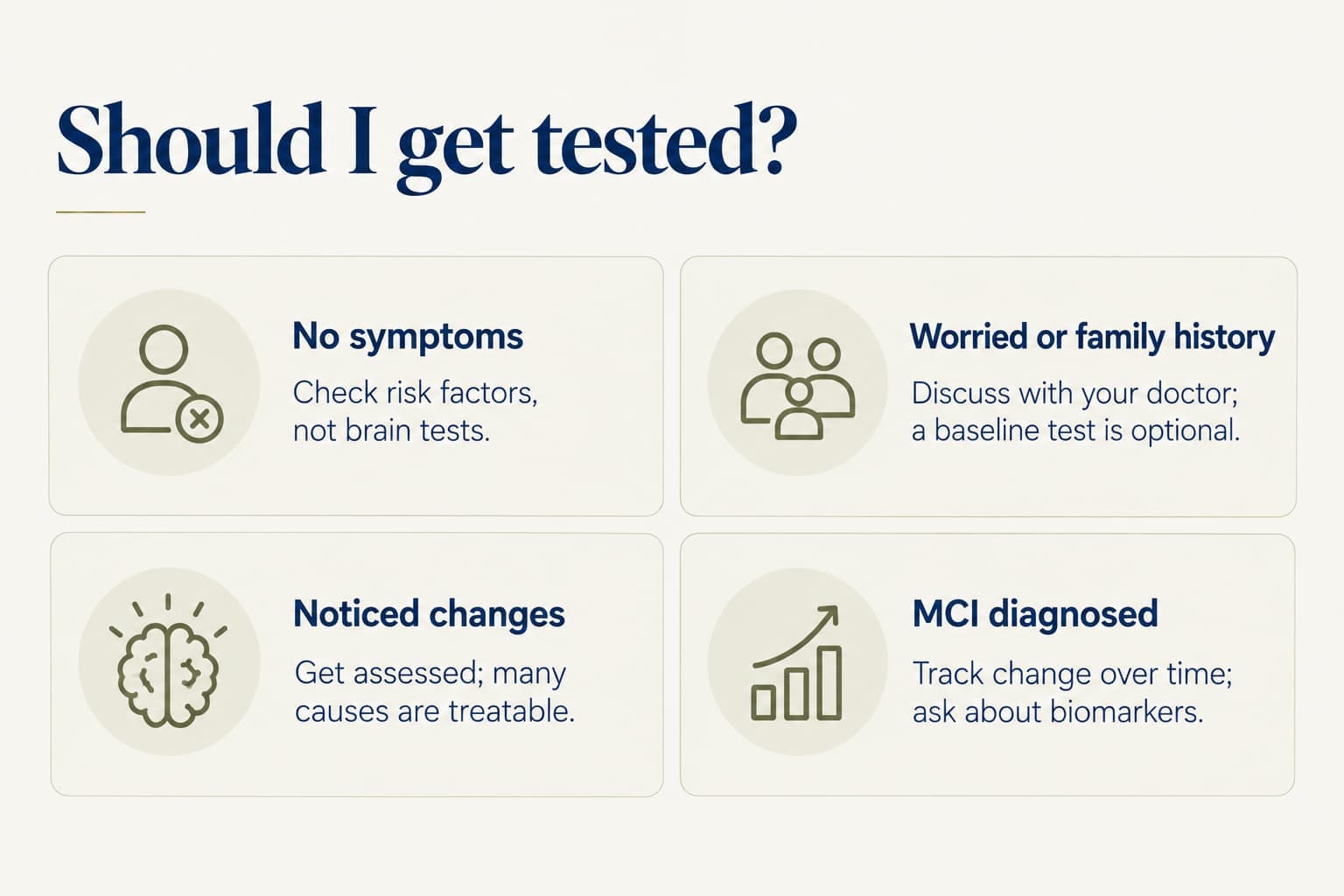
- →Routine brain screening isn't necessary. Focus on checking and managing risk factors.
- →Don't order blood biomarker tests for Alzheimer's out of curiosity. They're designed for people with symptoms, and results in people without symptoms are hard to interpret.
No symptoms, but worried or strong family history
- →Talk to your doctor about your concerns and risk factors.
- →A baseline cognitive test can be reasonable if you understand that a normal result doesn't guarantee the future and a borderline result may cause worry.
- →Think carefully before genetic testing, ideally with counselling.
You've noticed changes yourself
- →See a doctor for an assessment. Mention specific examples and how long they've been happening.
- →Expect a brief cognitive test, blood tests and a review of medicines, mood, sleep and hearing. Many causes of memory problems are treatable.
- →Worry about memory is common and doesn't mean dementia, but it's still worth checking.
Family members have noticed changes
- →Take it seriously and go together. Family members often notice changes before the person does.
- →Bring notes on what's changed and when.
Mild cognitive impairment already diagnosed
- →Ask about follow-up testing to track change over time.
- →Ask whether biomarker testing is appropriate, especially if new treatments are being considered.
- →Focus on the things that help: exercise, blood pressure control, hearing, sleep and staying socially and mentally active.
Understanding your results
Cognitive test scores can be affected by many things other than brain disease:
- →Education and language. People with less formal education, or who take a test in a second language, can score lower without any impairment. Tests need to be interpreted with this in mind.
- →Mood, sleep and stress. Depression, anxiety and poor sleep can lower scores (see Depression and Cognitive Decline).
- →Hearing and vision. Problems with either can make tests harder (see Hearing Loss and Dementia Risk).
- →Medicines. Some sedatives, sleeping pills and other medicines can impair performance.
A single score is a snapshot. Change over time, and how you're managing everyday life, often matter more.
Testing in Sri Lanka
- →Local-language versions exist. A Sinhala version of the MoCA was validated in Sri Lanka in 2011: at a cut-off of 24 (lower than the original's 26), it detected 98% of people with Alzheimer's dementia, with 79.6% specificity. A Sri Lankan Tamil version has also been developed. Testing in your first language gives more reliable results.
- →Ask about education adjustments. Score cut-offs based on Western populations may not suit everyone, especially older adults with fewer years of schooling.
- →Specialist biomarker tests such as amyloid PET and the newest blood tests may not be widely available locally. For most people, a careful clinical assessment, standard blood tests and an MRI or CT scan provide the key information.
Practical notes
Brain testing is most useful when there's a question to answer: when you or your family have noticed changes, or when a diagnosis would change what happens next. For people without symptoms, the evidence doesn't yet support routine screening, and the most valuable step is checking and managing the risk factors you can change. If you do get tested, see it as a starting point: many causes of memory problems are treatable, results need to be interpreted in context, and change over time tells you more than any single score.
- US Preventive Services Task Force. Screening for Cognitive Impairment in Older Adults: US Preventive Services Task Force Recommendation Statement. JAMA, 2020;323(8):757-763.
- Nasreddine ZS, et al. The Montreal Cognitive Assessment, MoCA: A Brief Screening Tool For Mild Cognitive Impairment. Journal of the American Geriatrics Society, 2005;53:695-699.
- Karunaratne S, Hanwella R, de Silva V. Validation of the Sinhala version of the Montreal Cognitive Assessment in screening for dementia. Ceylon Medical Journal, 2011;56(4):147-153.
- Fujirebio. Lumipulse G pTau217/β-Amyloid 1-42 Plasma Ratio: FDA 510(k) clearance, 16 May 2025. As reported by AJMC (American Journal of Managed Care), May 2025.
- Palmqvist S, et al. Alzheimer's Association Clinical Practice Guideline on the use of blood-based biomarkers in the diagnostic workup of suspected Alzheimer's disease within specialized care settings. Alzheimer's & Dementia, 2025.
Have you or your family noticed
any changes in memory or thinking?
Take the free Aevum Protocol assessment to see how your cognitive longevity and 6 other longevity domains are performing — and get a personalised 90-day plan.
Take the Free Assessment →