Cognitive Longevity
Exercise and Brain Health:
A Practical Guide
Of all the lifestyle habits linked to brain health, physical activity has some of the most consistent evidence. People who move more have lower rates of dementia. In trials, aerobic exercise has increased the size of the brain's main memory centre, and strength training has improved thinking in people with mild cognitive impairment. But the evidence also has limits. Recent large trials found that even gentle exercise helped people hold steady, so it's not clear that harder is always better. And exercise seems to work best as part of a wider healthy lifestyle. This guide sets out what the evidence supports and what to do in practice, depending on your age, fitness and brain health.
Key numbers
| Finding | Detail |
|---|---|
| Aerobic walking for 1 year (120 older adults) | Hippocampus grew by 2%, reversing roughly 1-2 years of age-related shrinkage |
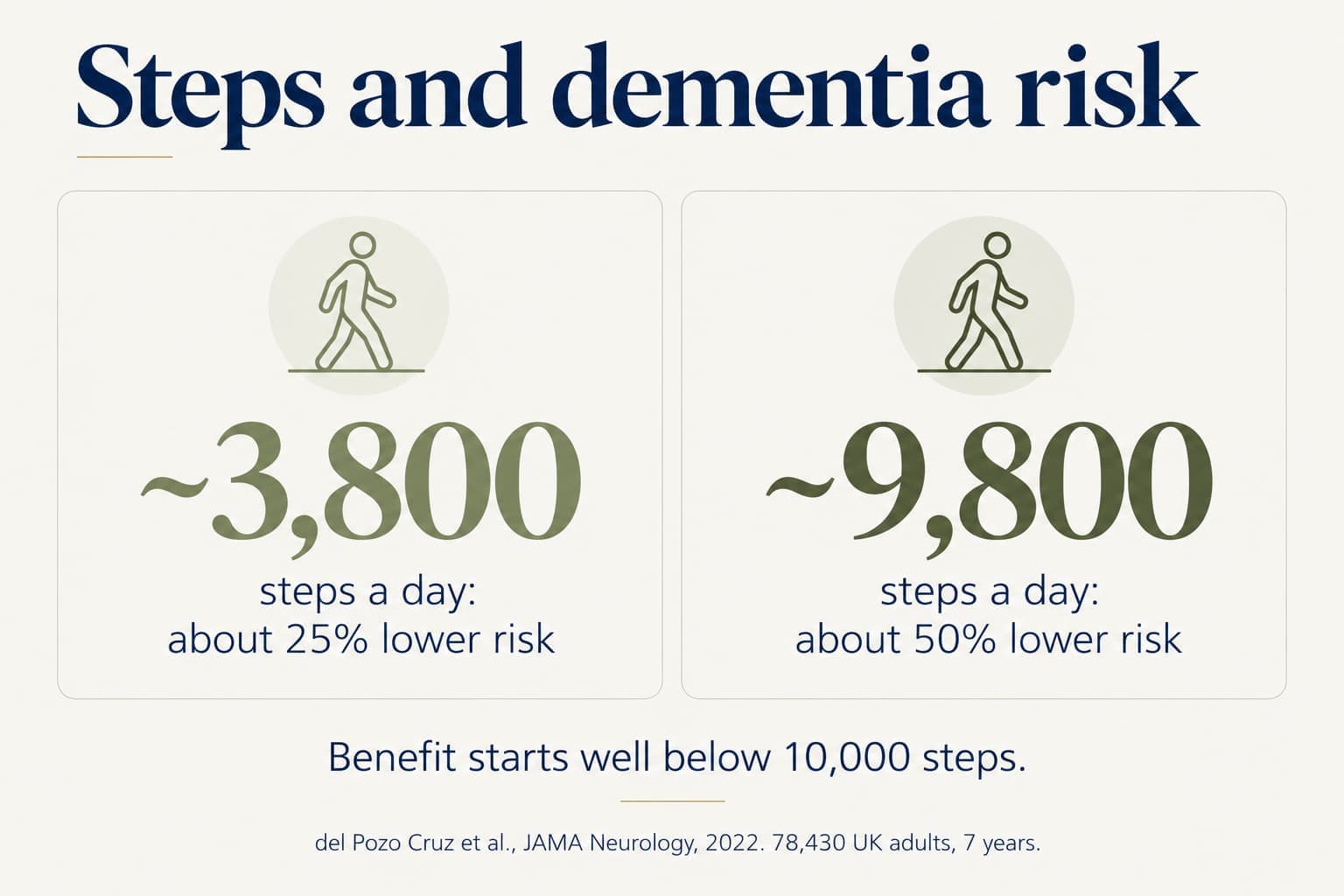
| Daily steps and dementia (78,430 UK adults, 7 years) | About 9,800 steps/day linked to ~50% lower risk; about 3,800 steps/day linked to ~25% lower risk |
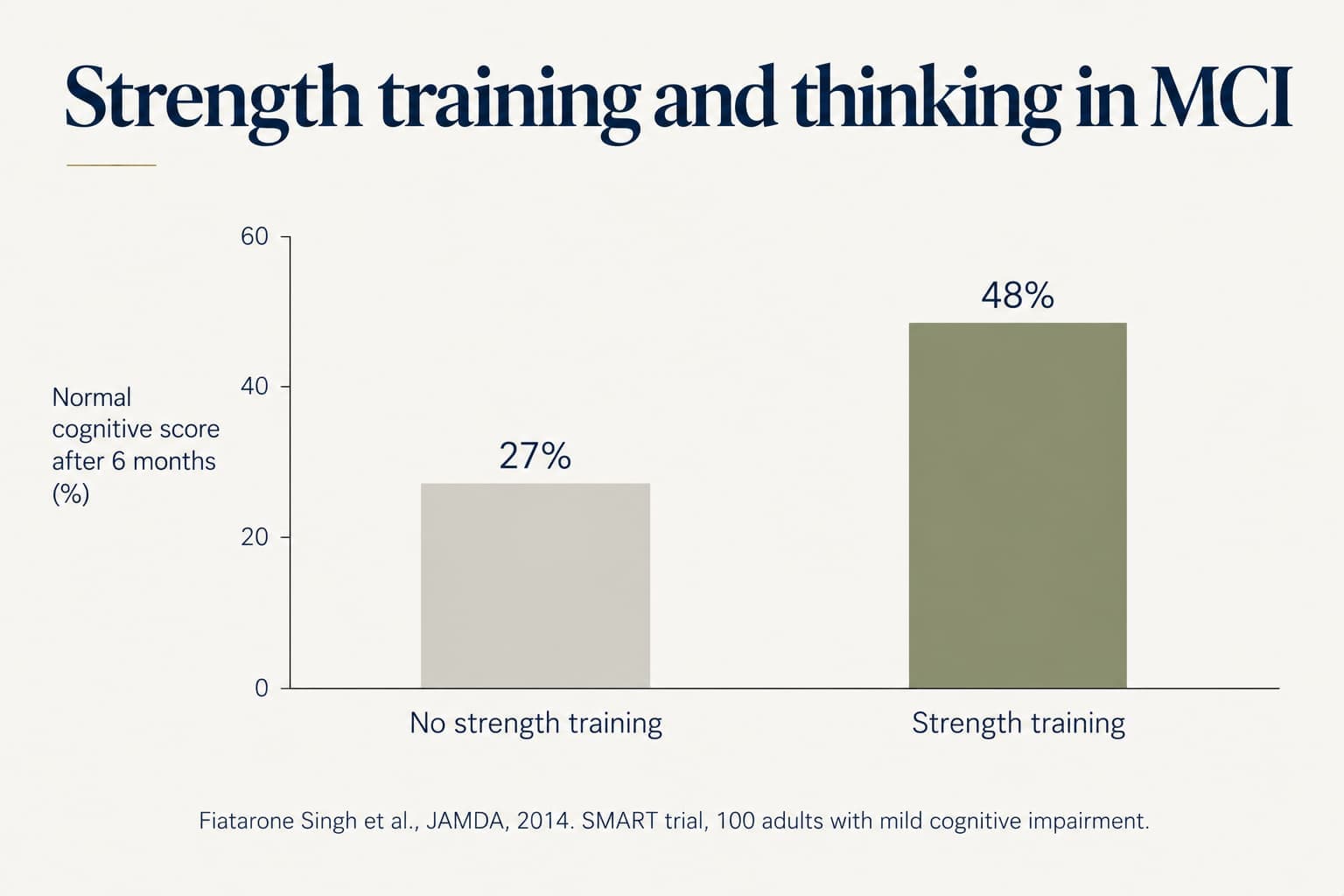
| Strength training in mild cognitive impairment (100 people, 6 months) | 48% had normal cognitive scores afterwards vs. 27% without strength training |
| EXERT trial (296 people with MCI, 18 months) | Aerobic exercise and gentle stretching gave similar results: no cognitive decline in either group over 12 months |
| US POINTER (2,111 at-risk older adults, 2 years) | Structured programme (exercise, diet, brain training, social activity) beat a self-guided one for cognition |
How exercise helps the brain
Exercise seems to protect the brain in several ways at once:
- →Blood flow and blood vessels. Regular activity lowers blood pressure, improves blood sugar control and keeps blood vessels healthier, which protects against the small-vessel damage covered in Vascular Health and the Brain.
- →Growth factors. Exercise raises BDNF (brain-derived neurotrophic factor), a protein that supports the growth and survival of nerve cells, especially in the hippocampus.
- →Inflammation. Regular activity lowers chronic low-grade inflammation (see Chronic Inflammation and the Brain).
- →Sleep and mood. Exercise improves sleep and reduces depression, both of which matter for cognition (see Depression and Cognitive Decline).
What the evidence shows
Aerobic exercise can grow the memory centre. In a 2011 trial, 120 older adults were assigned to a year of walking three days a week or to stretching and toning. In the walking group, the hippocampus (the brain's key memory structure) grew by 2%, effectively reversing one to two years of age-related shrinkage, while the stretching group lost volume. Larger increases went along with higher BDNF levels. Both groups improved on the memory test, though, and other researchers have pointed out that the trial didn't show the memory gains came specifically from the walking. The brain-structure finding is the robust part. For more on how the adult brain adapts, see Neuroplasticity After 40.
More steps, lower risk, with benefit starting well below 10,000. In a UK Biobank study of 78,430 adults aged 40-79 who wore activity trackers, 866 developed dementia over about seven years. About 9,800 steps a day was linked to the lowest risk, about half that of the least active people. But about 3,800 steps a day was already linked to a meaningfully lower risk, around 25%. Walking at a brisk pace (around 112 steps per minute for your best half-hour of the day) was linked to additional benefit. As with all observational studies, people who walk more may be healthier in other ways, but the pattern is consistent with the trial evidence.
Strength training helps too. Aerobic exercise gets most of the attention, but strength training has good evidence. In the SMART trial, 100 people with mild cognitive impairment did high-intensity resistance training, cognitive training, both or neither (with sham versions for comparison), two to three days a week for six months. Resistance training improved overall cognition. Afterwards, 48% of those who did strength training had normal scores on the main cognitive test, compared with 27% of those who didn't, and benefits to executive function lasted for 18 months. For more on building strength, see Exercise and Joint Health.
In people with memory problems, some activity is better than none. An Australian trial in 2008 gave 170 adults aged 50 and over with memory complaints either a six-month home-based physical activity programme or usual care. At 18 months, the activity group had improved slightly on a standard memory and thinking scale, by 0.73 points, versus 0.04 points in the usual-care group. The effect was modest, but it came from a simple home programme.
The American Academy of Neurology's 2018 guideline recommends regular exercise, twice a week, for people with mild cognitive impairment. It rates this recommendation more strongly than its advice on cognitive training (see Mild Cognitive Impairment).
Harder isn't always better. The EXERT trial tested whether exercise intensity matters. It assigned 296 sedentary older adults with mild cognitive impairment to either moderate-to-high-intensity aerobic exercise or gentle stretching, balance and range-of-motion exercises for 18 months, supervised for the first year. Cognitive results didn't differ between the groups. But neither group declined over 12 months, and brain shrinkage in both was low, which is unusual for people with MCI. In a companion analysis, researchers compared both groups with similar patients in an observational study who weren't exercising, and those patients declined more. The takeaway: regular, supervised activity of any kind may help people hold steady, and intensity may matter less than consistency.
Exercise works best as part of a package. Two major trials tested exercise combined with other healthy habits. In Finland, the FINGER trial randomised 1,260 at-risk adults aged 60-77 to two years of exercise, diet advice, brain training and blood pressure and risk-factor monitoring, or to general health advice. The intervention group did better on thinking tests. In the US POINTER trial, 2,111 at-risk older adults followed a structured programme with aerobic exercise four days a week, strength training twice a week, the MIND diet, online brain training and social activity, or a self-guided version of the same goals. After two years, both groups improved, but the structured group improved more. The difference was small, but it confirmed that more support and structure help. The diet side is covered in The MIND Diet and Brain Health.
Recommendations by situation
Healthy adult under 60
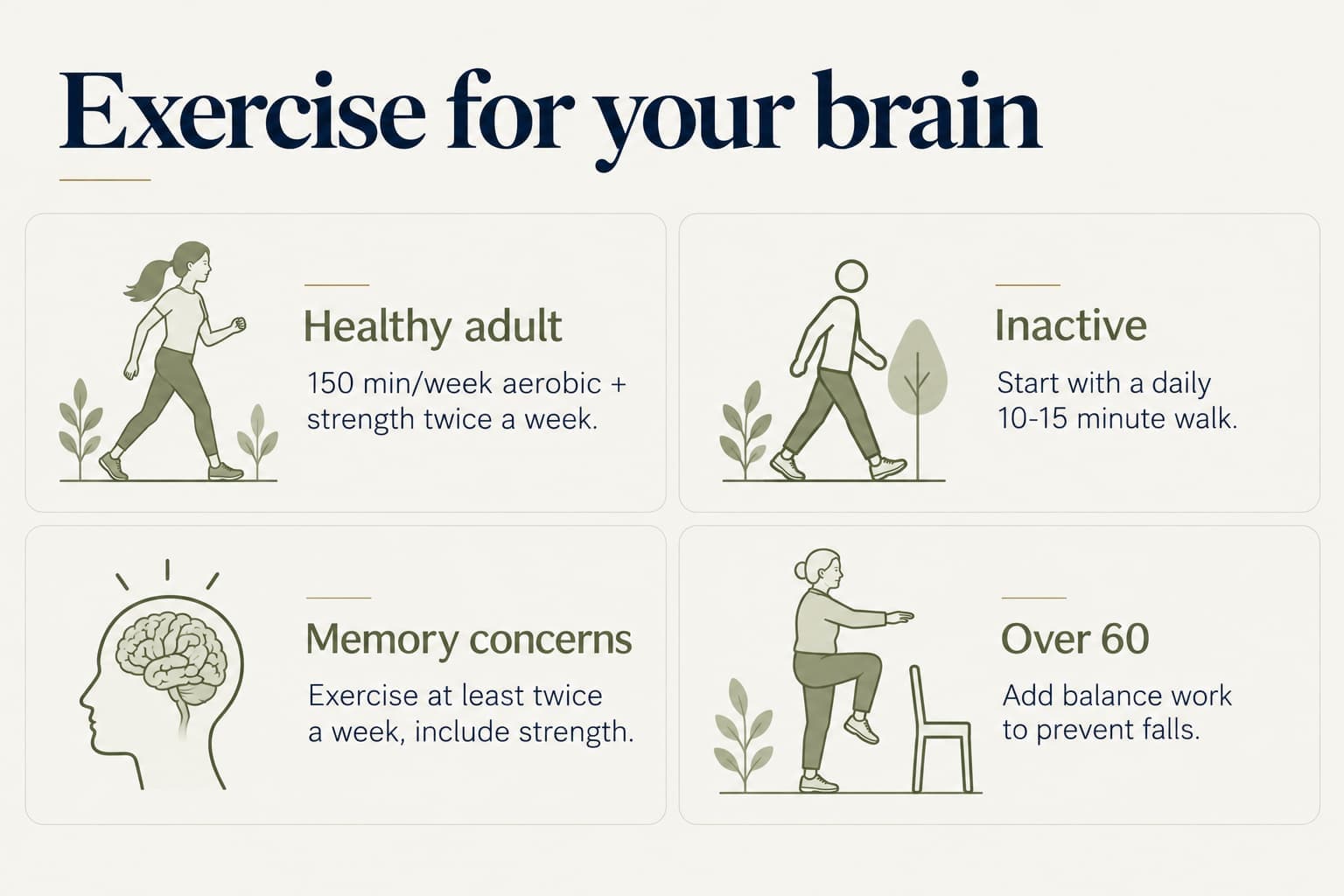
- →Aim for at least 150 minutes a week of moderate aerobic activity (such as brisk walking, cycling or swimming), or 75 minutes of vigorous activity.
- →Add strength training at least twice a week. It supports both brain and body.
- →Think of this as an investment. Midlife fitness supports brain health decades later, and the risk factors exercise helps control (blood pressure, blood sugar, weight) matter most in midlife (see Alzheimer's Disease: Risk Factors You Can Actually Change).
Healthy adult over 60
- →Keep up aerobic activity and strength training as above, adjusted to your fitness level.
- →Include balance exercises. Preventing falls protects the brain from head injury.
- →Walk more. Even around 4,000 steps a day was linked to lower dementia risk, with more benefit up to around 10,000.
Currently inactive
- →Start small. Any increase from very low activity brings the biggest relative benefit. A daily 10-15 minute walk is a good start.
- →Build up gradually by adding a few minutes each week.
- →Consider short bursts. Brief activity breaks through the day count too (see Exercise Snacking).
Mild cognitive impairment or memory concerns
- →Exercise at least twice a week, in line with the neurology guideline.
- →Include strength training. The SMART trial found it improved cognition in people with MCI.
- →Consistency matters more than intensity. In EXERT, gentle supervised activity helped as much as vigorous exercise.
- →Consider supervised or group exercise to help with safety and regularity.
Family history of dementia or APOE4 carrier
- →Follow the same guidance as healthy adults, and start early. Exercise is one of the best-supported ways to lower risk whatever your genes (see APOE4 and Genetic Risk).
- →Combine it with other healthy habits. FINGER and US POINTER suggest that exercise, diet, brain challenge, social contact and risk-factor control work best together.
Living with heart disease, diabetes or joint problems
- →Get medical advice before starting vigorous exercise.
- →Walking, swimming, cycling and water-based exercise are gentle on the joints.
- →Adapt rather than avoid. The brain benefits of exercise are especially relevant here, because these conditions raise dementia risk.
Practical tips for Sri Lanka
- →Beat the heat. Walk early in the morning or in the evening, and drink water before, during and after exercise.
- →Use indoor options on hot or rainy days: stair climbing, home strength workouts, mall walking or a gym.
- →Walk with others. Walking groups and park walks add social contact, which has its own brain-health benefits (see Social Connection and Cognitive Decline).
- →Build activity into daily routines: walking to nearby shops or temple, taking stairs, and gardening all add up.
Practical notes
Exercise is one of the most reliable things you can do for your brain, and it helps your heart, muscles, mood and sleep at the same time. The evidence supports a mix of aerobic activity and strength training, and it shows that even modest activity helps. The best exercise is one you'll keep doing. If you want the best chance of protecting your brain, combine regular activity with the other habits in this series: a healthy diet, good sleep, blood pressure control, hearing care and staying socially and mentally engaged.
- Erickson KI, et al. Exercise training increases size of hippocampus and improves memory. PNAS, 2011;108(7):3017-3022.
- del Pozo Cruz B, et al. Association of Daily Step Count and Intensity With Incident Dementia in 78 430 Adults Living in the UK. JAMA Neurology, 2022.
- Fiatarone Singh MA, et al. The Study of Mental and Resistance Training (SMART) study. Journal of the American Medical Directors Association, 2014;15(12):873-880.
- Lautenschlager NT, et al. Effect of physical activity on cognitive function in older adults at risk for Alzheimer disease: a randomized trial. JAMA, 2008;300(9):1027-1037.
- Baker LD, et al. Effects of exercise on cognition and Alzheimer's biomarkers in a randomized controlled trial of adults with mild cognitive impairment: The EXERT study. Alzheimer's & Dementia, 2025;21(4):e14586.
- Shadyab, et al. Effects of exercise versus usual care on older adults with amnestic mild cognitive impairment: EXERT versus ADNI. Alzheimer's & Dementia, 2025.
- Ngandu T, et al. A 2 year multidomain intervention of diet, exercise, cognitive training, and vascular risk monitoring versus control to prevent cognitive decline in at-risk elderly people (FINGER). The Lancet, 2015;385(9984):2255-2263.
- Baker LD, et al. Structured vs Self-Guided Multidomain Lifestyle Interventions for Global Cognitive Function: The US POINTER Randomized Clinical Trial. JAMA, 2025.
- Petersen RC, et al. Practice guideline update summary: Mild cognitive impairment. Neurology, 2018;90(3):126-135.
How many days a week do you
get your heart rate up?
Take the free Aevum Protocol assessment to see how your cognitive longevity and 6 other longevity domains are performing — and get a personalised 90-day plan.
Take the Free Assessment →