Cognitive Longevity
Depression and Cognitive Decline:
A Two-Way Street
People who have had depression are more likely to develop dementia — in one national study, more than twice as likely. But the relationship runs in more than one direction. Depression can be a risk factor that raises dementia risk decades later. It can also be one of the earliest signs of a brain disease that's already under way. And depression and dementia share some of the same underlying causes, such as damage to small blood vessels. Working out which is happening matters, because it changes what a new episode of depression in later life might mean, and what treatment can realistically achieve. This article sets out the evidence for each direction and what's known about whether treating depression lowers dementia risk.
Key numbers
| Finding | Detail |
|---|---|
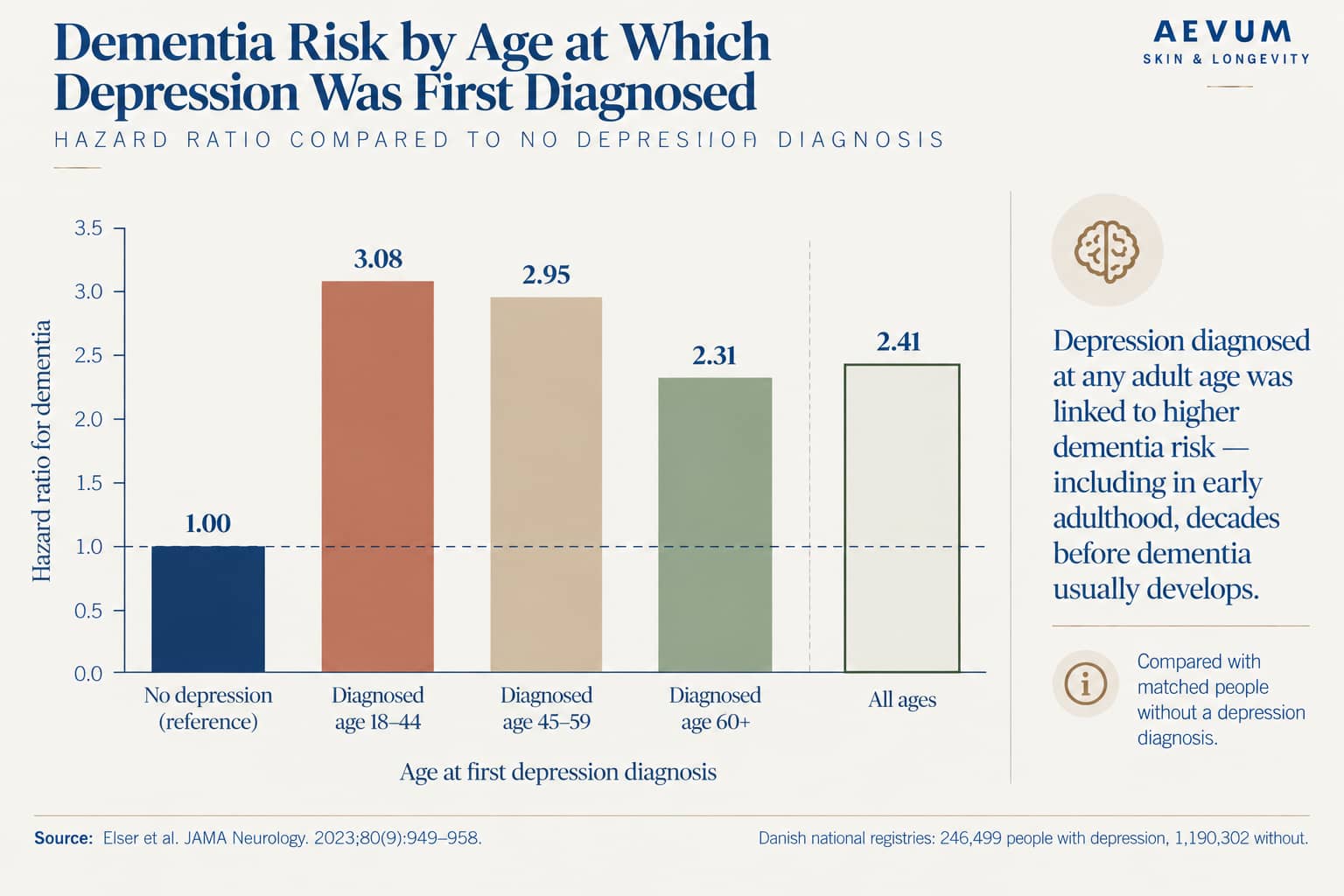
| Dementia risk after a depression diagnosis (Denmark, ~1.4 million people) | 2.41x overall |
| Depression first diagnosed at ages 18-44 | 3.08x |
| Depression first diagnosed at ages 45-59 | 2.95x |
| Depression first diagnosed at 60+ | 2.31x |
| Depressive symptoms in midlife (UK civil servants, ~27-year follow-up) | 1.21x — not significant |
| When depressive symptoms began rising before a dementia diagnosis | About 11 years earlier |
| People with treated vs. untreated depression (UK Biobank) | 30% lower dementia risk with treatment (HR 0.70) |
| People with treated vs. untreated depression (Denmark) | No difference (HR 2.42 vs. 2.35) |
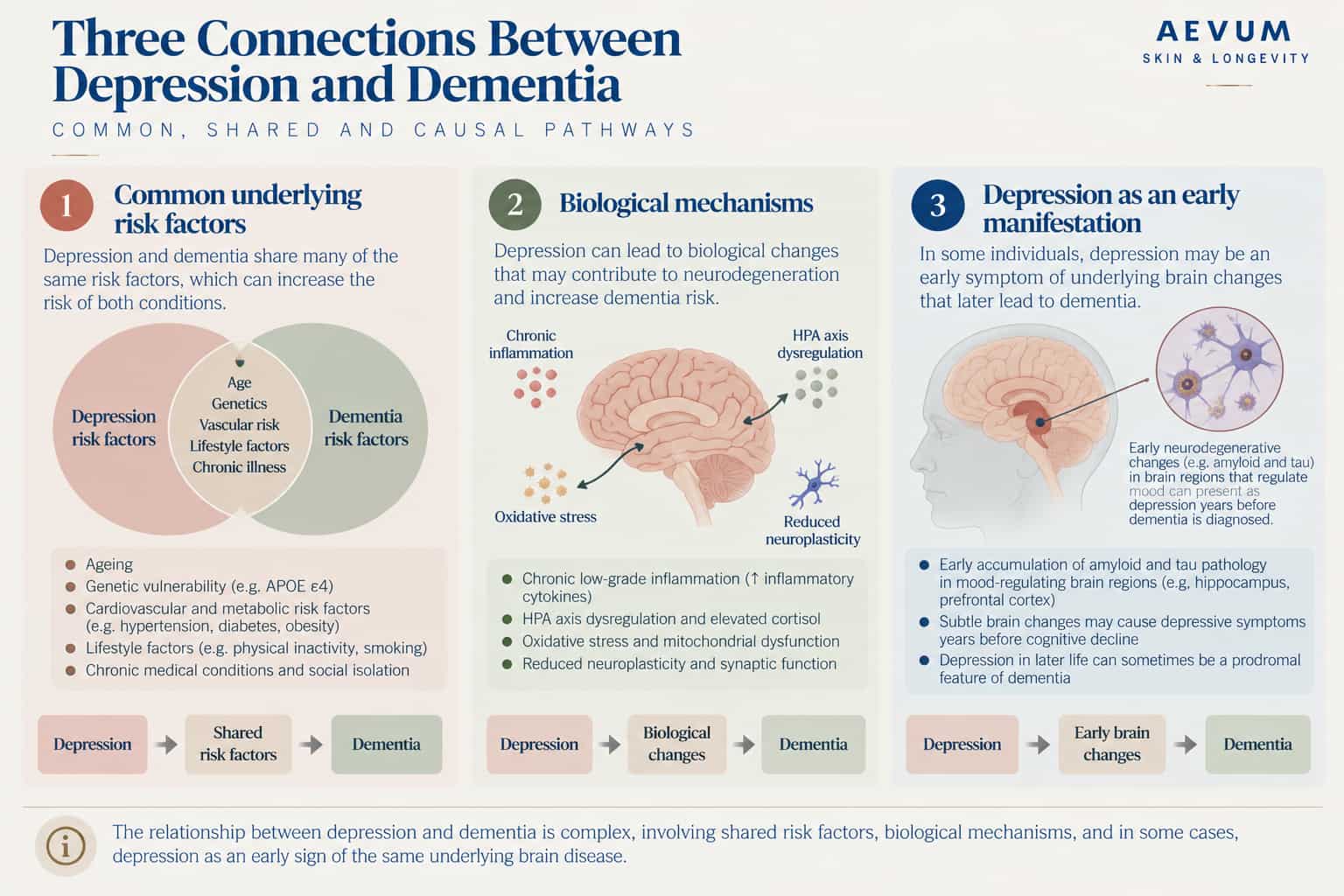
Three ways depression and dementia are connected
1. Depression as a risk factor. Depression may harm the brain directly over time. Proposed routes include prolonged exposure to stress hormones (see Chronic Stress and the Brain), chronic inflammation (see Chronic Inflammation and the Brain), and the knock-on effects of depression on sleep, exercise, diet, social contact and managing other health conditions. If this is the main story, preventing and treating depression should lower dementia risk.
2. Depression as an early sign of dementia. The brain changes of Alzheimer's and other dementias begin many years before memory problems become obvious. Those same changes can affect mood, motivation and emotional regulation. In that case, depression isn't causing dementia — it's an early symptom of it. Treating the depression would help the person's mood and quality of life, but wouldn't be expected to stop the underlying disease.
3. Shared causes. Some conditions raise the risk of both. The clearest example is damage to the brain's small blood vessels, which is linked both to depression that starts in later life and to vascular dementia (see Vascular Health and the Brain). Here, depression and dementia travel together because they share a cause.
These three explanations aren't mutually exclusive. The evidence suggests all three play a part, with their relative importance depending on when in life the depression occurs.
Depression and dementia: the risk table
| Factor | Association with dementia | 95% CI | Evidence strength |
|---|---|---|---|
| Diagnosed depression, any adult age (Denmark) | HR 2.41 | 2.35-2.47 | Very large registry study; observational |
| Depression diagnosed at 18-44 | HR 3.08 | 2.64-3.58 | Same study; hard to explain by early dementia |
| Depression diagnosed at 45-59 | HR 2.95 | 2.75-3.17 | Same study |
| Depression diagnosed at 60+ | HR 2.31 | 2.25-2.38 | Same study; may partly reflect early dementia |
| Depressive symptoms in midlife (UK civil servants) | HR 1.21 | 0.95-1.54 | Long-term cohort; not significant |
| Depression (UK Biobank) | ~51% higher risk | — | Large cohort; observational |
Depression is treatable, and depression in midlife accounts for about 3% of dementia cases worldwide in the 2024 Lancet Commission's list of 14 modifiable risk factors (see Alzheimer's Disease: Risk Factors You Can Actually Change).
What the research shows
Depression at any adult age is linked to higher dementia risk. The largest study to date used Danish national health registries to compare 246,499 people diagnosed with depression with 1,190,302 people without it. Those with a depression diagnosis were 2.41 times as likely to be diagnosed with dementia later. The association held whether depression was first diagnosed in early adulthood (3.08 times the risk), middle age (2.95 times) or later life (2.31 times), and it was present in both men (2.98 times) and women (2.21 times).
The early-adulthood finding is the most important for understanding cause. Depression diagnosed between 18 and 44 comes decades before dementia would normally develop, so it's very unlikely to be an early symptom of it. That's why the authors concluded that depression may genuinely increase dementia risk. One limitation is that registry diagnoses mostly capture people treated in hospital, so these are generally more severe cases.
But depressive symptoms can also be an early warning sign. A study that followed more than 10,000 British civil servants for 28 years, starting when they were aged 35-55, points in the other direction. Having depressive symptoms at the start — on average 27 years before any dementia diagnosis — was not significantly linked to later dementia (HR 1.21, not significant). But among people who went on to develop dementia, depressive symptoms started to rise about 11 years before diagnosis. The authors concluded that depressive symptoms in this group were more likely an early feature of dementia, or a sign of shared causes, than a cause.
The two studies aren't necessarily in conflict. The civil-servant study measured milder symptoms on a questionnaire, while the Danish study captured clinically diagnosed, usually more severe, depression. A reasonable reading is that significant depression, especially earlier in life, may raise dementia risk, while new or worsening depressive symptoms in later life can also be an early signal of brain changes.
Depression can mimic cognitive impairment. Depression itself affects concentration, processing speed and memory. In older adults, it can produce cognitive problems that look like early dementia but improve when the depression is treated. This is why depression screening is a standard part of assessing anyone with memory complaints (see Mild Cognitive Impairment).
Does treating depression lower dementia risk? This is the most practical question, and the evidence is genuinely mixed:
- →Evidence that it helps. In the UK Biobank, among more than 350,000 people aged 50-70 followed for a median of about 12 years, depression was linked to 51% higher dementia risk. But among people with depression, those who received treatment had a 30% lower risk than those who didn't (HR 0.70). That held for medication (HR 0.77), talking therapy (HR 0.74) and especially both together (HR 0.62).
- →Evidence that it doesn't. In the Danish study, dementia risk was essentially the same whether or not people were prescribed an antidepressant around the time of diagnosis (HR 2.42 treated vs. 2.35 untreated).
Both are observational studies, so neither can prove cause and effect: people who seek and stick with treatment may differ in other ways, and antidepressants are more often prescribed for more severe depression. No randomised trial has yet shown that treating depression prevents dementia. What's not in doubt is that depression is worth treating for its own sake — it's one of the most disabling conditions there is, and effective treatments exist.
What you can actually change
- 1Treat depression properly, at any age
Whatever the effect on dementia risk turns out to be, depression causes great suffering and responds to treatment — talking therapies, medication, or both. The UK Biobank data hint that combining approaches may be most protective. Depression in midlife is also one of the 14 recognised modifiable dementia risk factors.
- 2Take new depression in later life seriously
A first episode of depression after about 60, or a clear change in mood, motivation or personality in an older person, deserves a proper medical assessment, including a check on memory and thinking. It may be ordinary depression that responds well to treatment, but it can also be an early signal of changes in the brain.
- 3Look after the shared risk factors
Blood pressure, blood sugar, cholesterol, physical activity, sleep and social connection affect both mood and brain health. Exercise in particular has good evidence for improving depression and for protecting the brain.
- 4Don't assume memory problems in someone with depression are dementia
Poor concentration and forgetfulness are common in depression and often improve with treatment. Treat the depression and then reassess.
For the exercise evidence, see Neuroplasticity After 40.
Recommendations
- →Treat depression as a brain-health issue as well as a mental-health one. Diagnosed depression is linked to roughly double the risk of dementia.
- →Seek treatment early. Depression diagnosed in early adulthood carries the strongest association with later dementia, and it responds to treatment.
- →Don't ignore late-onset depression. New depressive symptoms in later life can be an early sign of brain changes and warrant a full assessment.
- →Expect treatment to help mood, not guarantee dementia prevention. The evidence on whether treatment lowers dementia risk is mixed, and no trial has proven it.
- →Use the overlap. Exercise, sleep, social connection and vascular health benefit mood and the brain at the same time.
Practical notes
The relationship between depression and dementia is less a single cause-and-effect link than a web: depression may raise risk, may be an early sign, and may share causes with dementia, depending on when it occurs. The practical response is the same in every case — recognise depression, treat it well, and pay attention to what it might be signalling, particularly when it appears for the first time later in life. If you're experiencing low mood that isn't lifting, speaking to a doctor is the right first step.
- Elser H, et al. Association of Early-, Middle-, and Late-Life Depression With Incident Dementia in a Danish Cohort. JAMA Neurology, 2023;80(9):949-958.
- Singh-Manoux A, et al. Trajectories of Depressive Symptoms Before Diagnosis of Dementia: A 28-Year Follow-up Study. JAMA Psychiatry, 2017.
- Yang L, et al. Depression, Depression Treatments, and Risk of Incident Dementia: A Prospective Cohort Study of 354,313 Participants. Biological Psychiatry, 2023.
- Livingston G, Huntley J, Liu KY, et al. Dementia prevention, intervention, and care: 2024 report of the Lancet Standing Commission. The Lancet, 2024;404(10452):572-628.
Has low mood been
harder to shift lately?
Take the free Aevum Protocol assessment to see how your cognitive longevity and 6 other longevity domains are performing — and get a personalised 90-day plan.
Take the Free Assessment →