Cognitive Longevity
Neuroplasticity After 40:
Can the Adult Brain Still Rewire Itself?
The idea that the adult brain is "fixed" past a certain age — that neural wiring is set in childhood and only degrades from there — has been one of the most consequential myths in neuroscience, and it's now clearly outdated. What's genuinely unsettled, and worth understanding honestly rather than glossing over, is exactly how far that rewiring capacity extends: whether brand-new neurons are still being born in the adult hippocampus is a real, unresolved scientific controversy. But the broader capacity for the brain to physically change in response to experience — new connections, new volume in specific regions, measurable functional change — is not in dispute, and one of the clearest levers for it is exercise.
Key numbers
| Finding | Detail |
|---|---|
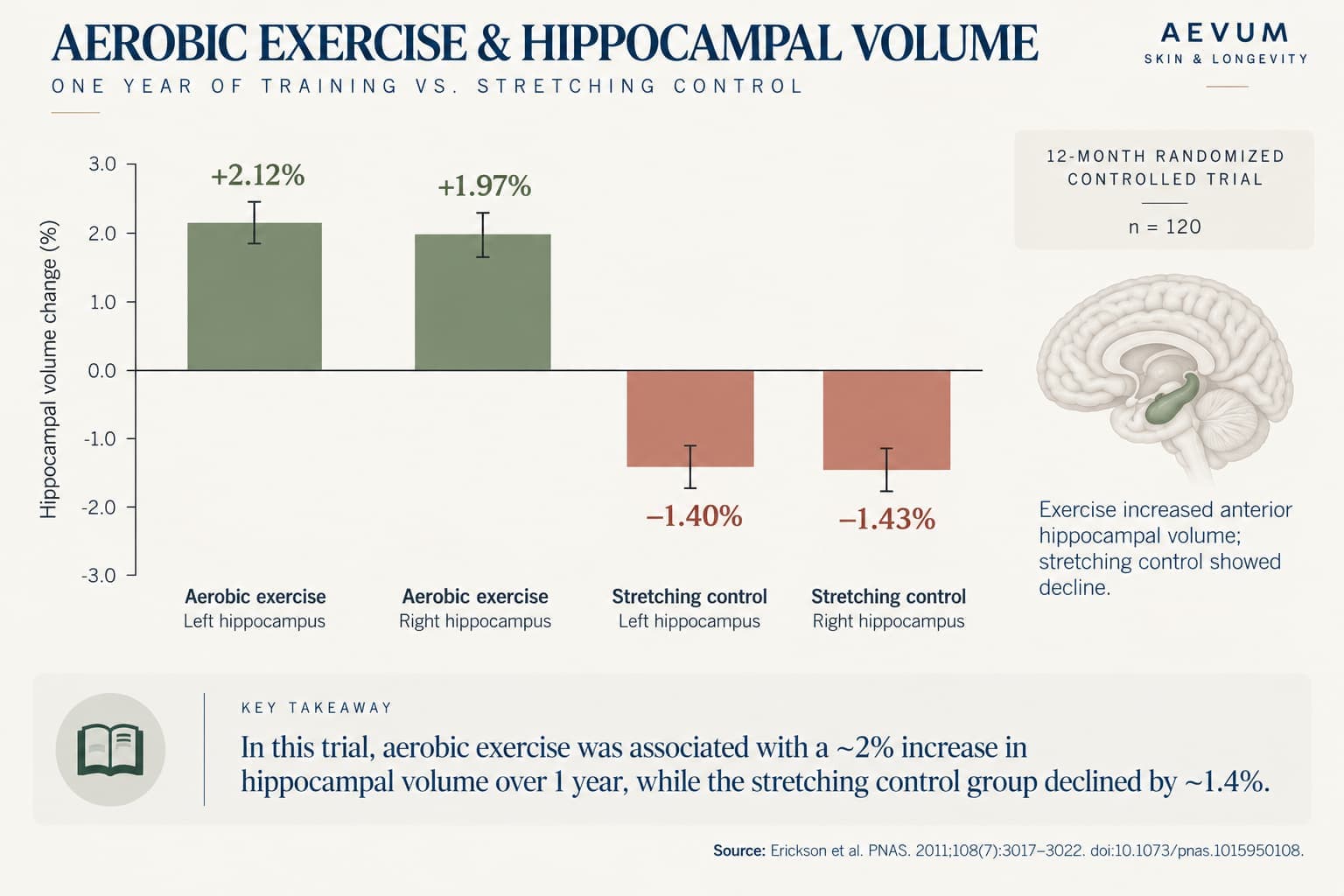
| Hippocampal volume change, 1-year aerobic exercise vs. control | +2.12% (left) / +1.97% (right) in exercisers vs. -1.40% to -1.43% in stretching-control group |
| Typical annual hippocampal loss in healthy older adults, for context | ~1-2% per year without intervention |
| Correlation between VO2 max improvement and hippocampal growth | r = 0.37 (left), r = 0.40 (right) |
| Plasma BDNF increase from exercise (neurodegenerative-disease populations, meta-analysis) | SMD 2.22 (large effect), pooled across 18 RCTs, 616 participants |
| Adult hippocampal neurogenesis | Genuinely unresolved — conflicting findings between major labs, no current consensus on rate or persistence into old age |
How it works
The unsettled part, stated honestly: does the adult brain make new neurons? For decades, the textbook answer was a firm no. That changed in the 1990s-2000s when rodent and some primate studies showed genuine adult neurogenesis (new neuron formation) in the hippocampus's dentate gyrus. Whether this holds true for adult humans, and for how long into life, is where the field currently splits. A widely cited 2018 study from a UCSF-led team (Sorrells et al., Nature) reported that neurogenesis "drops sharply in children to undetectable levels in adults," based on staining analysis of human brain tissue. The same year, a Columbia University-led team (Boldrini et al., Cell Stem Cell) studying tissue from 28 people aged 14-79 reported the opposite: no clear decline in the number of young neurons with age, suggesting the healthy human brain keeps making new neurons throughout life — with a person in their seventies potentially having comparable numbers of young neurons in this region to a teenager. Neither team has been able to fully explain the other's contradictory result — disagreements center on tissue sample size and location within the hippocampus, and on whether certain staining markers reliably distinguish true new neurons from other cell types in human tissue. The honest state of the science: this remains a live, unresolved controversy, not a settled fact in either direction.
The unambiguous part: the brain visibly changes in response to what you do. Separate from the neurogenesis debate, structural and functional brain plasticity in adulthood is well established and directly measurable on MRI — this is the part of neuroplasticity that matters most practically, regardless of how the neurogenesis question eventually resolves. A well-known controlled trial randomized 120 previously sedentary older adults into a moderate-intensity aerobic walking group or a stretching-and-toning control group for one full year. The aerobic group's hippocampus grew — 2.12% in the left hemisphere, 1.97% in the right — while the control group's hippocampus shrank by roughly 1.4% in each hemisphere, consistent with the typical age-related decline of about 1-2% per year covered in our Aging Brain article. The magnitude of fitness improvement (VO2 max gain) correlated directly with the amount of hippocampal growth (r = 0.37 left, r = 0.40 right) — a genuine dose-response relationship, not just a binary "exercisers did better" finding.
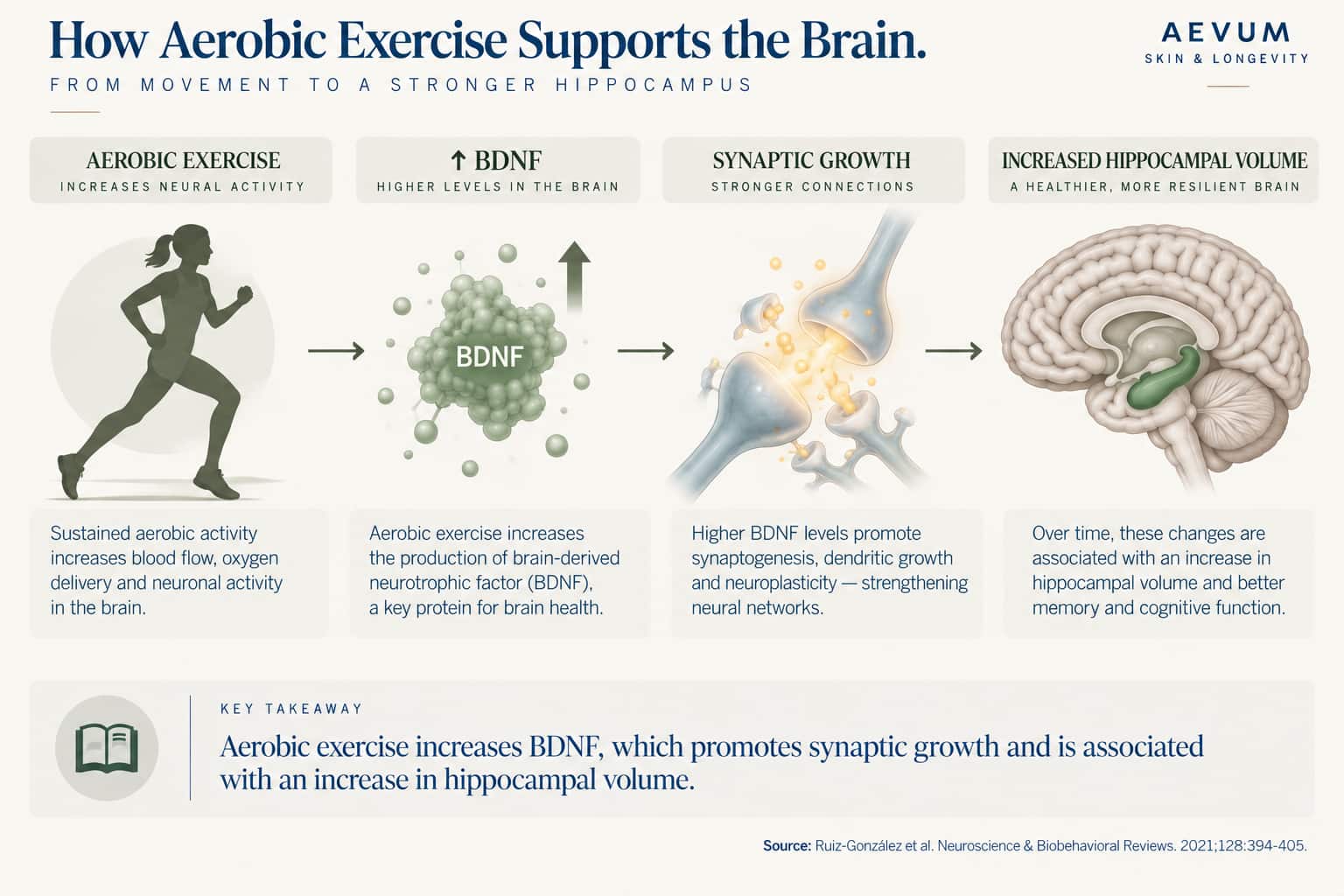
The likely mechanism: BDNF. The leading biological explanation connecting exercise to this kind of structural brain change is brain-derived neurotrophic factor (BDNF) — a protein that supports the survival of existing neurons and encourages the growth of new synaptic connections. A meta-analysis pooling 18 randomized controlled trials (616 participants, spanning multiple sclerosis, Parkinson's disease, mild cognitive impairment, and Alzheimer's populations) found exercise interventions produced a large, statistically significant increase in plasma BDNF levels (SMD 2.22), with the effect holding across aerobic, resistance, and combined training types, and across both shorter and longer intervention durations. This gives the exercise-hippocampus finding above a plausible biological mechanism, rather than leaving it as an unexplained correlation.
What the research shows
Plasticity is genuine, but it isn't unlimited or effortless. The evidence here supports a specific, bounded claim: the adult brain retains real capacity for structural and functional change well into older age, and this capacity responds measurably to deliberate input — particularly aerobic exercise. It does not support the more sweeping claim sometimes made in pop-science framing that the brain can be "rewired" into any desired state through willpower or passive exposure alone. The clearest evidence specifically involves sustained, structured physical activity — not brain games or passive activities, which are addressed on their own evidence-strength terms in our upcoming Cognitive Training and Brain Games article later in this series.
This reframes what "brain aging" actually means. Combined with the accelerating-decline pattern from our Aging Brain article, the picture that emerges is less fatalistic than a simple decline curve suggests: the same hippocampus that's losing volume by default is demonstrably capable of growing back some of that volume in response to a specific, well-evidenced intervention. Brain aging isn't a one-directional process being merely slowed by healthy habits — in at least this one well-documented case, it can be measurably reversed.
Recommendations
- 1Don't wait for the neurogenesis debate to resolve before acting
Whether or not new neurons are being generated, the exercise-driven volume and connectivity changes described here are independently well-supported and don't depend on which side of that debate turns out to be right.
- 2Aerobic exercise specifically, not just general activity, has the strongest direct evidence for hippocampal plasticity
The dose used in the walking-intervention trial (moderate intensity, most days of the week) is a reasonable, evidence-matched target — consistent with our Movement & Strength series' Minimum Effective Dose article.
- 3Treat "brain plasticity" claims skeptically when they're not tied to a specific, measurable intervention
The strength of evidence varies enormously between "structured aerobic exercise changes hippocampal volume" (well-supported) and vaguer claims about brain rewiring through general life changes (much weaker evidence base).
- 4This is relevant at any adult age, not just for people already showing cognitive symptoms
The exercise-hippocampus trial specifically used healthy older adults with no cognitive impairment — this is a prevention and optimization lever, not only a remediation one.
Practical notes
The single most useful takeaway from the neuroplasticity literature isn't really about neurogenesis at all — it's that a specific, replicable, easily-accessible intervention (aerobic exercise) has been shown to measurably grow back brain volume that would otherwise be lost to normal aging. That's a stronger and more actionable claim than the more mythologized version of "the brain can rewire itself," and it's the focus of Exercise and Brain Health.
- Erickson KI, Voss MW, Prakash RS, et al. Exercise training increases size of hippocampus and improves memory. PNAS, 2011;108(7):3017-3022.
- Ruiz-González D, Hernández-Martínez A, Valenzuela PL, Morales JS, Soriano-Maldonado A. Effects of physical exercise on plasma brain-derived neurotrophic factor in neurodegenerative disorders: A systematic review and meta-analysis of randomized controlled trials. Neuroscience & Biobehavioral Reviews, 2021;128:394-405.
- Sorrells SF, Paredes MF, Cebrian-Silla A, et al. Human hippocampal neurogenesis drops sharply in children to undetectable levels in adults. Nature, 2018;555(7696):377-381.
- Boldrini M, Fulmore CA, Tartt AN, et al. Human Hippocampal Neurogenesis Persists throughout Aging. Cell Stem Cell, 2018;22(4):589-599.
How many days a week
do you currently do aerobic exercise?
Take the free Aevum Protocol assessment to see how your cognitive longevity and 6 other longevity domains are performing — and get a personalised 90-day plan.
Take the Free Assessment →