Cognitive Longevity
Cognitive Training and Brain Games:
Do They Actually Work?
Brain-training apps promise to sharpen memory, boost focus and even protect against dementia. The evidence supports a much narrower claim. Practising a mental task reliably makes you better at that task, and sometimes at very similar ones. Evidence that it improves everyday thinking or prevents dementia is weak — with one notable exception: a specific kind of visual speed training, tested in a large randomised trial, was linked to fewer dementia diagnoses up to 20 years later, but only in people who also did follow-up "booster" sessions. This article separates what's been shown from what's been marketed, including a brain-training company that paid a US government settlement over its claims.
Key numbers
| Finding | Detail |
|---|---|
| Effect of practice on the trained task | Reliable improvement |
| Transfer to unrelated tasks and everyday life (major 2016 review) | Little evidence |
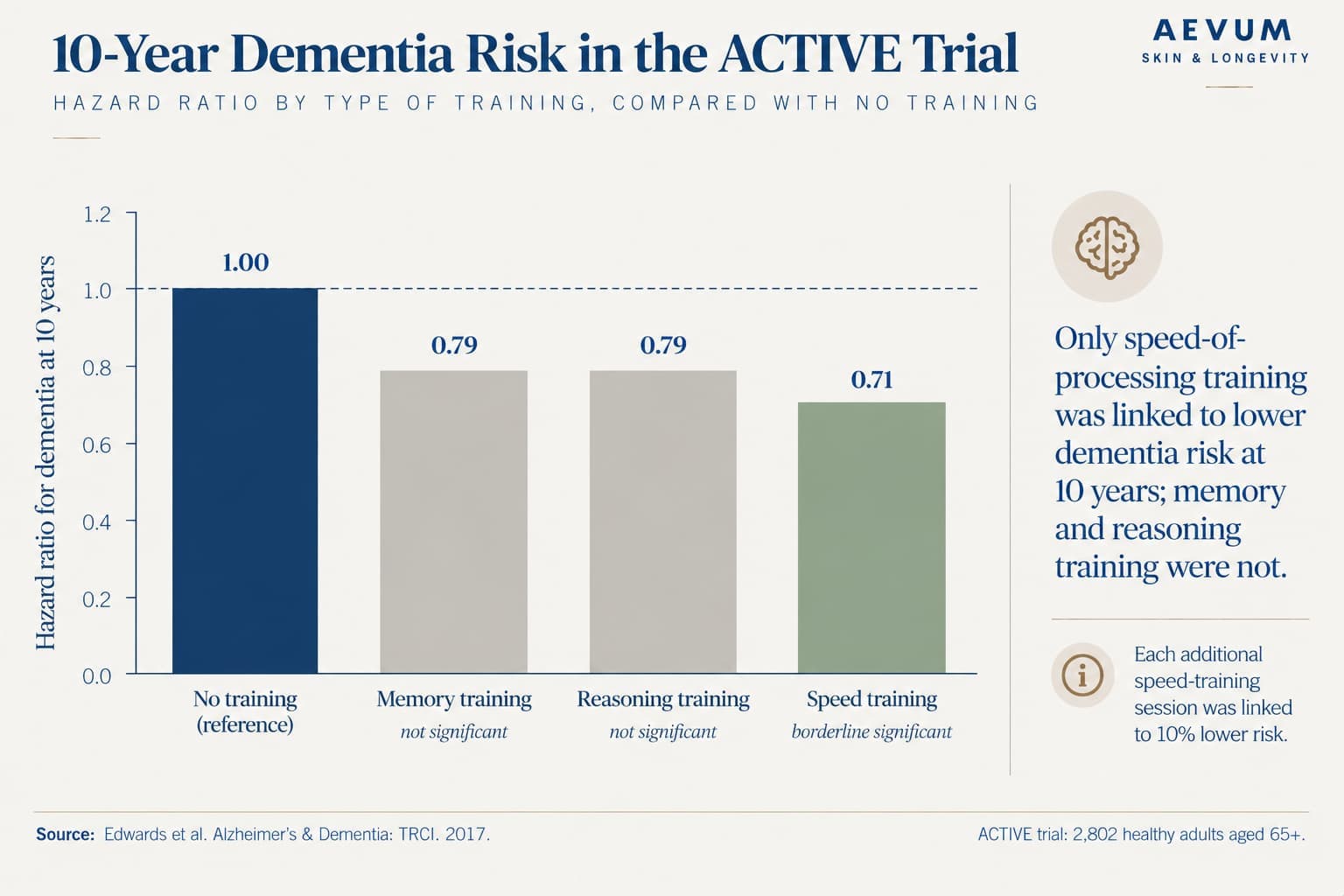
| ACTIVE trial, speed training, 10-year dementia risk | 29% lower (HR 0.71), borderline significance |
| ACTIVE trial, memory or reasoning training, 10-year dementia risk | No significant reduction (HR 0.79 for each) |
| ACTIVE 20-year follow-up, speed training with boosters | 25% lower rate of diagnosed dementia (HR 0.75) |
| ACTIVE 20-year follow-up, speed training without boosters | No benefit (HR 1.01) |
| Lumosity settlement with the US Federal Trade Commission (2016) | $2 million, over unsupported claims including dementia prevention |
What brain training claims vs. what's been tested
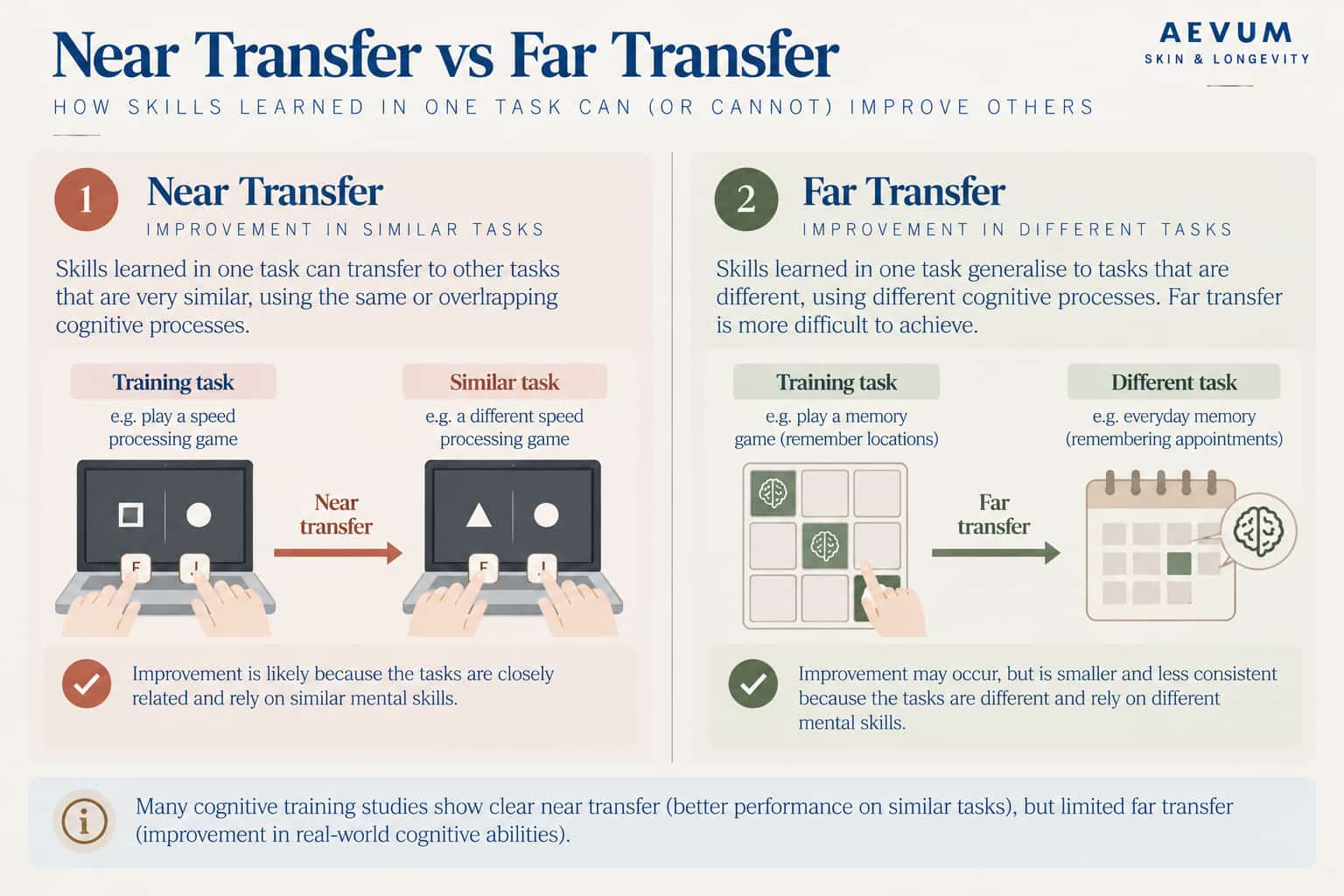
"Brain training" covers a wide range of products and programmes, from commercial app games to structured exercises tested in research trials. The key scientific question is transfer. Near transfer means getting better at the task you practised, or at very similar tasks. Far transfer means improvements carrying over to different abilities or to everyday life — remembering names, managing medications, staying independent, or lowering dementia risk.
Almost every brain-training programme produces near transfer. The marketing usually promises far transfer. That gap is where most of the problems lie.
Evidence strength
Well supported: you get better at what you practise. This isn't in dispute. A major 2016 review in Psychological Science in the Public Interest confirmed that people reliably improve on the specific tasks they practise. If you practise a memory game, you'll get better at that memory game.
Weak: broad benefits for everyday thinking. The same review, by a team of cognitive psychologists who examined the studies cited by brain-training companies, found "little evidence for broad transfer from brain-training tasks to other tasks", and little evidence that brain training improves everyday cognitive performance. As the lead author put it, practising remembering playing cards makes you very good at remembering playing cards, but there's little evidence it helps you remember which medications to take.
Enforcement action: when marketing outran the evidence. In 2016, the maker of Lumosity agreed to pay $2 million to settle charges from the US Federal Trade Commission. The FTC said the company had claimed its games would improve performance at work, at school and in sport; delay age-related cognitive decline and protect against mild cognitive impairment, dementia and Alzheimer's disease; and help with conditions from stroke to ADHD — and that scientific studies proved these benefits. According to the FTC, the evidence didn't support these claims. The full judgment was $50 million, suspended because of the company's finances.
Moderate, and specific: speed-of-processing training in the ACTIVE trial. The most important exception comes from ACTIVE, a large randomised trial that began in 1998-99 with 2,802 healthy adults aged 65 and over. Participants were assigned to one of three types of training — memory, reasoning or visual speed of processing — or to no training. Training involved about ten sessions of 60-75 minutes over five to six weeks, and some participants were randomly offered booster sessions at 11 and 35 months.
The speed-training exercise asks people to identify objects flashed briefly on a screen, including at the edges of their vision, with the display getting faster as they improve.
- →At 10 years, speed training was linked to a 29% lower risk of dementia (HR 0.71). The result only just reached statistical significance (95% CI 0.50-0.998). Each additional speed-training session was linked to a 10% lower risk. Memory training (HR 0.79) and reasoning training (HR 0.79) showed no significant effect.
- →At 20 years, researchers linked 2,021 participants to US Medicare records. People who did speed training and booster sessions had a 25% lower rate of diagnosed dementia than the control group (HR 0.75). Speed training without boosters showed no benefit (HR 1.01), and memory and reasoning training didn't reduce dementia risk either way.
This is some of the best evidence that any form of cognitive training might affect dementia, and it comes from a randomised trial rather than an observational study. But it has real limitations. Dementia at 20 years was identified from insurance claims rather than clinical assessment. The benefit depended on booster sessions, and only people who had completed at least eight of the ten initial sessions were eligible for boosters, which may introduce bias. The researchers themselves say it isn't yet clear why speed training worked when memory and reasoning training didn't.
In people with mild cognitive impairment. The American Academy of Neurology's 2018 guideline on mild cognitive impairment gave cognitive training a weak recommendation (Level C): clinicians may recommend it. That's weaker than its recommendation for regular exercise (Level B). See Mild Cognitive Impairment.
How to approach brain training
- →Treat apps as entertainment, not medicine. If you enjoy puzzles and brain games, there's no harm in them. Just don't expect them to protect against dementia or improve everyday memory.
- →If you want the best-evidenced option, it's speed-of-processing training — with follow-up sessions. The only benefit seen at 20 years was in people who kept going with boosters.
- →Don't let training replace things with stronger evidence. Time spent on brain games is time not spent on exercise, social contact or learning a genuinely new skill, all of which have stronger or broader evidence (see Social Connection and Cognitive Decline).
- →Be sceptical of claims that cite "scientific studies" without specifics. Ask what was actually measured: better scores on the game itself, or real-world outcomes like independence or dementia diagnoses?
Recommendations by goal
- 1Keeping your mind active for enjoyment
Brain games are fine. Choose ones you find engaging and vary them.
- 2Reducing long-term dementia risk
Prioritise exercise, blood pressure, hearing, sleep and social connection. If you want to add training, the ACTIVE-style speed training with boosters has the best evidence, but it's still one trial.
- 3Improving everyday memory now
Practical strategies (lists, calendars, routines) and treating things like poor sleep, hearing loss or depression are more likely to help than games.
- 4Already diagnosed with mild cognitive impairment
Cognitive training is a reasonable add-on, but regular exercise has stronger guideline support.
Practical notes
Brain training is a good example of a real scientific finding being stretched well beyond what it shows. The honest picture: practice makes you better at the thing you practise; broad benefits for everyday thinking are largely unproven; and one specific type of speed training, with boosters, has intriguing long-term evidence that still needs confirming. For most people, the strongest brain-health returns still come from the fundamentals covered elsewhere in this series.
- Simons DJ, et al. Do "Brain-Training" Programs Work? Psychological Science in the Public Interest, 2016;17(3):103-186.
- Edwards JD, et al. Speed of processing training results in lower risk of dementia. Alzheimer's & Dementia: Translational Research & Clinical Interventions, 2017.
- Coe NB, et al. Impact of cognitive training on claims-based diagnosed dementia over 20 years: evidence from the ACTIVE study. Alzheimer's & Dementia: Translational Research & Clinical Interventions, 2026;12(1):e70197.
- US Federal Trade Commission. Lumosity to Pay $2 Million to Settle FTC Deceptive Advertising Charges for Its "Brain Training" Program. January 2016.
- Petersen RC, et al. Practice guideline update summary: Mild cognitive impairment. Neurology, 2018;90(3):126-135.
Do you use a
brain-training app?
Take the free Aevum Protocol assessment to see how your cognitive longevity and 6 other longevity domains are performing — and get a personalised 90-day plan.
Take the Free Assessment →