Cognitive Longevity
Cognitive Reserve:
Why Some Brains Age Better Than Others
Two people can have near-identical brain scans — similar volume loss, similar plaque burden, even similar Alzheimer's pathology — and yet one shows clear symptoms while the other functions normally. This isn't a measurement error; it's one of the most well-replicated findings in cognitive aging research, and it has a name: cognitive reserve. This article covers what reserve actually is, the strongest evidence behind it (education, bilingualism, occupational complexity), and why it changes how our previous article's brain-volume data should be interpreted — reserve doesn't prevent the underlying structural changes, but it changes how much damage the brain can absorb before that damage becomes noticeable.
Key numbers
| Finding | Detail |
|---|---|
| Dementia risk, low vs. high education (pooled prevalence odds ratio) | 2.61 (low education ~2.6x more likely to have dementia) |
| Dementia risk, low vs. high education (pooled incidence odds ratio) | 1.88 |
| Meta-analysis scope | 133 studies, 437,477 subjects; 69 studies in the quantitative pooled analysis |
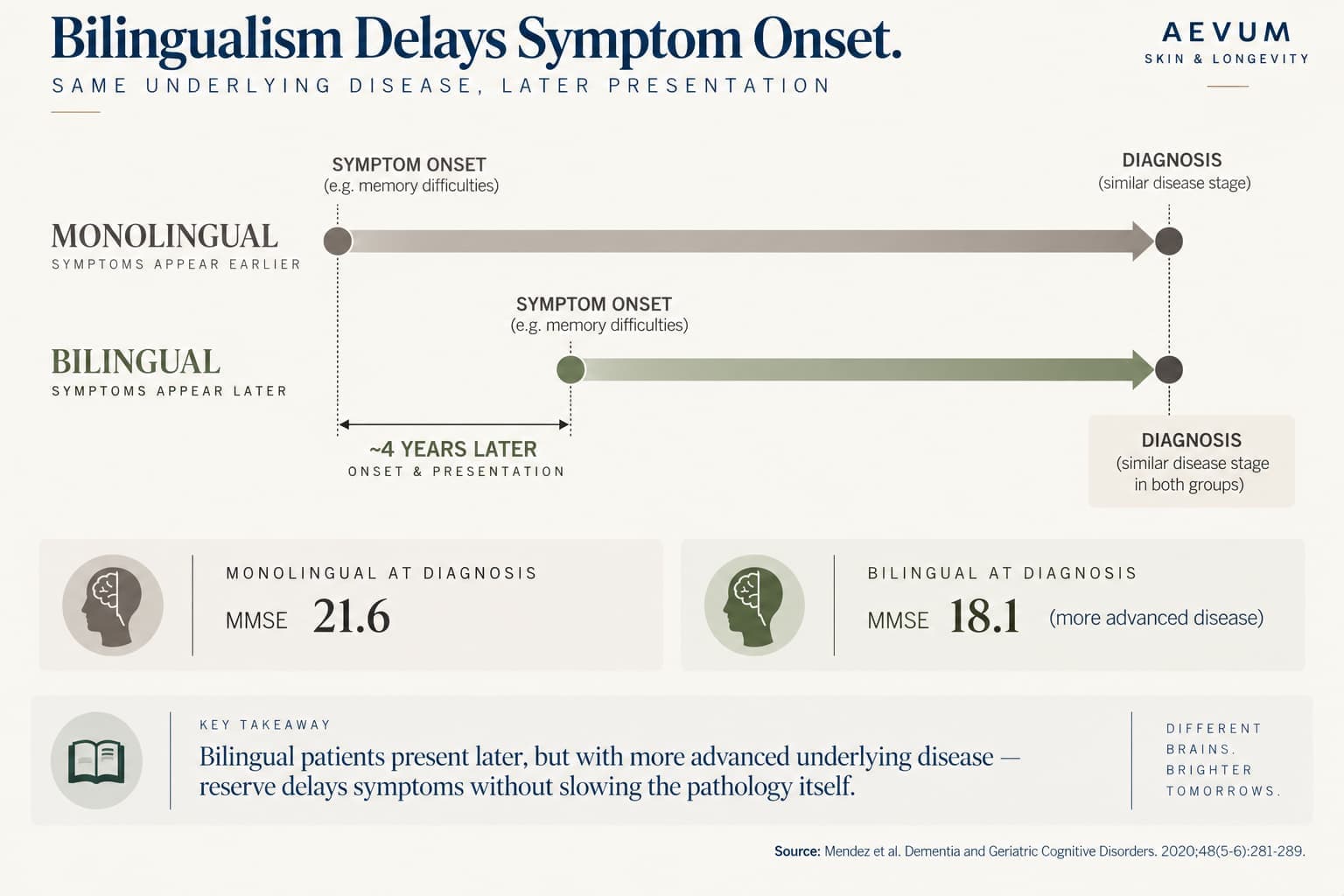
| Bilingualism and Alzheimer's symptom onset | ~4 years later onset and presentation vs. monolinguals (n=253: 74 bilingual/179 monolingual) |
| Notable trade-off | Bilingual patients had lower MMSE scores at diagnosis (18.1 vs. 21.6) — despite the later onset, consistent with more advanced underlying disease |
How it works
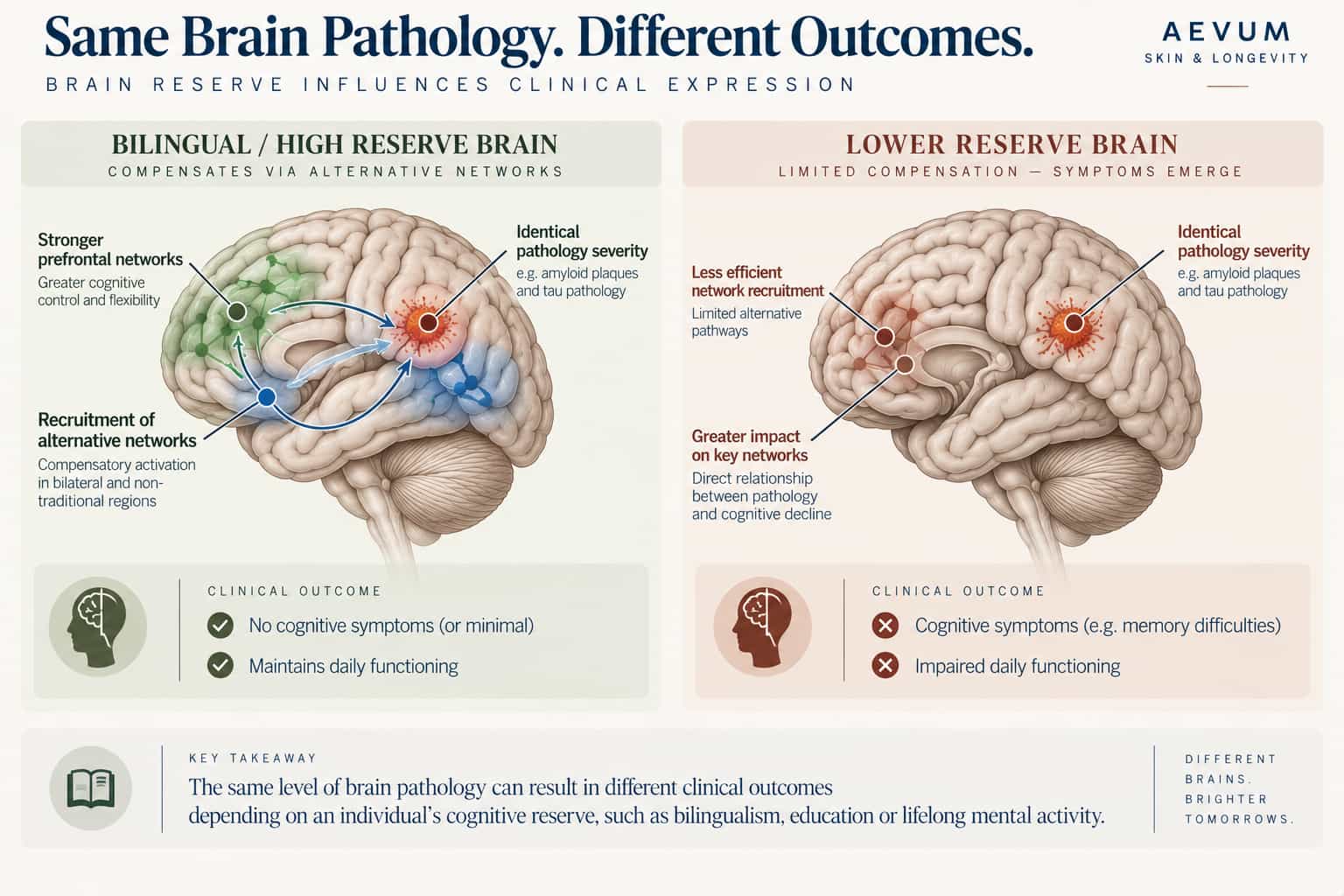
The core idea: reserve is capacity, not protection from damage. Cognitive reserve, as formalized by neuropsychologist Yaakov Stern, describes the brain's ability to actively compensate for age-related change or pathology by using alternative networks or more efficient cognitive strategies — rather than simply having more tissue to lose. This is a genuinely different concept from "brain reserve" (raw brain size or neuron count, a more passive buffer). Cognitive reserve is about how efficiently the brain that's actually there gets used: someone with high reserve facing the same degree of structural damage covered in our Aging Brain article can often recruit alternative neural pathways to maintain function, effectively masking the underlying damage for longer.
Education as the most heavily studied reserve-builder. The largest body of evidence for cognitive reserve comes from education. A systematic review and meta-analysis pooling 133 studies and 437,477 subjects (69 in the quantitative pooled analysis) found that people with low educational attainment had roughly 2.6 times higher odds of having dementia (prevalence) and roughly 1.9 times higher odds of developing it (incidence) compared to those with higher education — a large, consistent effect that held up across Alzheimer's disease specifically (OR 2.62), vascular dementia (OR 2.11), and unspecified dementia (OR 2.79). Education's protective association isn't fully explained by socioeconomic confounding alone in this literature — the consistency across dementia subtypes and across multiple independent cohorts is part of why the cognitive reserve framework, rather than a purely confounded association, is the leading explanation.
Bilingualism: a striking, more mechanistic example. Bilingualism offers one of the clearest illustrations of reserve in action because it's a specific, identifiable lifelong cognitive practice (constant executive-control demand from managing two language systems) rather than a broad proxy like years of schooling. A clinical study of 253 confirmed Alzheimer's patients (74 bilingual, 179 monolingual) found bilingual patients showed a significant ~4-year delay in both age of symptom onset and age of clinical presentation compared to monolingual patients — despite otherwise comparable underlying disease. The more revealing part of this finding: at the point of diagnosis, bilingual patients actually had worse cognitive test scores than monolinguals (MMSE 18.1 vs. 21.6). This is the clearest illustration of what reserve actually does — it doesn't stop the underlying pathology, it lets the brain keep functioning at a near-normal level for longer despite that pathology, which means by the time symptoms finally become undeniable enough to bring someone in for evaluation, the underlying disease has typically progressed further than it would have in someone with less reserve to mask it.
What the research shows
Reserve builds throughout life, not just in childhood or during formal education. While formal education is the most-studied single factor, the broader cognitive reserve literature — occupational complexity, engagement in mentally stimulating leisure activities, social engagement — consistently points to reserve as something that continues accumulating through adulthood, not a fixed quantity set by early-life schooling alone. This is the throughline connecting this article to Learning New Skills and Brain Health and Social Connection and Cognitive Decline — both cover specific, adulthood-accessible ways to keep building reserve, regardless of educational background.
A separate, larger meta-analysis quantifies exactly how much reserve moderates outcomes. A 2021 systematic review and meta-analysis found that cognitive reserve protects against mild cognitive impairment and dementia progression above and beyond the effect of Alzheimer's-related structural pathology and biomarkers — people with high cognitive reserve showed a 47% reduced relative risk of MCI or dementia even when accounting for the same underlying brain changes. This is the more general, quantified version of the specific bilingualism finding above: identical neuropathological burden can produce meaningfully different clinical trajectories depending on reserve.
Why this reframes how to think about brain scans and risk. Given cognitive reserve, a brain scan or pathology marker alone doesn't fully predict who will show symptoms and when — the same degree of structural change covered in our Aging Brain article can look very different clinically depending on the reserve built up around it. This has a genuinely important clinical implication worth taking seriously: someone with high cognitive reserve who does eventually show clear cognitive symptoms may already have more advanced underlying pathology than the symptom severity suggests, precisely because reserve delayed the point at which symptoms became obvious enough to prompt evaluation.
Recommendations
- 1Formal education's protective association is well-established, but it's not the only path to reserve
For someone whose educational opportunities were limited, the literature on occupational complexity, bilingualism, and sustained mentally engaging activity offers alternative, adulthood-accessible routes to building comparable reserve.
- 2Bilingual or multilingual individuals shouldn't assume clean cognitive testing rules out concern
Given the masking effect shown in the research, a bilingual person scoring only mildly below expectations on standard cognitive testing may warrant closer attention than the raw score alone suggests.
- 3Sudden, rapid symptom progression after a late, delayed diagnosis is consistent with (not contrary to) high reserve
Family members of someone with high lifelong cognitive engagement who then seems to decline unusually fast after diagnosis shouldn't necessarily read this as an unusually aggressive disease course — it may reflect reserve having masked a more advanced underlying process before diagnosis.
- 4Building reserve is a lifelong project, not a childhood one
Since the research base extends well beyond formal schooling, actively building reserve in midlife and beyond — through the mechanisms covered later in this series — is a reasonable, evidence-consistent goal at any age.
Practical notes
The core reframe this article offers for the rest of the series: brain structure, covered in our previous article, and clinical symptoms are related but not the same thing, and the gap between them is where cognitive reserve does its work. Nearly every modifiable-factor article later in this series is, in one way or another, a way of building or protecting that reserve.
- Meng X, D'Arcy C. Education and Dementia in the Context of the Cognitive Reserve Hypothesis: A Systematic Review with Meta-Analyses and Qualitative Analyses. PLOS ONE, 2012;7(6):e38268.
- Nelson ME, Jester DJ, Petkus AJ, Andel R. Cognitive Reserve, Alzheimer's Neuropathology, and Risk of Dementia: A Systematic Review and Meta-Analysis. Neuropsychology Review, 2021;31(2):233-250.
- Mendez MF, Chavez D, Akhlaghipour G. Bilingualism Delays Expression of Alzheimer's Clinical Syndrome. Dementia and Geriatric Cognitive Disorders, 2020;48(5-6):281-289.
How many languages
do you speak?
Take the free Aevum Protocol assessment to see how your cognitive longevity and 6 other longevity domains are performing — and get a personalised 90-day plan.
Take the Free Assessment →