Cognitive Longevity
Social Connection and Cognitive Decline:
The Isolation-Dementia Link
People with fewer social connections are more likely to develop dementia. That link shows up across dozens of long-term studies and is now one of the 14 recognised modifiable risk factors, accounting for about 5% of dementia cases worldwide. But "social connection" covers two different things that researchers increasingly separate: social isolation (how much contact you actually have) and loneliness (how disconnected you feel). The evidence for isolation is fairly consistent. The evidence for loneliness is more mixed. And a real complication runs through the whole field: early dementia itself makes people withdraw, so some of the association may run backwards. This article covers what the evidence shows, where it's uncertain, and what the first trials of social interventions have found.
Key numbers
| Finding | Detail |
|---|---|
| Share of dementia linked to social isolation (2024 Lancet Commission) | ~5%, a late-life risk factor |
| Dementia risk with social isolation (UK Biobank, 462,619 people) | 1.26x, independent of loneliness and depression |
| Dementia risk with loneliness (UK Biobank, fully adjusted) | 1.04x — not significant |
| Dementia risk with loneliness (2024 meta-analysis, 608,561 people) | 1.31x overall; held after adjusting for depression and isolation |
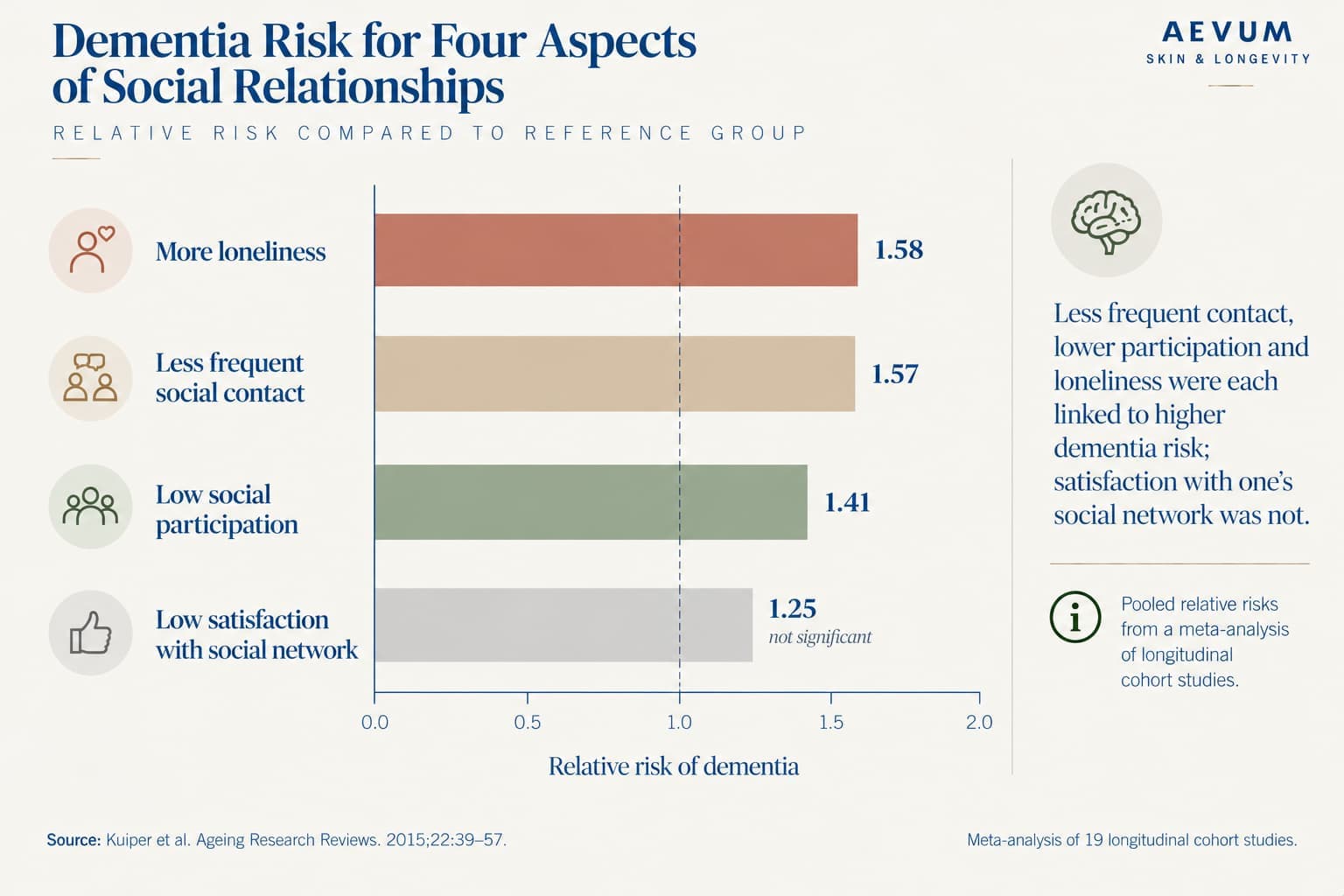
| Less frequent social contact (2015 meta-analysis) | 1.57x |
| Low social participation (2015 meta-analysis) | 1.41x |
| Video-chat conversation trial in adults 75+ with MCI | +1.75 points on a global cognition test (MoCA) vs. control at 6 months |
Isolation vs. loneliness
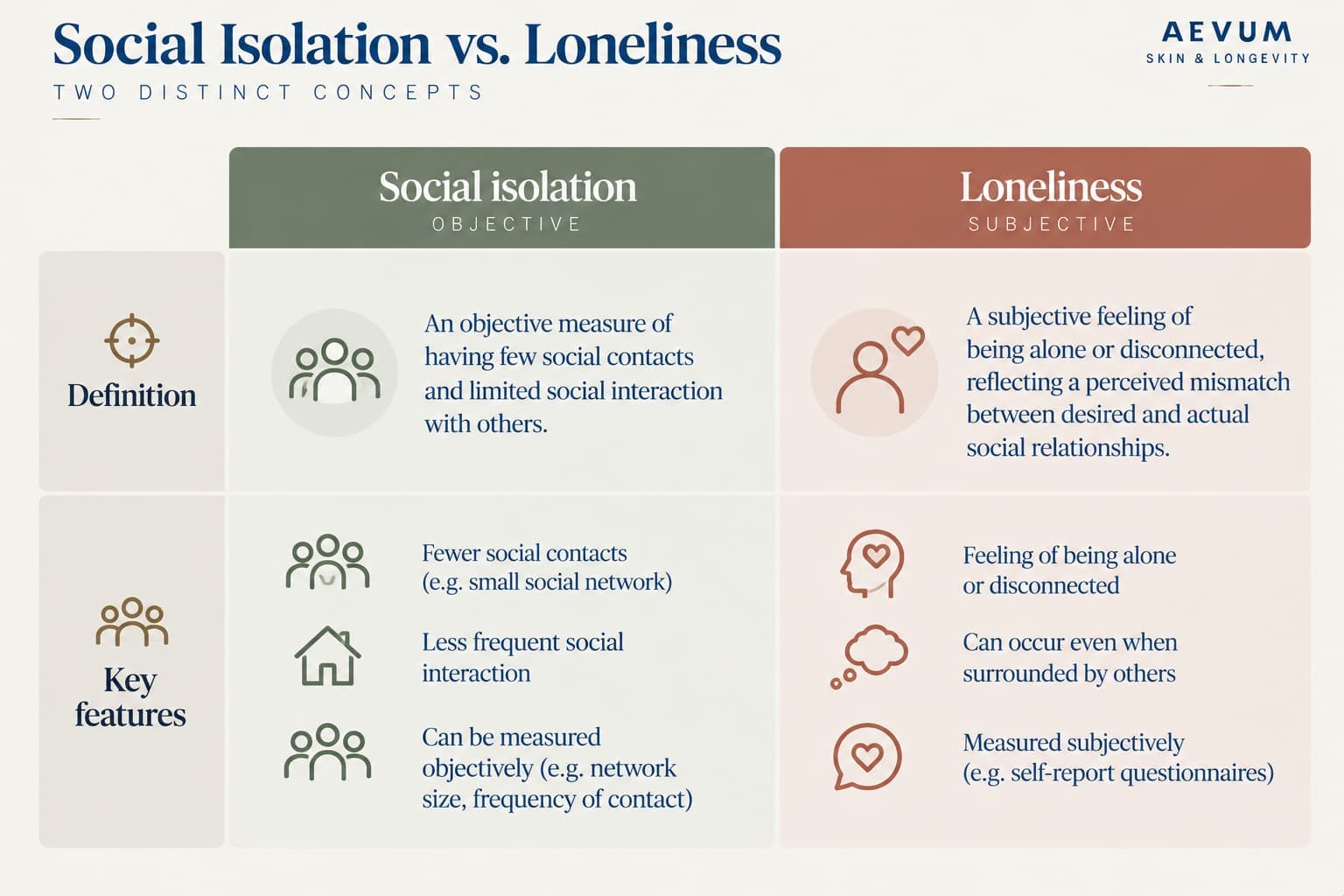
These two terms are often used interchangeably, but they're different and they don't always go together. Social isolation is objective: living alone, rarely seeing friends or family, not taking part in groups or activities. Loneliness is subjective: the feeling that your relationships aren't what you want them to be.
Someone can live alone and see few people without feeling lonely, and someone surrounded by family can feel deeply lonely. The distinction matters because the evidence differs for each, and because they call for different responses.
Social relationships and dementia: the risk table
| Factor | Association with dementia | 95% CI | Evidence strength |
|---|---|---|---|
| Social isolation (UK Biobank, fully adjusted) | HR 1.26 | 1.15-1.37 | Large cohort; independent of loneliness and depression |
| Less frequent social contact | RR 1.57 | 1.32-1.85 | Meta-analysis of cohort studies |
| Low social participation | RR 1.41 | 1.13-1.75 | Meta-analysis of cohort studies |
| Loneliness (2024 meta-analysis) | HR 1.31 | 1.20-1.43 | 21 samples; held after adjusting for depression and isolation |
| Loneliness (UK Biobank, fully adjusted) | HR 1.04 | 0.94-1.16 | Not significant once depression and isolation accounted for |
| Low satisfaction with social network | RR 1.25 | 0.96-1.62 | Not significant |
Social isolation and low participation are directly modifiable; loneliness is partly modifiable, and closely tied to mood.
What the research shows
Social isolation: the more consistent finding. The largest single study, from the UK Biobank, followed 462,619 adults with an average age of 57 for nearly 12 years, during which 4,998 developed dementia. People who were socially isolated had a 26% higher risk of dementia. That figure held after accounting for a long list of other factors, including loneliness and depression. Brain scans in a subset of participants showed that socially isolated people had less grey matter in temporal and frontal regions and in the hippocampus — areas involved in memory and thinking.
An earlier meta-analysis of 19 long-term cohort studies found a similar pattern across different measures of social connection: less frequent social contact was linked to 1.57 times the risk, and low participation in social activities to 1.41 times the risk.
Loneliness: real, but harder to pin down. The evidence on loneliness points in two directions. In the UK Biobank study, loneliness was linked to dementia at first, but the link disappeared (HR 1.04, not significant) once depression and social isolation were taken into account — the authors estimated that about three-quarters of the loneliness association ran through depressive symptoms.
A 2024 meta-analysis in Nature Mental Health, pooling 21 samples and more than 600,000 people, reached a different conclusion. Loneliness was linked to a 31% higher risk of all-cause dementia, a 39% higher risk of Alzheimer's disease and a 74% higher risk of vascular dementia, and these associations held when the analyses controlled for depression, social isolation and other risk factors.
The honest summary is that loneliness is linked to dementia risk, but it's less clear than for isolation how much of that link is independent of depression and social contact. Both deserve attention.
Could early dementia be causing the withdrawal? This is the main weakness of the whole literature. Dementia develops over many years before diagnosis, and early changes in memory, confidence and hearing can lead people to pull back from social life. If that's happening, some of the "isolation causes dementia" association is really "early dementia causes isolation". Studies try to reduce this by following people for a long time, or by excluding people who develop dementia in the first few years. Long follow-up helps — the UK Biobank study averaged nearly 12 years — but no observational study can fully rule out reverse causation.
Why social connection might protect the brain. Researchers have proposed several routes, which probably work together:
- →Cognitive stimulation. Conversation is one of the most demanding everyday mental tasks, and regular social engagement may help build and maintain cognitive reserve (see Cognitive Reserve).
- →Stress buffering. Supportive relationships dampen the stress response (see Chronic Stress and the Brain).
- →Mood. Isolation and loneliness raise the risk of depression, itself a dementia risk factor covered in Depression and Cognitive Decline.
- →Health behaviours. Socially connected people tend to be more active, eat better and get medical problems addressed sooner.
Does increasing social contact help? Early trial evidence. Randomised trials of social interventions are still few and small. The most direct so far is the I-CONECT trial, which randomised 186 socially isolated adults aged 75 and over to either regular video-chat conversations with trained interviewers (four times a week for six months, then twice a week for another six) or a control group. In the 100 participants with mild cognitive impairment, those in the conversation group scored 1.75 points higher on a global cognition test (the MoCA) than controls at six months. In the 86 with normal cognition, there was no significant difference in the main outcome, though one measure of verbal fluency improved. It's an encouraging first result, not yet proof.
What you can actually change
- 1Treat social contact as part of your health routine
Regular, meaningful contact — seeing friends and family, taking part in groups, volunteering, community or religious activities — is the most direct way to reduce isolation. The meta-analysis data suggest both how often you're in contact and whether you take part in shared activities matter.
- 2Fix the things that make socialising harder
Hearing loss is one of the most common reasons older adults withdraw from conversation, and it's treatable. The same applies to untreated vision problems, depression, mobility limits and continence problems.
- 3Take loneliness seriously, even if you're not alone
Because loneliness and isolation are different, someone with plenty of contact can still be lonely. Loneliness is closely tied to depression, so persistent loneliness is worth raising with a doctor, especially alongside low mood.
- 4Watch for withdrawal in older relatives
Because social withdrawal can also be an early sign of cognitive change, a noticeable pulling back from social life in an older person is worth paying attention to — both as a risk factor to address and as a possible early signal.
Related reading: Hearing Loss and Dementia Risk and Mild Cognitive Impairment.
Recommendations
- →Treat social isolation as a real health risk. It's one of the 14 recognised modifiable dementia risk factors and has consistent evidence behind it.
- →Aim for regular contact and shared activities, not just occasional visits. Frequency of contact and participation both show up in the data.
- →Address the barriers first. Hearing loss, depression and mobility problems often drive isolation, and each is treatable.
- →Don't dismiss loneliness in someone who isn't alone. Feeling disconnected carries its own risk, closely tied to depression.
- →Keep the evidence in proportion. Social connection is linked to lower risk, and early trials are promising, but it hasn't yet been shown to prevent dementia on its own.
Practical notes
Of all the risk factors in this series, social connection is probably the most pleasant to act on, and its benefits go well beyond the brain — better mood, better health habits and a better quality of life. The evidence for its effect on dementia specifically is still maturing, and some of the association likely reflects early dementia causing withdrawal. But the balance of evidence supports treating regular, meaningful contact as part of a brain-healthy life, particularly in later years, when isolation becomes more common.
- Shen C, et al. Associations of Social Isolation and Loneliness With Later Dementia. Neurology, 2022;99(2):e164-e175.
- Kuiper JS, et al. Social relationships and risk of dementia: A systematic review and meta-analysis of longitudinal cohort studies. Ageing Research Reviews, 2015;22:39-57.
- Luchetti M, et al. A meta-analysis of loneliness and risk of dementia using longitudinal data from >600,000 individuals. Nature Mental Health, 2024;2(11):1350-1361.
- Dodge HH, et al. Internet-Based Conversational Engagement Randomized Controlled Clinical Trial (I-CONECT) Among Socially Isolated Adults 75+ Years Old With Normal Cognition or Mild Cognitive Impairment: Topline Results. The Gerontologist, 2024;64(4):gnad147.
- Livingston G, Huntley J, Liu KY, et al. Dementia prevention, intervention, and care: 2024 report of the Lancet Standing Commission. The Lancet, 2024;404(10452):572-628.
How often do you have a
real conversation in a typical week?
Take the free Aevum Protocol assessment to see how your cognitive longevity and 6 other longevity domains are performing — and get a personalised 90-day plan.
Take the Free Assessment →