Cognitive Longevity
Chronic Stress and Cortisol:
How Stress Physically Changes the Brain
Short bursts of stress are normal and even useful. The concern for brain health is stress that doesn't switch off — months and years of it. Long-term studies link repeated midlife stress to higher dementia risk later on, post-traumatic stress disorder (PTSD) to about 60% higher risk, and higher cortisol in middle age to smaller brain volume and weaker memory. The evidence is observational and the effects are moderate, and chronic stress isn't one of the 14 factors in the main international dementia-risk framework. But the pattern is consistent, the biology is plausible, and several of the most effective ways of managing stress also protect the brain for other reasons. This article covers what the evidence shows, how stress might affect the brain, and what helps.
Key numbers
| Finding | Detail |
|---|---|
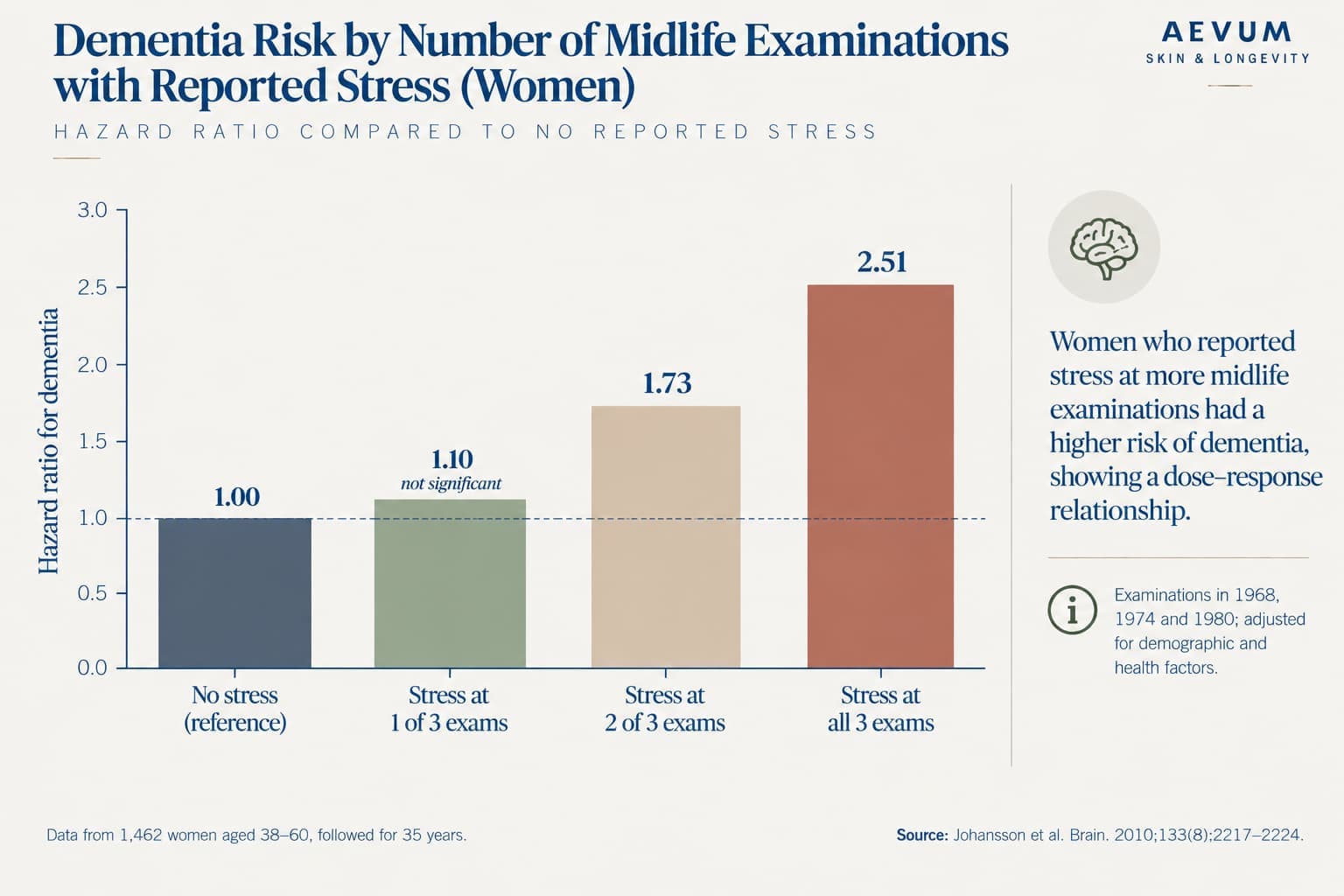
| Dementia risk, women reporting stress at 2 of 3 midlife examinations | 1.73x (vs. no stress) |
| Dementia risk, women reporting stress at all 3 examinations | 2.51x |
| Dementia risk with PTSD (meta-analysis, ~1.7 million people) | 1.61x overall; 2.11x in general-population studies |
| Higher morning cortisol in midlife (mean age 48.5) | Lower total brain volume and worse memory |
| 18-month meditation programme in adults 65+ | No measurable change in brain volume or blood flow in the regions studied |
How stress affects the brain
The stress response and cortisol. When the brain perceives a threat, it activates the hypothalamic-pituitary-adrenal (HPA) axis, which ends with the adrenal glands releasing cortisol. Cortisol mobilises energy, sharpens attention and, normally, feeds back to the brain to switch the response off once the threat passes. With chronic stress, that feedback can become less effective and cortisol stays elevated for longer.
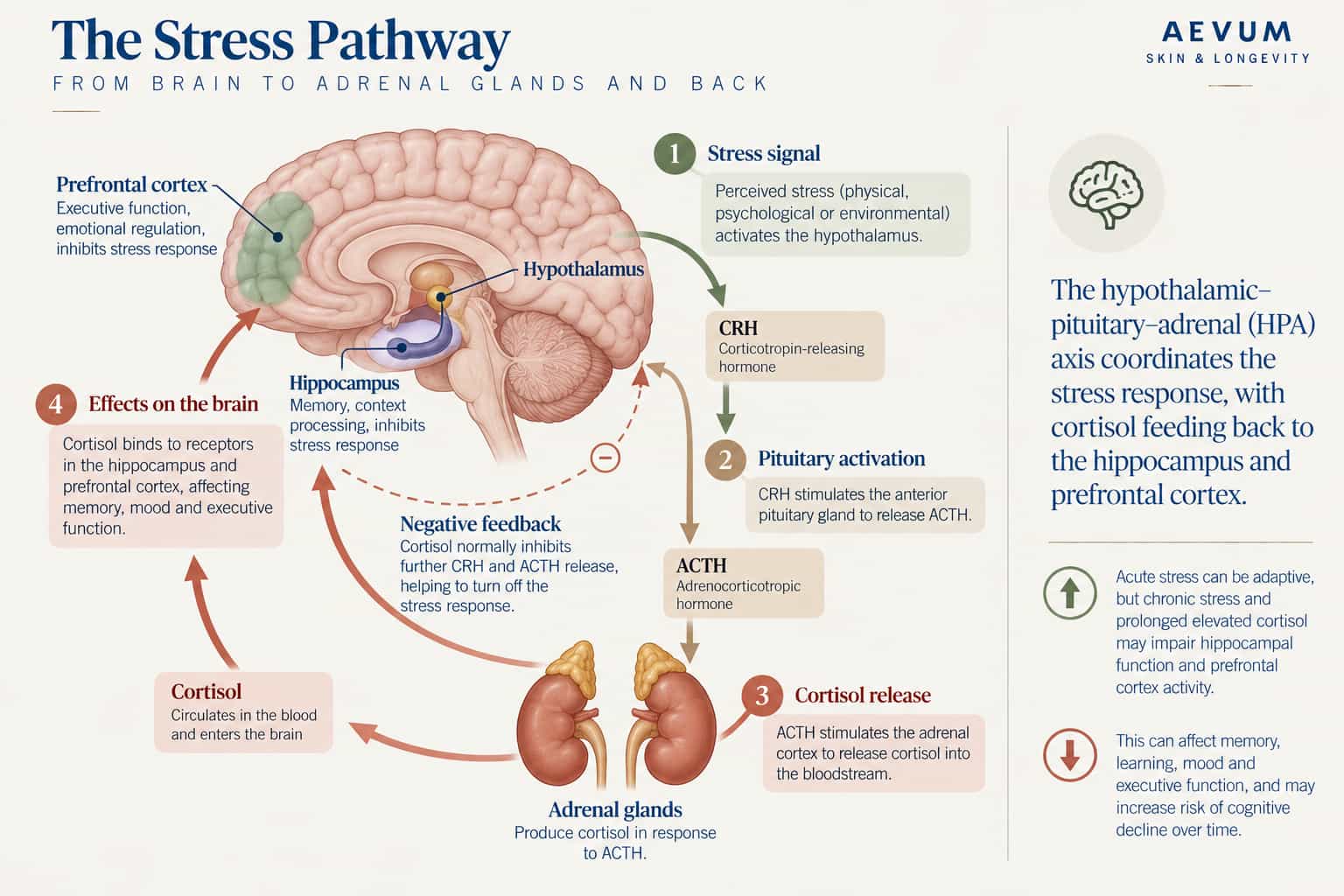
Why the hippocampus is vulnerable. The hippocampus — central to forming new memories, and one of the first regions affected in Alzheimer's (see The Aging Brain: What Actually Changes With Age) — has a high density of cortisol receptors. So does the prefrontal cortex, which handles planning and working memory. In animal studies, prolonged high glucocorticoid exposure causes neurons in these regions to lose some of their branching connections. Much of that change reverses when the stress ends, which is one reason stress is considered a modifiable risk rather than permanent damage. Whether the same mechanisms fully explain the human findings below is still not established.
Chronic stress also acts indirectly. It disrupts sleep, raises blood pressure, encourages inflammation, and makes smoking, drinking and inactivity more likely — each of which carries its own brain risks.
Stress and dementia: the risk table
| Factor | Association with dementia | 95% CI | Evidence strength |
|---|---|---|---|
| Stress reported at 1 of 3 midlife exams | HR 1.10 | 0.71-1.71 | Observational; not significant |
| Stress reported at 2 of 3 midlife exams | HR 1.73 | 1.01-2.95 | Observational |
| Stress reported at all 3 midlife exams | HR 2.51 | 1.33-4.77 | Observational; dose-response |
| PTSD (all studies) | HR 1.61 | 1.43-1.81 | Meta-analysis of observational studies |
| PTSD (general-population studies) | HR 2.11 | 1.03-4.33 | Only 3 studies, wide uncertainty |
| High morning cortisol in midlife | Lower brain volume, worse memory | — | Observational, single time point |
Stress data come from 1,462 Swedish women aged 38-60 at baseline, followed for 35 years. PTSD data come from a meta-analysis of 8 studies and 1,693,678 people. Stress itself is partly modifiable; PTSD is a treatable condition.
What the research shows
Repeated midlife stress and later dementia. The longest-running evidence comes from a Swedish study that enrolled 1,462 women aged 38-60 in 1968-69 and followed them for 35 years. Stress was defined as feeling irritable, tense, nervous, anxious, fearful or having sleep problems for a month or more because of work, health, family or other problems, and was asked about at three examinations (1968, 1974 and 1980). Over the follow-up, 161 women developed dementia.
The pattern was graded. Women who reported frequent or constant stress at just one of the three examinations had no significant increase in risk. Those who reported it at two examinations had 1.73 times the risk of women with no stress, and those who reported it at all three had 2.51 times the risk. That dose-response pattern — the longer stress persists, the higher the risk — is what makes the finding more than a single association. It also suggests that a stressful period, on its own, isn't the concern; stress that keeps recurring over years is.
The study has limits. It included only women, stress was self-reported, and in an observational study stress may be partly a marker of other disadvantages that also raise dementia risk.
PTSD: the most severe form of chronic stress. A 2020 meta-analysis in The British Journal of Psychiatry pooled 8 studies covering nearly 1.7 million people. People with PTSD had a 61% higher risk of developing dementia (HR 1.61). The association held after excluding studies at high risk of bias (HR 1.55). It was similar in veterans (HR 1.61) and higher in general-population studies (HR 2.11), though that estimate rests on only three studies and is imprecise. PTSD is a treatable condition, which makes this one of the more actionable findings in this area.
Cortisol and the brain in middle age. In the Framingham Heart Study, researchers measured early-morning cortisol in 2,231 adults with an average age of 48.5; 2,018 of them also had brain MRI. People in the highest third of cortisol levels had lower total brain volume and worse memory than those in the middle third. The brain-volume link appeared in women but not men.
This is a single measurement at one point in time, so it can't show that cortisol caused the differences. What it does show is that cortisol-related brain differences are detectable well before old age and well before any cognitive symptoms — the same midlife window where most modifiable dementia risk sits (see Alzheimer's Disease: Risk Factors You Can Actually Change).
Where stress sits among the recognised risk factors. The 2024 Lancet Commission's list of 14 modifiable dementia risk factors does not include chronic stress as a separate item, though it does include depression, social isolation and several conditions that stress makes worse, such as high blood pressure. The evidence for stress is suggestive rather than definitive. It's reasonable to treat long-term stress as a contributor to brain risk, but not to rank it alongside hearing loss or blood pressure in strength of evidence.
What you can actually change
- 1Treat anxiety, PTSD and depression properly
The strongest numbers in this article relate to diagnosable conditions — PTSD in particular — that have effective treatments, including trauma-focused psychological therapies. Persistent anxiety, trauma symptoms or low mood deserve proper assessment and treatment, not just "stress management". Depression's own link with dementia is covered later in this series.
- 2Use the stress reducers that also protect the brain directly
The most reliable stress-management tools overlap with the strongest brain-health interventions in this series: regular exercise lowers stress and has direct evidence for protecting the hippocampus; good sleep is disrupted by chronic stress, and poor sleep carries its own brain risks; and social connection buffers stress and is itself a recognised dementia risk factor.
- 3Address the source where you can
Stress that comes from a specific, recurring problem — workload, caregiving, finances, a difficult relationship — tends to respond better to changing the situation, or getting practical support with it, than to coping techniques alone. The Swedish data suggest that it's persistent, recurring stress that matters, so breaking the cycle is the goal.
- 4Meditation: good for wellbeing, unproven for brain structure
Mindfulness and meditation can reduce perceived stress and improve wellbeing. But the best trial so far on brain structure was negative. The Age-Well trial randomised 136 healthy adults aged 65 and over to 18 months of meditation training, 18 months of English-language learning, or no intervention. Meditation produced no significant change in the volume or blood flow of the brain regions measured (the anterior cingulate cortex and insula) compared with either control, although it did improve measures of attention and emotional regulation compared with language learning.
For the exercise side of this, see Neuroplasticity After 40.
Recommendations
- →Take persistent stress seriously, but don't panic about stressful periods. The risk in the long-term data comes from stress that keeps recurring over years, not from a hard few months.
- →Get PTSD, anxiety and depression assessed and treated. These are the most clearly linked, most treatable parts of the stress-dementia picture.
- →Prioritise exercise, sleep and social contact as stress tools. They reduce stress and have their own evidence for brain health.
- →Treat stress as part of the midlife risk picture. Cortisol-related brain differences are already visible around age 50, the same window where blood pressure and metabolic health matter most.
- →Keep expectations for meditation realistic. It helps wellbeing, but so far hasn't been shown to change brain structure.
Practical notes
Chronic stress is best understood as an amplifier rather than a stand-alone cause: it worsens sleep, blood pressure, mood and health habits, and may also act on the hippocampus directly. That's why the practical response isn't a special "stress protocol" but the same foundations this series keeps returning to — exercise, sleep, social connection and proper treatment of mental health conditions — applied with the recognition that long-term stress makes all of them harder and more important.
- Johansson L, et al. Midlife psychological stress and risk of dementia: a 35-year longitudinal population study. Brain, 2010;133(8):2217-2224.
- Günak MM, et al. Post-traumatic stress disorder as a risk factor for dementia: systematic review and meta-analysis. The British Journal of Psychiatry, 2020;217(5):600-608.
- Echouffo-Tcheugui JB, et al. Circulating cortisol and cognitive and structural brain measures: The Framingham Heart Study. Neurology, 2018;91:e1961-e1970.
- Chételat G, et al. Effect of an 18-Month Meditation Training on Regional Brain Volume and Perfusion in Older Adults: The Age-Well Randomized Clinical Trial. JAMA Neurology, 2022.
- Livingston G, Huntley J, Liu KY, et al. Dementia prevention, intervention, and care: 2024 report of the Lancet Standing Commission. The Lancet, 2024;404(10452):572-628.
Has stress been a constant
rather than a phase for you?
Take the free Aevum Protocol assessment to see how your cognitive longevity and 6 other longevity domains are performing — and get a personalised 90-day plan.
Take the Free Assessment →