Cognitive Longevity
Alzheimer's Disease:
Risk Factors You Can Actually Change
Dementia is often framed as something that simply happens with age or genetics — largely outside anyone's control. The most authoritative body of evidence on this question, a standing international commission that periodically reviews the entire global evidence base, disagrees: it estimates that nearly half of dementia cases worldwide are linked to factors people can actually influence. This article lays out that full risk-factor picture — what's on the list, how much each factor is estimated to contribute, and which ones deserve the most attention.
The 14 modifiable risk factors
| Risk factor | Life stage | PAF | Modifiable? |
|---|---|---|---|
| Hearing loss | Midlife | 7% | Yes — hearing aids |
| High LDL cholesterol | Midlife | 7% | Yes — diet, medication |
| Social isolation | Late life | 5% | Yes |
| Less education | Early life | 5% | Yes, in youth — reserve-building later partially compensates |
| Depression | Midlife | 3% | Yes |
| Traumatic brain injury | Midlife | 3% | Partially — prevention-focused |
| Air pollution | Late life | 3% | Partially — individual + policy-level |
| Physical inactivity | Midlife | 2% | Yes |
| Diabetes | Midlife | 2% | Yes |
| Smoking | Midlife | 2% | Yes |
| Hypertension | Midlife | 2% | Yes |
| Untreated vision loss | Late life | 2% | Yes |
| Obesity | Midlife | 1% | Yes |
| Excessive alcohol | Midlife | 1% | Yes |
| Total (all 14 combined) | — | ~45% | — |
How to read this table
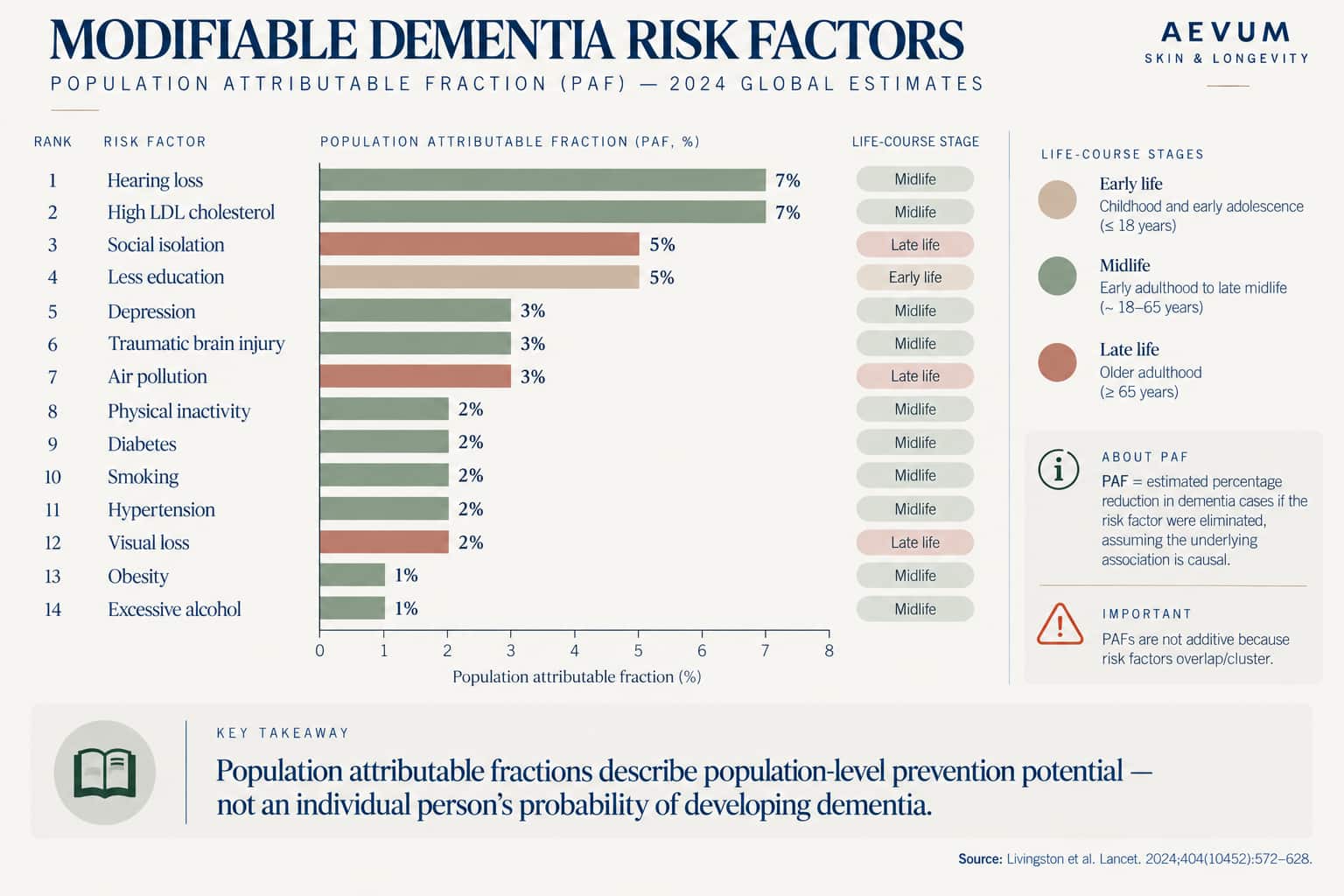
What "population attributable fraction" actually means. The population attributable fraction (PAF) is not the same as individual risk — it's an estimate of how much dementia incidence, across an entire population, would theoretically drop if a given risk factor were completely eliminated from that population. A 7% PAF for hearing loss doesn't mean any one person with hearing loss has a 7% chance of developing dementia because of it — it means that, across the whole population, roughly 7% of dementia cases are statistically linked to hearing loss as a contributing factor. These fractions also aren't strictly additive in a simple sense (some risk factors interact with and partially overlap each other), but the commission's methodology accounts for this, arriving at a combined estimate of ~45% of dementia cases being linked to all 14 factors together.
This is a standing, periodically updated international consensus, not a single study. This risk-factor framework comes from a standing Lancet Commission — a body of dementia researchers that periodically reviews the full global evidence base and updates its risk-factor list and estimates accordingly. The 2024 update added two new factors to the previous list of twelve: high LDL cholesterol in midlife and untreated vision loss in late life, and re-ran meta-analyses specifically for depression and hearing loss given new evidence since the prior report — which is also why air pollution shifted into the late-life category in this update, alongside social isolation and vision loss. This is meaningfully different from citing one observational study — it represents the current best synthesis of the field, regularly revised as new evidence emerges.
What you can actually change
The three largest individually-quantified factors: hearing, cholesterol, and education. Three factors are at or near the top of this list: midlife hearing loss and high midlife LDL cholesterol each at 7%, with less education in early life close behind at 5%. Education is the one factor on this list that can't be retroactively changed once someone reaches adulthood — but its underlying mechanism (building cognitive reserve) remains addressable throughout life through other routes, covered in Cognitive Reserve: Why Some Brains Age Better Than Others. Hearing loss and LDL cholesterol, by contrast, are both directly and immediately actionable at any adult age — hearing aids and lipid management are established, accessible interventions.
The cluster of cardiometabolic factors. Hypertension, obesity, diabetes, physical inactivity, and smoking together represent a cluster of interrelated cardiometabolic risk factors — the same category already covered with strong trial-level evidence in Vascular Health and the Brain. This overlap isn't a coincidence: several of the mechanisms linking these factors to dementia risk run through the same vascular and metabolic pathways, meaning that addressing one (for instance, blood pressure) often has beneficial knock-on effects on the others.
Depression and social isolation: smaller individual weight, but genuinely distinct pathways. Depression (3%) has a smaller individually-quantified contribution than some other factors, but it's included precisely because the evidence supporting it as an independent, non-overlapping risk pathway (not simply a symptom of early dementia itself) has strengthened enough to warrant its own dedicated meta-analysis in the 2024 update. Social isolation, at 5%, carries a genuinely larger individual weight than its "soft" framing sometimes suggests. Both get their own dedicated articles later in this series given how much nuance underlies each.
Recommendations
- 1Don't treat this table as a checklist to eliminate all 14 factors perfectly
The 45% figure describes a population-level ceiling on preventable risk, not a guarantee for any individual — genetics, age, and unmodifiable factors still play a substantial role.
- 2Midlife is where most of the actionable factors concentrate
The majority of the 14 factors sit in the midlife category specifically — this is a strong argument for taking cardiovascular and metabolic health seriously well before any cognitive symptoms would ever appear, not waiting until later life.
- 3Hearing and vision are commonly overlooked but genuinely actionable
Both sensory factors are often deprioritized relative to more "medical-sounding" risks like blood pressure, despite carrying real, quantified attributable fractions — a hearing or vision check is a low-friction, high-leverage addition to a longevity-focused health plan.
- 4Cardiometabolic factors cluster together, so addressing one often helps several
A patient working on blood pressure, weight, and physical activity simultaneously is addressing several line items on this list at once, not just one.
Practical notes
This risk-factor framework is the connective tissue for much of the rest of this series — nearly every remaining article in the Risk & Modifiable Factors and Practical Guide sections maps onto one or more lines in this table. Treating dementia risk as substantially modifiable, rather than fixed, is the evidence-backed starting point for everything that follows.
- Livingston G, Huntley J, Liu KY, et al. Dementia prevention, intervention, and care: 2024 report of the Lancet Standing Commission. The Lancet, 2024;404(10452):572-628.
Which of these 14 factors
feels most addressable for you?
Take the free Aevum Protocol assessment to see how your cognitive longevity and 6 other longevity domains are performing — and get a personalised 90-day plan.
Take the Free Assessment →