Cognitive Longevity
Vascular Health and the Brain:
Why What's Good for Your Heart Is Good for Your Mind
The brain is the body's most metabolically demanding organ, consuming roughly a fifth of the body's oxygen despite being about 2% of body weight — which makes it disproportionately dependent on a healthy blood supply. This article closes out the Foundational Science section of this series with what may be its most directly actionable finding: a landmark randomized controlled trial found that simply treating blood pressure more aggressively — a purely cardiovascular intervention — measurably reduced the risk of mild cognitive impairment. Vascular health isn't a tangential factor in brain aging; it's one of the few genuinely modifiable drivers with trial-level, not just observational, evidence behind it.
Key numbers
| Finding | Detail |
|---|---|
| SPRINT MIND trial sample | 9,361 adults, age 50+ (mean 68), with ≥1 cardiovascular risk factor |
| Blood pressure targets compared | Intensive (systolic <120 mmHg) vs. standard (systolic <140 mmHg) |
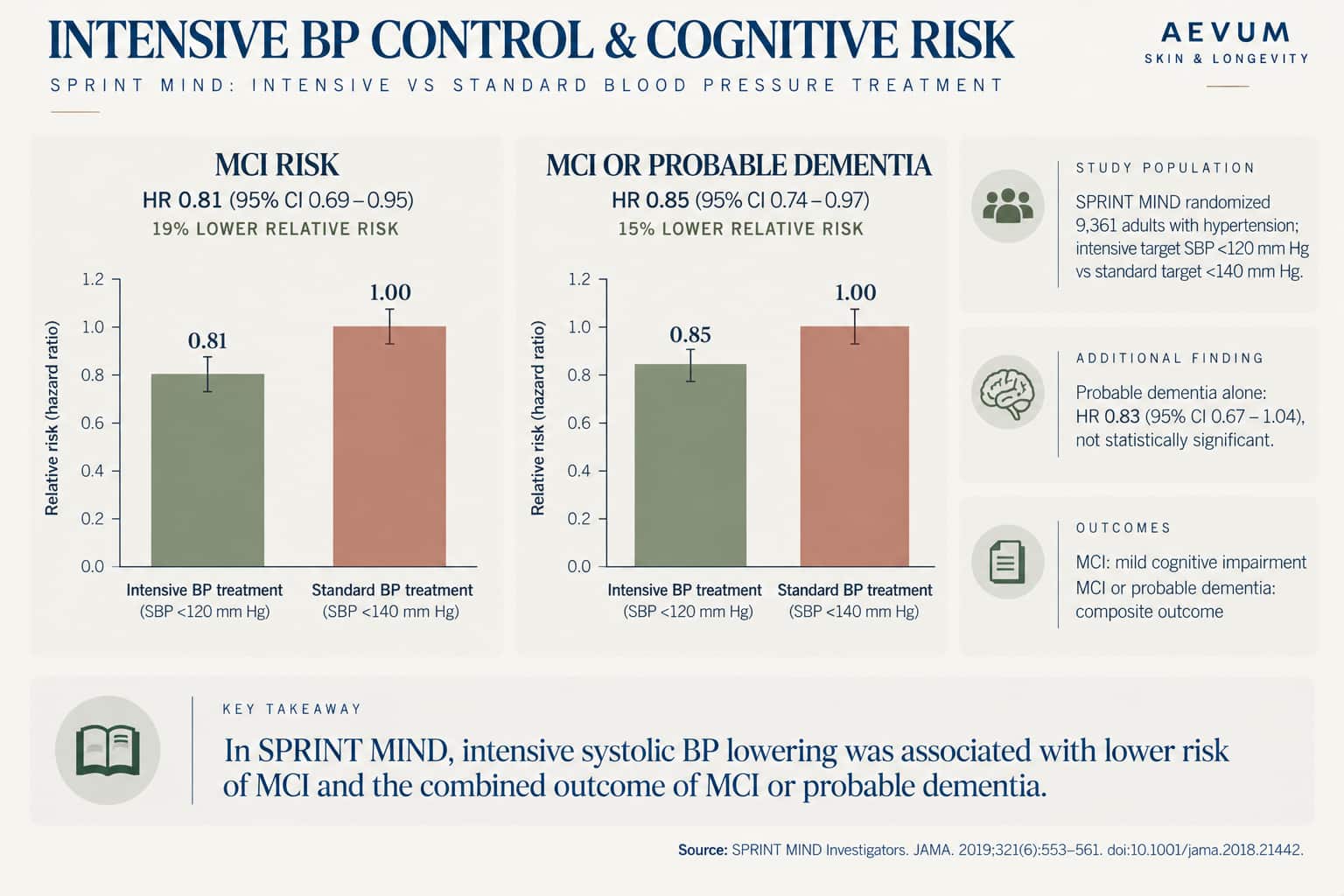
| MCI risk, intensive vs. standard treatment | 19% lower (HR 0.81, statistically significant, p=0.01) |
| Combined MCI + probable dementia risk | 15% lower (HR 0.85, statistically significant, p=0.02) |
| Probable dementia alone (primary outcome) | Not statistically significant (HR 0.83) — trial stopped early at 3.3 years, likely underpowered for this specific outcome |
| White matter hyperintensity volume and dementia risk (Northern Manhattan cohort, n=1,290) | HR 1.032 per unit increase in WMH volume — higher WMH burden = higher dementia risk |
How it works
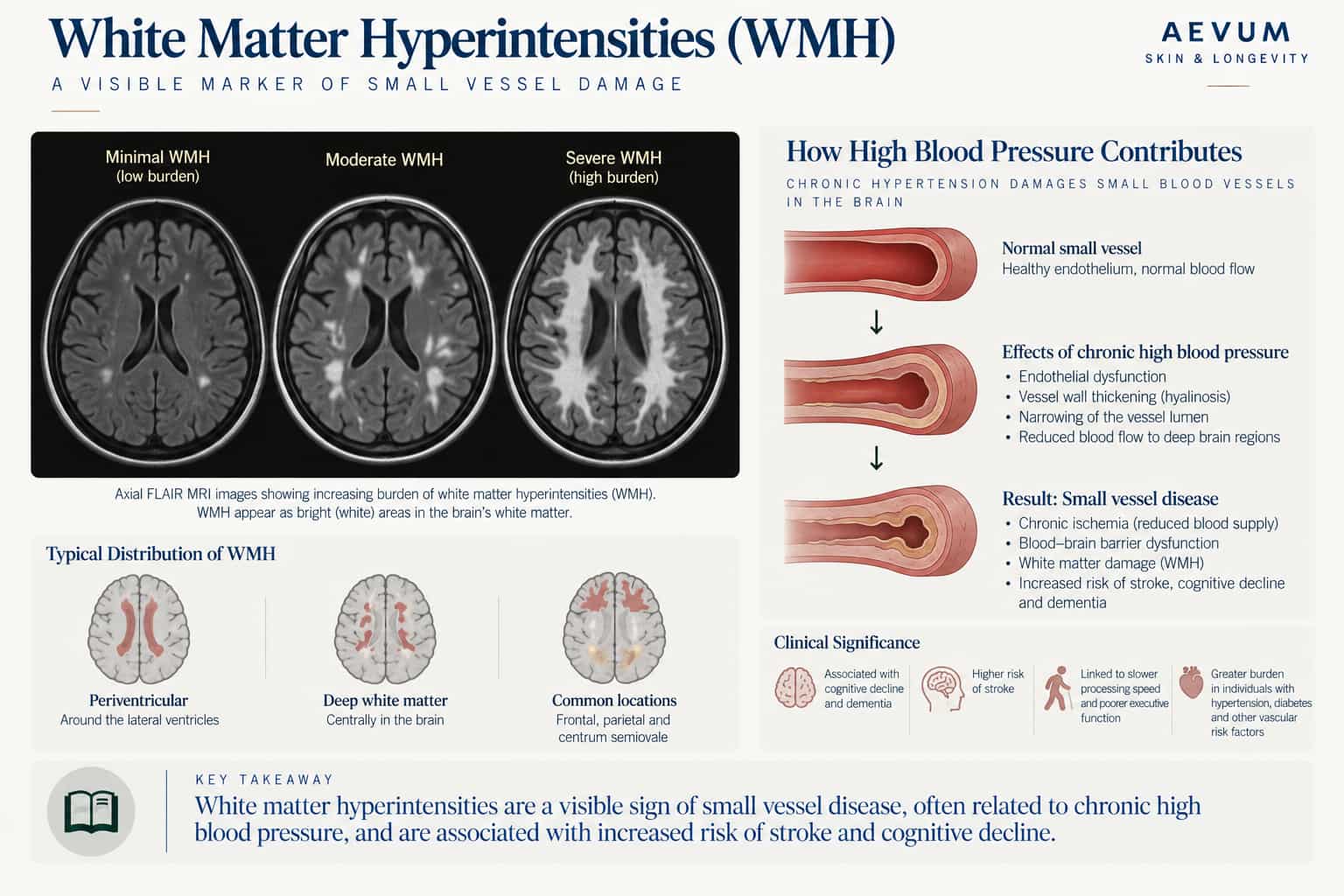
The brain's blood supply is unusually demanding and unusually vulnerable. The brain receives roughly 15-20% of resting cardiac output and consumes a similarly disproportionate share of the body's oxygen and glucose, despite its relatively small mass. This isn't incidental — neurons have essentially no capacity to store energy locally and depend on continuous, well-regulated blood flow to function. The brain's small vessels (the arterioles and capillaries supplying deep white matter and subcortical structures specifically) are particularly vulnerable to damage from chronically elevated blood pressure, since they lack the same protective structural reinforcement as larger vessels elsewhere in the body.
White matter hyperintensities: the visible signature of vascular brain damage. When small vessels in the brain are damaged by sustained high blood pressure (or other vascular risk factors), the surrounding white matter tissue shows characteristic bright spots on MRI called white matter hyperintensities (WMH) — a visible marker of small-vessel disease. A community cohort study from northern Manhattan (1,290 stroke-free participants, mean age 70.6, followed for an average of 8.85 years) found that greater baseline WMH volume independently predicted higher dementia risk (HR 1.032 per unit volume increase), along with measurable associations to worse performance in global cognition, episodic memory, and processing speed at baseline, and predicted future decline in memory and executive function over the following years. WMH volume is now a well-established, visible marker connecting vascular health directly to the structural and functional brain changes covered earlier in The Aging Brain: What Actually Changes With Age and Brain Volume and Longevity.
What the research shows
The strongest evidence in this entire series: a randomized trial, not just an association. Most of the modifiable-factor evidence in cognitive longevity research is observational — real, useful, but always carrying the caveat that association isn't proof of causation. The SPRINT MIND trial is a genuine exception: a large randomized controlled trial (9,361 participants) that directly assigned people to either intensive blood pressure treatment (systolic target under 120 mmHg) or standard treatment (under 140 mmHg) and tracked cognitive outcomes prospectively. The intensive group showed a statistically significant 19% lower risk of developing mild cognitive impairment, and a 15% lower risk of the combined MCI-plus-dementia outcome, compared to the standard treatment group.
Why the "no effect on dementia" headline is misleading on its own. Some coverage of this trial emphasized that intensive treatment showed no statistically significant reduction in probable dementia specifically, which can read as a disappointing or null result if taken out of context. The fuller picture matters here: the trial was stopped early at 3.3 years (rather than its planned five-year duration) because the cardiovascular benefits of intensive treatment were already so clear that continuing to withhold it from the standard-treatment group became ethically difficult — a good outcome for cardiovascular health that happened to leave the dementia-specific analysis underpowered, since dementia typically takes longer to manifest and diagnose than MCI. The trial's own investigators noted this shortened duration likely limited the ability to detect a dementia-specific effect. The MCI finding — a statistically robust, clinically meaningful reduction — is the more reliable and interpretable result from this trial, and it strongly supports the broader vascular hypothesis of cognitive decline.
Recommendations
- 1Blood pressure management deserves to be treated as a cognitive-health intervention, not only a cardiovascular one
This is one of the few factors in this entire series with actual randomized trial evidence — rather than only observational association — behind a specific, achievable target.
- 2A systolic target closer to 120 mmHg, where appropriate and tolerated, has trial-level evidence for reducing MCI risk specifically
This is a conversation worth having directly with a physician, since intensive BP targets carry their own considerations — medication side effects, fall risk in older adults — that need individualized weighing, not a blanket recommendation for everyone.
- 3White matter hyperintensities found incidentally on a brain scan are worth taking seriously as a vascular signal
Even in someone with no current cognitive symptoms, they're a marker of exactly the kind of small-vessel damage this article's evidence connects to future decline.
- 4This ties directly to the cardiovascular risk factors already managed as part of routine longevity care
Blood pressure, cholesterol, and metabolic health — vascular brain health isn't a separate system to manage, it's the same cardiovascular system already being addressed, with a direct cognitive stake attached.
Practical notes
This article closes the Foundational Science section of this series on its strongest evidentiary note: unlike most of the factors still to come, vascular health has genuine randomized-trial support, not just correlation. The rest of this series builds on this foundation — moving next into specific, individually modifiable risk factors, several of which (chronic stress, hearing loss, social isolation) interact with or compound this same vascular pathway.
- SPRINT MIND Investigators. Effect of Intensive vs Standard Blood Pressure Control on Probable Dementia: A Randomized Clinical Trial. JAMA, 2019;321(6):553-561.
- Barreto B, Ge H, Nafeli M, et al. White Matter Hyperintensities, Cognitive Decline and Dementia Risk in a Community-Dwelling Cohort of Northern Manhattan. Research Square [preprint, not yet peer-reviewed], 2026.
When did you last
check your blood pressure?
Take the free Aevum Protocol assessment to see how your cognitive longevity and 6 other longevity domains are performing — and get a personalised 90-day plan.
Take the Free Assessment →