Cognitive Longevity
APOE4 and Genetic Risk:
What a Gene Variant Does and Doesn't Determine
APOE is the single most important common gene for late-onset Alzheimer's disease, and its ε4 variant is the one people worry about. Carrying one copy raises risk roughly threefold; carrying two raises it much further, and a 2024 study argued that two copies should be treated as a distinct genetic form of the disease. But APOE4 is still a risk gene, not a guarantee: most people with one copy never develop Alzheimer's, a meaningful share of people with two copies don't either, and many people with Alzheimer's carry no ε4 at all. This article sets out what the numbers actually say, how much they vary by ancestry, and what an ε4 carrier can do with that information.
Key numbers
| Finding | Detail |
|---|---|
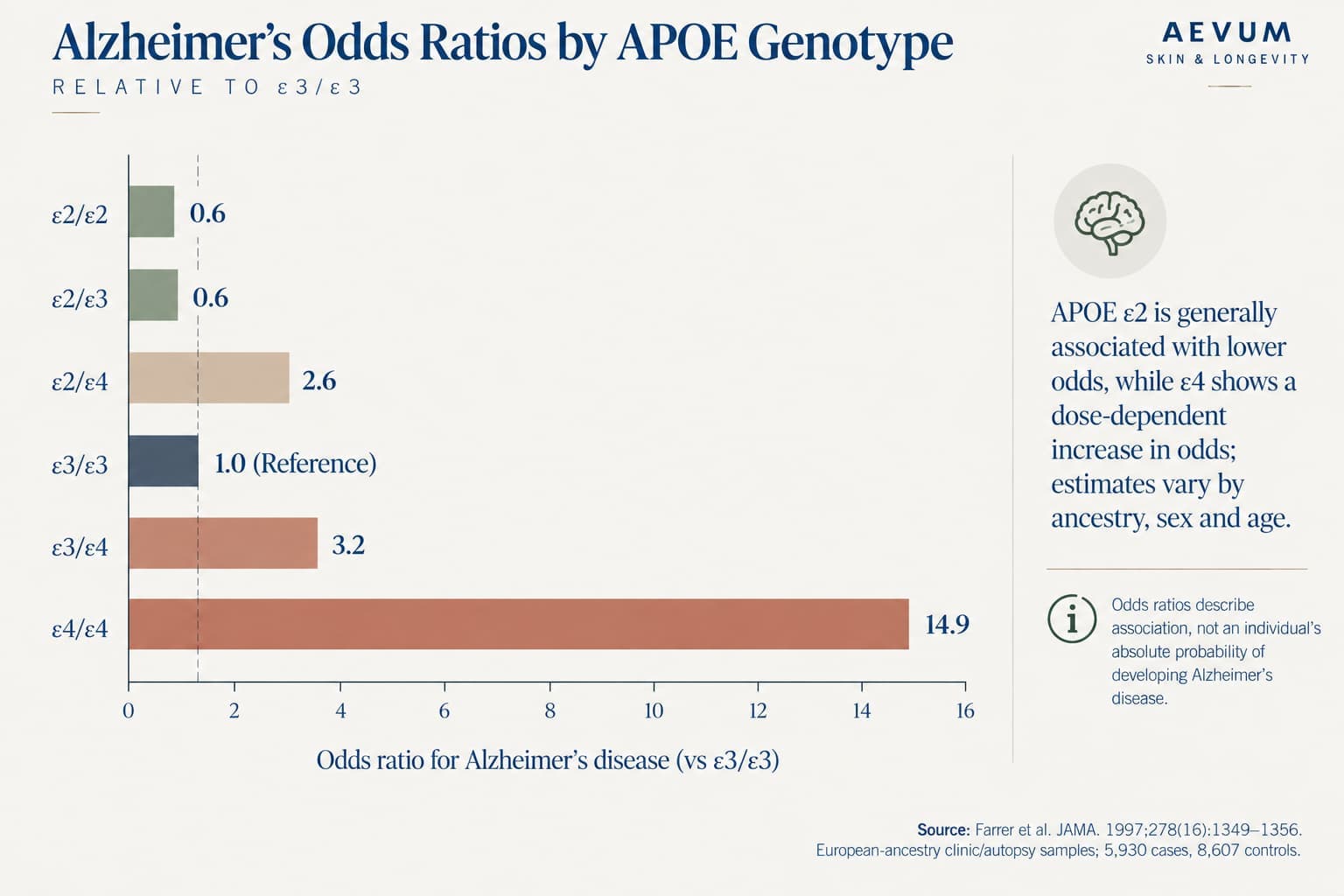
| Alzheimer's odds, one ε4 copy (ε3/ε4) vs. ε3/ε3 | ~3.2x (European-ancestry clinic and autopsy samples) |
| Alzheimer's odds, two ε4 copies (ε4/ε4) vs. ε3/ε3 | ~14.9x |
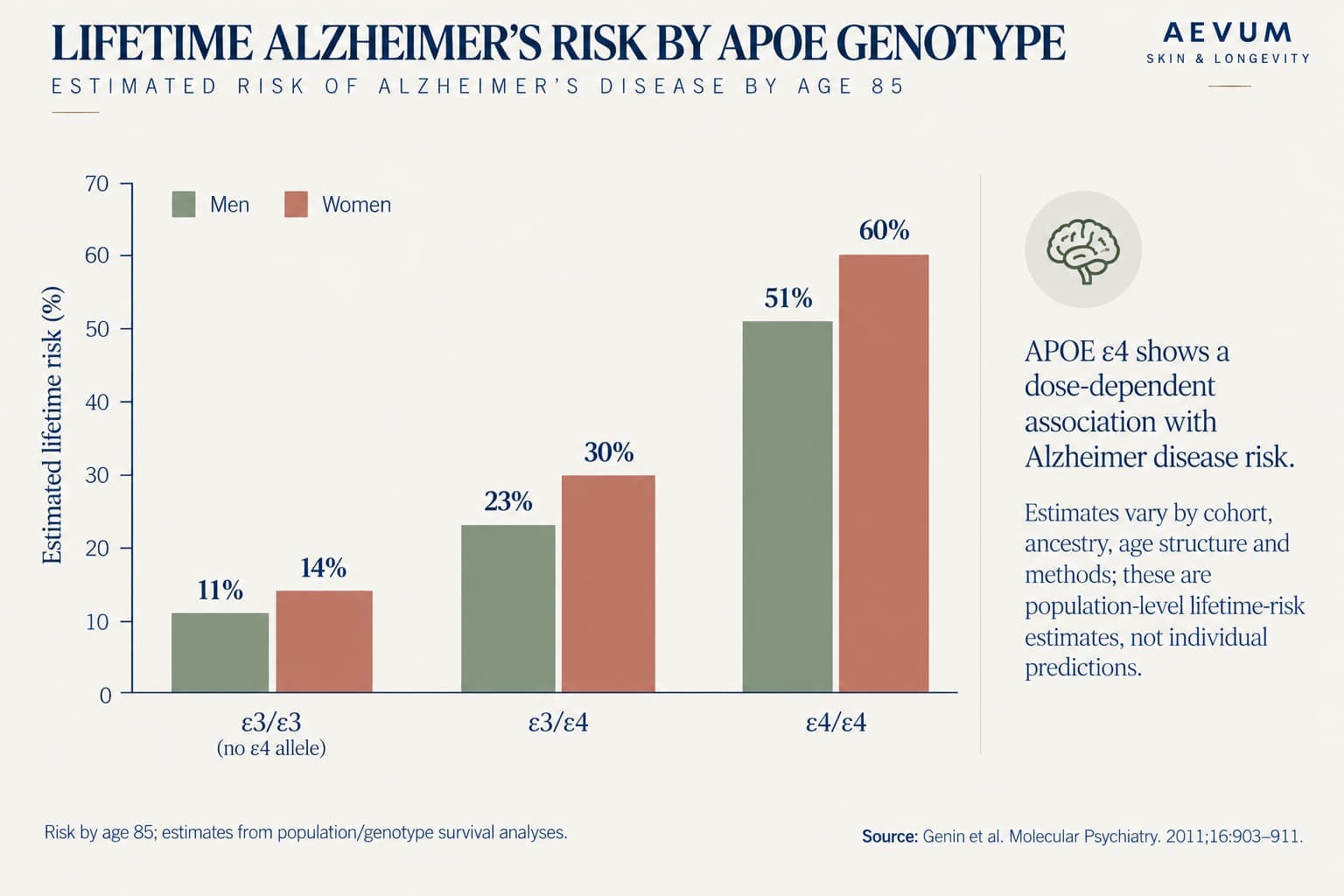
| Lifetime Alzheimer's risk by age 85, ε3/ε3 | ~11% (men) / ~14% (women) |
| Lifetime Alzheimer's risk by age 85, ε3/ε4 | ~23% (men) / ~30% (women) |
| Lifetime Alzheimer's risk by age 85, ε4/ε4 | ~51% (men) / ~60% (women) |
| Share of population with two ε4 copies | ~2% |
| Average age of symptom onset, ε4/ε4 | ~65 years |
What APOE is
APOE (apolipoprotein E) is a protein that carries cholesterol and other fats in the blood and brain. Everyone inherits two copies of the APOE gene, one from each parent, and each copy comes in one of three common versions: ε2, ε3, or ε4. ε3 is the most common and is treated as the neutral reference point. ε4 is the risk version. ε2 is modestly protective.
The ways ε4 raises risk are still being worked out, but they include less efficient clearance of amyloid-beta (the protein that forms plaques in Alzheimer's), effects on brain lipid metabolism and inflammation, and effects on blood vessel health. That last point matters for this series: APOE4 overlaps with the vascular pathways covered in Vascular Health and the Brain.
What each genotype means
| Genotype | Odds of Alzheimer's vs. ε3/ε3 | Lifetime risk by 85 (men / women) | Modifiable? |
|---|---|---|---|
| ε2/ε3 | ~0.6x (lower risk) | Not separately estimated here | Gene: no |
| ε3/ε3 | 1.0 (reference) | ~11% / ~14% | Gene: no |
| ε3/ε4 | ~3.2x | ~23% / ~30% | Gene: no; other risk factors: yes |
| ε4/ε4 | ~14.9x | ~51% / ~60% | Gene: no; other risk factors: yes |
Odds ratios come from a meta-analysis of 5,930 Alzheimer's patients and 8,607 controls across 40 research teams. Lifetime risk estimates come from a separate analysis of 7,351 cases and 10,132 controls. Both are based on people of European ancestry.
What the research shows
Odds ratios and lifetime risk tell different stories. The largest classic meta-analysis of APOE genotype and Alzheimer's found that, compared with the common ε3/ε3 genotype, one ε4 copy raised the odds of Alzheimer's about 3.2-fold and two copies raised them about 14.9-fold. Those multipliers sound alarming, and for ε4/ε4 they are substantial.
Lifetime risk puts the same picture in a more useful frame. A 2011 analysis estimated that by age 85, about 11-14% of people with the common ε3/ε3 genotype develop Alzheimer's. For ε3/ε4 the estimate roughly doubles to 23-30%. For ε4/ε4 it reaches about 51-60%. In other words, most people with one ε4 copy won't develop Alzheimer's by 85, and even among people with two copies, a large minority won't either. Women had higher estimates than men in every genotype group.
Two copies: a "distinct genetic form" of Alzheimer's? A 2024 study in Nature Medicine analysed brain pathology from 3,297 donors and clinical and biomarker data from 10,039 people. Almost all ε4/ε4 carriers showed Alzheimer's-type brain pathology, with biomarker levels clearly raised from age 55 onward. By age 65, nearly all had abnormal amyloid levels in spinal fluid and about 75% had positive amyloid PET scans. On average, symptoms started at about 65 — earlier than in people without ε4. The authors argued that the near-complete biological penetrance and predictable timing make ε4/ε4 look more like the inherited (autosomal dominant) forms of Alzheimer's than a simple risk factor, and that it deserves its own prevention trials.
Two points keep this in proportion. First, having Alzheimer's pathology on a scan or in spinal fluid isn't the same as developing dementia. Cognitive reserve, vascular health and other factors shape whether and when pathology turns into symptoms (see Cognitive Reserve). The lifetime risk figures above make the same point. Second, participants were mainly of European ancestry, and the findings need testing in other populations. Only about 2% of people carry two ε4 copies.
The effect of ε4 varies by ancestry. The same classic meta-analysis found the ε4 effect was weaker in African American and Hispanic participants and noticeably stronger in Japanese participants (odds ratios of about 5.6 for one copy and about 33 for two). Most APOE research has been done in people of European ancestry, and much less is known about South Asian populations, including Sri Lankans. Risk figures from Western studies are a reasonable starting point, but they shouldn't be treated as exact for everyone.
What you can actually change
Carriers still respond to lifestyle intervention. The strongest evidence here comes from the FINGER trial in Finland, a two-year programme combining diet guidance, exercise, cognitive training and management of vascular and metabolic risk factors. In a 2018 analysis of about 1,100 participants with genotype data (362 of them ε4 carriers), carriers who received the intervention improved overall cognition and memory compared with carriers in the control group. The benefit was not weaker in carriers, and if anything was clearer in them. APOE4 does not block the benefits of a healthier lifestyle.
The modifiable risk factors still apply. A gene you can't change sits alongside 14 risk factors you largely can, covered in Alzheimer's Disease: Risk Factors You Can Actually Change. Because ε4 overlaps with vascular and lipid pathways, blood pressure, LDL cholesterol, diabetes, physical activity and sleep are especially worth attention for carriers. None of these erase genetic risk, but the FINGER results suggest carriers have at least as much to gain from them as anyone else.
APOE status now matters for some treatments. APOE testing has become clinically relevant for newer anti-amyloid antibody drugs used in early Alzheimer's disease. The FDA label for lecanemab states that APOE ε4 testing should be performed before starting treatment, because ε4 carriers have a higher risk of the brain swelling and microbleeds known as ARIA. In the main lecanemab trial, symptomatic brain swelling (ARIA-E) occurred in 9.2% of ε4/ε4 participants, compared with 1.7% of people with one copy and 1.4% of non-carriers. This matters for people who already have early Alzheimer's, not for prevention in healthy people.
Recommendations
- →Read APOE4 as risk, not destiny. One copy roughly doubles lifetime risk from a low baseline. Two copies raise it substantially, but even then many people don't develop dementia by 85.
- →Think before testing. APOE status can't tell you whether you will or won't develop Alzheimer's, and some direct-to-consumer genetic tests report it without counselling. It's worth deciding in advance what you'd do with the result, ideally with a doctor or genetic counsellor.
- →If you're a carrier, prioritise vascular and metabolic health. Blood pressure, LDL cholesterol, blood sugar, exercise and sleep are the most relevant levers, and carriers in the FINGER trial clearly benefited from addressing them.
- →Know your status if anti-amyloid treatment is ever on the table. ε4 status directly affects safety for these drugs, and testing is required before starting lecanemab.
- →Interpret figures with ancestry in mind. The size of the ε4 effect varies across populations, and South Asian data are limited.
Practical notes
APOE4 is the clearest example in this series of a risk factor you can't change sitting on top of many you can. For most carriers, the practical response is the same as for everyone else, just with more reason to act on it: look after blood pressure, cholesterol, metabolic health, exercise, sleep and social and cognitive engagement. The next articles in this section cover several of those factors in detail, starting with one of the most overlooked: hearing loss.
- Farrer LA, Cupples LA, Haines JL, et al. Effects of age, sex, and ethnicity on the association between apolipoprotein E genotype and Alzheimer disease: a meta-analysis. APOE and Alzheimer Disease Meta Analysis Consortium. JAMA, 1997;278(16):1349-1356.
- Genin E, et al. APOE and Alzheimer disease: a major gene with semi-dominant inheritance. Molecular Psychiatry, 2011;16(9):903-907.
- Fortea J, Pegueroles J, Alcolea D, et al. APOE4 homozygosity represents a distinct genetic form of Alzheimer's disease. Nature Medicine, 2024;30(5):1284-1291.
- Solomon A, Turunen H, Ngandu T, et al. Effect of the Apolipoprotein E Genotype on Cognitive Change During a Multidomain Lifestyle Intervention: A Subgroup Analysis of a Randomized Clinical Trial. JAMA Neurology, 2018;75(4):462-470.
- Lecanemab Therapy and APOE Genotype. Medical Genetics Summaries, NCBI Bookshelf.
Do you know your
APOE status?
Take the free Aevum Protocol assessment to see how your cognitive longevity and 6 other longevity domains are performing — and get a personalised 90-day plan.
Take the Free Assessment →