Cognitive Longevity
Hearing Loss and Dementia Risk:
An Underappreciated Link
Hearing loss tends to be treated as an inconvenience of getting older rather than a medical priority. Yet in the most recent global review of dementia risk, midlife hearing loss ties with high LDL cholesterol as the largest single modifiable risk factor, linked to about 7% of dementia cases worldwide. People with hearing loss are more likely to develop dementia, and the risk climbs with severity. What's less settled is whether treating hearing loss prevents dementia: the best randomised trial so far found no benefit overall, but a clear benefit in people at higher risk. This article covers what the evidence shows, where it's still uncertain, and why a hearing test is one of the simplest things a person can do for brain health.
Key numbers
| Finding | Detail |
|---|---|
| Share of dementia linked to hearing loss (2024 Lancet Commission) | ~7% — tied for the largest single modifiable factor |
| Dementia risk per 10 dB of hearing loss | ~27% higher (HR 1.27) |
| People over 60 with disabling hearing loss (WHO) | More than 25% |
| Adults 71+ with any hearing loss (US national sample) | 65.3% |
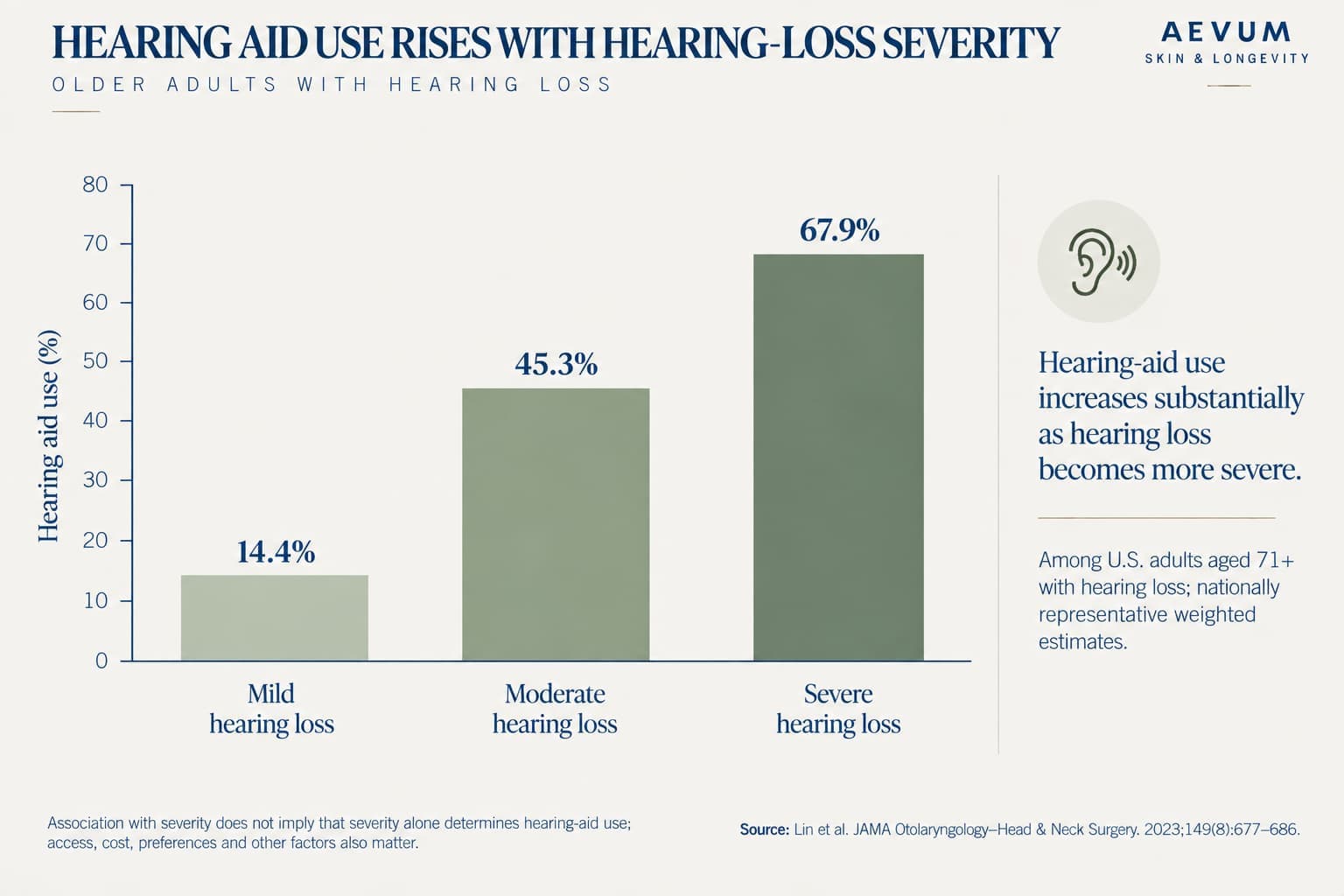
| Of those with hearing loss, share using hearing aids | 29.2% overall; 14.4% with mild loss |
| Cognitive decline, hearing aid or cochlear implant users vs. uncorrected hearing loss (meta-analysis) | 19% lower risk (HR 0.81) |
| ACHIEVE trial, 3-year hearing intervention | No effect in the full cohort; 48% slower cognitive decline in the higher-risk subgroup |
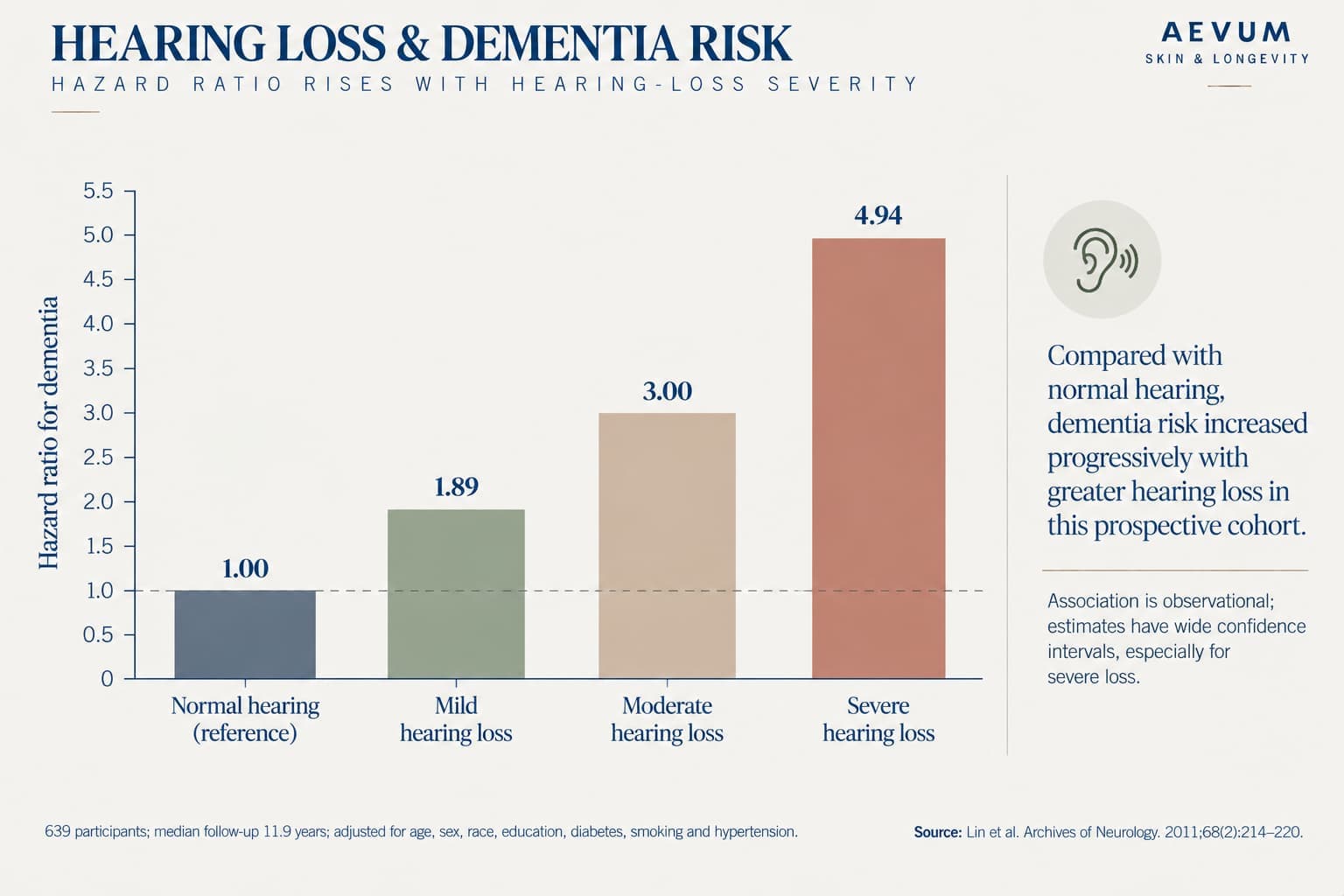
Hearing loss severity and dementia risk
| Hearing status | Dementia risk vs. normal hearing (HR) | 95% CI | Evidence strength |
|---|---|---|---|
| Normal hearing | 1.0 (reference) | — | — |
| Mild hearing loss | 1.89 | 1.00-3.58 | Observational; borderline significance |
| Moderate hearing loss | 3.00 | 1.43-6.30 | Observational |
| Severe hearing loss | 4.94 | 1.09-22.40 | Observational; few cases, wide uncertainty |
| Each additional 10 dB of loss | 1.27 | 1.06-1.50 | Observational; consistent dose-response |
Figures come from 639 dementia-free adults in the Baltimore Longitudinal Study of Aging, followed for a median of 11.9 years, during which 58 developed dementia. Hearing loss is modifiable in part — through hearing aids and by treating underlying causes — across every severity level.
What the research shows
The link: more hearing loss, more dementia risk. The study that put hearing loss on the dementia map followed 639 older adults who were dementia-free at the start, with hearing measured by audiometry, for a median of almost 12 years. Compared with people with normal hearing, the risk of developing dementia was about 1.9 times higher with mild hearing loss, 3 times higher with moderate loss, and nearly 5 times higher with severe loss. Each additional 10 decibels of hearing loss raised the risk by about 27%. That graded, dose-response pattern is one of the reasons researchers take the association seriously.
The confidence intervals matter here, though. The mild-loss result only just reached statistical significance, and the severe-loss estimate rests on only six people in that group and is very imprecise (anywhere from about 1.1 to 22 times). The per-10-dB estimate is the most reliable single number from this study.
Why hearing loss might affect the brain. Researchers have proposed three main explanations, and they aren't mutually exclusive:
- →Cognitive load. When hearing is poor, the brain spends more effort decoding sound, leaving less capacity for memory and thinking.
- →Social withdrawal. Hearing loss makes conversation tiring, so people tend to withdraw from social situations — a separate risk factor covered in Social Connection and Cognitive Decline.
- →Reduced stimulation. Less auditory input may speed up structural changes in brain regions that process sound and language.
A fourth possibility is that hearing loss and dementia partly share causes, such as vascular damage (see Vascular Health and the Brain). If so, some of the association would not be fixable by hearing aids alone.
Does treating hearing loss help? The observational evidence says probably. A 2023 meta-analysis in JAMA Neurology pooled 31 studies with more than 137,000 participants. In the 8 long-term studies (126,903 people), users of hearing aids or cochlear implants had a 19% lower risk of cognitive decline than people with uncorrected hearing loss (HR 0.81). Across 11 shorter studies, cognitive test scores improved by about 3% after people started using hearing aids.
These are mostly observational studies, which have a known weakness: people who get and wear hearing aids tend to be healthier, better off and more engaged than those who don't. That can make hearing aids look more protective than they really are. The consistency of the results is encouraging, but it isn't proof.
The randomised trial: no overall effect, but a benefit in people at higher risk. The ACHIEVE trial, published in The Lancet in 2023, is the best test so far. It randomised 977 adults aged 70-84 with untreated hearing loss to either a three-year hearing intervention (hearing aids, a self-management toolkit, and ongoing audiologist support) or a health-education control.
In the full study population, the hearing intervention did not slow cognitive decline. But participants came from two groups. 238 came from a long-running heart-health study (ARIC); these participants had more risk factors for cognitive decline, lower starting cognitive scores and faster decline during the trial. In that group, the hearing intervention slowed cognitive decline by 48%. The other 739 were healthy volunteers recruited for the trial, and in them there was no clear effect.
The reasonable reading is that hearing treatment probably doesn't make much difference over three years for people who are otherwise healthy and cognitively robust, but may meaningfully slow decline in people already at elevated risk. Three years is also short relative to how dementia develops, so longer follow-up matters.
What you can actually change
- 1Get your hearing tested
Hearing loss creeps up gradually and is easy to underestimate — WHO estimates that more than a quarter of people over 60 have disabling hearing loss, and in a large US sample, nearly two-thirds of adults over 71 had at least some degree of loss. A hearing test is quick, inexpensive and non-invasive. It's worth doing from midlife, and routinely from 60, even without obvious symptoms.
- 2Treat it, and use the treatment
The gap between need and treatment is wide. In the same US sample, only 29% of older adults with hearing loss used hearing aids — and just 14% of those with mild loss, which is the stage where the risk association already appears. The ACHIEVE intervention wasn't just a device: it included fitting, a self-management toolkit and ongoing audiologist support. That's a good model for anyone starting out, because hearing aids that sit in a drawer do nothing.
- 3Protect the hearing you have
Most age-related hearing loss can't be prevented, but noise-induced damage can. Hearing protection in loud workplaces and at loud events, and keeping headphone volume moderate, reduce avoidable loss.
- 4Look after the shared risk factors
Because hearing loss and dementia may partly share vascular causes, blood pressure, blood sugar and cholesterol control likely help both.
The full list of modifiable risk factors is covered in Alzheimer's Disease: Risk Factors You Can Actually Change.
Recommendations
- →Treat hearing loss as a health issue, not just a nuisance. It carries one of the largest attributable shares of dementia risk of any modifiable factor.
- →Test early, including for mild loss. Mild hearing loss is where treatment rates are lowest and where the risk association already begins.
- →If you're fitted with hearing aids, get proper follow-up. Adjustment, counselling and regular use are part of the intervention that showed benefit.
- →Expect the biggest benefit if you're at higher risk. The trial evidence is strongest for people with more cardiovascular and cognitive risk factors. For healthier people, hearing treatment is still worthwhile for quality of life and communication, even if the cognitive benefit is less certain.
- →Don't overstate it. Hearing aids are a sensible, low-risk step with promising evidence, not a guaranteed way to prevent dementia.
Practical notes
Hearing loss sits in an unusual position: it's one of the most common and most undertreated conditions in older age, it's linked to one of the largest shares of preventable dementia, and the fix is relatively simple and safe. The evidence on whether treatment prevents dementia is still maturing, but the case for testing and treating hearing loss doesn't depend on it — better hearing improves communication, relationships and quality of life in its own right.
- Lin FR, et al. Hearing Loss and Incident Dementia. Archives of Neurology, 2011;68(2):214-220.
- Yeo BSY, et al. Association of Hearing Aids and Cochlear Implants With Cognitive Decline and Dementia: A Systematic Review and Meta-analysis. JAMA Neurology, 2023;80(2):134-141.
- Lin FR, Pike JR, Albert MS, et al. Hearing intervention versus health education control to reduce cognitive decline in older adults with hearing loss in the USA (ACHIEVE): a multicentre, randomised controlled trial. The Lancet, 2023;402(10404):786-797.
- Reed NS, et al. Prevalence of Hearing Loss and Hearing Aid Use Among US Medicare Beneficiaries Aged 71 Years and Older. JAMA Network Open, 2023;6(7):e2326320.
- World Health Organization. Deafness and hearing loss — fact sheet.
- Livingston G, Huntley J, Liu KY, et al. Dementia prevention, intervention, and care: 2024 report of the Lancet Standing Commission. The Lancet, 2024;404(10452):572-628.
When did you last
have your hearing tested?
Take the free Aevum Protocol assessment to see how your cognitive longevity and 6 other longevity domains are performing — and get a personalised 90-day plan.
Take the Free Assessment →