Cognitive Longevity
Learning New Skills and Brain Health:
What Kind of Mental Challenge Helps
"Use it or lose it" is one of the most familiar pieces of brain-health advice. The evidence broadly supports it, with some important details. Older people who regularly read, play board games, play music or take part in other mentally engaging activities have lower rates of dementia, and in one large study the most mentally active people developed Alzheimer's about five years later than the least active. Trials show that learning a demanding new skill can change the ageing brain and improve memory. But not every activity helps equally, the gains can fade when you stop, and some skills, such as learning a language for a few weeks, haven't improved general thinking in trials. This guide covers what the evidence supports and how to choose activities that are most likely to help.
Key numbers
| Finding | Detail |
|---|---|
| Leisure activities in adults over 75 (469 people, ~5 years) | Most mentally active third had 63% lower dementia risk than the least active (HR 0.37) |
| Each extra point on a cognitive-activity score | 7% lower dementia risk (HR 0.93) |
| Cognitive activity and Alzheimer's onset (1,903 people, ~7 years) | High activity (90th percentile) diagnosed at 93.6 years vs. 88.6 for low activity (10th percentile): about 5 years later |
| Synapse Project (learning digital photography and/or quilting, ~15 hours/week, 3 months) | Episodic memory improved; social activities alone didn't produce the same gain |
| Juggling training in older adults (69 people, 3 months) | Grey matter increased in visual and memory areas, then reversed 3 months after training stopped |
| Learning Italian for 11 weeks (160 people aged 65-75) | Basic language gained, but no improvement in memory or intelligence vs. relaxation training |
Why learning might protect the brain
Two ideas from earlier in this series explain why mental challenge might matter.
- →Neuroplasticity. The adult brain can still form new connections and, in some areas, grow in response to learning (see Neuroplasticity After 40).
- →Cognitive reserve. People with richer mental lives seem to tolerate more brain damage before symptoms appear. Their brains may compensate better, using alternative networks when others are affected by disease (see Cognitive Reserve).
Learning a new skill is thought to build both: it challenges the brain in new ways and may strengthen the networks that help it cope with ageing and disease.
What the evidence shows
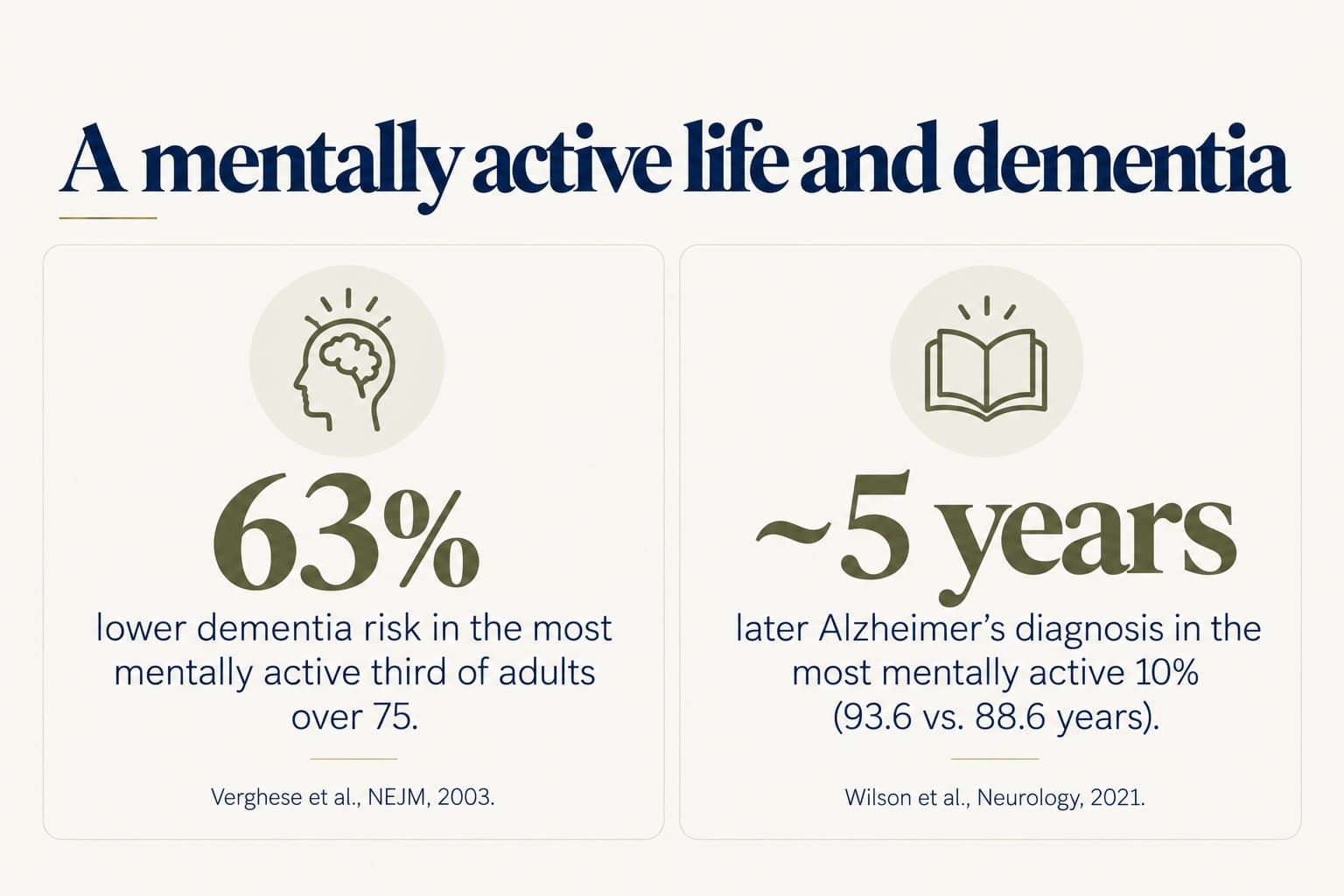
Observational studies: mentally active people have lower dementia risk. In a landmark study published in 2003, researchers followed 469 people over 75 who didn't have dementia for a median of about five years, during which 124 developed dementia. People who did more cognitively engaging leisure activities, such as reading, board games, playing a musical instrument and dancing, had lower risk. Each additional point on a cognitive-activity score (roughly one activity one day a week) was linked to a 7% lower risk. People in the top third of cognitive activity had a 63% lower risk than those in the bottom third. Interestingly, in this study, most physical leisure activities weren't linked to lower risk, but dancing, which is both physical and mentally demanding, was.
A 2021 study from the Rush Memory and Aging Project followed 1,903 older adults for about seven years. Among the 457 who developed Alzheimer's, people with high cognitive activity (at the 90th percentile) were diagnosed at an average age of 93.6, compared with 88.6 for those with low activity (at the 10th percentile), a delay of about five years. In the 695 people who had brain autopsies, cognitive activity wasn't linked to the amount of Alzheimer's-type damage in the brain. This fits the idea of cognitive reserve: mental activity didn't prevent the disease from developing, but it seemed to help people function for longer despite it.
The limitation of both studies is that they're observational. People who are already developing dementia often become less active years before diagnosis, and mentally active people may differ in other ways. The researchers tried to account for this, but it can't be ruled out entirely.
Trials: learning a demanding skill can change the brain and memory.
- →The Synapse Project. In this US trial, older adults were randomly assigned to about 15 hours a week of learning digital photography, quilting or both, or to control activities that were social but not mentally demanding, or to simple tasks done alone. After three months, only the groups learning demanding new skills showed improved episodic memory, the kind that lets you remember events and details. Social activity alone didn't produce the same gain, and the researchers reported that some benefits lasted up to a year.
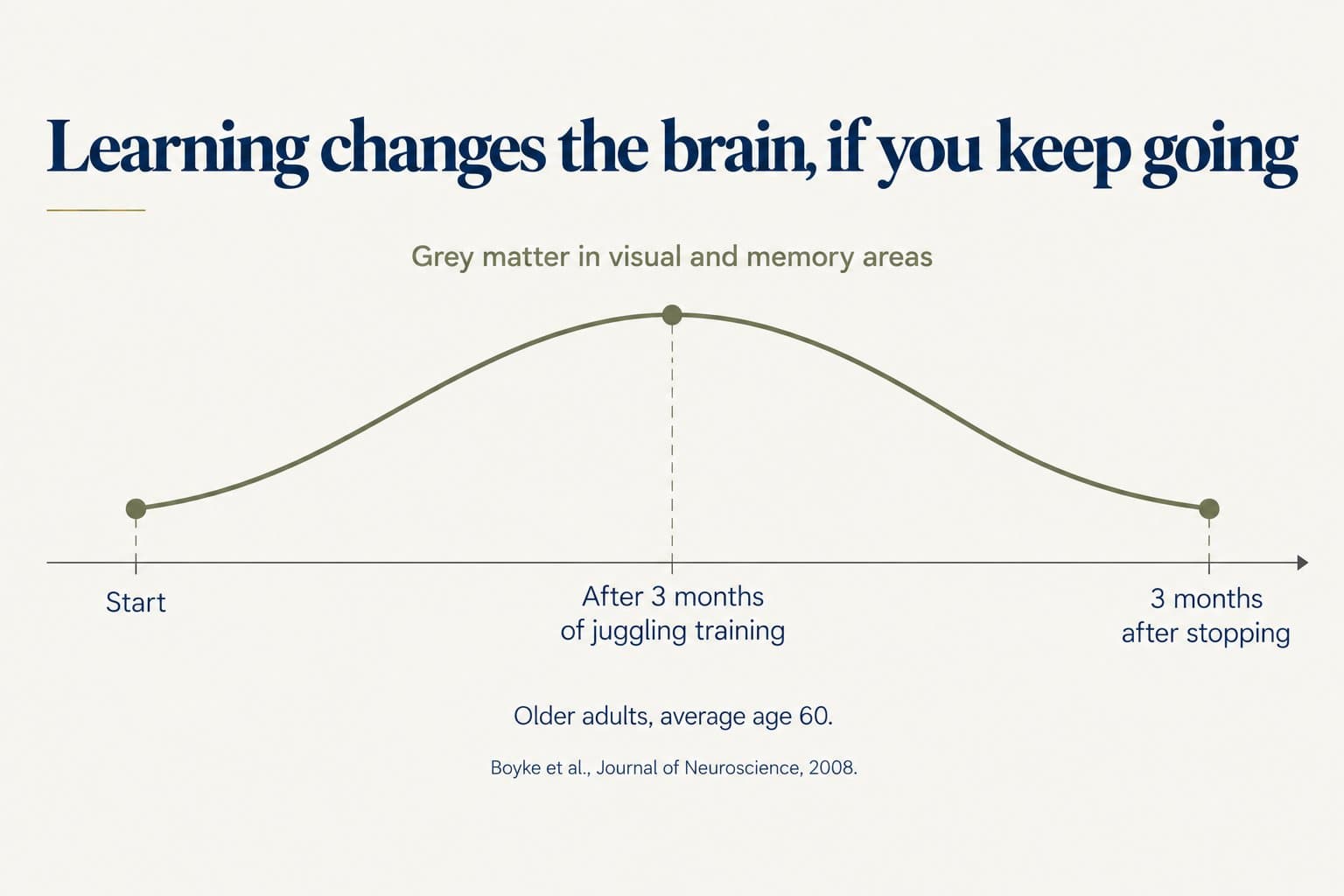
- →Juggling. In a German study, 69 older adults (average age 60) learned to juggle three balls over three months. During training, grey matter increased in brain areas involved in visual motion and in the hippocampus. Three months after training stopped, these increases had reversed. The older learners were less skilled than young adults (only 23% could keep juggling for a minute), but their brains changed in the same areas.
- →Music. In a European trial, 132 healthy older adults were randomly assigned to six months of piano lessons or to a music-listening and appreciation course. Taken together, participants showed grey-matter increases in areas including the cerebellum, which is involved in movement and coordination, with no difference between the piano and listening groups. The cerebellar gains went along with better working memory for musical tones, and scores on a standard verbal working-memory test also rose.
Not every skill helps: the language-learning trial. Learning a language is often recommended for brain health, partly because lifelong bilingualism is linked to later onset of dementia symptoms (see Cognitive Reserve). But in a Swedish trial, 160 healthy adults aged 65-75 were randomly assigned to 11 weeks of learning Italian or to relaxation training. The language learners picked up basic Italian but didn't improve more than the relaxation group on tests of memory, intelligence or working memory. This doesn't mean language learning is useless. It may take much longer, or it may matter more as a lifelong habit than a short course. But it's a reminder that "learn a language" isn't a guaranteed brain boost.
How this differs from brain-training apps. Brain-training games mostly make you better at the games themselves (see Cognitive Training and Brain Games). The skills in the more promising trials, such as photography, quilting, juggling and music, are different. They're complex, real-world activities that use several abilities at once, involve steady progress over weeks or months, and often have a social or creative element.
What seems to matter
Pulling the evidence together, the activities most likely to help share these features:
- 1Genuinely new
Doing crosswords you've done for 30 years is less demanding than learning something unfamiliar.
- 2Challenging
The Synapse Project found gains only in the high-challenge groups. The task should stretch you, not bore you.
- 3Sustained
The trials that showed benefit involved many hours over months. The juggling study suggests gains can fade when you stop.
- 4Complex
Activities that combine memory, attention, planning and physical skill (music, dance, crafts, a new sport) exercise more of the brain than a single repetitive task.
- 5Enjoyable
You're far more likely to stick with something you like, and sticking with it is what counts.
Recommendations by situation
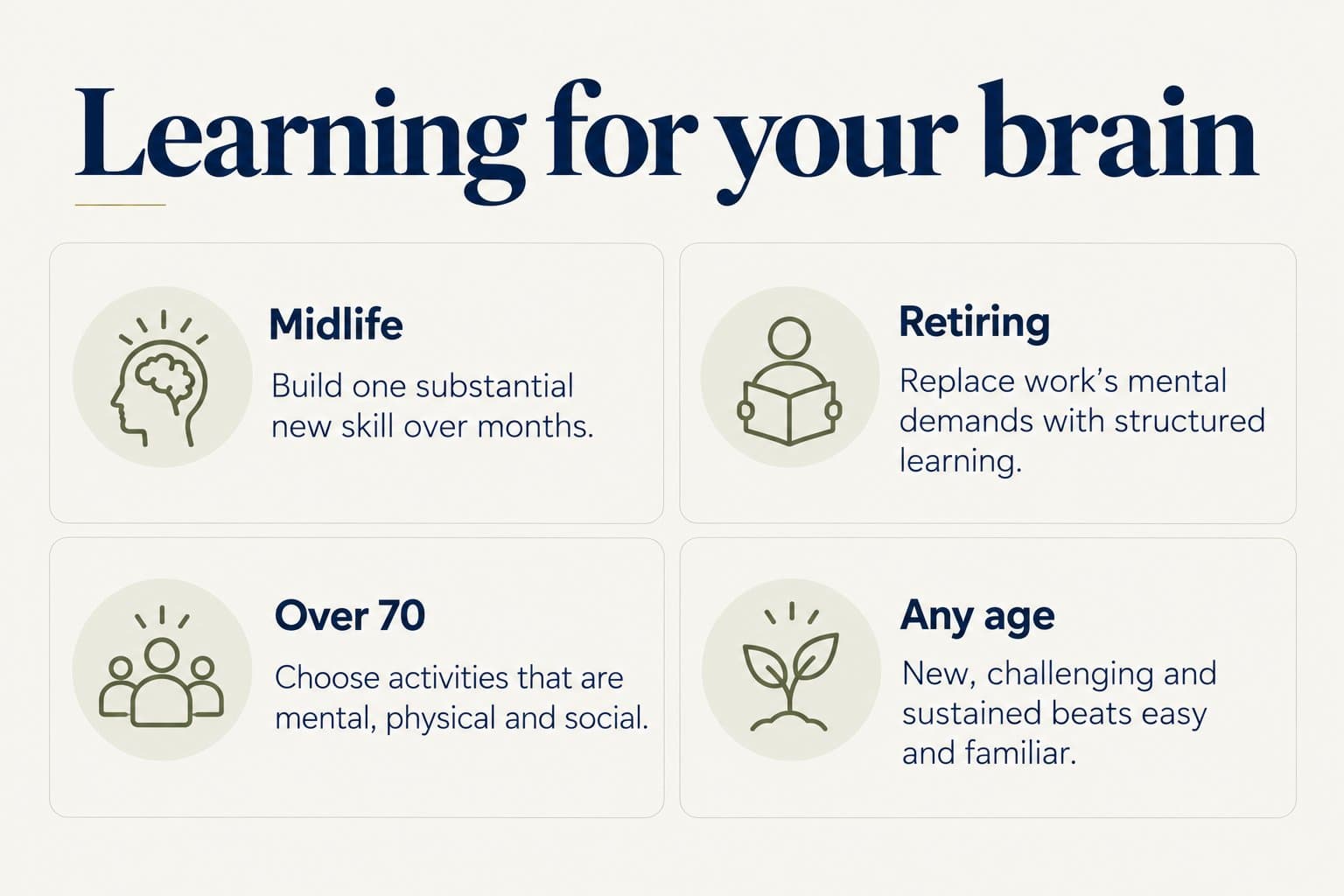
Working adult in midlife
- →Keep learning at work and outside it. Mentally demanding work and ongoing learning contribute to cognitive reserve over decades.
- →Choose one substantial new skill to build over months, such as an instrument, a craft, a sport or a course of study.
Approaching or entering retirement
- →Replace the mental demands of work. Retirement can remove a major source of daily challenge. Plan something structured to take its place: classes, volunteering with new responsibilities, or a serious hobby.
- →Aim for several hours a week. The Synapse Project used about 15 hours a week. You don't need that much, but occasional dabbling is unlikely to give the same benefit.
Over 70
- →It's not too late. Brain changes from learning were seen in older adults in the juggling and music studies.
- →Favour activities that combine mental, physical and social demands, such as dancing, group music, or crafts in a class setting.
- →Keep going. Benefits may fade if you stop, so choose something you can continue.
Mild cognitive impairment or memory concerns
- →Stay mentally engaged with activities you enjoy, adjusted to your abilities. Frustration isn't the goal.
- →Get a medical assessment first so that treatable causes aren't missed (see Mild Cognitive Impairment).
Limited formal education
- →It's never too late to build reserve. Education earlier in life is linked to lower dementia risk, but later-life mental activity also counts. Learning a practical skill, joining a class or taking on a new challenge all contribute.
Ideas for Sri Lanka
- →Music and dance: learning a traditional instrument such as the violin, flute or drums, or joining a dance or choir group.
- →Crafts: local crafts such as woodcarving, beeralu lace-making, batik or pottery, especially in a class.
- →Language: learning Tamil, Sinhala or English if it isn't your first language, as a long-term goal rather than a short course.
- →Digital skills: learning photography, video editing or new technology, which the Synapse Project suggests can be genuinely demanding.
- →Games and strategy: chess or carrom with others, combining mental challenge with social contact.
- →Teaching and volunteering: helping others learn, which combines mental effort, responsibility and social connection (see Social Connection and Cognitive Decline).
Practical notes
Mentally active people consistently have lower dementia risk, and trials show that learning a demanding new skill can change the ageing brain and improve memory. But the benefits depend on the activity being new, challenging and sustained, and they can fade when you stop. No single activity has been proven to prevent dementia, and a short language course didn't improve general thinking in one trial. The practical message is to choose something you enjoy that genuinely stretches you, keep at it for months and years, and combine it with the other brain-health foundations in this series, especially exercise, sleep and social connection.
- Verghese J, et al. Leisure Activities and the Risk of Dementia in the Elderly. New England Journal of Medicine, 2003;348:2508-2516.
- Wilson RS, et al. Cognitive Activity and Onset Age of Incident Alzheimer Disease Dementia. Neurology, 2021;97(9):e922-e929.
- Park DC, et al. The Impact of Sustained Engagement on Cognitive Function in Older Adults: The Synapse Project. Psychological Science, 2014;25(1):103-112.
- Boyke J, et al. Training-Induced Brain Structure Changes in the Elderly. Journal of Neuroscience, 2008;28(28):7031-7035.
- Marie D, et al. Music interventions in 132 healthy older adults enhance cerebellar grey matter and auditory working memory, despite general brain atrophy. NeuroImage: Reports, 2023;3(2):100166.
- Berggren R, et al. Foreign Language Learning in Older Age Does Not Improve Memory or Intelligence: Evidence From a Randomized Controlled Study. Psychology and Aging, 2020;35(2):212-219.
When did you last learn
something genuinely new?
Take the free Aevum Protocol assessment to see how your cognitive longevity and 6 other longevity domains are performing — and get a personalised 90-day plan.
Take the Free Assessment →