Movement & Strength
Exercise Snacking:
What a Few Minutes of Hard Effort Actually Does
"I don't have time to exercise" is one of the most common reasons people give for staying sedentary — and one of the largest studies on the topic suggests that reasoning may not hold up. Brief, vigorous bursts of effort woven into an ordinary day — climbing a flight of stairs quickly, a hard minute of walking to catch a bus — are associated with dramatic reductions in mortality risk in people who don't formally exercise at all. This guide walks through what "exercise snacking" actually is, what the evidence shows it can and can't replace, and how to use it depending on your situation.
Key numbers
| Finding | Detail |
|---|---|
| Study sample | 25,241 non-exercisers, UK Biobank, mean age 61.8, 6.9-year follow-up (852 deaths) |
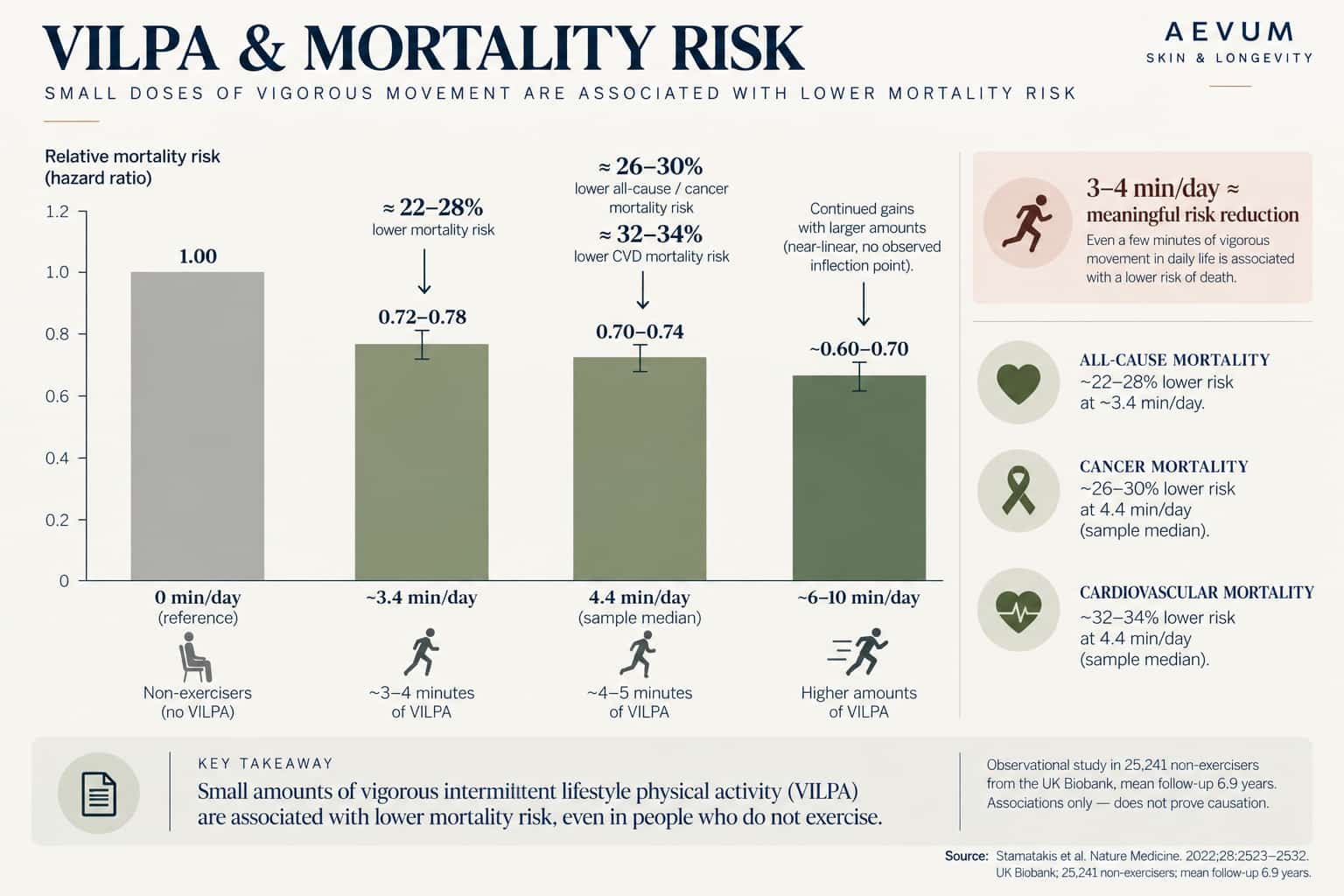
| All-cause mortality reduction, median VILPA (~4.4 min/day, ~3 bouts) | 26-40% reduction (across reported statistical models) |
| Cardiovascular mortality reduction | 32-49% reduction |
| Cancer mortality reduction | 26-40% reduction |
| Minimum dose showing meaningful benefit | Fewer than 2 bouts/day (roughly 3.4-4.1 min/day) still associated with 22-33% risk reductions |
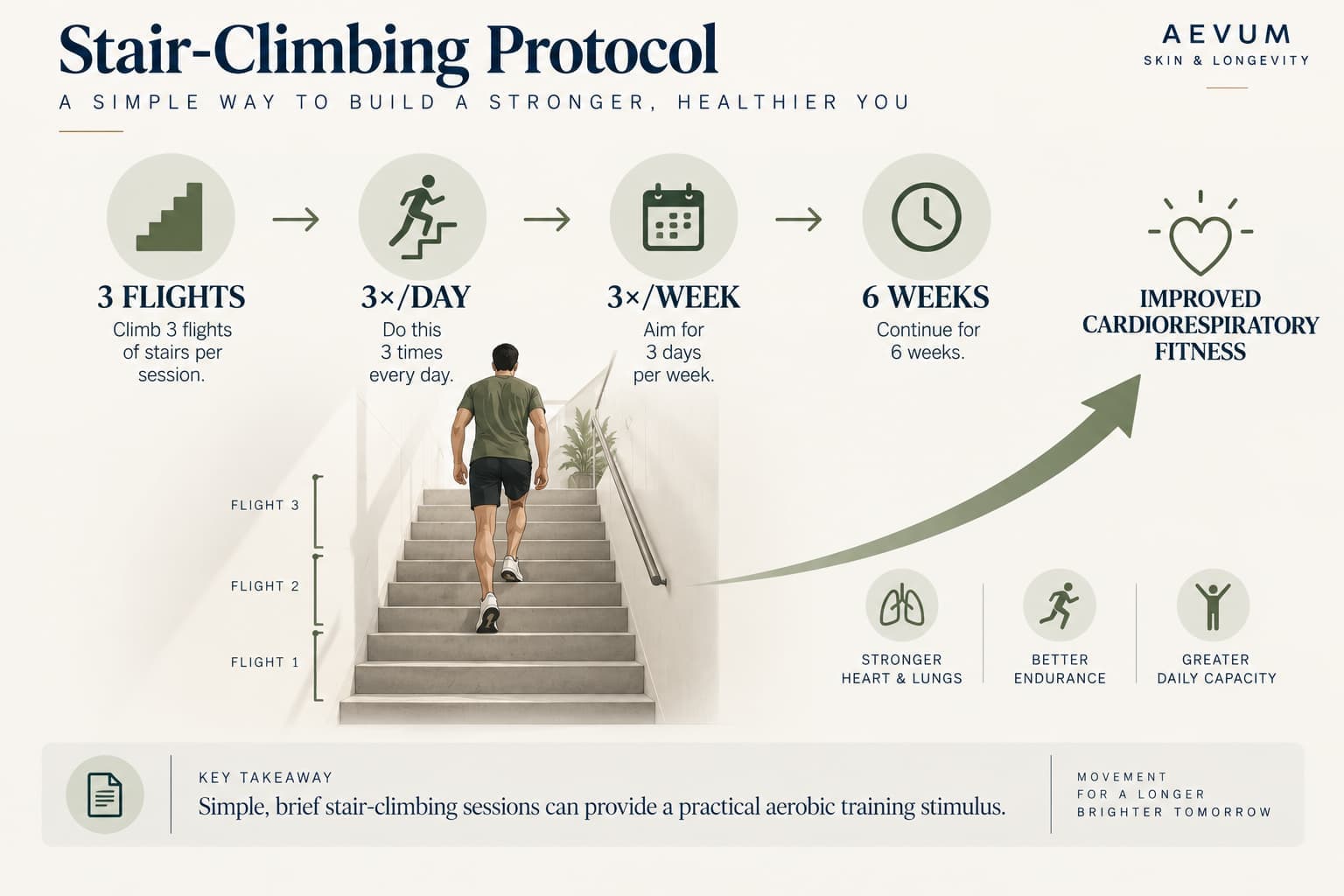
| Stair-climbing protocol, fitness gains | 3 flights, 3x/day, 3x/week, 6 weeks — measurable cardiorespiratory fitness and power improvements in previously sedentary adults |
What exercise snacking actually is
Exercise snacking (also studied under the term VILPA — vigorous intermittent lifestyle physical activity) refers to brief, sporadic bursts of vigorous-intensity effort folded into the normal flow of a day, rather than a dedicated workout session. The defining study described it as activity "done as part of daily living, such as bursts of very fast walking while commuting to work or moving from place to place, or stair climbing" — typically lasting up to 1-2 minutes per bout. The key distinguishing feature isn't the activity itself (walking fast, climbing stairs) — it's the intensity: genuinely vigorous effort, not a brisk-but-comfortable pace, for a short burst.
Evidence Strength: What the Research Shows
A large cohort study found striking associations for people who don't exercise at all. Using wearable accelerometer data from 25,241 UK Biobank participants who reported doing no leisure-time exercise, researchers used machine-learning classification to identify these brief vigorous bursts embedded in daily activity and tracked outcomes over a median 6.9 years of follow-up (852 deaths recorded). At the sample's median VILPA level — around 3 short bouts totaling roughly 4.4 minutes per day — all-cause mortality was reduced by 26-40% (depending on the specific statistical model used), cardiovascular mortality by 32-49%, and cancer mortality by 26-40%, compared with people who recorded essentially no vigorous activity at all. Even at the lower end — fewer than 2 bouts per day, in the 3.4-4.1 minute range — meaningful risk reductions (22-33%) were still observed.
It's worth being precise about what this design can and can't show: this is observational data, so it demonstrates a strong association, not proof that the brief bursts alone caused the mortality difference — people who move vigorously through their day may differ in other health-relevant ways from those who don't. But the size of the association, the dose-response pattern (more bouts, generally larger reductions), and the biological plausibility (vigorous intensity is known to drive cardiorespiratory adaptations even in short bursts) make this a genuinely different finding from just "active people are healthier," and specifically relevant to the large share of adults who don't do structured exercise.
Controlled trials confirm short vigorous bouts drive real fitness change. Separately from the observational mortality data, a controlled trial protocol tested this idea directly: previously sedentary young adults vigorously climbed a three-flight stairwell three times a day, spaced one to four hours apart, three days a week, for six weeks — a total of well under 10 minutes of actual stair-climbing per week. Compared to a non-training control group, the stair-climbing group showed measurable improvements in cardiorespiratory fitness, strength, and power output on a maximal cycling test. This confirms the mortality association isn't just a marker of some other healthy trait — brief, genuinely vigorous effort produces real, physiologically measurable adaptation, even in tiny total weekly doses.
What exercise snacking can and can't replace
Exercise snacking is best understood as a floor, not a ceiling. It's strong evidence that some vigorous activity, in whatever small doses fit into a day, is dramatically better than none — a genuinely useful message for the large proportion of adults who do no structured exercise at all. It is not evidence that a few minutes of stair-climbing is equivalent to or a substitute for the dose-response benefits of structured training covered elsewhere in this series — progressive resistance training for strength and bone density (see our Progressive Overload and Bone Density and Resistance Training articles), or sustained cardiorespiratory training for the larger VO2 max gains linked to longevity. The mortality reductions seen with VILPA are calculated against a genuinely sedentary comparison group — the honest reading is "some vigorous movement beats none, dramatically," not "a few minutes replaces a real training program."
Recommendations by scenario
- 1Currently doing no exercise at all
This is where the evidence is strongest and most directly relevant. Adding a handful of genuinely vigorous 30-60 second bursts through the day — taking stairs quickly, a fast walk to catch transport, a brief burst of effort during a break — is a realistic, low-barrier starting point with a strong evidence base behind it, and a much easier entry point than committing to a formal workout routine from zero.
- 2Already doing structured exercise regularly
Exercise snacking isn't necessary on top of a solid training program, though it's not harmful either — the evidence here is specifically about closing the gap for non-exercisers, not about optimizing further gains for people already training.
- 3Very limited time, want the highest-leverage use of a few minutes
Genuine intensity is the active ingredient, not duration. A hard, breathless 30-60 second effort (stairs, fast walking, a brief bodyweight circuit) several times a day is a more evidence-backed use of scattered minutes than the same total time at a comfortable pace.
- 4Office or desk-based work with long sedentary stretches
Exercise snacks pair naturally with breaking up sitting time — a short vigorous burst during a coffee or bathroom break serves the dual purpose of interrupting prolonged sitting and accumulating genuine vigorous-intensity minutes across the day.
- 5Recovering from injury or new to vigorous effort
"Vigorous" should be calibrated to your own current fitness, not an absolute pace — a brief effort that leaves you breathless relative to your own baseline captures the same intensity principle, and checking with a doctor before adding vigorous bursts is reasonable if you have underlying health conditions.
Practical notes
The core, evidence-backed message of exercise snacking is a genuinely encouraging one: for someone doing nothing, the jump from zero to a few scattered minutes of real effort per day is associated with one of the larger risk reductions in the physical activity literature — a far lower bar than the "you need 150 minutes a week or it doesn't count" framing that keeps many people from starting at all.
Do you currently do any
structured exercise at all?
Take the free Aevum Protocol assessment to see how your movement & strength and 6 other longevity domains are performing — and get a personalised 90-day plan.
Take the Free Assessment →