Movement & Strength
VO2 Max:
The Single Best Predictor of Longevity?
Our Muscle Mass article covered how sarcopenia has a formal clinical definition and a precisely quantified decline rate. VO2 max — a measure most people associate purely with elite athletes — has an even more striking research story behind it: a landmark study of over 122,000 people found it predicted mortality risk more strongly than smoking, diabetes, or coronary artery disease, with no upper limit to the benefit of improving it, at any fitness level.
Key numbers
| Measure | Figure |
|---|---|
| Participants in the landmark Cleveland Clinic study | 122,007 |
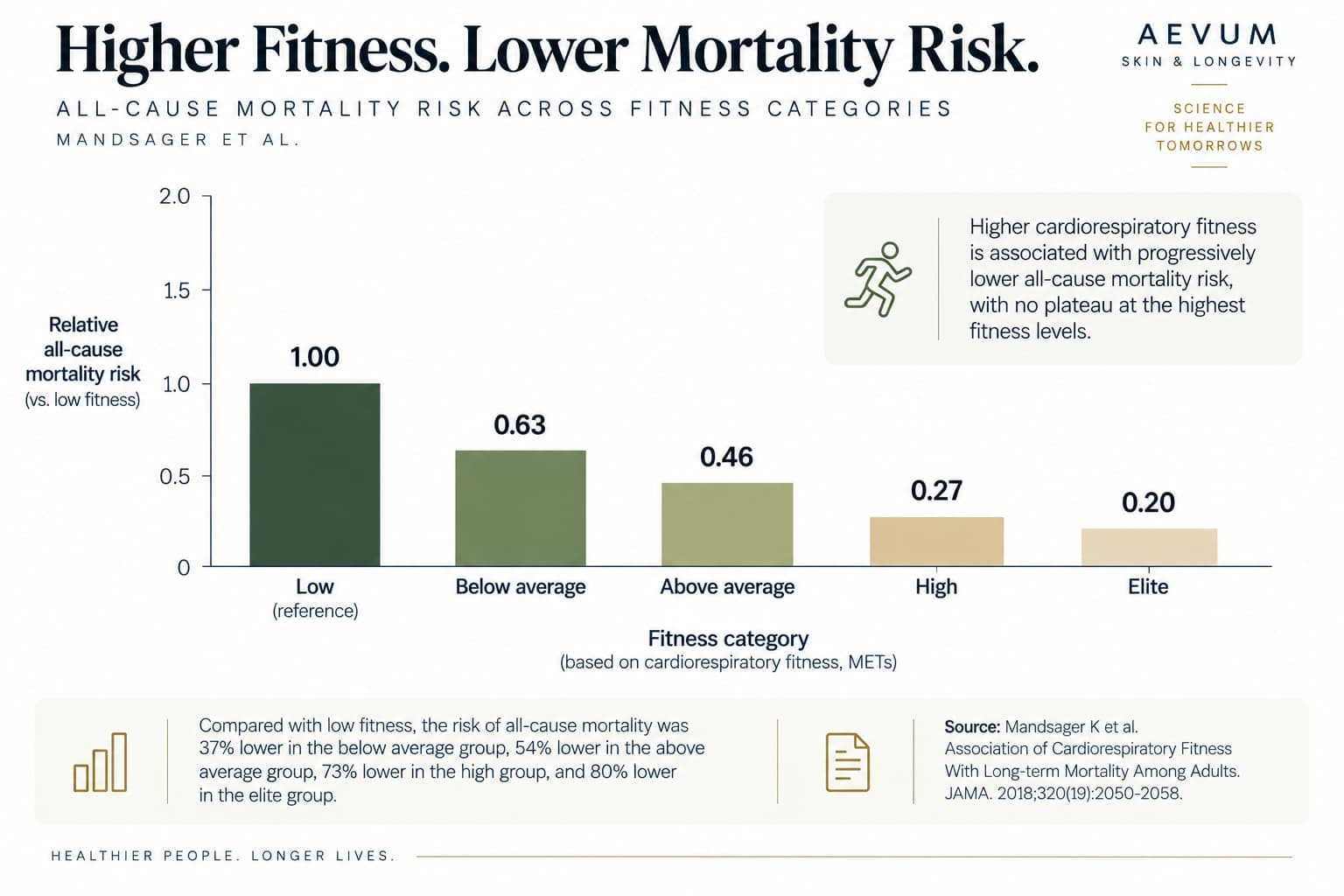
| Mortality risk, low-fitness vs. elite-fitness group | ~5x higher (adjusted HR 5.04) |
| Mortality reduction, elite vs. low fitness | ~80% lower risk (adjusted HR 0.20) |
| VO2 max decline per decade (well-maintained training vs. reduced training) | ~5-6.5% vs. up to 46% |
| VO2 max decline after 12 weeks of training cessation | ~18-20% |
How it works: what VO2 max actually measures
VO2 max (maximal oxygen uptake) is the maximum rate at which the body can take in, transport, and use oxygen during intense exercise, typically expressed in millilitres of oxygen per kilogram of body weight per minute. It's genuinely a systems-level integrated marker — reflecting how well the lungs extract oxygen, how effectively the heart pumps oxygenated blood, and how efficiently muscle tissue actually uses that oxygen to produce energy, all at once. This is part of why it functions as such a powerful overall health signal rather than a narrow measure of one isolated system.
The gold-standard measurement is cardiopulmonary exercise testing (CPET) — a maximal treadmill or bike test with direct gas exchange analysis. In large clinical studies like the one below, fitness is more commonly estimated using peak metabolic equivalents (METs) achieved during a standardised exercise treadmill test, calculated from treadmill speed and grade at peak effort, then converted into age- and sex-specific percentiles — a practical, widely-used proxy for direct VO2 max measurement in large populations.
What the research shows
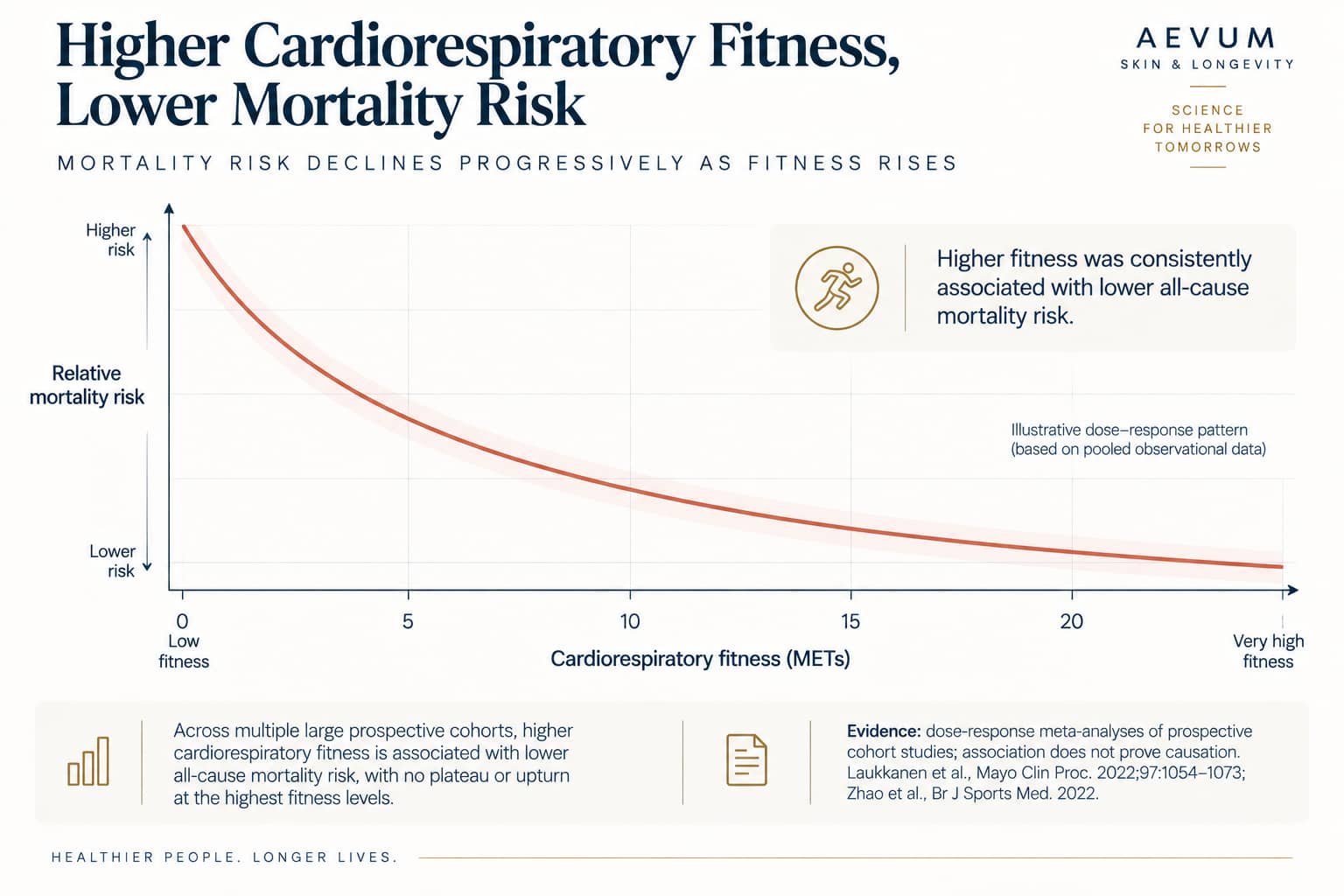
The landmark finding: no upper limit to the benefit of fitness. A study published in JAMA Network Open in 2018 followed 122,007 patients who underwent standardised exercise treadmill testing at the Cleveland Clinic, tracking mortality over a median 8.4 years of follow-up (13,637 deaths, 1.1 million person-years). Patients were divided into fitness categories — low, below average, above average, high, and elite — based on their percentile ranking for age and sex. The central finding was genuinely striking: cardiorespiratory fitness was inversely associated with all-cause mortality, with no observed upper limit of benefit — the authors concluded that "increases in CRF were associated with a reduction in all-cause mortality at any level, without evidence of a plateau effect," and extreme fitness (two or more standard deviations above the mean for age and sex) showed no evidence of the risk reversing or flattening out at the very top, the way many other health metrics eventually do.
The scale of the difference is genuinely large. The least-fit patients had an adjusted mortality risk roughly five times that of the elite-fitness group (HR 5.04, 95% CI 4.10-6.20; equivalently, the elite group's risk was about 80% lower than the low group's, HR 0.20). Subsequent commentary on this study has noted this gap exceeds the mortality difference typically observed between smokers and non-smokers, and compares to or exceeds the risk associated with conditions like diabetes and coronary artery disease. The study's senior investigators were direct about the clinical implication: cardiorespiratory fitness is a modifiable indicator of long-term mortality, and clinicians should actively encourage patients toward achieving and maintaining high fitness levels, regardless of age, sex, or existing health conditions.
You don't need to become elite to capture most of the benefit. This is a genuinely important, practical nuance often missed in how this study gets discussed. Commentary on this dataset and related cohorts has found that a large share of the total survival benefit is captured simply by moving out of the lowest fitness category into the next one up — one widely cited analysis noted that more than half of the total reduction in all-cause mortality occurred between the low and moderate fitness groups. This reframes the practical target: the goal isn't necessarily elite athletic fitness, but simply escaping the bottom category, which is a considerably more achievable, motivating target for most people starting from a sedentary baseline.
VO2 max decline with age is far more modifiable than commonly assumed. A study tracking masters endurance athletes over 6-22 years of follow-up found VO2 max decline ranging enormously — from as little as 5-6.5% per decade in athletes who maintained near-normal training volume, up to 46% per decade in those whose training volume dropped substantially. Regression analysis found that changes in training volume explained roughly 54% of the variance in VO2 max decline in men and 39% in women — meaning the rate of decline is, to a substantial degree, a function of continued training rather than age itself. This same body of research found VO2 max responds quickly in both directions: training cessation produced an almost linear decline, reaching as much as 18-20% within 12 weeks, tied to reduced cardiac output and reduced mitochondrial oxidative capacity — a genuinely fast-acting, "use it or lose it" marker. Encouragingly, the same athletes recovered 15-29% of lost fitness within 12 weeks of resuming training.
Recommendations by fitness level
- 1Anyone currently sedentary or in the lowest fitness category
This is where the research shows the single largest mortality risk reduction is available — moving out of the bottom fitness quartile, not reaching elite status, captures a substantial share of the total benefit, making this a genuinely achievable, high-leverage starting point.
- 2Anyone already moderately active
Given how quickly VO2 max can decline with reduced training (up to 20% in as little as 12 weeks), maintaining consistency matters as much as the specific training method — see our HIIT vs. Steady-State Cardio article for how different training styles compare.
- 3Highly trained individuals and athletes
The "no observed upper limit" finding is genuinely relevant here too — continued improvement in fitness appears to keep delivering mortality benefit even at already-high levels, rather than plateauing once a certain threshold is reached.
- 4Older adults
The masters athletes research specifically studied people well into their 70s and 80s, and found the rate of decline remained substantially trainable at these ages — worth knowing that VO2 max isn't simply a fixed casualty of ageing, even later in life.
Practical notes
- →The "no upper limit" finding is genuinely unusual — most health metrics show diminishing or reversed returns at the extremes; cardiorespiratory fitness, in this large dataset, did not
- →You don't need to be elite to capture most of the benefit — a large share of the total gain comes from escaping the lowest fitness category, a genuinely achievable target for most people
- →VO2 max decline is substantially explained by training volume, not age alone — over half the variance in decline rate in one study was attributable to how much training was maintained
- →This marker responds fast in both directions — meaningful loss can occur within as little as 12 weeks of reduced training, underscoring the value of consistency
- →This is a genuinely modifiable, trackable marker at any age, including well into the seventies and eighties, based on the masters athlete research above
VO2 max is one of the more compelling examples in longevity medicine of a single, measurable marker with an exceptionally strong, well-documented relationship to mortality risk — and one that remains genuinely modifiable at virtually any age or starting point. For how our Muscle Mass article's sarcopenia findings connect to overall physical capacity, see that article directly, and for the specific training approaches that improve cardiorespiratory fitness, see our HIIT vs. Steady-State Cardio article and our upcoming Zone 2 training piece.
Have you ever had your
cardiorespiratory fitness measured?
Take the free Aevum Protocol assessment to see how your movement & strength and 6 other longevity domains are performing — and get a personalised 90-day plan.
Take the Free Assessment →