Movement & Strength
HIIT vs. Steady-State Cardio:
What the Evidence Actually Shows
High-intensity interval training (HIIT) is often framed as the time-efficient shortcut to the same cardiovascular gains as long, steady-state cardio sessions — and for VO2max specifically, the evidence broadly supports that framing, within limits. This article covers what a large meta-analysis found comparing the two approaches, a striking small trial showing 1 minute of hard effort matching 45 minutes of moderate cycling, and where the real trade-offs lie so you can choose the right tool rather than assuming one approach is simply superior.
Key numbers
| Finding | Detail |
|---|---|
| HIIT vs. no exercise (VO2max) | Large effect across populations (SMD 0.79-1.65), 53 pooled studies |
| HIIT vs. moderate continuous training (VO2max) | Long intervals (≥2 min), high volume (≥15 min), 4-12 week programs showed clear advantage (SMD 0.65-1.07) |
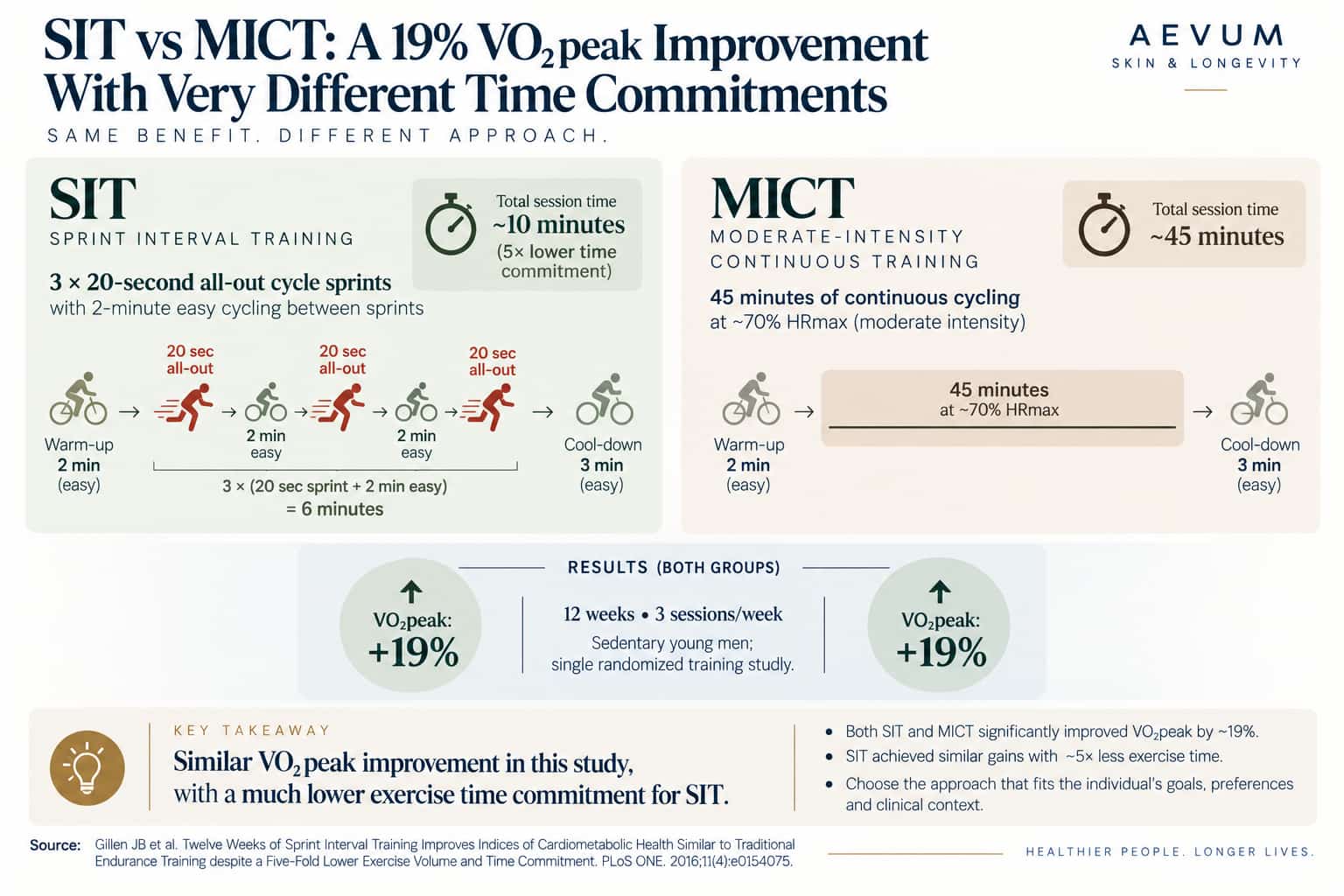
| Time-efficient SIT protocol | 3×20-second all-out sprints (1 minute total hard effort, 10-minute session) matched 45 minutes of moderate cycling for VO2peak gains over 12 weeks |
| VO2peak improvement, both groups | +19% in both the 10-minute sprint protocol and the 50-minute moderate protocol |
| SIT vs. MICT, pooled VO2peak change (separate 2024 meta-analysis) | SIT +1.75 mL/kg/min vs. MICT +3.10 mL/kg/min — MICT showed the larger pooled gain across these specific trials |
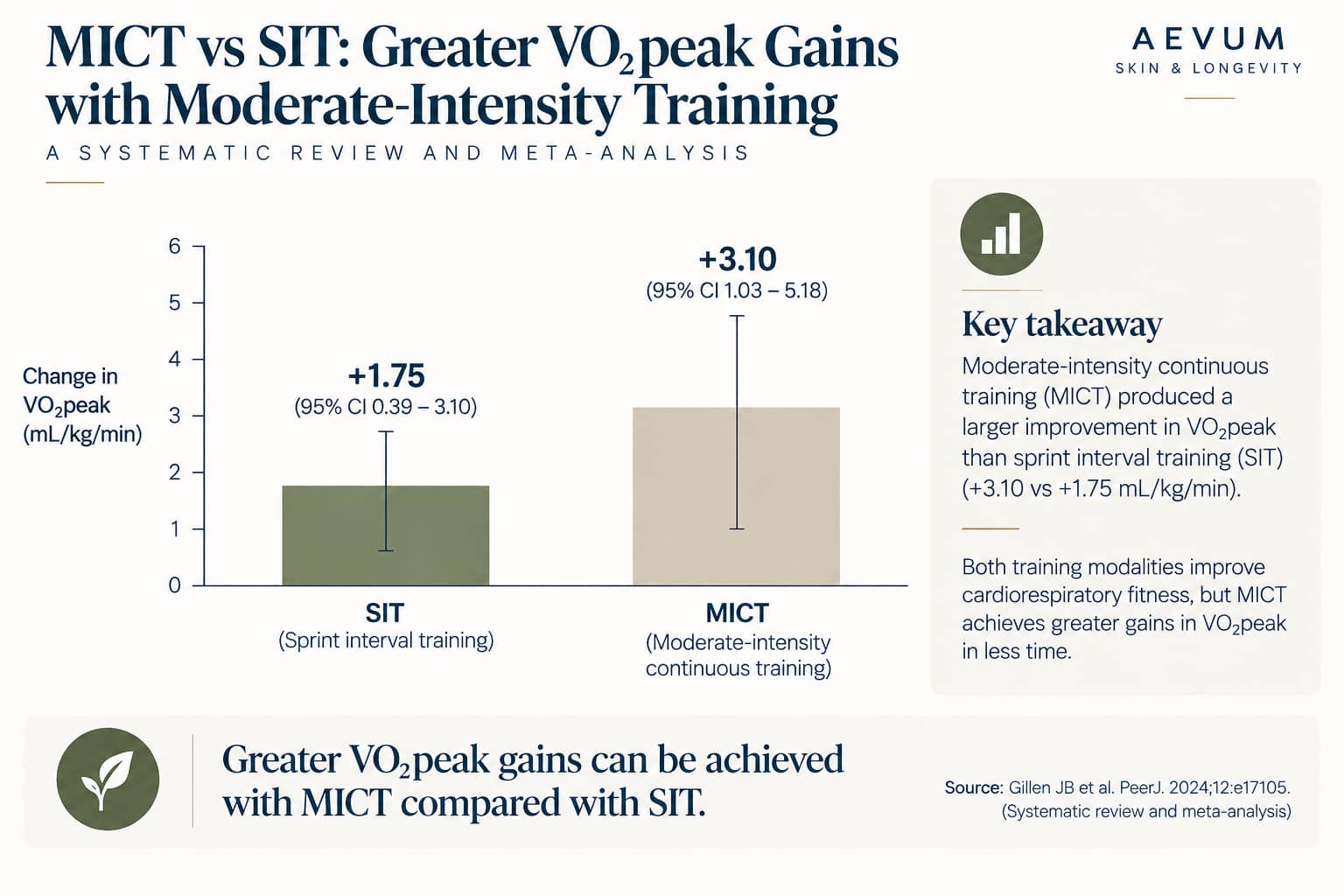
It's worth holding this alongside the meta-analysis above: pooling a different, smaller set of trials specifically comparing SIT and MICT head-to-head, a 2024 systematic review found MICT produced the larger mean VO2peak gain of the two (+3.10 vs. +1.75 mL/kg/min) — a reminder that “HIIT matches or beats steady-state” isn't a universal law. The picture depends heavily on which HIIT protocol, which population, and which specific trials are being pooled; the individual Gillen study below remains a genuine, well-documented result, just not one that generalizes to every SIT protocol against every MICT protocol.
How it works
Why intervals can match or exceed steady-state for VO2max. Very high-intensity efforts recruit a greater proportion of fast-twitch muscle fibres and push cardiac output and oxygen extraction closer to their ceiling than sustained moderate effort does, even though the total duration of hard effort is far shorter. This is the physiological basis for why brief, maximal or near-maximal intervals can drive VO2max adaptations efficiently — the stimulus intensity substitutes, to a meaningful degree, for stimulus duration.
The landmark time-efficiency finding. A frequently cited study compared two 12-week protocols in sedentary men: a sprint interval training (SIT) group doing three 20-second all-out cycling efforts (with 2-minute recovery between, plus warm-up/cool-down) for a total session time of 10 minutes — just 1 minute of actual hard effort — three times a week, against a moderate-intensity continuous training (MICT) group cycling for 45 minutes at roughly 70% of max heart rate, three times a week (50 minutes total per session including warm-up/cool-down).
The results: VO2peak improved by 19% in both groups — a nearly identical gain from roughly one-fifth the total weekly time commitment in the SIT group. Insulin sensitivity also improved more in the SIT group (+53%) than the MICT group (+34%), and citrate synthase activity (a marker of mitochondrial density) rose more in the SIT group as well (+48% vs. +27%). It's worth being direct about this study's limits: the sample was small (9 SIT, 10 MICT, 6 control participants) and all were young, sedentary men — a real result, but one that shouldn't be over-generalized to every population without caveat.
Comparing HIIT and steady-state cardio
| Factor | HIIT | Steady-state cardio |
|---|---|---|
| Time efficiency | High — large adaptations from short total sessions | Lower — requires more total time for comparable VO2max gains |
| VO2max improvement | Strong, particularly with long intervals (≥2 min) and adequate volume | Strong, well-established, more forgiving on protocol precision |
| Joint/injury stress | Higher — near-maximal efforts increase mechanical and cardiovascular strain | Lower — sustained moderate effort is generally gentler |
| Recovery demand | Higher — requires adequate recovery between sessions | Lower — more sessions can be stacked with less accumulated fatigue |
| Adherence/sustainability | Mixed — effective but often less enjoyable for some; short sessions can also aid adherence | Generally high — comfortable, conversational-pace effort is easier to sustain long-term for many people |
| Suitability for beginners | Requires caution and, ideally, medical clearance for true “all-out” efforts | Generally the safer starting point |
How to actually train
- →Choose HIIT protocol length based on your goal. The meta-analysis findings point to long intervals (≥2 minutes of work) with adequate total volume (≥15 minutes of accumulated high-intensity work) as most effective for VO2max gains when compared directly against moderate continuous training; very short, low-volume protocols (like the 1-minute SIT example above) are best understood as a time-efficient minimum-effective-dose option, not necessarily the single best protocol for maximizing VO2max specifically
- →Don't skip the warm-up. Given the mechanical and cardiovascular demand of near-maximal efforts, an adequate warm-up meaningfully reduces injury risk before any hard interval work
- →Build a base before going all-out. Steady-state cardio is a reasonable foundation to build from before adding true maximal-effort intervals, particularly for those newer to structured training
- →Use both, deliberately. Given the different trade-offs — HIIT's time efficiency and strong VO2max stimulus against steady-state's lower injury risk and easier recovery — a training week combining both, rather than treating them as competing philosophies, is well supported by the evidence rather than any single dogmatic approach
Recommendations by level
- 1Beginners/deconditioned individuals
Build an aerobic base with steady-state work first; introduce interval training gradually and at sub-maximal intensities before progressing to true all-out efforts.
- 2Time-constrained trainees
A short, well-structured interval protocol (even something close to the 1-minute-of-hard-effort model) is a genuinely evidence-supported way to gain meaningful VO2max improvement without a large weekly time commitment.
- 3Those prioritizing VO2max specifically
Long-interval HIIT (≥2 minutes per interval, ≥15 minutes total accumulated hard effort per session) showed the clearest advantage over moderate continuous training in the pooled trial data.
- 4Those with existing cardiovascular risk factors
Medical clearance before starting true high-intensity interval work is a reasonable precaution, given the higher acute cardiovascular demand relative to steady-state cardio.
Practical notes
HIIT and steady-state cardio both ultimately move the same needle — cardiorespiratory fitness — through different routes with different trade-offs. Neither approach needs to “win”; the practical takeaway from the comparative evidence is that both are valid tools, and the right mix depends on available time, current fitness level, and injury/recovery considerations more than any inherent superiority of one method. If you'd like your own cardiorespiratory fitness assessed and a training approach matched to your goals, our Longevity Doctors offer a free consultation as a starting point.
Which training approach fits
your current fitness level and goals?
Take the free Aevum Protocol assessment to see how your movement & strength and 6 other longevity domains are performing — and get a personalised 90-day plan.
Take the Free Assessment →