Movement & Strength
Grip Strength:
Why This Simple Test Predicts How Long You'll Live
Our Muscle Mass article noted that the formal EWGSOP2 sarcopenia definition uses handgrip strength as its primary diagnostic measure. Grip strength has its own, equally striking evidence base — a landmark study of nearly 140,000 people found it predicted mortality more accurately than systolic blood pressure, using nothing more than a simple handheld device.
Quick Summary
- →A landmark study of 139,691 adults across 17 countries found grip strength was a stronger predictor of both all-cause and cardiovascular mortality than systolic blood pressure — a genuinely striking finding given how central blood pressure measurement is to standard medical risk assessment
- →Every 5kg reduction in grip strength was associated with a 16% increase in all-cause mortality risk, alongside comparable increases in cardiovascular death, non-cardiovascular death, heart attack, and stroke risk
- →It's worth being precise about what this specific study did and didn't find: grip strength was not significantly associated with incident diabetes, hospital admission for pneumonia or COPD, falls, or fractures in this dataset — its predictive power is genuine, but not universal across every health outcome
- →Weak grip strength independently predicts cognitive decline and dementia risk, not just physical outcomes — a study of over 19,000 older adults found it associated with a 43% higher dementia risk and 11% higher risk of general cognitive decline
- →Grip strength functions as a proxy for whole-body neuromuscular health, not narrowly hand or forearm strength — which is exactly why a two-minute test using an inexpensive device carries this much predictive weight
Key numbers at a glance
| Measure | Figure |
|---|---|
| Participants in the PURE study | 139,691, across 17 countries |
| All-cause mortality risk increase, per 5kg grip strength reduction | 16% |
| Cardiovascular mortality risk increase, per 5kg reduction | 17% |
| Stroke risk increase, per 5kg reduction | 9% |
| Dementia risk increase, weak grip strength (19,114-person cohort) | 43% |
How it works: why a hand squeeze predicts so much
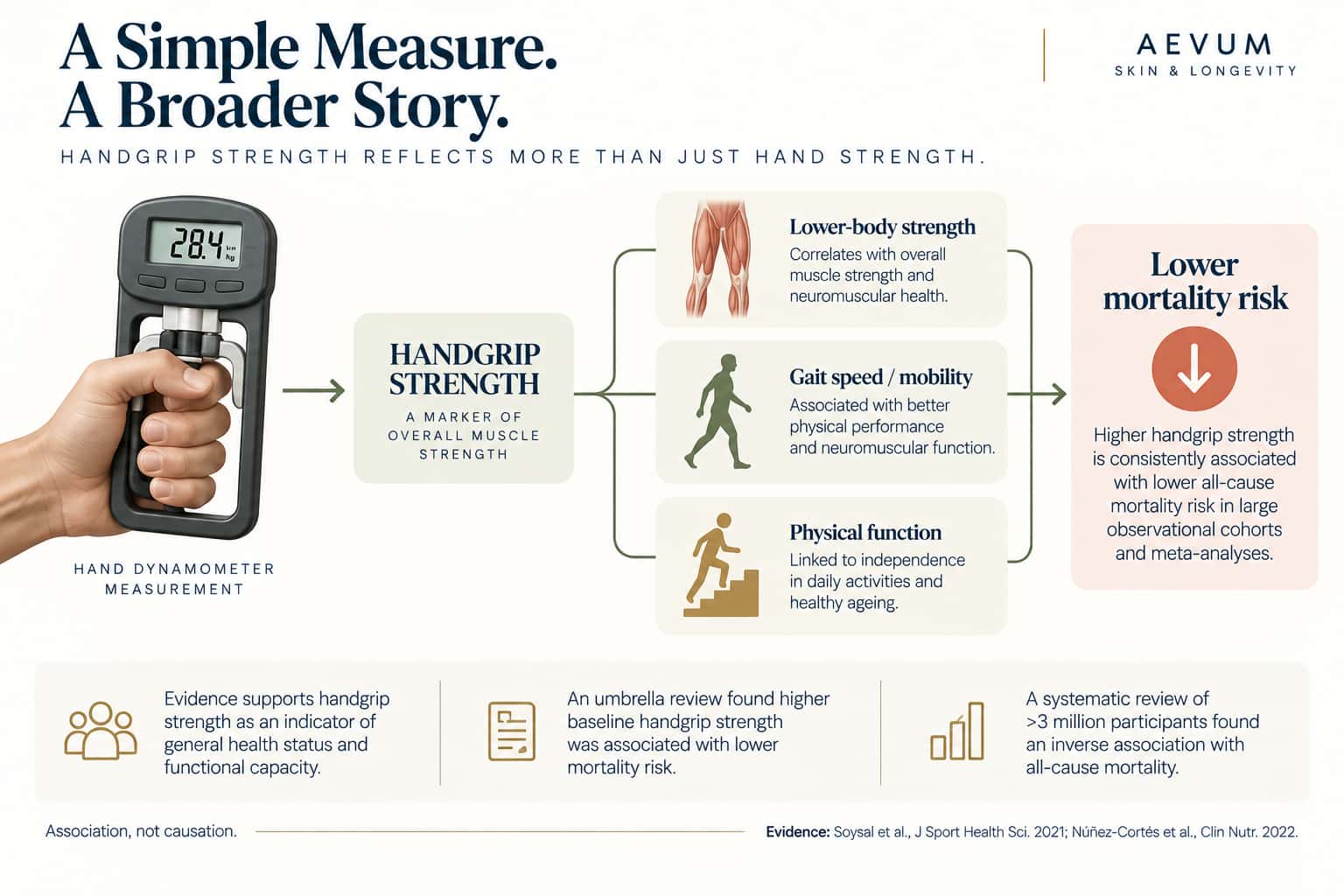
Grip strength is measured using a handheld dynamometer — a simple, inexpensive device that records the maximum force generated during an isometric hand squeeze. On its surface, this looks like a narrow, localised measurement. In practice, it functions as a genuinely reliable proxy for whole-body neuromuscular function — grip strength correlates meaningfully with strength in other major muscle groups, and producing a strong grip requires coordinated activation across the nervous system and muscular system together, not just isolated hand and forearm muscle. This is exactly why it was selected as the primary strength criterion in the formal EWGSOP2 sarcopenia definition covered in our Muscle Mass article — it's a practical, standardised stand-in for overall muscular and neuromuscular reserve, achievable in a clinical setting in under a minute, without the specialised equipment or maximal exertion required for a direct fitness test.
What the research shows
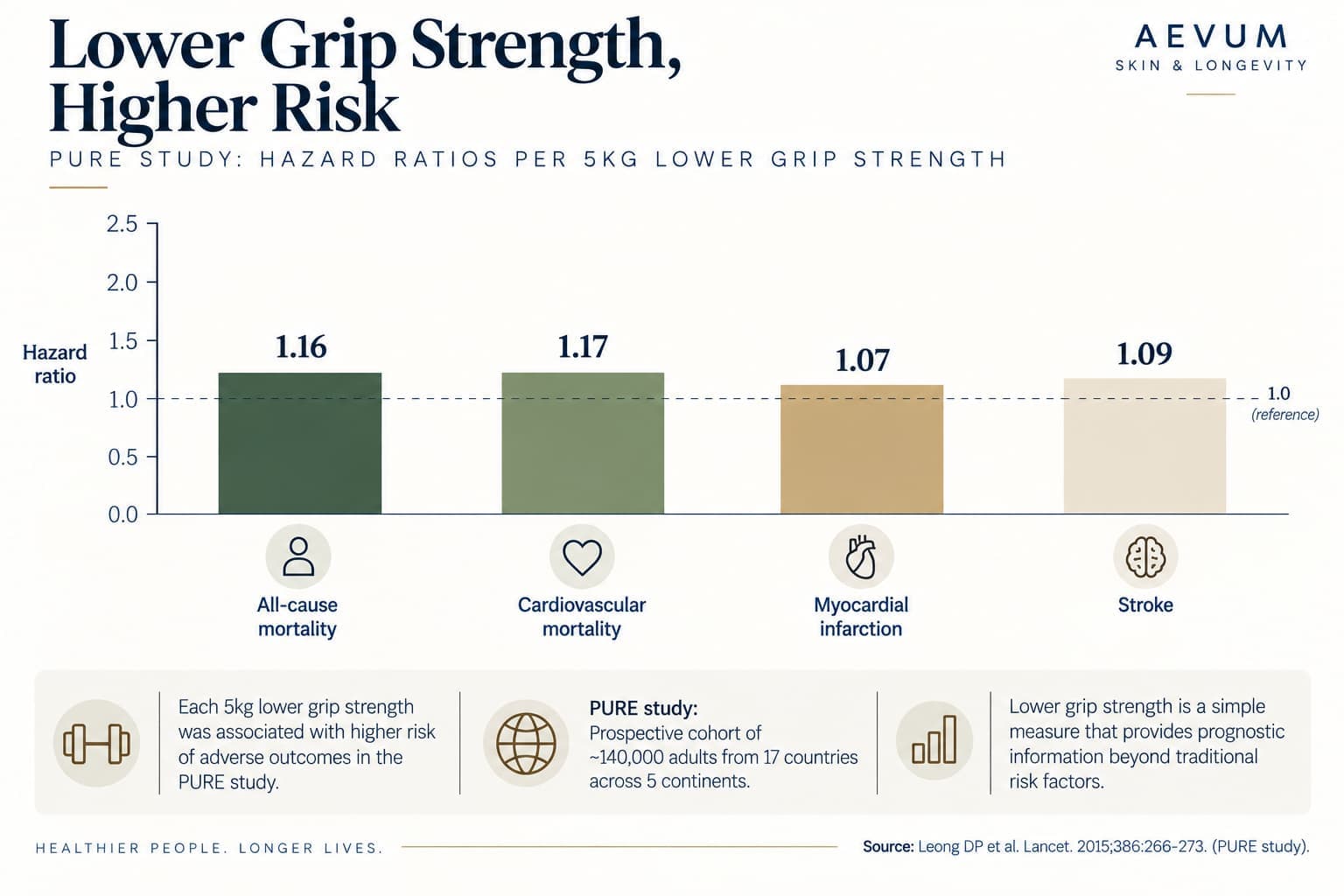
The landmark finding: outpredicting blood pressure. The Prospective Urban Rural Epidemiology (PURE) study, published in The Lancet in 2015, measured grip strength in 139,691 adults across 17 countries spanning a wide range of economic settings, then tracked health outcomes over follow-up. The results were precise and striking: for every 5kg reduction in grip strength, researchers found a 16% increase in all-cause mortality risk (hazard ratio 1.16), a 17% increase in cardiovascular mortality (1.17), a 17% increase in non-cardiovascular mortality (1.17), a 7% increase in myocardial infarction risk (1.07), and a 9% increase in stroke risk (1.09) — all statistically robust findings (p<0.0001 for most). The headline conclusion: grip strength was a stronger predictor of both all-cause and cardiovascular mortality than systolic blood pressure, a genuinely remarkable result given how central blood pressure is to routine cardiovascular risk assessment worldwide.
It's worth being precise about the limits of this specific finding. The same PURE study explicitly found no significant association between grip strength and incident diabetes, hospital admission for pneumonia or COPD, injury from falls, or fractures — an important, honest nuance. Grip strength's predictive power in this dataset was genuine and substantial for mortality and cardiovascular outcomes specifically, but this wasn't a universal predictor of every health outcome studied — a distinction worth keeping in mind rather than assuming grip strength forecasts all aspects of health equally.
A separate study following 19,114 adults aged 70 and older (65 and older for US minority participants) found that weak grip strength at baseline was associated with a 43% higher risk of developing dementia and an 11% higher risk of general cognitive decline over a median follow-up of 4.7 years — findings that held even after adjusting for gait speed measured in the same study. While gait speed was found to be a somewhat stronger predictor of cognitive outcomes than grip strength alone, the two measures were independently associated with risk when considered together, suggesting each captures a genuinely distinct piece of overall physiological ageing rather than fully overlapping information.
Recommendations by life stage
- 1Adults in midlife (40s-60s)
Given how simple and inexpensive this test is, and how strongly it tracks with future cardiovascular and mortality risk, grip strength is a genuinely worthwhile marker to know and monitor over time — a two-minute measurement carrying real prognostic weight.
- 2Older adults, particularly those concerned about cognitive health
The dementia and cognitive decline findings make grip strength relevant well beyond physical outcomes — a weak grip in later life is worth discussing with a doctor as one meaningful data point among others, not dismissed as simply a hand-strength issue.
- 3Anyone building a resistance training routine
Grip strength tends to improve as a natural byproduct of compound, full-body resistance training (deadlifts, rows, farmer's carries) rather than requiring isolated grip-specific exercises.
- 4Anyone interpreting their own grip strength result
Worth remembering this specific research doesn't claim grip strength predicts everything — it's a strong, well-evidenced marker for mortality, cardiovascular outcomes, and cognitive decline specifically, not a universal forecast of every possible health outcome.
Practical notes
- →Grip strength outpredicted systolic blood pressure for mortality in a study of nearly 140,000 people — a genuinely striking result given how routinely blood pressure is used in standard risk assessment
- →The relationship is graded, not a simple cutoff — each 5kg reduction carries a consistent, incremental increase in risk, rather than only mattering below some threshold
- →This specific evidence base is strongest for mortality and cardiovascular outcomes, not universal — the same study found no significant link to diabetes, falls, fractures, or certain hospital admissions
- →Cognitive decline and dementia risk are independently linked to weak grip strength, not just physical health outcomes — a genuinely broader relevance than the name suggests
- →Grip strength serves as a practical proxy for whole-body neuromuscular health, connecting directly to the muscle mass and sarcopenia content covered in our Muscle Mass article
Grip strength is a genuinely compelling example of how a simple, inexpensive measurement can carry outsized predictive weight — outperforming a cornerstone of standard medical risk assessment in one of the largest studies of its kind. For the broader muscle mass and sarcopenia context this connects to, see our Muscle Mass article. If you'd like your own grip strength and broader physical function assessed as part of a longevity evaluation, our Longevity Doctors offer a free consultation as a starting point.
How does your grip strength
score on your longevity assessment?
Take the free Aevum Protocol assessment to see how your movement & strength and 6 other longevity domains are performing — and get a personalised 90-day plan.
Take the Free Assessment →