Movement & Strength
Exercise and Joint Health:
Does Running Really Wreck Your Knees?
"Running is bad for your knees" is one of the most persistent pieces of exercise folklore — and it has the causal direction almost exactly backwards. The actual evidence shows recreational runners have lower rates of knee osteoarthritis than sedentary people, cartilage is a living tissue that adapts to loading rather than simply wearing down like a tire, and exercise itself is a first-line, strongly recommended treatment for osteoarthritis, not something to avoid because of it. This article separates what genuinely increases joint risk (high-volume competitive loading, prior injury) from what doesn't (moderate running, exercising with existing arthritis).
Key numbers
| Finding | Detail |
|---|---|
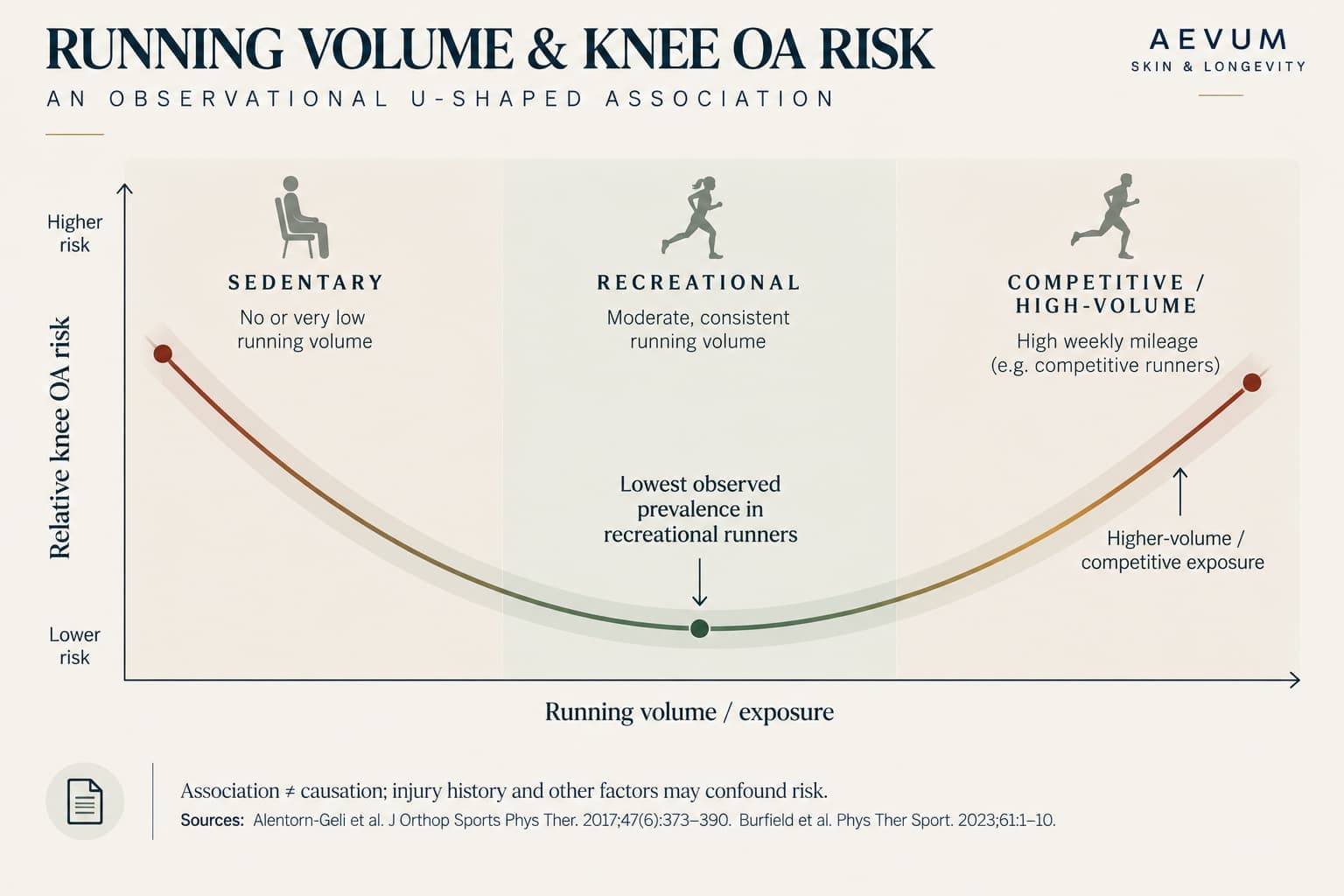
| Knee OA prevalence, recreational runners | 3.5% |
| Knee OA prevalence, sedentary controls | 10.2% |
| Knee OA prevalence, competitive/elite runners (>92 km/week) | 13.3% |
| Marathon runner cohort, arthritis prevalence | 7.3% (n=3,804) vs. ~26% in the general age-matched population |
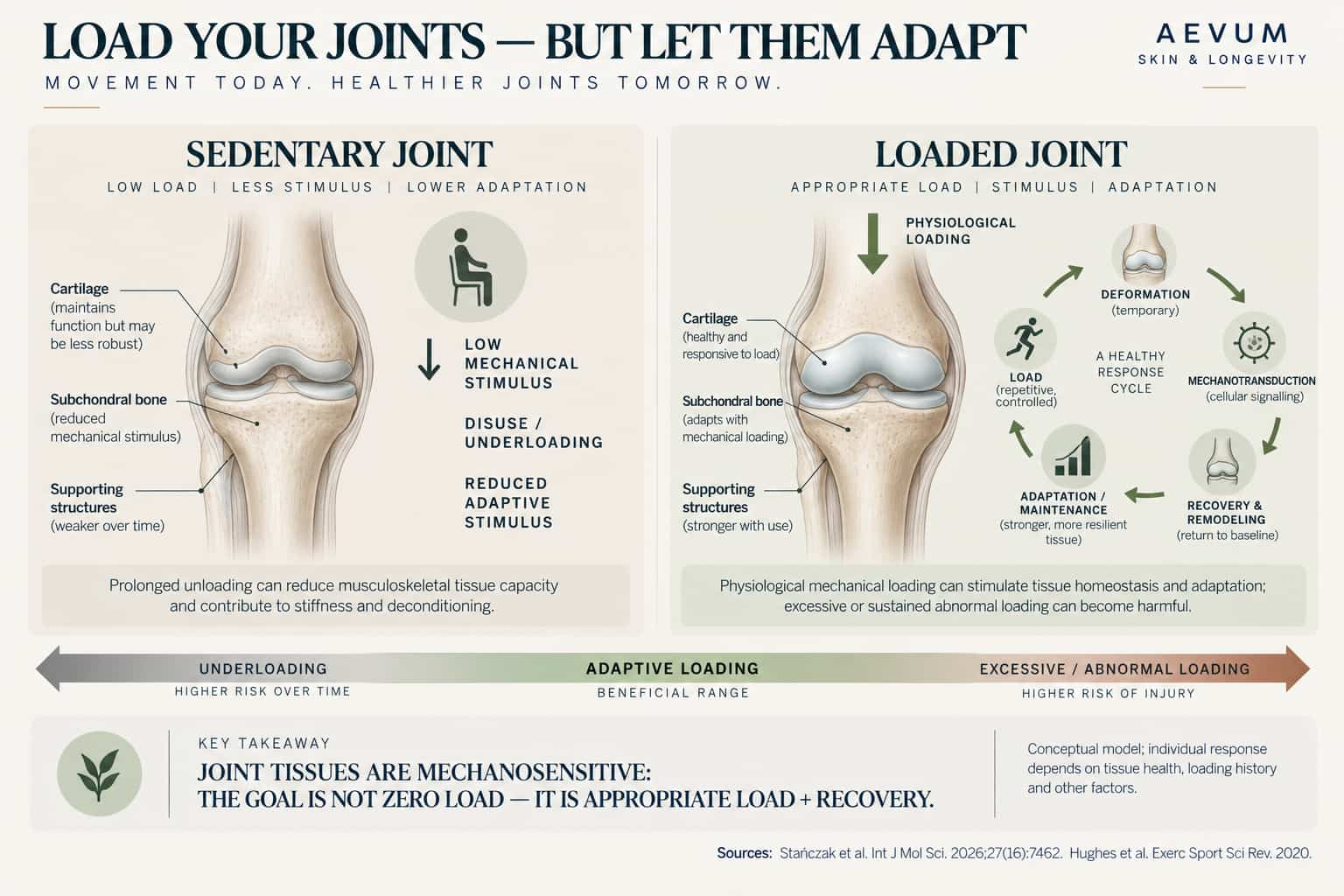
| Cartilage deformation after a run | 3.3-4.9%, fully reversible within 1-24 hours |
| Genetic risk (Mendelian randomization), moderate activity vs. sedentary | OR 0.15 (large protective effect) vs. OR 2.10 for sedentary behavior |
Evidence Strength: What the Research Actually Shows
The relationship is U-shaped, not linear. The single biggest misunderstanding about exercise and joints is treating "more loading = more wear" as a straight line. The actual data traces a U-shape: sedentary people have meaningfully higher rates of knee osteoarthritis than recreational runners, while only very high-volume competitive runners (the review cited a threshold above roughly 92 km/week) show elevated risk again. In one dataset, recreational runners had a 3.5% knee OA prevalence against 10.2% for sedentary controls — nearly a three-fold difference in the opposite direction from the popular assumption — while competitive/elite runners came in at 13.3%, driven specifically by the highest-volume group.
A separate, large prospective cohort of 3,804 marathon runners followed by researchers found an overall arthritis prevalence of just 7.3%, well below the roughly 26% expected in an age-matched general population. Critically, when the researchers ran a multivariable analysis to find what actually predicted arthritis risk within this group of committed runners, cumulative running exposure — years of running, number of marathons completed, weekly mileage, even pace — was not associated with arthritis risk. What was associated: age, BMI, prior injury or surgery, and family history — the same risk factors that predict osteoarthritis in the general population regardless of running history.
Why cartilage doesn't behave like a tire
The mental model behind "running wears down your joints" treats cartilage as a passive, non-renewable material that simply thins with use — closer to how a tire's tread wears. That model is wrong. Cartilage is living tissue that responds to mechanical loading much like bone does (see the mechanostat principle covered in our Bone Density and Resistance Training article): a properly loaded joint typically shows measurable but temporary deformation immediately after exercise — in one review, on the order of 3.3% to 4.9% — as fluid is transiently pushed out of the cartilage matrix under load. In healthy joints, this fully reverses within roughly 1 to 24 hours, and higher loading rates appear to increase cartilage stiffness in a way that protects the underlying collagen network rather than damaging it. The tissue's problem is less often "too much use" and more often the opposite: prolonged immobility and disuse are associated with cartilage thinning and weakening, not protection.
Genetic evidence points the same direction
A Mendelian randomization study — a genetic-epidemiology method designed specifically to help separate correlation from causation — analyzed data from over 400,000 people and found sedentary behavior (under 1.5 METs of activity) roughly doubled genetically-predicted knee OA risk (OR 2.10), while moderate activity (1.5-5.9 METs) showed a large protective association (OR 0.15). Only activity at the very high end (≥6 METs, sustained) showed elevated risk again (OR 2.16) — the same U-shape seen in the observational running data, this time from a study design built to be more resistant to the usual confounding problem (i.e., "maybe healthier people just choose to run" rather than "running causes health").
Across this evidence base, the consistent risk factors for osteoarthritis are: age, higher BMI, a prior joint injury or surgery (an ACL tear especially), family history, and — at the extreme end — sustained very-high training volumes well beyond typical recreational levels. Simply being a runner, or running for years, isn't independently on that list.
Exercise as treatment, not just prevention
Perhaps the most counterintuitive part of the evidence: for people who already have osteoarthritis, exercise isn't something to avoid — it's one of the strongest first-line treatments available. Updated guidelines from the American College of Rheumatology and Arthritis Foundation give exercise a strong recommendation as a core, foundational intervention for knee and hip OA, alongside weight loss and self-management programs — the same top tier of evidence given to any treatment in the guideline. Exercise produces modest but real improvements in pain and function, with benefits that persist for roughly a year, and the evidence doesn't point to one specific exercise type as superior (most of the underlying trials tested aerobic and strength-based approaches). Weight loss belongs in this same top tier: even a modest 5% reduction in body weight measurably improves knee and hip pain, on top of whatever exercise contributes directly. By contrast, several commonly reached-for options — acupuncture, thermal therapy, certain medications like tramadol or acetaminophen — carry only a conditional recommendation, reflecting smaller or more variable evidence.
Consistent with the cartilage-adaptation findings above, follow-up data on runners over 50 with existing radiographic knee OA found no evidence of accelerated structural progression from continued running, alongside a meaningfully higher odds of pain improvement compared with non-runners in the same age group.
Recommendations by scenario
- 1Healthy joints, considering starting or continuing running
The evidence supports running as joint-neutral-to-protective at recreational volumes. Build up gradually (see our Progressive Overload article) rather than jumping straight to high weekly mileage, since injury — not mileage itself — is the more consistent risk factor.
- 2Already diagnosed with knee or hip osteoarthritis
Exercise is a strongly recommended first-line treatment, not something to avoid. Low-impact options (cycling, swimming, walking) and structured strength programs are all reasonable starting points; the guidelines don't favor one modality strongly over another, so the best exercise is the one that's sustainable for you.
- 3History of a significant joint injury (ACL tear, meniscus surgery)
This is a genuine risk factor independent of activity level, worth discussing with a physiotherapist or sports medicine physician for a tailored loading progression — not a reason to avoid exercise altogether, since disuse carries its own joint risk.
- 4Considering very high training volumes (competitive/ultra-endurance level)
This is the one population where the data shows elevated OA risk again. It doesn't mean don't do it — it means monitoring joint symptoms and recovery becomes more relevant at these volumes than at recreational ones.
Practical notes
The evidence here runs directly against the intuitive, tire-wear model of joint health — and that gap between intuition and evidence is exactly why so many people needlessly avoid or stop exercise out of misplaced fear for their joints. The actual risk profile is close to the opposite of the folklore: moving too little is more clearly linked to worse joint outcomes than moving, even a lot, in a well-built-up way.
Have you ever avoided or cut back on running
out of concern for your knees?
Take the free Aevum Protocol assessment to see how your movement & strength and 6 other longevity domains are performing — and get a personalised 90-day plan.
Take the Free Assessment →