Cognitive Longevity
B Vitamins, Homocysteine,
and Brain Aging
Homocysteine is an amino acid in the blood that rises when folate, vitamin B12 or vitamin B6 run low. High levels are linked to a higher risk of dementia, and B vitamins reliably bring them down. That made B vitamins look like an easy way to protect the brain. The reality is more specific. When B vitamins were tested in large trials in the general population, they didn't improve memory or thinking. But in older people with mild cognitive impairment and high homocysteine, a smaller trial found they slowed brain shrinkage — especially in people who also had good omega-3 levels. This article explains who B vitamins are likely to help, who they aren't, and why testing matters more than taking a supplement on spec.
Key numbers
| Finding | Detail |
|---|---|
| Framingham study, homocysteine and Alzheimer's (1,092 people, median 8 years) | 1.8x risk per standard deviation higher; risk nearly doubled above 14 µmol/L |
| Meta-analysis of 11 B-vitamin trials (22,000 people) | Homocysteine lowered by about a quarter; no effect on memory or thinking |
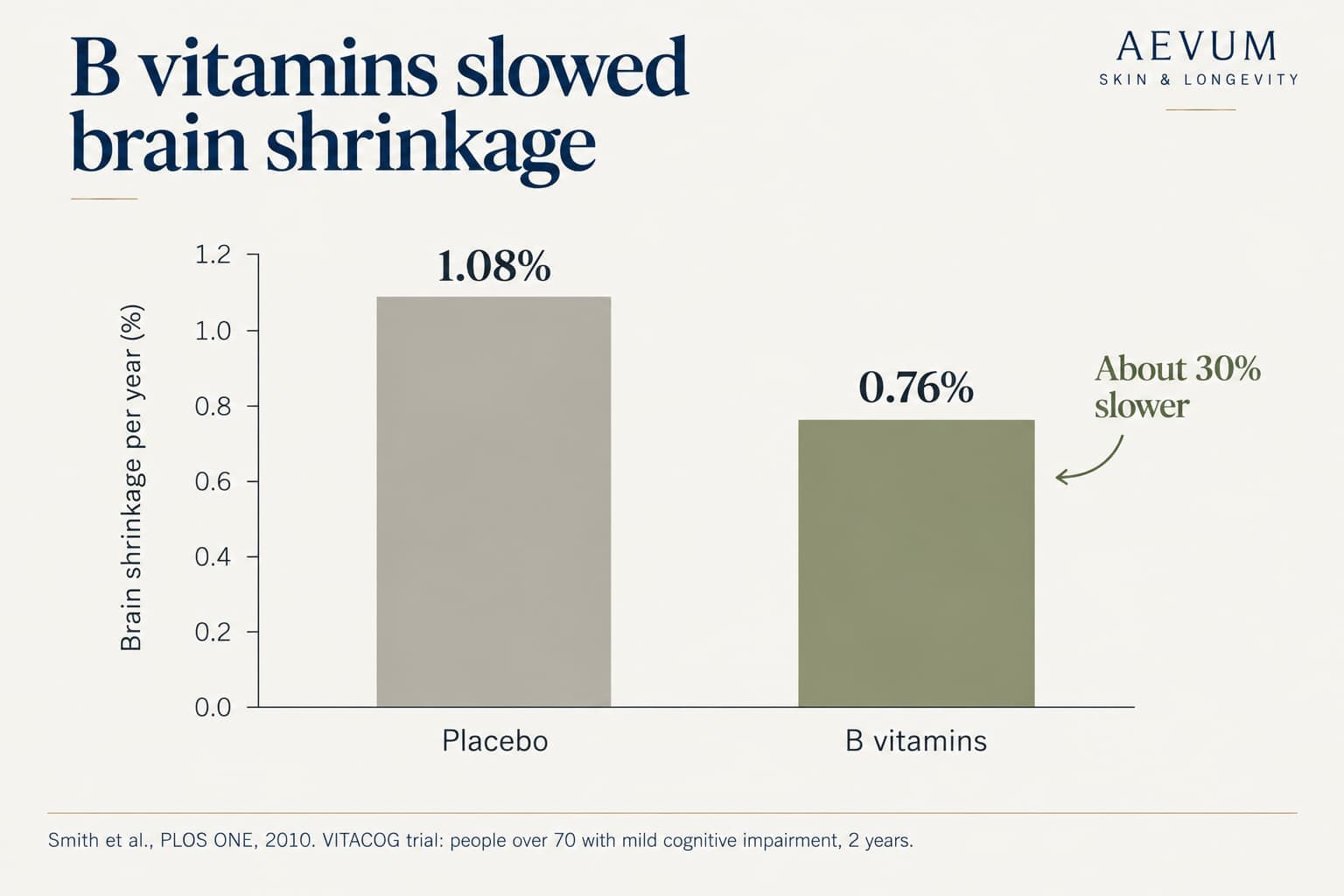
| VITACOG trial (271 people 70+ with mild cognitive impairment, 2 years) | Brain shrinkage 0.76%/year on B vitamins vs. 1.08%/year on placebo (~30% slower) |
| VITACOG, participants with homocysteine above 13 µmol/L | 53% slower brain shrinkage |
| VITACOG, participants with higher omega-3 levels | 40% slower shrinkage; no effect when omega-3 was low |
What homocysteine is
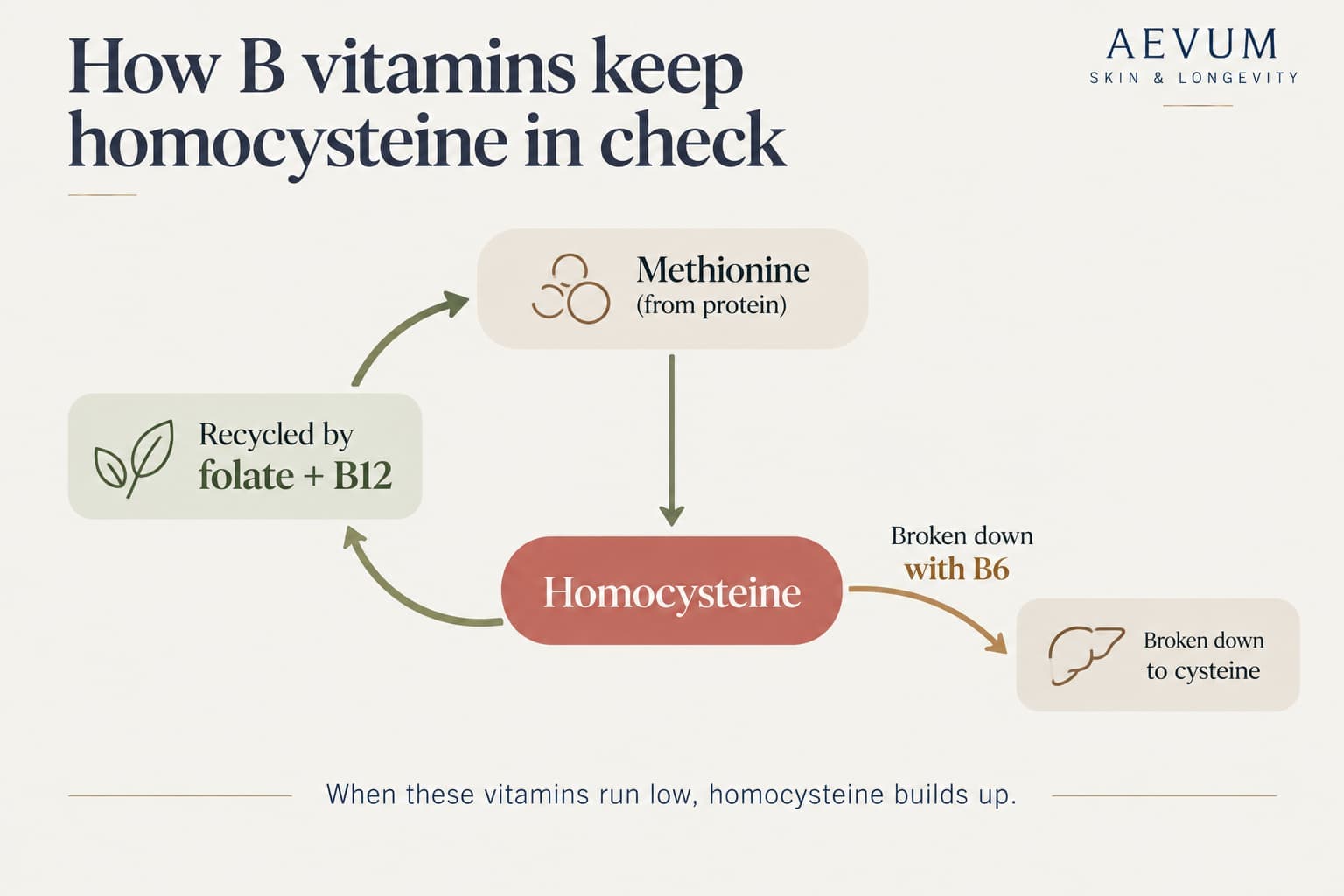
Homocysteine is produced when the body processes methionine, an amino acid found in protein. Normally, it's quickly recycled or broken down, and that process depends on three B vitamins:
- →Folate (vitamin B9) and vitamin B12 recycle homocysteine back into methionine.
- →Vitamin B6 helps break it down by another route.
When any of these vitamins is in short supply, homocysteine builds up in the blood. High homocysteine is thought to damage blood vessels and may harm nerve cells directly, which links it to both the vascular and the neurodegenerative sides of brain ageing (see Vascular Health and the Brain).
Low B12 matters in its own right, too. Genuine B12 deficiency can cause memory problems, confusion and nerve damage, and it's one of the standard reversible causes doctors check for when someone has cognitive symptoms (see Mild Cognitive Impairment).
Evidence strength
Well established: high homocysteine goes with higher dementia risk. In the Framingham study, 1,092 people without dementia had their homocysteine measured and were followed for a median of eight years, during which 111 developed dementia. Each standard-deviation increase in homocysteine was linked to 1.4 times the risk of dementia and 1.8 times the risk of Alzheimer's disease. People with levels above 14 µmol/L had nearly double the risk of Alzheimer's. The association held for homocysteine measured eight years earlier, which makes it less likely that early dementia was causing the high levels.
Tested broadly, no benefit: B vitamins for everyone. If homocysteine drives dementia risk, lowering it should help. A meta-analysis of 11 large randomised trials with cognitive data on about 22,000 people tested exactly that. B vitamins lowered homocysteine by about 26-28%, but made no significant difference to any area of cognition, overall cognitive function or cognitive ageing.
Researchers who favour the homocysteine hypothesis have pointed out that many of these trials were designed to prevent heart disease or stroke rather than dementia, that many participants didn't have particularly high homocysteine, and that some were done in countries where flour is fortified with folic acid. If so, the trials largely tested B vitamins in people who weren't short of them.
Promising, in a specific group: people with MCI and high homocysteine. The VITACOG trial in Oxford took a more targeted approach. It randomised 271 people over 70 with mild cognitive impairment to high-dose B vitamins (0.8 mg folic acid, 0.5 mg vitamin B12 and 20 mg vitamin B6 daily) or placebo for two years. In the 168 who had brain scans at both the start and the end, brain shrinkage averaged 0.76% per year on B vitamins versus 1.08% on placebo — about 30% slower. In people who started with homocysteine above 13 µmol/L, shrinkage was 53% slower. Faster shrinkage went along with lower cognitive scores at the end of the trial.
This is a meaningful result, but it has limits. It was a single, fairly small trial; its main outcome was brain shrinkage on MRI rather than dementia diagnoses; and it hasn't yet been confirmed by a larger trial.
The omega-3 connection. Follow-up analyses of VITACOG found that B vitamins only worked well in people with good omega-3 levels. In participants with higher blood omega-3 levels, B vitamins slowed brain shrinkage by 40%; in those with low omega-3 levels, they had no significant effect. The same pattern appeared for cognition: among people with better omega-3 status, only 33% of those on B vitamins ended the trial with a score above zero on a standard dementia rating scale (indicating some impairment), compared with 59% on placebo. When omega-3 levels were low, B vitamins had no effect on cognitive decline. These are subgroup findings from one trial, so they need confirming, but they may help explain why broad B-vitamin trials failed. Omega-3s are covered in Omega-3s and Cognitive Function.
Who should think about B vitamins
- 1People with low B12 or at risk of it
B12 deficiency is common in older adults, partly because absorption declines with age. Long-term use of metformin (a diabetes medicine) and acid-reducing medicines can also lower B12, as can a vegetarian or vegan diet with little or no animal food. Correcting a genuine deficiency is clearly worthwhile.
- 2People with high homocysteine
This is the group where the trial evidence for brain benefit is strongest. A simple blood test can check it.
- 3People with mild cognitive impairment
Checking B12, folate and homocysteine is a reasonable part of the work-up. If homocysteine is raised, B-vitamin treatment under medical guidance has some evidence behind it.
- 4People with normal levels
On the current evidence, taking extra B vitamins won't protect memory if you already have enough.
How to approach it
- →Test before you supplement. B12, folate and, where appropriate, homocysteine are standard blood tests. Knowing your levels tells you whether supplements are likely to help.
- →Don't take high-dose folic acid on its own without checking B12. High folic acid can hide the anaemia that signals B12 deficiency while nerve damage continues, which is one more reason to test first.
- →Eat foods rich in B vitamins. Folate comes from leafy greens, legumes and many vegetables; B12 comes almost entirely from animal foods such as fish, meat, eggs and dairy; B6 is found in fish, poultry, potatoes and bananas. People who eat little or no animal food usually need a B12 source such as a supplement or fortified foods.
- →Pair with omega-3s. Based on the VITACOG findings, B vitamins may work best alongside adequate omega-3 intake, mainly from oily fish.
Recommendations by situation
- 1Healthy adult with a varied diet
No strong reason to take B-vitamin supplements for brain health. Focus on diet.
- 2Over 60, on metformin or acid-reducing medicines, or vegetarian/vegan
Ask your doctor to check B12. Treat any deficiency.
- 3Mild cognitive impairment or memory concerns
Ask for B12, folate and homocysteine testing as part of the assessment. If homocysteine is high, discuss B-vitamin treatment.
- 4High homocysteine found on testing
B vitamins lower it reliably. Combining treatment with good omega-3 intake is sensible given the trial evidence.
Practical notes
B vitamins are a good example of why "who" matters as much as "what" in nutrition research. For the general population, they don't improve cognition. For people who are deficient, have high homocysteine or already have mild cognitive impairment, the picture is more encouraging, and testing is cheap and simple. The practical message is to check levels rather than guess, correct deficiencies, and pay attention to omega-3 status alongside B vitamins.
- Seshadri S, et al. Plasma homocysteine as a risk factor for dementia and Alzheimer's disease. New England Journal of Medicine, 2002;346(7):476-483.
- Clarke R, et al. Effects of homocysteine lowering with B vitamins on cognitive aging: meta-analysis of 11 trials with cognitive data on 22,000 individuals. American Journal of Clinical Nutrition, 2014;100(2):657-666.
- Smith AD, et al. Homocysteine-Lowering by B Vitamins Slows the Rate of Accelerated Brain Atrophy in Mild Cognitive Impairment: A Randomized Controlled Trial. PLOS ONE, 2010;5(9):e12244.
- Jernerén F, et al. Brain atrophy in cognitively impaired elderly: the importance of long-chain ω-3 fatty acids and B vitamin status in a randomized controlled trial. American Journal of Clinical Nutrition, 2015;102(1):215-221.
- Oulhaj A, et al. Omega-3 Fatty Acid Status Enhances the Prevention of Cognitive Decline by B Vitamins in Mild Cognitive Impairment. Journal of Alzheimer's Disease, 2016;50(2):547-557.
Have you had your B12, folate
or homocysteine checked?
Take the free Aevum Protocol assessment to see how your cognitive longevity and 6 other longevity domains are performing — and get a personalised 90-day plan.
Take the Free Assessment →