Cognitive Longevity
Omega-3s and Cognitive Function:
Separating Signal From Supplement Hype
Omega-3 fatty acids — especially DHA, a major building block of brain cell membranes — have a strong reputation as brain nutrients, and fish oil is one of the most popular supplements in the world. The evidence splits in two. People who eat more fish, or who have higher omega-3 levels in their blood, tend to have lower dementia risk and healthier-looking brains on MRI. But when omega-3 capsules have been tested in large randomised trials in older adults, they haven't improved memory or thinking. This article explains that gap, what it means for food versus supplements, and who might still benefit.
Key numbers
| Finding | Detail |
|---|---|
| Fish eaters vs. little or no fish (meta-analysis, >40,000 people) | ~20% lower dementia risk (RR 0.80) |
| Highest fish intake, Alzheimer's disease | ~33% lower risk (RR 0.67) |
| Higher red blood cell omega-3 at midlife (Framingham, 2,183 people, average age 46) | Larger hippocampus, better abstract reasoning |
| Cochrane review, omega-3 supplements (3,536 healthy people over 60, 6-40 months) | No benefit on memory or thinking tests |
| VITAL trial, 1 g/day fish oil for 2-3 years (~3,400 older adults) | No cognitive benefit |
| MAPT trial, 800 mg DHA + 225 mg EPA/day for 3 years (1,680 adults 70+) | No effect on cognitive decline |
Why omega-3s are linked to the brain
The brain is rich in fat, and DHA is one of its main structural fatty acids, concentrated in the membranes of nerve cells and their connections. Omega-3s are also involved in regulating inflammation and in blood-vessel health, both relevant to brain ageing (see Chronic Inflammation and the Brain and Vascular Health and the Brain). The body makes very little DHA or EPA on its own, so levels depend largely on diet, mainly oily fish.
That biology is solid. The question is whether taking more — particularly as a supplement — protects thinking in people who aren't obviously deficient.
Evidence strength
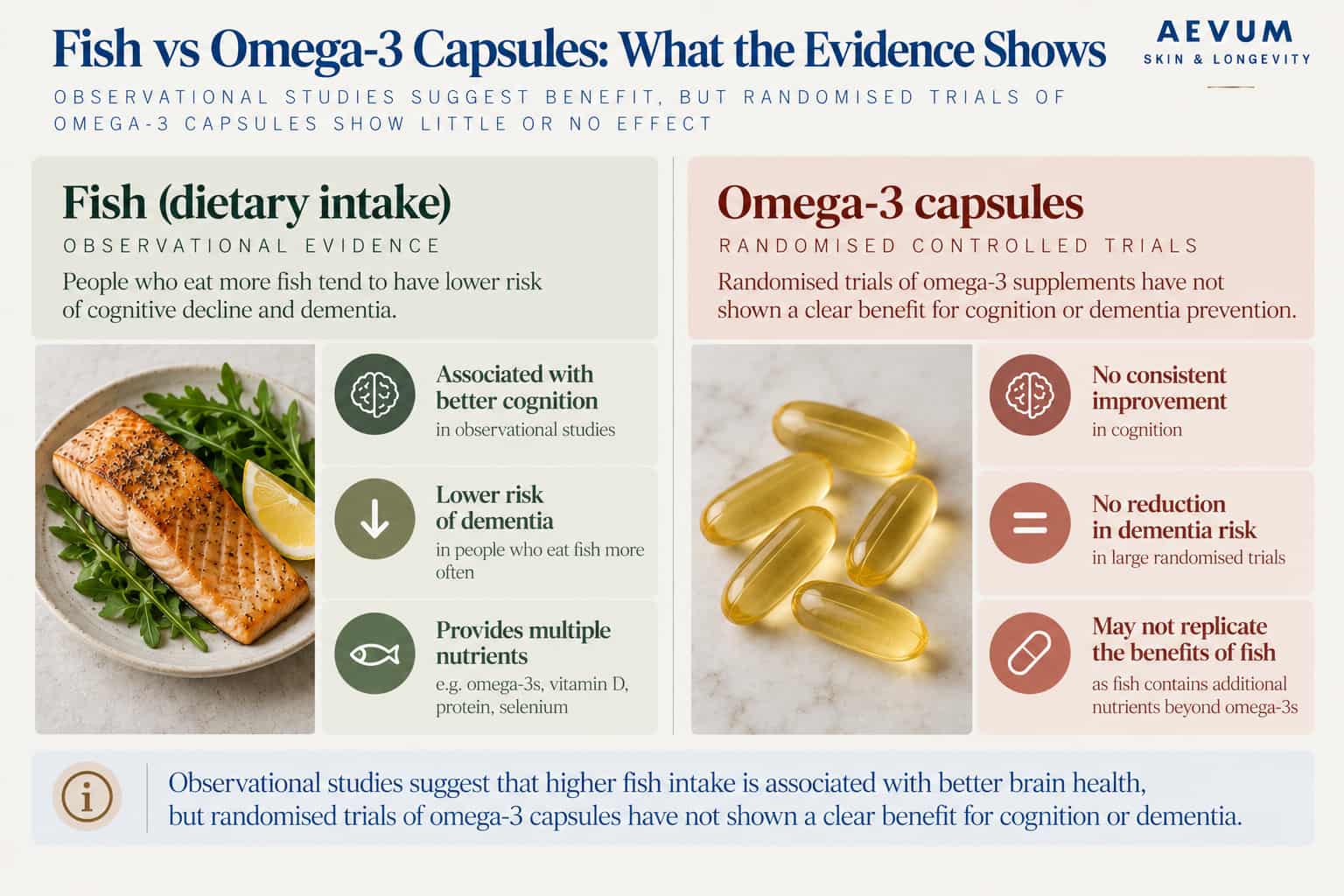
Consistent, but observational: people who eat fish do better. A meta-analysis pooling data from more than 40,000 people found that people who ate fish had about a 20% lower risk of dementia than those who ate little or none (RR 0.80). For Alzheimer's disease, people with the highest fish consumption had about a 33% lower risk (RR 0.67).
Brain imaging points the same way. In the Framingham Heart Study, researchers measured omega-3 levels in the red blood cells of 2,183 people with an average age of 46 and no dementia or stroke. Those with higher levels had larger hippocampal volumes — the brain's key memory structure — and better abstract reasoning. Among carriers of the APOE4 risk gene (see APOE4 and Genetic Risk), higher omega-3 levels were linked to less small-vessel disease.
These findings are consistent, but they are observational. People who eat fish regularly often eat better overall, exercise more and have higher incomes, and fish itself contains more than omega-3s. So these studies show that fish eating goes along with better brain health, not that omega-3 capsules cause it.
Tested in trials, no benefit in healthy older adults. When omega-3s have been given as supplements in randomised trials, the results have been consistently disappointing:
- →Cochrane review (2012): Trials including 3,536 people over 60, lasting six to 40 months, found that those given omega-3 capsules or spreads did no better than those on placebo on memory, verbal fluency or overall mental-state tests.
- →VITAL (2022): About 3,400 older adults (average age 71) took 1 g/day of fish oil or placebo for two to three years. There was no cognitive benefit, whether cognition was tested by phone or in person.
- →MAPT (2017): 1,680 adults aged 70 and over with memory complaints were assigned to omega-3 (800 mg DHA plus 225 mg EPA daily), a lifestyle programme, both, or placebo for three years. Neither omega-3 alone, the lifestyle programme alone, nor the combination significantly slowed cognitive decline.
Why the gap between observation and trials? Several explanations are plausible, and they aren't mutually exclusive:
- 1Fish is a marker for a healthier life
The observational link may largely reflect everything else that goes with eating fish.
- 2Food isn't a capsule
Fish provides protein, vitamin D, selenium and other nutrients, and often replaces less healthy foods on the plate.
- 3Timing
Omega-3s may matter most over decades, starting in midlife — something short trials in older people can't test. The Cochrane authors noted that their trials were short and saw little decline in either group.
- 4Who was studied
Many trial participants already had reasonable omega-3 intakes. The Cochrane authors suggested future research should focus on people with low intakes, where a supplement might make a difference.
Food vs. supplements
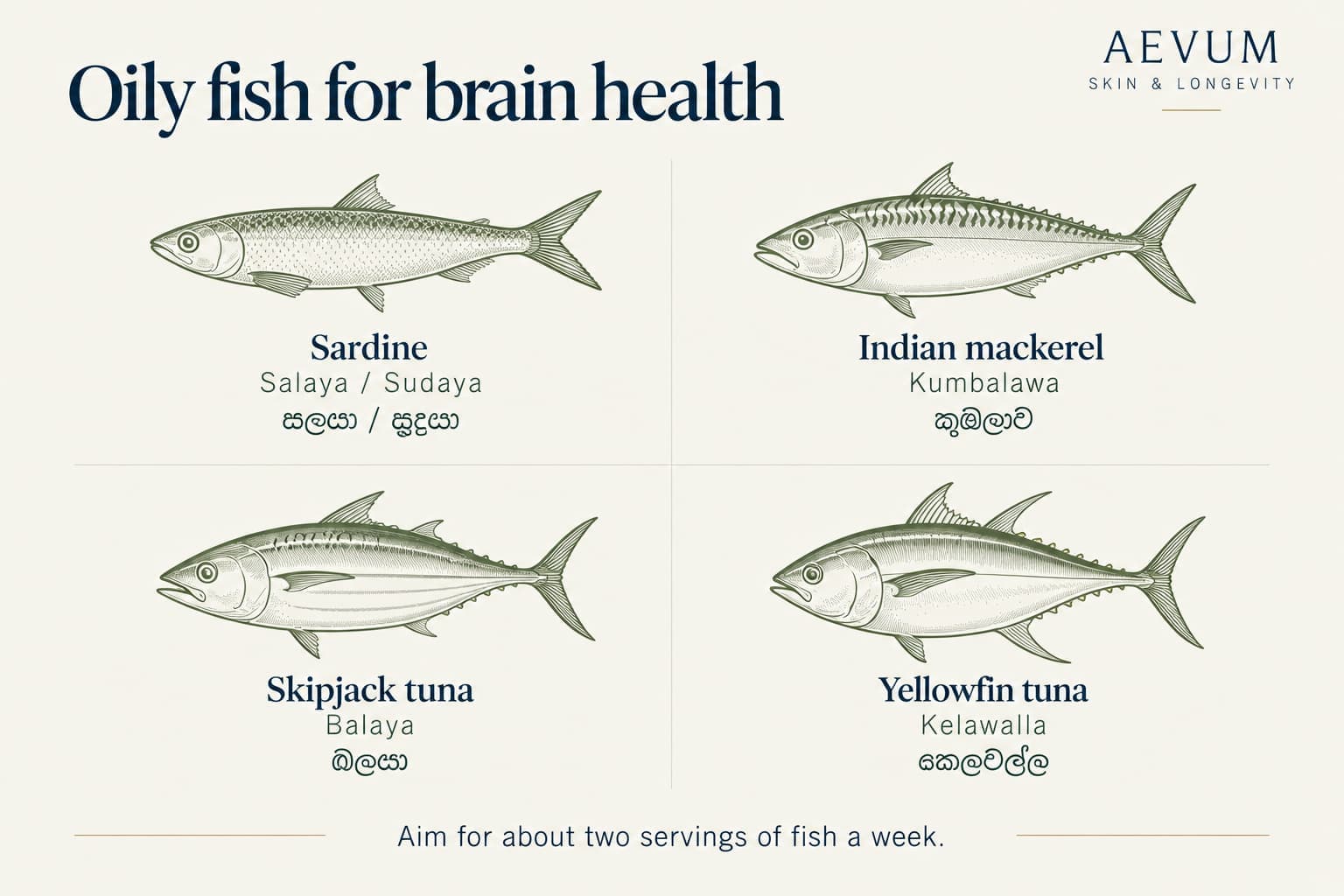
Fish in the diet has the better evidence. The commonly recommended intake is about two servings of fish a week, ideally oily fish. In Sri Lanka, affordable oily options include sardines (salaya / sudaya), Indian mackerel (kumbalawa) and tuna (balaya, kelawalla). Fish is also one of the foods emphasised in the MIND diet, covered in The MIND Diet and Brain Health.
Supplements are a reasonable backup, not a brain-protection strategy. For people who don't eat fish, a supplement is a sensible way to get omega-3s for general health. But on current trial evidence, it shouldn't be expected to protect memory or prevent dementia.
Omega-3s may matter for B vitamins. Some research suggests that omega-3 status affects how well B vitamins work for the brain. That's covered in B Vitamins, Homocysteine, and Brain Aging.
Recommendations by situation
- 1You eat fish regularly
You're already getting the dietary pattern linked to lower dementia risk. There's no trial evidence that adding a supplement on top will help cognition.
- 2You rarely or never eat fish
Aim for about two servings a week, prioritising oily fish. If that isn't possible, a supplement is a reasonable way to get omega-3s, but don't rely on it to protect your memory.
- 3You're already taking fish oil for memory
Current large trials don't support that use. It's worth discussing with your doctor, especially if you take blood thinners.
- 4You have heart disease or high triglycerides
Prescription-strength omega-3s have specific cardiovascular uses. That's a separate question from brain health and should be guided by your doctor.
- 5You're in midlife
The most promising signal — larger hippocampal volume with higher omega-3 levels — comes from people in their 40s. Building a fish-inclusive diet now is more likely to matter than starting capsules at 75.
Practical notes
Omega-3s are a textbook case of a nutrient with real biological importance for the brain and strong observational support, but little evidence that supplements improve thinking in healthy older adults. The practical takeaway is simple: eat fish regularly, especially oily fish, as part of a healthy overall diet, starting well before old age. Treat fish oil capsules as a nutritional backup, not a memory treatment. For more on supplements generally, see Nootropics and Cognitive Enhancers.
- Bakre AT, et al. Association between fish consumption and risk of dementia: a new study from China and a systematic literature review and meta-analysis. Public Health Nutrition, 2018;21(10):1921-1932.
- Satizabal CL, et al. Association of Red Blood Cell Omega-3 Fatty Acids With MRI Markers and Cognitive Function in Midlife: The Framingham Heart Study. Neurology, 2022.
- Sydenham E, Dangour AD, Lim WS. Omega 3 fatty acid for the prevention of cognitive decline and dementia. Cochrane Database of Systematic Reviews, 2012.
- Kang JH, et al. Marine n-3 fatty acids and cognitive change among older adults in the VITAL randomized trial. Alzheimer's & Dementia: Translational Research & Clinical Interventions, 2022.
- Andrieu S, et al. Effect of long-term omega 3 polyunsaturated fatty acid supplementation with or without multidomain intervention on cognitive function in elderly adults with memory complaints (MAPT): a randomised, placebo-controlled trial. The Lancet Neurology, 2017;16:377-389.
How often do you eat
oily fish in a typical week?
Take the free Aevum Protocol assessment to see how your cognitive longevity and 6 other longevity domains are performing — and get a personalised 90-day plan.
Take the Free Assessment →