Cognitive Longevity
Nootropics and Cognitive Enhancers:
What's Actually Backed by Evidence
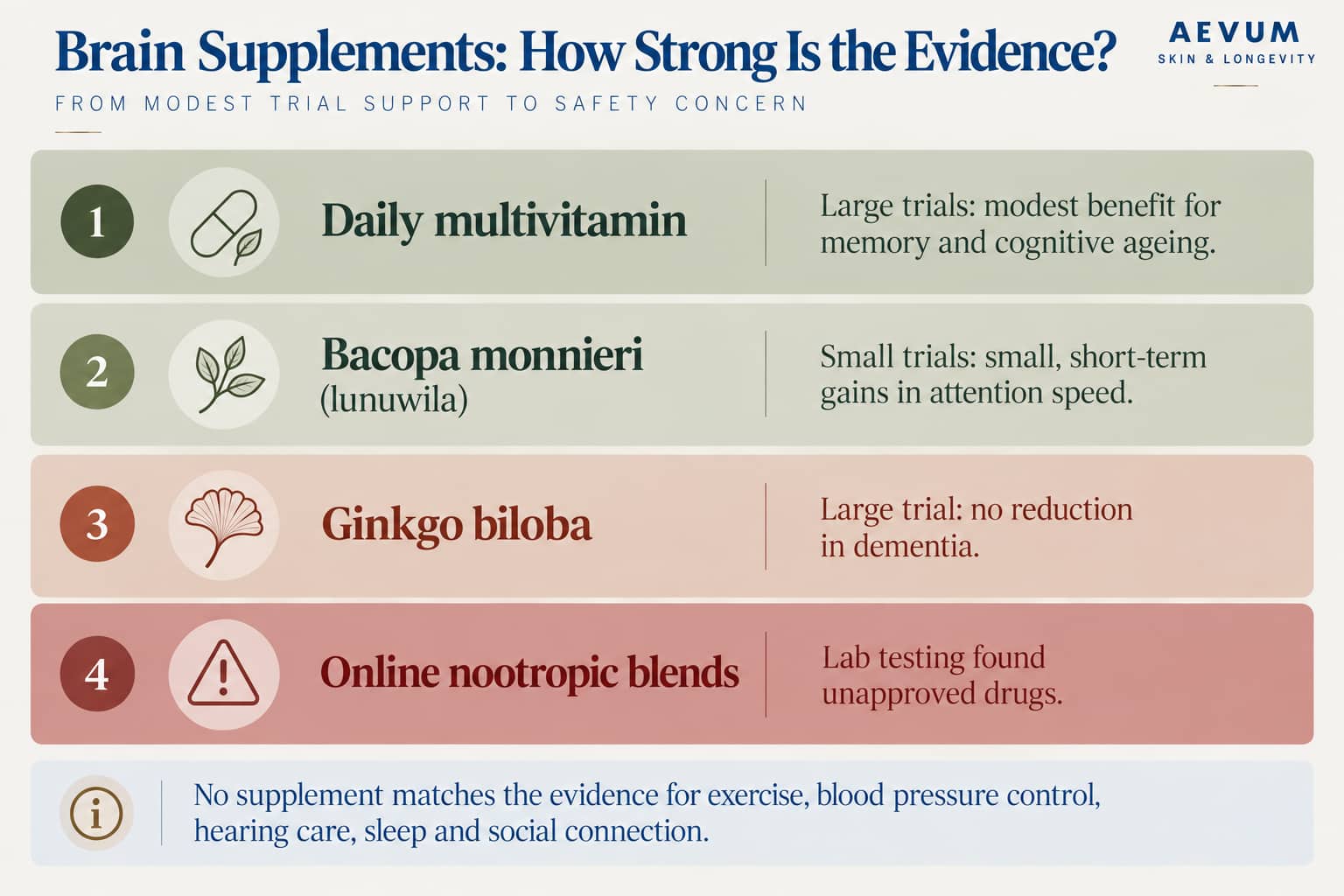
"Nootropics" — supplements and substances sold to sharpen memory, focus or protect the ageing brain — are a large and fast-growing market. The evidence behind them ranges from reasonable to nonexistent, and a few products carry real risks. Some have been tested properly: a daily multivitamin showed a modest benefit in large trials, and the traditional herb Bacopa monnieri (known in Sri Lanka as lunuwila) has small positive trials. Others failed their best test: ginkgo biloba didn't prevent dementia in a large, long trial. One of the best-known memory supplements, Prevagen, was found in court to have unsupported marketing claims. And laboratory testing of "brain-boosting" products has found unapproved drugs, sometimes at doses above prescription levels. This article sorts the main options by the strength of their evidence.
Key numbers
| Finding | Detail |
|---|---|
| Daily multivitamin, 3 COSMOS trials (>5,000 older adults, 2-3 years) | Slowed global cognitive ageing by the equivalent of ~2 years vs. placebo |
| Bacopa monnieri, meta-analysis (9 trials, 518 people, ≥12 weeks) | Small improvements in speed of attention and reaction time |
| Ginkgo biloba, GEM trial (3,069 adults aged 75+) | No reduction in dementia: 277 cases on ginkgo vs. 246 on placebo |
| Prevagen, US jury verdict (2024) | Marketing claims lacked competent scientific support; two memory claims found materially misleading |
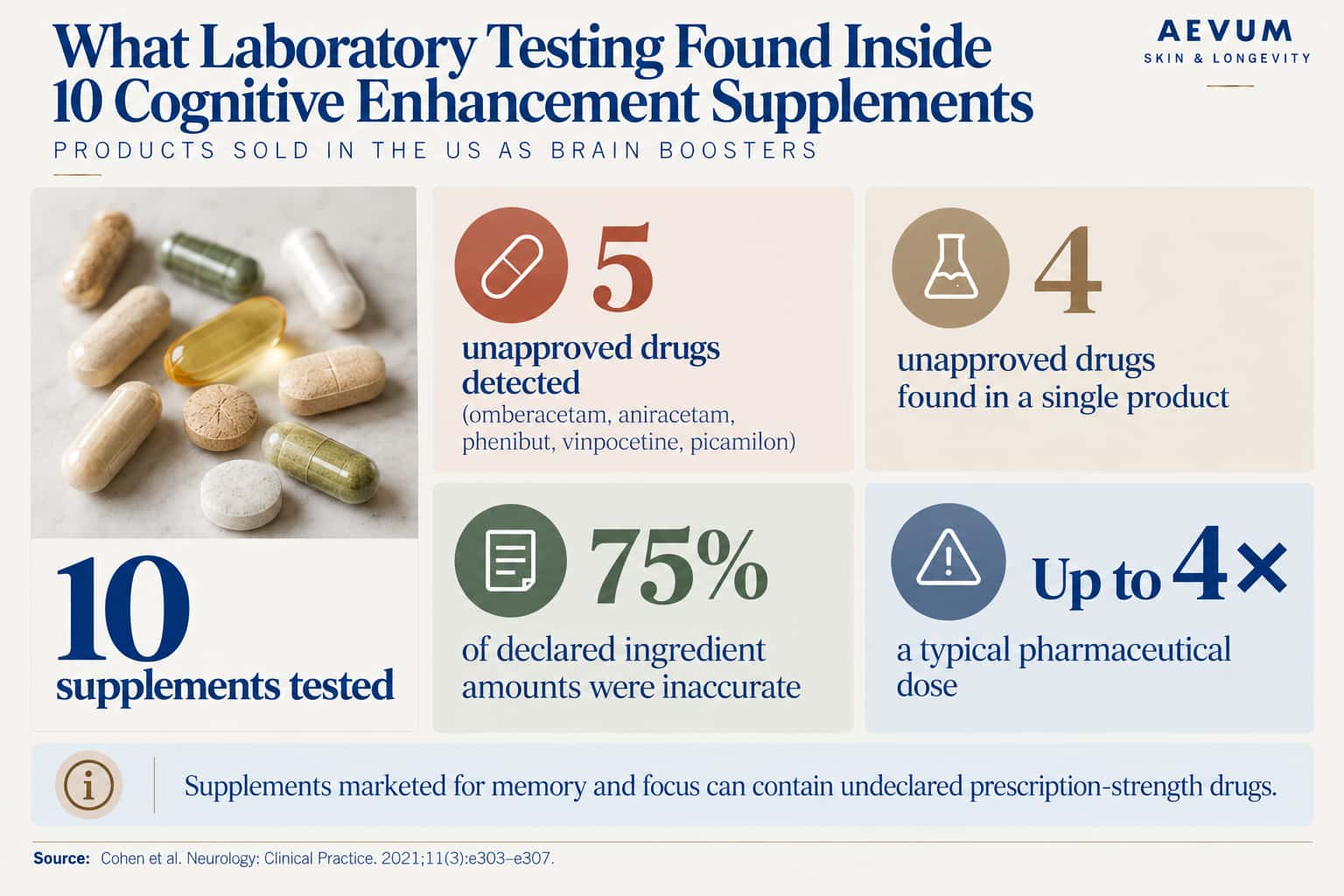
| Lab test of 10 "cognitive enhancement" supplements (2021) | 5 unapproved drugs found; 75% of declared amounts inaccurate; doses up to 4x pharmaceutical levels |
Why supplements are hard to judge
In the US, for example, dietary supplements don't have to prove they work before they're sold, and regulators don't check products before they reach the shelf. That leaves a lot of room between what's marketed and what's been shown. When evaluating any brain supplement, three questions matter:
- →Has it been tested in a randomised, placebo-controlled trial in people like you? Lab and animal studies don't count.
- →What was measured? A faster reaction time in a lab task is very different from a lower risk of dementia.
- →Is the product you're buying the same as the one tested? Doses, extracts and quality vary widely.
Evidence strength
Some trial support, modest effect: daily multivitamin. The COSMOS study, one of the largest trials of its kind, tested an ordinary daily multivitamin against placebo in older adults. In a clinic-based subgroup of 573 people followed for two years, the multivitamin gave a modest benefit for global cognition and a statistically significant benefit for episodic memory, but not for executive function and attention. When the researchers pooled three COSMOS cognitive studies — more than 5,000 participants over two to three years — they estimated that the multivitamin slowed global cognitive ageing by the equivalent of about two years compared with placebo.
This is among the better evidence for any brain supplement, but it should be kept in proportion. The effects are modest, part of the benefit may come from correcting mild nutrient shortfalls (which a varied diet can also address), and the multivitamin and placebo tablets were donated by a supplement manufacturer (the trial also received a grant from a food company). The trial tested a standard, inexpensive multivitamin — not a specialised "brain formula".
Small, early support: Bacopa monnieri (lunuwila). Bacopa monnieri is a creeping wetland herb long used in Ayurvedic medicine and known in Sri Lanka as lunuwila (ලුනුවිල). A meta-analysis of nine randomised controlled trials with 518 participants, each lasting at least 12 weeks with standardised extracts, found small but statistically significant improvements in speed of attention, including faster choice reaction time. The reviewers rated the trials as good quality, but concluded that a large, well-designed trial is needed before its efficacy can be considered established.
So Bacopa has more genuine trial evidence than most herbal nootropics, but the benefits measured so far are small, short-term changes in lab tests of speed and attention. It hasn't been shown to prevent cognitive decline or dementia, and products vary in extract quality.
Tested and failed: ginkgo biloba. Ginkgo is one of the most widely sold memory supplements, which makes its best trial especially important. The Ginkgo Evaluation of Memory (GEM) study randomised 3,069 adults aged 75 and over, with normal cognition or mild cognitive impairment, to 120 mg of ginkgo extract twice daily or placebo, and followed them for several years. There was no difference in the rate of dementia or Alzheimer's disease between the groups: 277 people on ginkgo developed dementia, compared with 246 on placebo. Ginkgo may also increase bleeding risk, which matters for people on blood thinners.
Marketing outran the evidence: Prevagen. Prevagen, which contains a protein originally found in jellyfish (apoaequorin), has been heavily marketed in the US as a memory supplement. The US Federal Trade Commission and the New York Attorney General sued its makers over its claims. In 2024, a jury found that the company's claims to have scientific proof were not supported by competent and reliable scientific evidence, and that two statements — that Prevagen "reduces memory problems associated with aging" and is "clinically shown" to do so — were materially misleading. A court ordered the company to stop making the deceptive claims. The case was under appeal as of early 2026.
Safety concern: "nootropic" blends with hidden drugs. A 2021 study in Neurology: Clinical Practice tested 10 supplements marketed for cognitive enhancement. It found five drugs not approved for use in the US — omberacetam, aniracetam, phenibut, vinpocetine and picamilon — including one product containing three and another containing four. Some combinations could expose people to up to four times a typical pharmaceutical dose, and 75% of the quantities declared on labels were inaccurate. Several of these substances are prescription drugs in other countries, and some have known risks.
Prescription drugs used as "smart drugs". Prescription stimulants and wakefulness drugs are sometimes used off-label to boost focus. These are prescription medicines with side effects and potential for misuse. They haven't been shown to protect the ageing brain, and they shouldn't be taken without a prescription and medical supervision.
What about omega-3s and B vitamins? These two have large evidence bases of their own and are covered in their own articles later in this Evidence Checks section.
How to approach brain supplements
- →Start with the fundamentals. No supplement comes close to the evidence behind exercise, blood pressure control, treating hearing loss, sleep and social connection (see Alzheimer's Disease: Risk Factors You Can Actually Change).
- →If you want to take something, a standard multivitamin has the most support. It's inexpensive, low-risk and has large-trial evidence of a modest benefit in older adults.
- →Be cautious with blends and imported "nootropic stacks". Products combining multiple ingredients, especially those sold online as "smart drugs", carry the highest risk of containing undeclared or unapproved substances.
- →Check for interactions. Ginkgo and several other herbal supplements can interact with blood thinners and other medications. Tell your doctor what you're taking.
- →Be wary of "clinically proven" on the label. As the Prevagen case shows, that phrase can be used without solid evidence behind it.
Recommendations by situation
- 1Healthy adult wanting to protect long-term brain health
Focus on lifestyle foundations. A standard daily multivitamin is a reasonable, low-risk addition, especially for older adults or people with a limited diet.
- 2Interested in traditional herbs such as lunuwila (Bacopa)
Small trials suggest modest short-term effects on attention and processing speed. Choose a standardised extract from a reputable source, and don't expect dementia prevention.
- 3Currently taking ginkgo for memory
The best trial found no dementia prevention. Discuss with your doctor whether it's worth continuing, particularly if you take blood thinners.
- 4Considering online "nootropic" stacks or "smart drugs"
The risk of undeclared or unapproved drugs is real. Avoid them unless recommended and supervised by a doctor.
- 5Worried about memory right now
Get a proper assessment rather than self-treating with supplements — some causes of memory problems are treatable.
For what a proper memory assessment involves, see Mild Cognitive Impairment.
Practical notes
The nootropics market is a clear case of marketing moving much faster than evidence. The honest ranking: a standard multivitamin has modest large-trial support; Bacopa has small early trials; ginkgo failed its main test; some heavily marketed products have been found in court to overstate their claims; and some "brain boosters" contain unapproved drugs. For most people, the money and attention are better spent on the lifestyle factors with much stronger evidence behind them.
- Vyas C, et al. Effect of multivitamin-mineral supplementation versus placebo on cognitive function: results from the clinic subcohort of the COcoa Supplement and Multivitamin Outcomes Study (COSMOS) randomized clinical trial and meta-analysis of 3 cognitive studies within COSMOS. American Journal of Clinical Nutrition, 2024;119(3):692-701.
- Kongkeaw C, et al. Meta-analysis of randomized controlled trials on cognitive effects of Bacopa monnieri extract. Journal of Ethnopharmacology, 2014;151:528-535.
- DeKosky ST, et al. Ginkgo biloba for prevention of dementia: a randomized controlled trial. JAMA, 2008;300(19):2253.
- Cohen PA, et al. Five Unapproved Drugs Found in Cognitive Enhancement Supplements. Neurology: Clinical Practice, 2021;11(3):e303-e307.
- US Federal Trade Commission. Statement on FTC's Win in Lawsuit Against the Makers of Dietary Supplement Prevagen. December 2024.
Are you taking any
supplements for your brain?
Take the free Aevum Protocol assessment to see how your cognitive longevity and 6 other longevity domains are performing — and get a personalised 90-day plan.
Take the Free Assessment →