Nutrition & Metabolism
The Mediterranean Diet:
What It Is, What You Eat and Why It Leads the Evidence
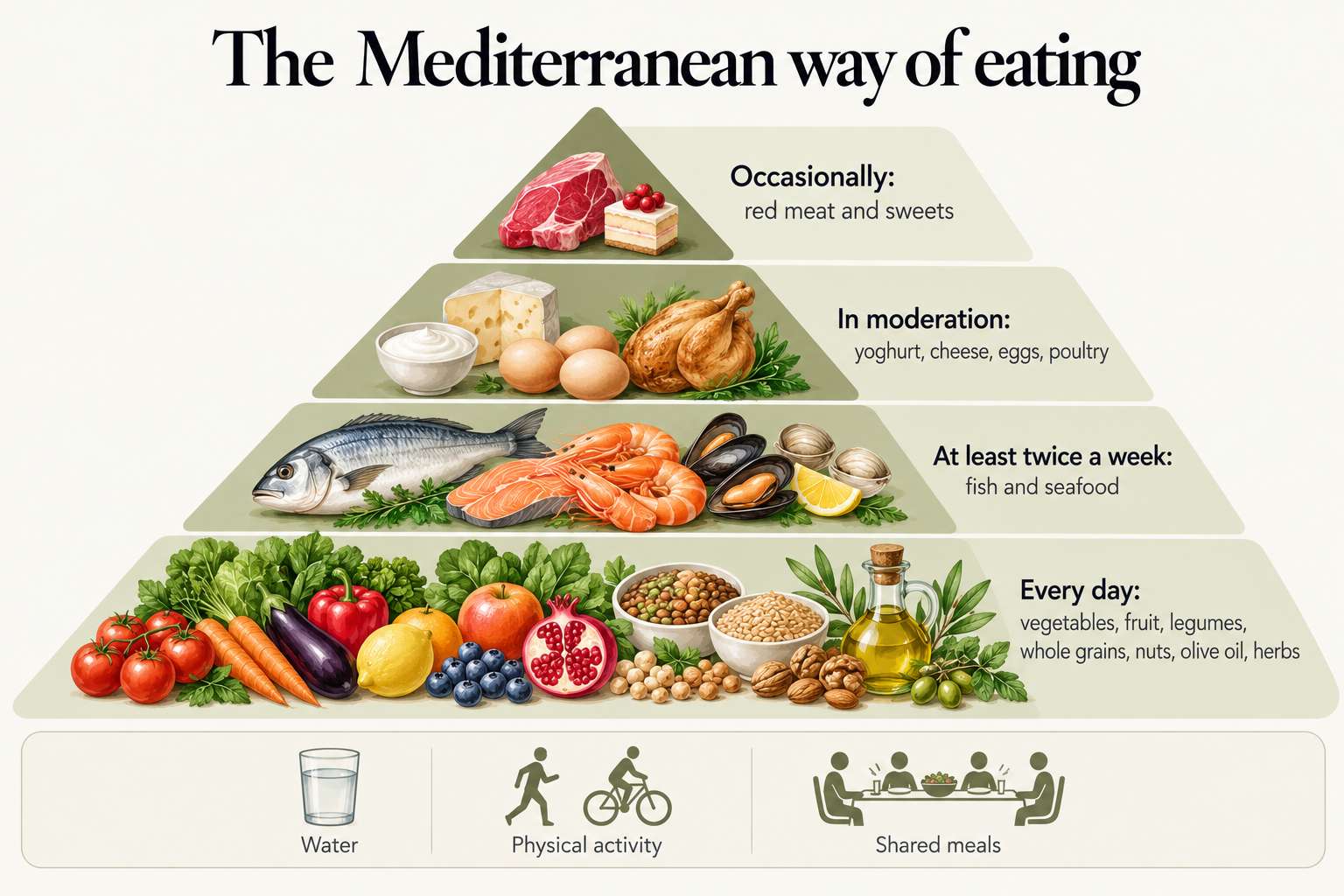
The Mediterranean diet is based on the traditional eating patterns of countries around the Mediterranean Sea, such as Greece, southern Italy and Spain. It's built on vegetables, fruit, legumes, whole grains, nuts and seeds, with extra virgin olive oil as the main fat, fish and seafood several times a week, moderate amounts of dairy, eggs and poultry, and little red or processed meat or sweets. It has more high-quality evidence behind it than any other named diet. In the Spanish PREDIMED trial of 7,447 adults at high cardiovascular risk, a Mediterranean diet supplemented with olive oil or nuts reduced heart attacks, strokes and cardiovascular deaths by about 30% compared with a low-fat diet. In the CORDIOPREV trial of 1,002 people with heart disease, it cut repeat cardiovascular events by about 25% over seven years. A substudy of PREDIMED found about 52% fewer new cases of type 2 diabetes, without weight loss. In more than 25,000 US women followed for 25 years, those who followed it most closely had a 23% lower risk of death. It's also linked to lower dementia risk. It isn't a strict or restrictive diet but a flexible eating pattern that can be adapted to any cuisine, including Sri Lankan food. This article explains what it is, what you eat, what the evidence shows, its limitations and how to follow it in Sri Lanka.
Key numbers
| Finding | Detail |
|---|---|
| PREDIMED (7,447 adults at high risk) | About 30% fewer heart attacks, strokes and cardiovascular deaths vs low-fat diet |
| CORDIOPREV (1,002 people with heart disease, 7 years) | About 25% fewer repeat cardiovascular events vs low-fat diet |
| Lyon Diet Heart Study (heart attack survivors) | Cardiac deaths and heart attacks: 14 vs 44 over about 4 years |
| PREDIMED-Reus (418 adults without diabetes) | About 52% fewer new cases of type 2 diabetes, with no weight loss |
| Women's Health Study (25,000+ women, 25 years) | 23% lower risk of death with highest adherence |
| UK Biobank (60,298 adults) | Up to 23% lower dementia risk with highest adherence |
What it is
The Mediterranean diet was first described by researchers in the 1950s and 1960s, most famously the American physiologist Ancel Keys, who noticed low rates of heart disease in parts of southern Europe despite limited access to medical care. In 2010, UNESCO recognised the Mediterranean diet as part of the cultural heritage of several Mediterranean countries.
It's less a set of rules than a pattern of eating, with a few core principles:
- Mostly plants: vegetables, fruit, legumes, whole grains, nuts and seeds form the base of every meal.
- Olive oil as the main fat: especially extra virgin olive oil, used for cooking and dressings.
- Fish and seafood: at least twice a week.
- Moderate dairy, eggs and poultry: mostly yoghurt and cheese.
- Little red and processed meat, and few sweets or refined foods.
- Herbs and spices for flavour rather than salt.
- Shared meals and an active lifestyle.
Traditionally it included moderate red wine with meals, but current evidence doesn't support starting to drink for health (see Alcohol and Longevity).
What you eat
| Food group | How often | Examples |
|---|---|---|
| Vegetables and fruit | Every meal | Leafy greens, tomatoes, onions, gourds, seasonal fruit |
| Legumes | Most days | Lentils, chickpeas, beans, dhal |
| Whole grains | Most meals | Whole wheat, oats, brown or red rice |
| Nuts and seeds | Daily, a small handful | Almonds, walnuts, peanuts, cashews, sesame |
| Olive oil or other unsaturated oils | Daily, main fat | Extra virgin olive oil, sesame (gingelly) oil |
| Fish and seafood | At least twice a week | Sardines, mackerel, tuna, prawns |
| Yoghurt, cheese, eggs, poultry | Moderate, a few times a week | Curd, yoghurt, eggs, chicken |
| Red meat | Occasionally, small portions | Beef, mutton, pork |
| Processed meat, sweets, sugary drinks | Rarely | Sausages, cakes, soft drinks |
How it works
The benefits probably come from the whole pattern rather than any single food:
- Healthier fats: replacing saturated and trans fats with unsaturated fats from olive oil, nuts and fish improves blood lipids (see Fats in the Sri Lankan Diet).
- Fibre: from vegetables, legumes and whole grains, supporting gut health and steadier blood sugar.
- Polyphenols: from olive oil, vegetables, fruit, nuts and herbs, with anti-inflammatory and antioxidant effects.
- Omega-3 fats: from fish.
- Less ultra-processed food, sugar and processed meat.
- Lower inflammation and insulin resistance: in the Women's Health Study, markers of inflammation, insulin resistance and body weight explained much of the lower risk of death.
What the evidence shows
Heart disease
PREDIMED was the landmark trial. In Spain, 7,447 adults aged 55-80 at high cardiovascular risk were assigned to a Mediterranean diet with extra virgin olive oil, a Mediterranean diet with nuts, or advice to follow a low-fat diet. The Mediterranean groups had about 30% fewer heart attacks, strokes and cardiovascular deaths. The original 2013 paper was retracted and republished in 2018 after problems were found with randomisation at some sites; a reanalysis that accounted for the 1,588 affected participants found the same results.
CORDIOPREV, published in The Lancet in 2022, assigned 1,002 people with established coronary heart disease, mostly men with an average age of 59.5, to a Mediterranean diet with extra virgin olive oil or a low-fat diet for seven years. There were 87 major cardiovascular events in the Mediterranean group and 111 in the low-fat group, about 25% fewer (hazard ratio 0.745). The trial was supported by olive oil industry foundations.
The earlier Lyon Diet Heart Study in France assigned people who'd survived a first heart attack to a Mediterranean-style diet or a typical "prudent" Western diet. Over an average of 46 months, there were 14 cardiac deaths or non-fatal heart attacks in the Mediterranean group compared with 44 in the control group, equivalent to roughly 50-70% lower risk.
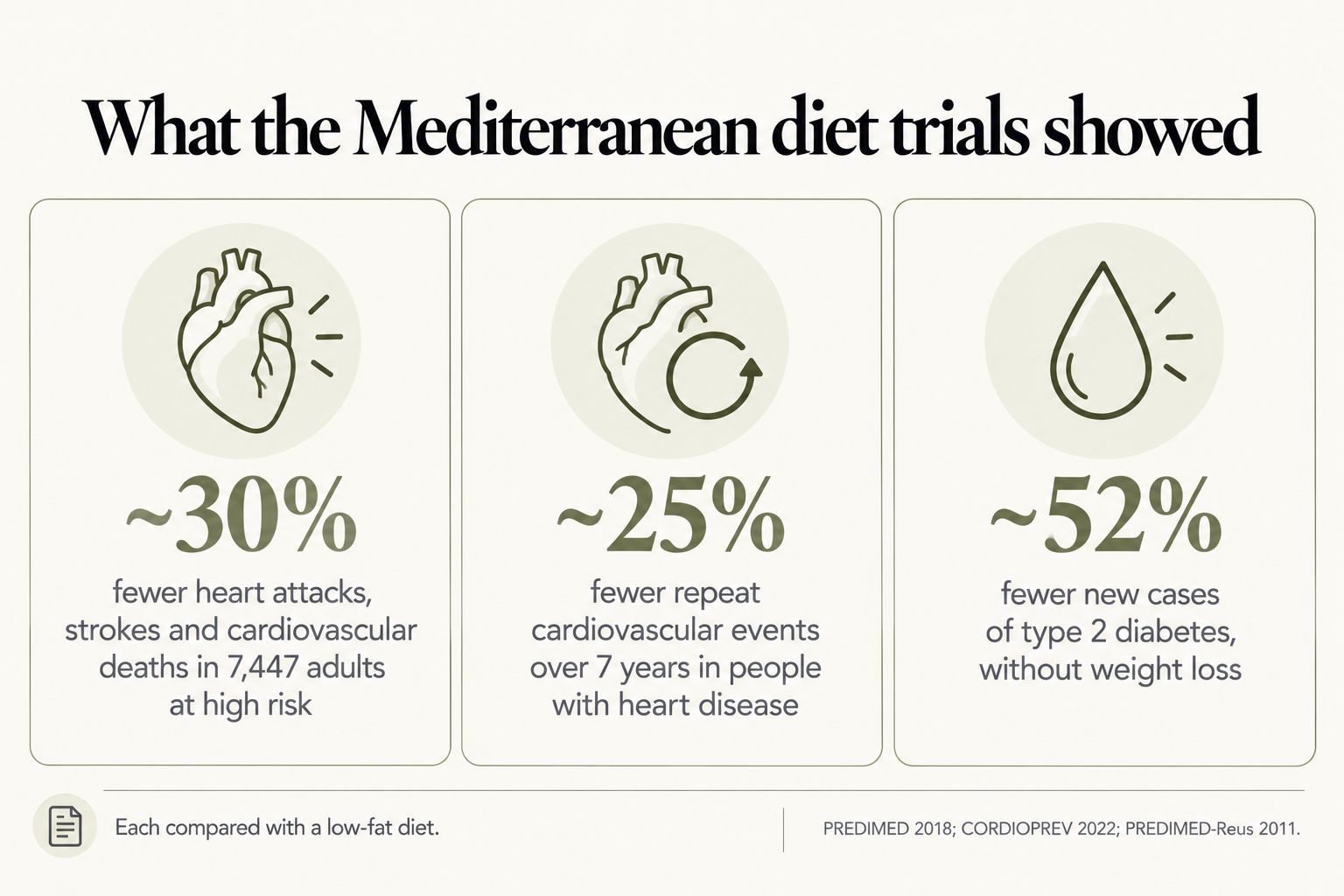
Type 2 diabetes. In the PREDIMED-Reus substudy, 418 adults without diabetes were followed for a median of four years. New diabetes developed in 10.1% of the olive oil group and 11.0% of the nuts group, compared with 17.9% of the low-fat group: about 52% fewer cases. This happened without calorie restriction or weight loss (see Insulin Resistance).
Longevity. In a 2024 study in JAMA Network Open, researchers followed more than 25,000 healthy women from the US Women's Health Study for over 25 years. Those who followed a Mediterranean diet most closely had a 23% lower risk of death from any cause, 17% lower risk of death from cardiovascular disease and 20% lower risk of death from cancer. Differences in inflammation, insulin resistance and body weight explained much of the benefit (see Eating Patterns for Longevity).
Brain health. In a 2023 study in BMC Medicine of 60,298 UK Biobank participants followed for more than nine years, those with the highest adherence to a Mediterranean-style diet had up to 23% lower risk of dementia, regardless of their genetic risk. The study included only white British and Irish participants, so it may not apply to everyone. The related MIND diet combines Mediterranean and DASH principles specifically for brain health (see The MIND Diet and Brain Health).
Weight. The Mediterranean diet isn't primarily a weight-loss diet, but it's filling, sustainable and doesn't cause weight gain despite being relatively high in fat. Weight loss depends mainly on overall calorie intake.
Evidence strength
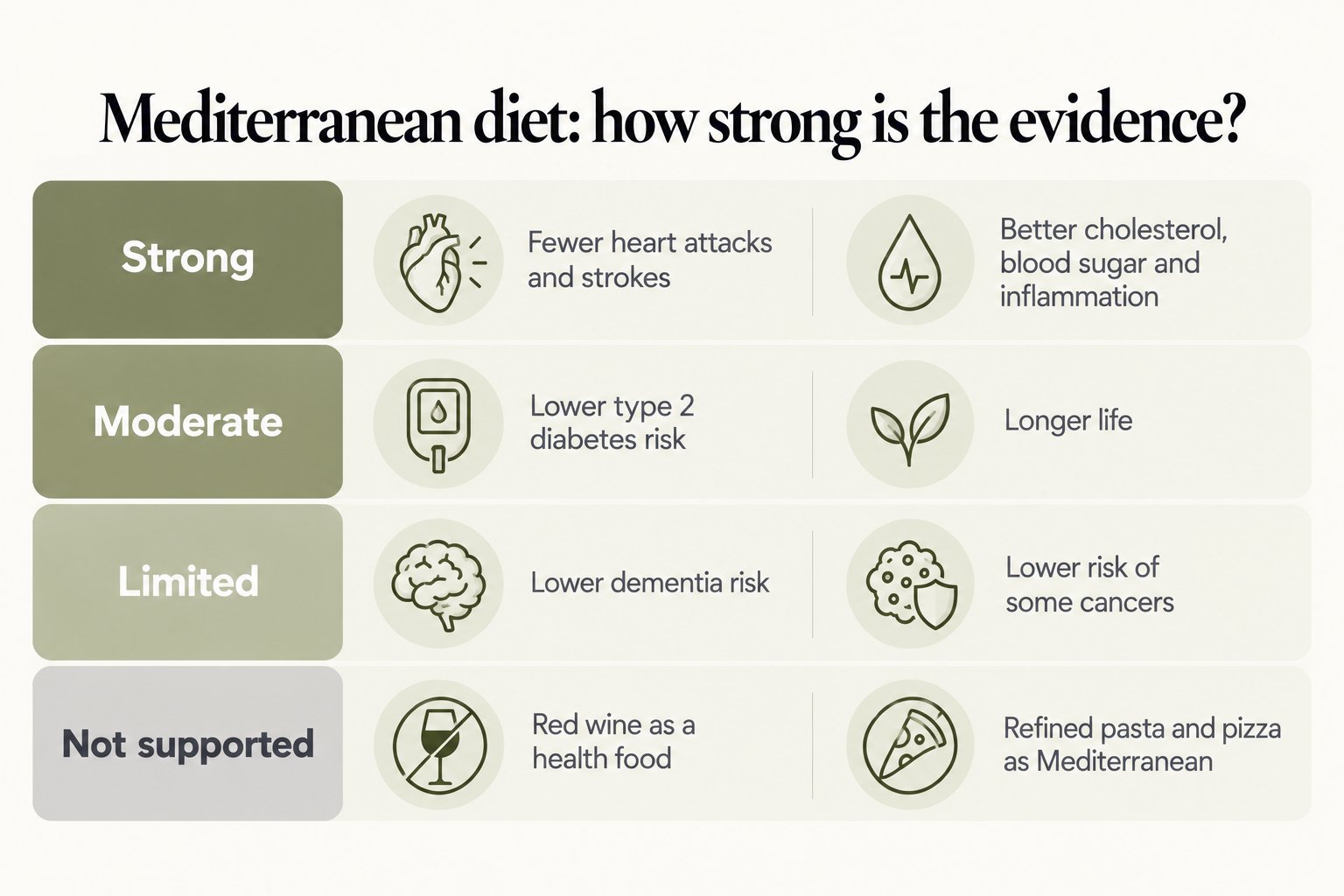
Strong.
- Fewer heart attacks and strokes: two large randomised trials (PREDIMED, CORDIOPREV) and the Lyon Diet Heart Study.
- Better cholesterol, blood sugar and inflammation markers.
Moderate.
- Lower risk of type 2 diabetes: one randomised substudy and consistent observational studies.
- Longer life: consistent large observational studies.
Limited.
- Lower dementia risk: mainly observational studies.
- Lower risk of some cancers: mainly observational studies.
Not supported.
- Red wine as a health food: the benefits don't depend on alcohol.
- Pasta, pizza and bread as "Mediterranean": refined, modern versions of these foods aren't the traditional pattern.
Important limitations.
- The main trials were done in Spain and France, mostly in older adults; there are few trials in South Asian populations.
- Several trials were supported by olive oil or nut industry groups.
- PREDIMED's comparison group followed a low-fat diet less well than intended.
- "Mediterranean diet" is defined slightly differently across studies.
Risks and who should be careful
The Mediterranean diet is safe for almost everyone, including children, pregnant women and older adults. Points to watch:
- Calories: olive oil and nuts are calorie-dense, so portions matter if you're trying to lose weight.
- Cost: olive oil and nuts can be expensive in Sri Lanka; local alternatives work well.
- Alcohol: not needed; avoid if you don't already drink, and avoid entirely in pregnancy, liver disease and with some medicines.
- Fish: choose smaller fish to reduce mercury, especially in pregnancy (see Meat, Fish and Eggs).
- Kidney disease or on blood thinners: discuss with your doctor, as potassium or vitamin K intake may need attention.
A Sri Lankan version
You don't need to eat Greek food to follow the Mediterranean diet. Many Sri Lankan dishes already fit its principles:
- Base: plenty of vegetable curries, mallung with gotukola, mukunuwenna or kankun, and salads.
- Legumes: dhal, chickpeas, mung beans, cowpeas and green gram most days (see Know Your Legumes).
- Grains: red or brown rice, kurakkan or whole wheat, in moderate portions.
- Fish: sardines (salaya), mackerel (kumbalawa), tuna (balaya) and other sea fish, curried or grilled rather than deep-fried.
- Fats: use olive oil, gingelly (sesame) oil or other unsaturated oils for some cooking; use coconut and coconut milk in moderation.
- Nuts and seeds: a small handful of peanuts, cashews or sesame seeds.
- Fruit: papaya, guava, mango, banana and seasonal fruit for dessert.
- Limit: fried short eats, processed meats, sweets, sugary tea and soft drinks.
See Building a Longevity Plate for a practical rice-and-curry guide.
Why this matters for longevity
No other named diet has as much high-quality evidence for preventing heart disease, the leading cause of death worldwide, as the Mediterranean diet. It's also linked to lower risk of diabetes, dementia and early death, and it's flexible, enjoyable and sustainable for life. Its principles, mostly plants, healthy fats, fish and legumes, few processed foods, are shared by almost every eating pattern linked to healthy ageing. For most people, it's the best starting point.
Recommendations by situation
| Situation | What to consider |
|---|---|
| Healthy adult wanting to eat for longevity | A Mediterranean-style pattern adapted to Sri Lankan food is an excellent default |
| Heart disease or high cardiovascular risk | Strongly recommended; strongest trial evidence of any diet |
| Prediabetes or type 2 diabetes | Recommended; watch rice portions and choose whole grains |
| Wanting to lose weight | Works well with smaller portions; watch oil and nut quantities |
| Worried about memory or dementia | Mediterranean or MIND-style eating |
| Pregnant or breastfeeding | Safe and recommended; avoid alcohol and high-mercury fish |
| Vegetarian | Easily adapted with more legumes, nuts, dairy and eggs |
| On a tight budget | Use local oils, legumes, seasonal vegetables and small fish |
Practical notes
Start with a few swaps rather than a complete change: add a vegetable curry or mallung to every meal, have dhal or another legume daily, switch some cooking to olive or gingelly oil, eat fish twice a week, snack on a small handful of nuts, and choose fruit over sweets. Keep red and processed meat occasional. The details matter less than the overall pattern, and the best version is one you enjoy and can keep up for life. Our Longevity Doctors can help you adapt a Mediterranean-style diet to your health, preferences and Sri Lankan food, starting with the free longevity assessment.
- Estruch R, et al. Primary prevention of cardiovascular disease with a Mediterranean diet supplemented with extra-virgin olive oil or nuts. New England Journal of Medicine, 2018;378(25):e34.
- Delgado-Lista J, et al. Long-term secondary prevention of cardiovascular disease with a Mediterranean diet and a low-fat diet (CORDIOPREV): a randomised controlled trial. The Lancet, 2022;399(10338):1876-1885.
- de Lorgeril M, et al. Mediterranean diet, traditional risk factors, and the rate of cardiovascular complications after myocardial infarction: final report of the Lyon Diet Heart Study. Circulation, 1999;99(6):779-785.
- Salas-Salvadó J, et al. Reduction in the incidence of type 2 diabetes with the Mediterranean diet: results of the PREDIMED-Reus nutrition intervention randomized trial. Diabetes Care, 2011;34(1):14-19.
- Ahmad S, et al. Mediterranean diet adherence and risk of all-cause mortality in women. JAMA Network Open, 2024;7(5):e2414322.
- Shannon OM, et al. Mediterranean diet adherence is associated with lower dementia risk, independent of genetic predisposition: findings from the UK Biobank prospective cohort study. BMC Medicine, 2023;21:81.
Free longevity assessment
Want a Mediterranean-style plan
for Sri Lankan food?
Take the free Aevum Protocol assessment to see how your nutrition & metabolism and 6 other longevity domains are performing — and get a personalised 90-day plan.
Take the free assessmentKeep reading