Nutrition & Metabolism
Alcohol and Longevity:
Why the 'Healthy Drink' Idea Doesn't Hold Up
For decades, many people believed that a drink a day, especially red wine, was good for the heart. Newer evidence has overturned that idea. A 2023 analysis of 107 studies with more than 4.8 million people found that low-volume drinkers didn't live longer than lifetime non-drinkers once the studies' biases were corrected; earlier studies often counted former heavy drinkers who had quit because of illness as "non-drinkers", making moderate drinking look protective. A 2018 Lancet analysis of nearly 600,000 drinkers found that death rates were lowest at about 100 grams of alcohol a week or less, and that drinking more than 350 grams a week at age 40 was linked to 4-5 fewer years of life. Alcohol is a Group 1 carcinogen that causes at least seven types of cancer, and the World Health Organization states that no level of drinking is safe for health. In Sri Lanka, about half of men drink, and 14% of male drinkers drink heavily. This article explains how alcohol affects long-term health and practical ways to cut down.
Key numbers
| Finding | Detail |
|---|---|
| Low-volume drinking and death (107 studies, 4.8 million people) | No lower risk than lifetime non-drinkers; higher risk from about 25 g a day for women and 45 g for men |
| Life expectancy at 40 by weekly drinking (599,912 drinkers, 83 studies) | About 6 months shorter at 100-200 g; 1-2 years at 200-350 g; 4-5 years above 350 g |
| Alcohol and cancer (WHO) | Group 1 carcinogen; at least 7 cancer types; about half of alcohol-related cancers in Europe in light to moderate drinkers |
| Drinking in Sri Lanka (6,473 adults, 2018-2019) | 53.1% of men and 2.0% of women drink; 14.1% of male drinkers drink heavily (21+ units a week) |
| WHO position | "No level of alcohol consumption is safe for our health" |
How alcohol affects the body
Alcohol (ethanol) is broken down mainly in the liver into acetaldehyde, a toxic compound that damages DNA. Alcohol affects almost every organ:
- Liver: fatty liver, hepatitis and cirrhosis (see Fatty Liver Disease (MASLD)).
- Heart and circulation: high blood pressure, atrial fibrillation, heart failure and stroke (see Atrial Fibrillation).
- Cancer: of the mouth, throat, oesophagus, liver, bowel and breast.
- Brain: memory problems, brain shrinkage and dementia with heavy use; disrupted sleep even at moderate levels.
- Metabolism: extra calories, weight gain and raised triglycerides.
- Mental health: depression, anxiety and dependence.
The problem with "moderate drinking is good for you"
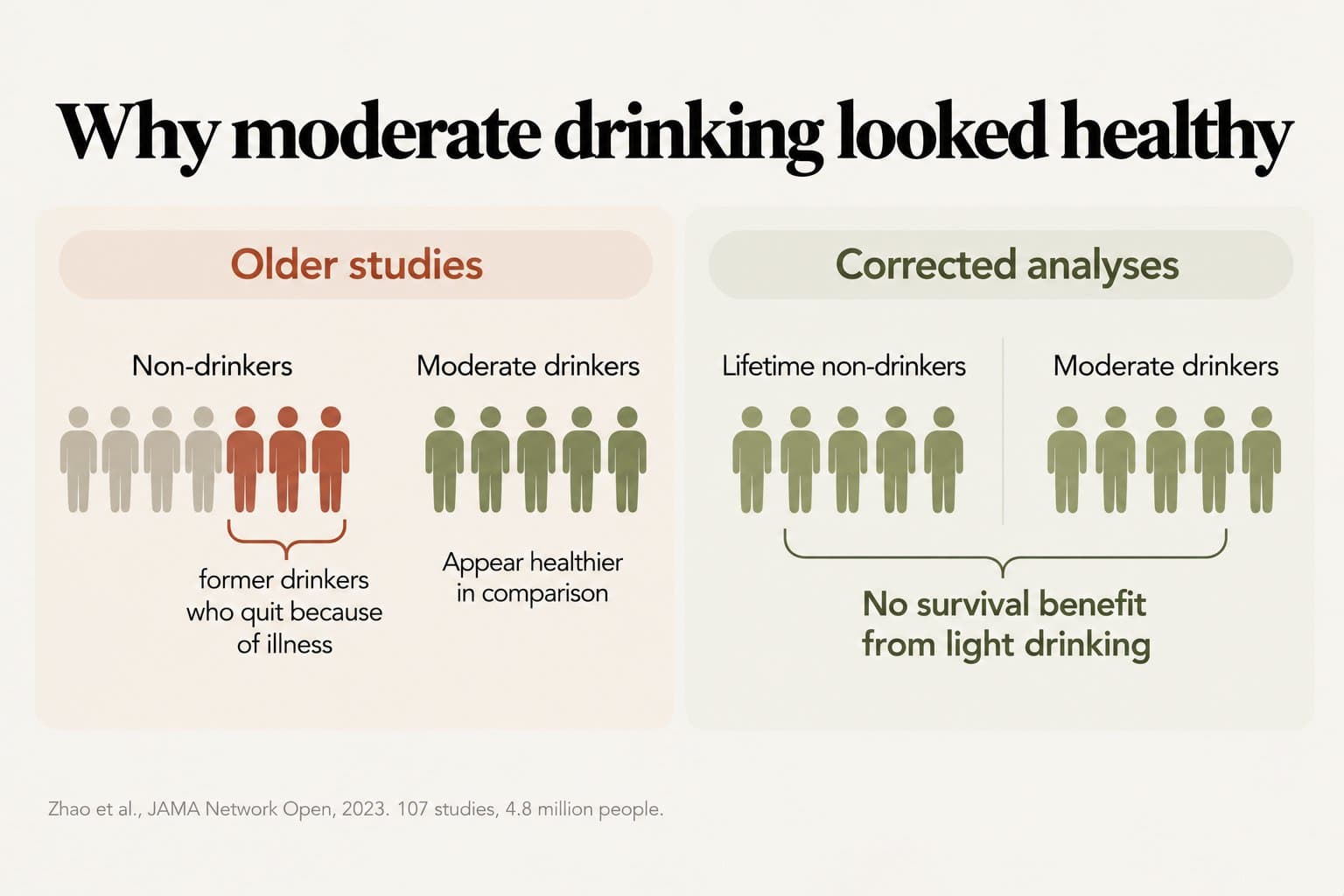
Many older studies found a "J-shaped curve": moderate drinkers seemed to live longer than non-drinkers. But non-drinkers often included former drinkers who had stopped because they were already ill, and people who don't drink may differ in income, health and lifestyle. A 2023 meta-analysis in JAMA Network Open reanalysed 107 studies covering more than 4.8 million people, correcting for these biases. It found no reduced risk of death in occasional or low-volume drinkers compared with lifetime non-drinkers. Risk rose significantly from about 25 grams a day in women and 45 grams in men, with women at higher risk than men at the same intake.
What the research shows
Drinking and life expectancy. A 2018 Lancet study combined data on 599,912 current drinkers from 83 prospective studies. The risk of death from any cause was lowest at about 100 grams of alcohol a week or less, roughly 10 standard drinks of 10 grams. Higher drinking was linked to higher risks of stroke and heart failure. Compared with drinking less than 100 grams a week, a 40-year-old drinking:
- 100-200 grams a week could expect about 6 months shorter life expectancy.
- 200-350 grams a week, about 1-2 years shorter.
- More than 350 grams a week, about 4-5 years shorter.
Experts commenting on the study noted that any apparent heart attack benefit was outweighed by higher risks of other cardiovascular diseases and death.
Bar chart, alcohol and life expectancy: shorter life expectancy at age 40 compared with drinking less than 100 g a week was about 6 months at 100-200 g a week, 1-2 years at 200-350 g and 4-5 years above 350 g (Wood et al., The Lancet, 2018, 599,912 drinkers, 83 studies)
Alcohol and cancer. The World Health Organization classifies alcohol as a Group 1 carcinogen, the same category as tobacco and asbestos. It causes at least seven types of cancer, including breast and bowel cancer. In a 2023 statement in The Lancet Public Health, WHO noted that about half of alcohol-attributable cancers in Europe occur in people who drink at light to moderate levels, and that no safe threshold has been identified. As a WHO Europe official put it, "the risk to the drinker's health starts from the first drop."
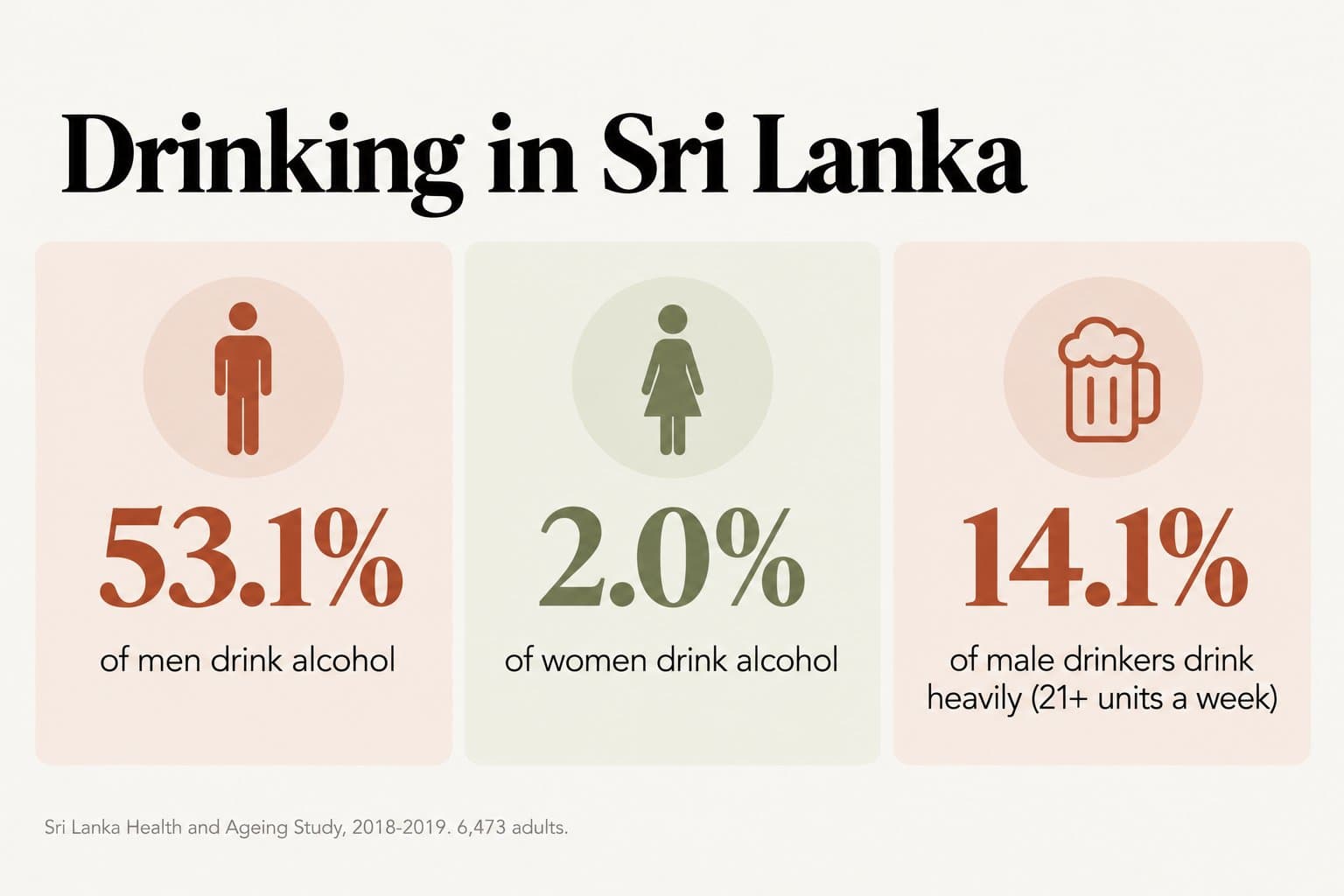
Drinking in Sri Lanka. The Sri Lanka Health and Ageing Study surveyed 6,473 adults in 2018-2019. About 26% of adults drank alcohol in the past year: 53.1% of men but only 2.0% of women. Among men who drank, 14.1% drank heavily, 21 or more units a week. Illicit and home-brewed alcohol, such as kasippu, adds further risks because its strength and purity vary.
When alcohol harms most
| Factor | Effect | Modifiable? | Evidence strength |
|---|---|---|---|
| Drinking more than about 100 g a week | Shorter life expectancy; higher stroke, heart failure and cancer risk | Yes | Strong |
| Binge drinking | Injuries, heart rhythm problems, alcohol poisoning | Yes | Strong |
| Any regular drinking | Raised risk of breast, bowel and other cancers | Yes | Strong |
| Female sex | Higher risk at the same intake | No | Moderate |
| Liver disease, atrial fibrillation or high blood pressure | Alcohol worsens these conditions | Yes | Strong |
| Combining alcohol with smoking | Multiplies risk of mouth and throat cancers | Yes | Strong |
| Illicit or home-brewed alcohol | Unknown strength; risk of toxic contaminants | Yes | Moderate |
| Drinking with certain medicines | Dangerous interactions, especially with sedatives | Yes | Strong |
What you can actually change
1. Drink less, and less is better. There's no level of drinking that improves health. If you drink, keeping well below about 100 grams a week (roughly 10 standard drinks) limits risk, and drinking less lowers it further.
2. Don't start drinking for health. If you don't drink, there's no health reason to start.
3. Have alcohol-free days. Several alcohol-free days each week help reduce total intake and dependence.
4. Avoid binge drinking. Spread out any drinks, alternate with water, and eat when you drink.
5. Know your drink sizes. Spirits, beer and wine vary in strength. Arrack and other spirits are around 33-40% alcohol, so standard pours add up quickly.
6. Get help if cutting down is hard. If you drink to cope, need more to feel the effect, or find it hard to stop, talk to a doctor. Effective support and treatments are available.
Recommendations
- Treat alcohol as a risk, not a health food. The heart benefits once claimed don't hold up in better-designed analyses.
- Have your blood pressure, liver function and heart rhythm checked if you drink regularly.
- Avoid alcohol completely in pregnancy, with liver disease, with certain medicines, and before driving.
- Talk to your doctor if you're worried about your drinking.
Practical notes
The belief that moderate drinking is good for you came largely from flawed comparisons with non-drinkers. Better analyses show no survival benefit from light drinking, rising risks above about 100 grams a week and clear cancer risks at any level. For longevity, less alcohol is better, and none is best. Cutting down is one of the most effective changes you can make for your liver, heart, brain and cancer risk.
- Zhao J, et al. Association between daily alcohol intake and risk of all-cause mortality: a systematic review and meta-analyses. JAMA Network Open, 2023;6(3):e236185.
- Wood AM, et al. Risk thresholds for alcohol consumption: combined analysis of individual-participant data for 599,912 current drinkers in 83 prospective studies. The Lancet, 2018;391(10129):1513-1523.
- Anderson BO, et al. Health and cancer risks associated with low levels of alcohol consumption. The Lancet Public Health, 2023;8(1):e6-e7. Reported by WHO Europe, 4 January 2023.
- Epidemiology of alcohol use in Sri Lanka: findings of the SLHAS national survey. 2025. ScienceDirect.
Free longevity assessment
How much do you really drink
in a typical week?
Take the free Aevum Protocol assessment to see how your nutrition & metabolism and 6 other longevity domains are performing — and get a personalised 90-day plan.
Take the free assessmentKeep reading
Related articles
Cardiovascular & Metabolic Health
Fatty Liver Disease (MASLD): The Silent Metabolic Condition That Affects the Heart
Cardiovascular & Metabolic Health
Atrial Fibrillation: The Common Heart Rhythm Problem Linked to Stroke, and How to Lower Your Risk
Nutrition & Metabolism