Longevity Science
The Limits of Human Lifespan:
Are Life Expectancy Gains Slowing, and What About Healthspan?
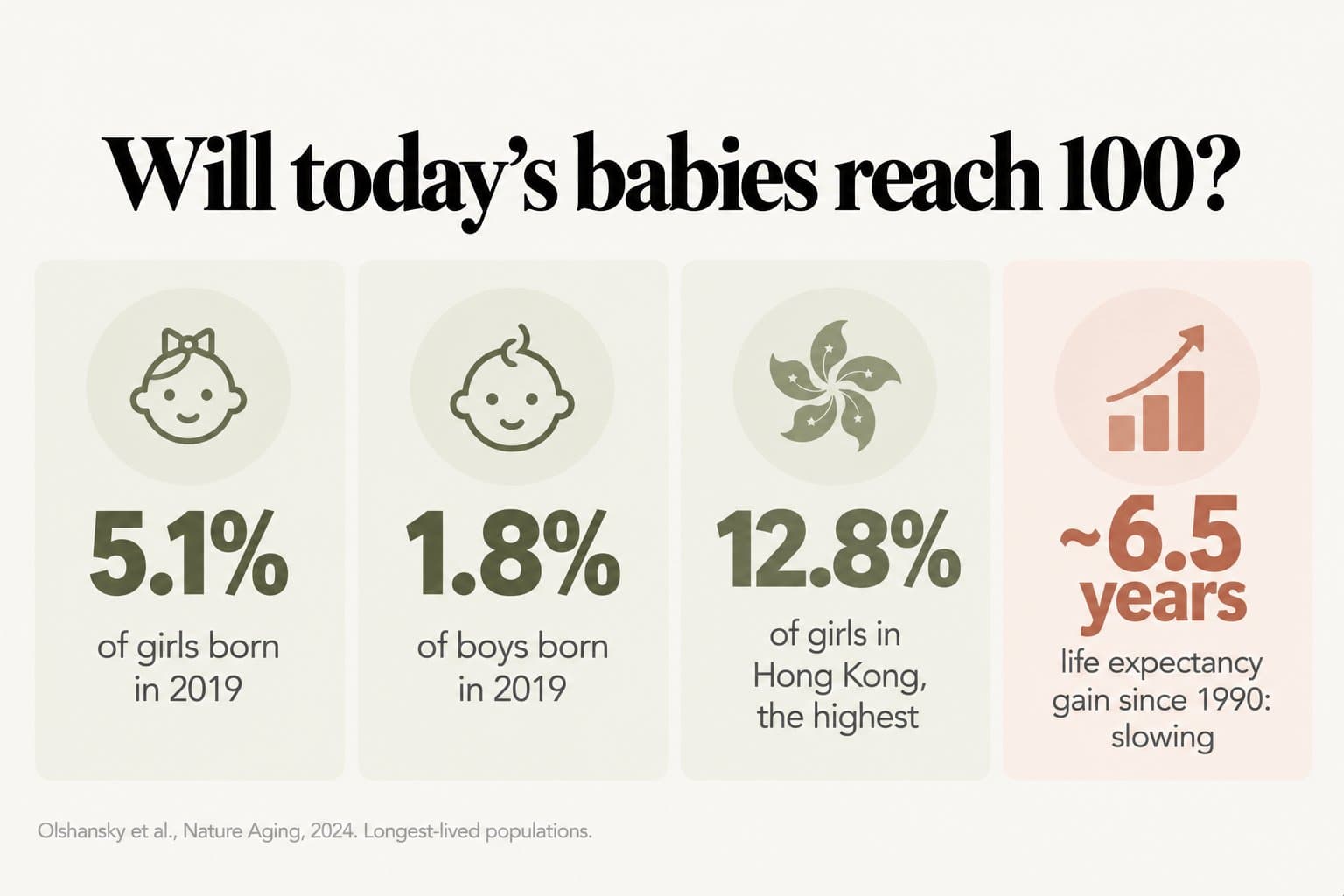
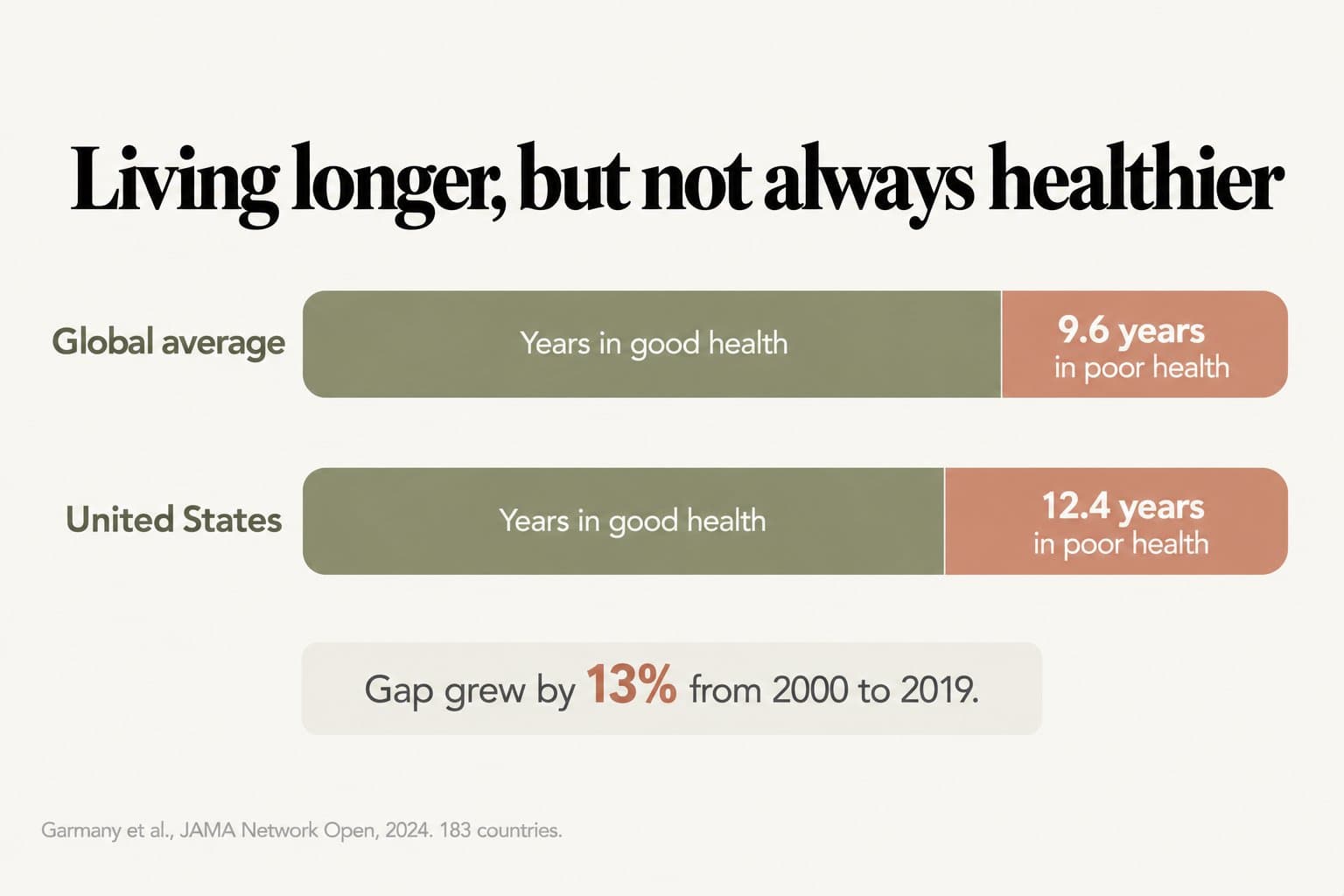
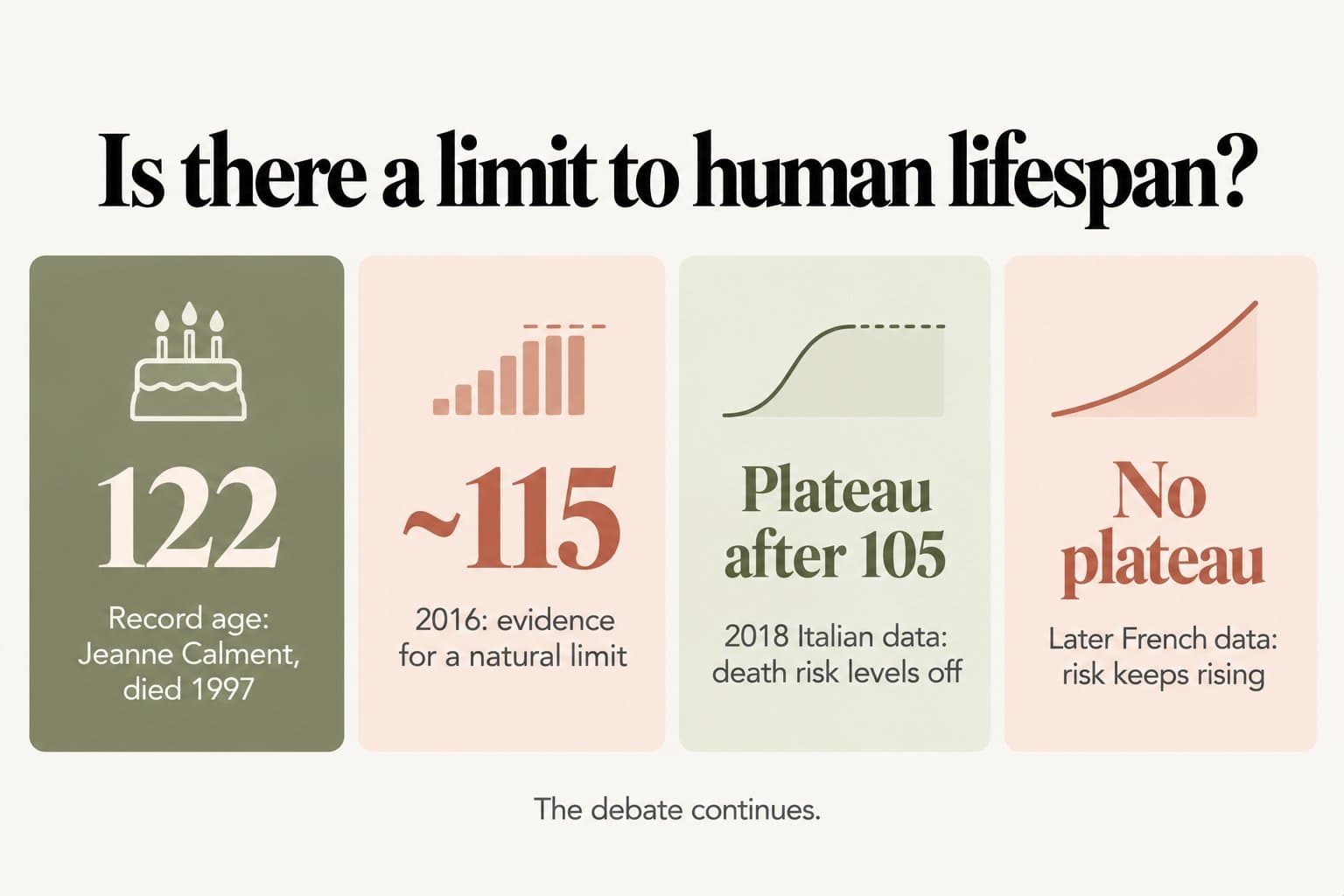
Will today's children routinely live to 100 or beyond? Some longevity enthusiasts say yes; most demographic evidence says not without a breakthrough. The longest verified human life is still that of Jeanne Calment of France, who died in 1997 aged 122 years and 164 days. A 2024 study in Nature Aging, led by S. Jay Olshansky, analysed the world's longest-lived populations and found that life expectancy gains have slowed markedly since 1990. It estimated that only 5.1% of girls and 1.8% of boys born in 2019 in these populations will reach 100. Whether there's a fixed upper limit to the human lifespan is still debated: one 2016 analysis suggested a limit of around 115, while a 2018 Italian study found that the risk of death levels off after 105, and a later French analysis didn't find that plateau. Perhaps more important is the gap between lifespan and healthspan, the years lived in good health. A 2024 analysis of 183 countries found that people spend on average 9.6 years of life in poor health, and that this gap grew by 13% between 2000 and 2019. This article reviews the evidence on how long humans can live and why healthy years may matter more.
Key numbers
| Finding | Detail |
|---|---|
| Longest verified human life | Jeanne Calment, France: 122 years, 164 days (died 1997) |
| Life expectancy gains since 1990 (Olshansky et al., 2024) | About 6.5 years in the longest-lived populations, much slower than in the 20th century |
| Chance of reaching 100 (born 2019) | 5.1% of women and 1.8% of men on average; highest in Hong Kong (12.8% of women, 4.4% of men) |
| Healthspan-lifespan gap (183 countries, 2019) | 9.6 years on average, up 13% since 2000; largest in the US at 12.4 years |
| Women vs men | Women live longer but spend 2.4 more years in poor health |
Lifespan, life expectancy and healthspan
- Maximum lifespan is the longest any individual has lived: 122 years so far.
- Life expectancy is the average number of years a newborn can expect to live, based on current death rates.
- Healthspan is the number of years lived in good health, free of serious disease or disability.
During the 20th century, life expectancy rose dramatically in many countries, mainly because fewer people died young from infections, childbirth and accidents, and later because of better treatment of heart disease. The question now is whether gains can continue at older ages.
Evidence strength
Strong: life expectancy gains have slowed in the longest-lived countries. Olshansky and colleagues analysed death data from 1990 to 2019 for the populations with the highest life expectancy (Australia, France, Italy, Japan, South Korea, Spain, Sweden, Switzerland and Hong Kong) and the United States. Life expectancy rose by an average of only about 6.5 years over that period, much more slowly than in the 20th century. They estimated that only 5.1% of women and 1.8% of men born in 2019 in these populations would reach 100, with Hong Kong highest at 12.8% of women and 4.4% of men. As Olshansky put it, "most people alive today at older ages are living on time that was manufactured by medicine", and medical advances are now producing "incrementally smaller improvements". Some experts are more optimistic: biologist Steven Austad accepted the findings but said, "I'm not so convinced about the predictions of the future," pointing to dozens of trials testing ways to slow ageing.
Strong: the gap between lifespan and healthspan is widening. A 2024 study in JAMA Network Open by Mayo Clinic researchers compared life expectancy with healthy life expectancy in 183 World Health Organization member states. In 2019, people spent on average 9.6 years in poor health at the end of life, 13% more than in 2000. The gap was largest in the United States, at 12.4 years. Women had a gap 2.4 years larger than men, linked to neurological, musculoskeletal and urinary and genital conditions. The authors concluded that "gains in longevity are not matched with equivalent advances in healthy longevity".
Moderate: is there a fixed upper limit? The record of 122 has stood since 1997. A 2016 study in Nature by Xiao Dong, Brandon Milholland and Jan Vijg argued for a natural limit of around 115 years. In contrast, a 2018 study in Science by Elisabetta Barbi and colleagues, using data on Italians aged 105 and over, found that the risk of death appeared to level off at extreme ages rather than continuing to rise, implying no fixed limit. A later analysis of French data, using the same method, found "no evidence of a plateau in human mortality after 105", and concluded that "no definitive conclusion" is yet possible. The debate continues.
Limited: radical life extension. Claims that people alive today will routinely live to 150 or more have no direct human evidence. They depend on future therapies that slow or reverse ageing, which so far have been shown mainly in animals (see Targeting Ageing as a Disease).
Important limitations.
- Projections assume current trends continue; a breakthrough in slowing ageing could change them.
- Extreme-age data are sparse, and errors in birth records can distort estimates (see Eating Patterns for Longevity on Blue Zones claims).
- Healthy life expectancy estimates depend on how disability and illness are measured.
Recommendations by situation
| Situation | What the evidence supports |
|---|---|
| Planning finances or retirement | Plan for a long life, but don't assume reaching 100 is typical |
| Wanting to live longer | Focus on adding healthy years: exercise, diet, sleep, not smoking, managing risk factors |
| Family history of long life | Helpful, but lifestyle matters more for most people |
| Hearing claims of living to 150 | Treat as speculation; no human evidence yet |
| Older adult with chronic conditions | Prioritise function, independence and quality of life |
How much family history counts is covered in The Genetics of Longevity.
Practical notes
The most realistic goal for most people isn't to break the record, but to close the gap between lifespan and healthspan: to stay healthy, active and independent for as much of life as possible. The evidence shows that the factors driving the years of poor health, such as heart disease, diabetes, musculoskeletal problems and mental health conditions, are largely preventable or manageable. In Sri Lanka, where one in four people is expected to be 60 or over by 2041, this matters for families and health services alike (see The Hallmarks of Ageing). Our Longevity Doctors focus on extending healthy years, starting with the free longevity assessment.
- Olshansky SJ, et al. Implausibility of radical life extension in humans in the twenty-first century. Nature Aging, 2024;4(11):1635-1642.
- Garmany A, et al. Global healthspan-lifespan gaps among 183 World Health Organization member states. JAMA Network Open, 2024;7(12):e2450241.
- Dong X, Milholland B, Vijg J. Evidence for a limit to human lifespan. Nature, 2016;538(7624):257-259.
- Barbi E, et al. The plateau of human mortality: demography of longevity pioneers. Science, 2018;360(6396):1459-1461.
- The question of the human mortality plateau. Demographic Research, 2023;48(11).
- Guinness World Records. Oldest person ever.
Free longevity assessment
How many of your years
will be healthy ones?
Take the free Aevum Protocol assessment to see how your longevity science and 6 other longevity domains are performing — and get a personalised 90-day plan.
Take the free assessmentKeep reading