Longevity Science
Cellular Reprogramming:
Can Yamanaka Factors Turn Back the Clock?
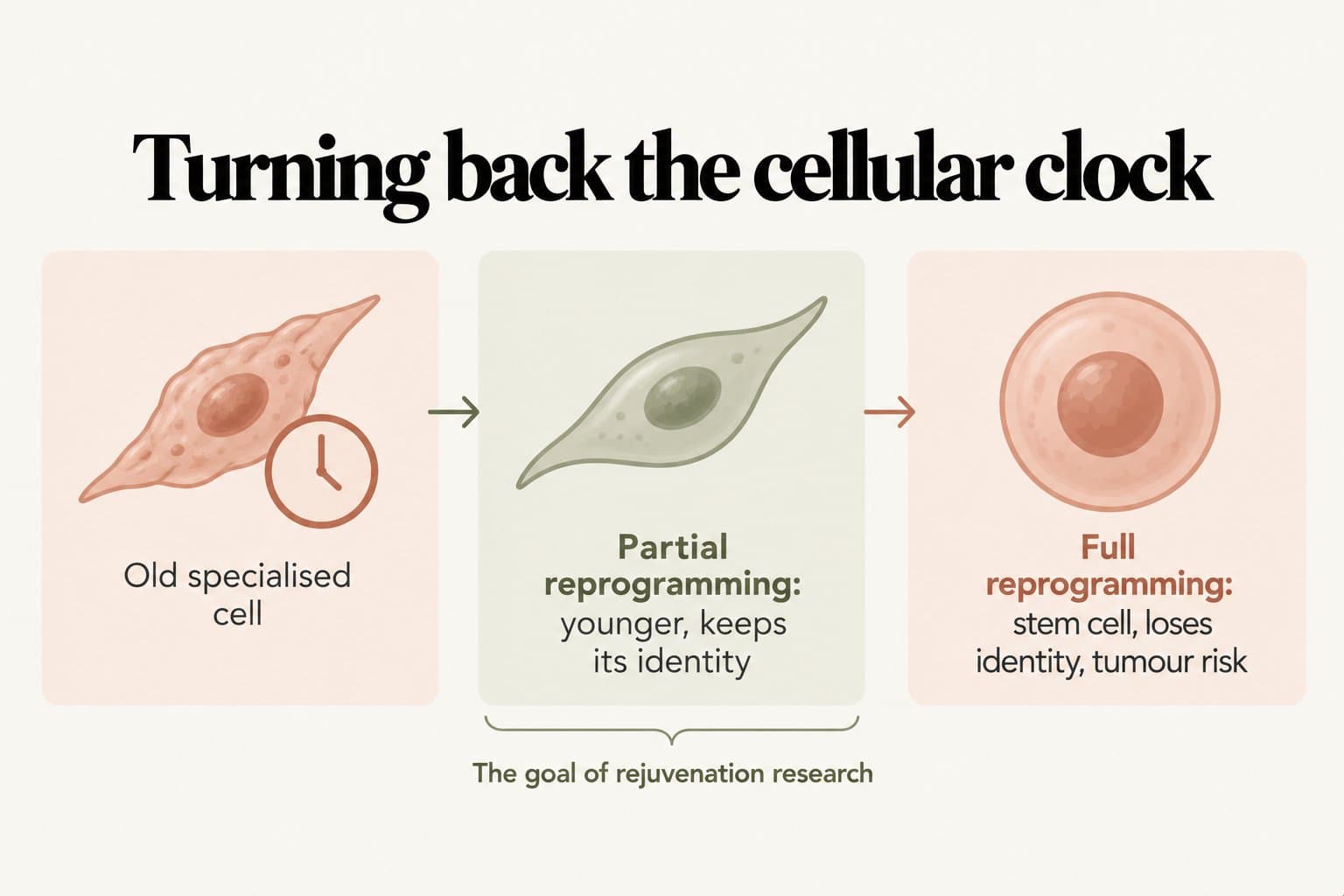
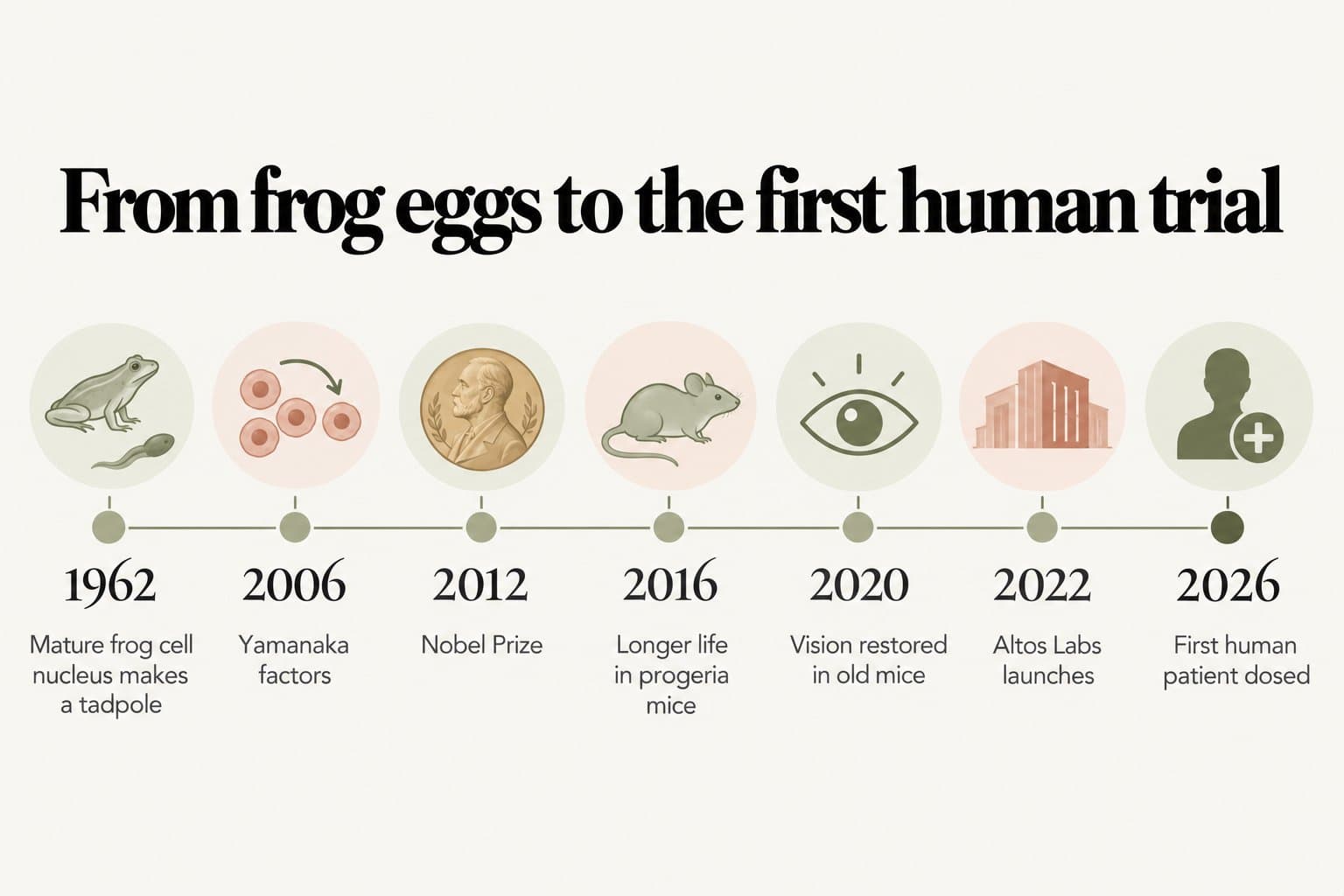
Few ideas in ageing research are as bold as cellular reprogramming: resetting old cells to a younger state. It builds on a Nobel Prize-winning discovery. In 2006, Shinya Yamanaka showed that just four genes could turn a mature skin cell back into an embryonic-like stem cell, wiping its age clock back to zero. Full reprogramming erases a cell's identity and can cause tumours, so scientists developed "partial reprogramming": switching the factors on briefly, enough to make cells younger without losing what they are. The results in mice have been striking. In 2016, cyclic partial reprogramming extended the lifespan of mice with a premature-ageing disease by 30%. In 2020, a gene therapy using three of the factors restored vision in old mice and in mice with glaucoma, doubling the survival of damaged nerve cells. The field has attracted huge investment, including Altos Labs, launched in 2022 with $3 billion. In 2026 it reached a milestone: Life Biosciences gave the first human patient a partial reprogramming therapy, ER-100, in a trial for glaucoma and another optic nerve disease. These are early days: human safety and benefit are still unknown. This article explains how reprogramming works, what's been shown and what's still uncertain.
Key numbers
| Finding | Detail |
|---|---|
| Yamanaka factors (2006) | 4 genes reprogram mature cells into stem cells; Nobel Prize 2012 |
| Cyclic partial reprogramming in progeria mice (Ocampo et al., 2016) | 30% longer lifespan without cancer |
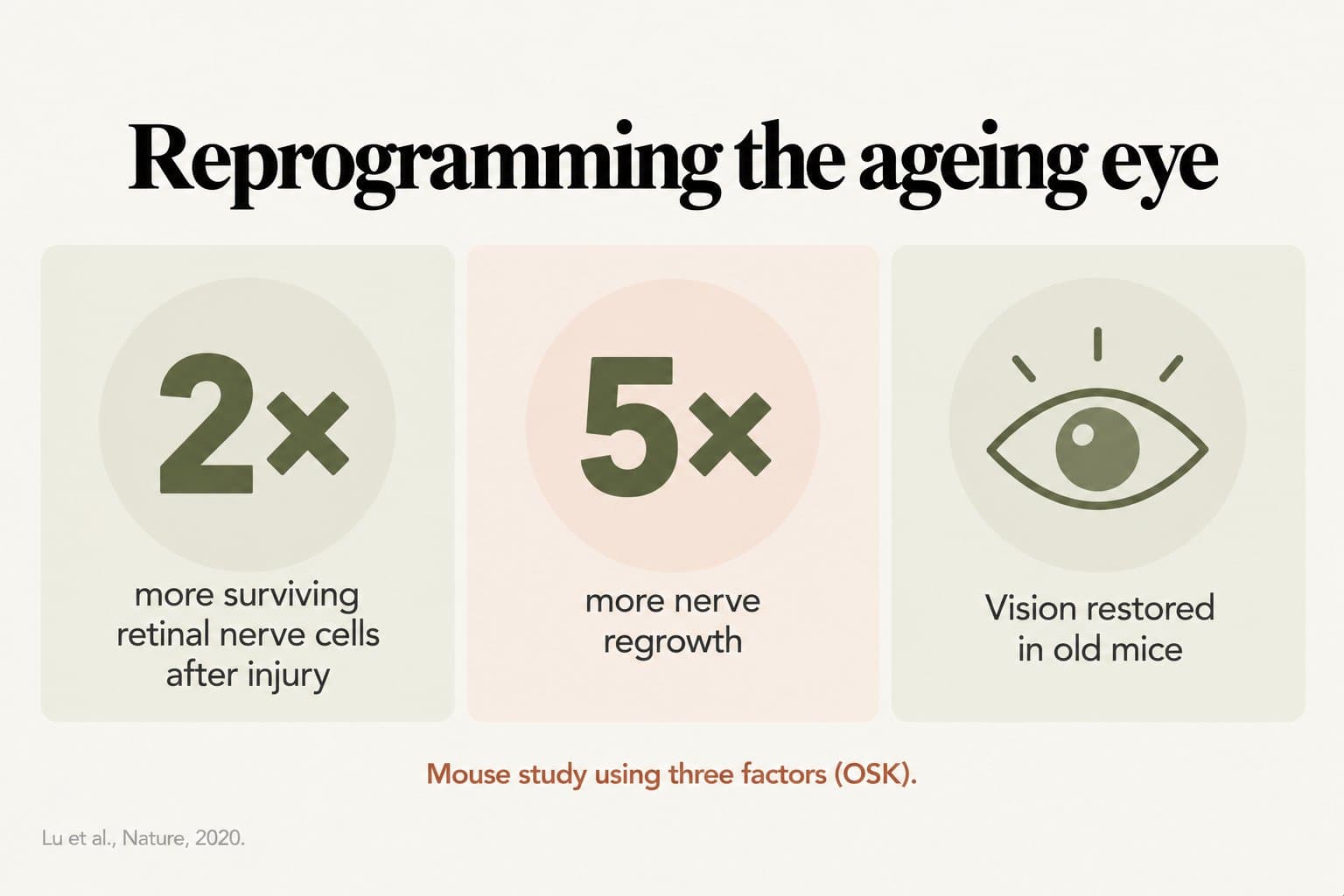
| Three-factor (OSK) gene therapy in mouse eyes (Lu et al., 2020) | 2 times more surviving retinal nerve cells and 5 times more nerve regrowth after injury; vision restored in old mice |
| Altos Labs (2022) | Launched with $3 billion to pursue cellular rejuvenation |
| First human trial (Life Biosciences ER-100) | FDA clearance January 2026; first patient dosed June 2026 |
The discovery
For most of the 20th century, scientists believed that once a cell specialised, as a skin, liver or nerve cell, there was no going back. In 1962, John Gurdon challenged this by transferring the nucleus of a mature frog intestinal cell into an egg, which developed into a tadpole. More than 40 years later, in 2006, Shinya Yamanaka found that adding just four genes, now known as the Yamanaka factors (Oct4, Sox2, Klf4 and c-Myc, or OSKM), could turn mouse skin cells into induced pluripotent stem cells (iPS cells), able to become almost any cell type. The two shared the 2012 Nobel Prize for showing that "the mature cell does not have to be confined forever to its specialised state".
Reprogramming also resets age: the epigenetic age of iPS cells is close to zero (see Epigenetic Clocks Explained). That raised a question: could a milder dose of reprogramming make old cells younger without turning them into stem cells?
From full to partial reprogramming
Full reprogramming in a living animal is dangerous: cells lose their identity, and in mice, continuous expression of the factors can cause tumours. Partial reprogramming aims for a middle ground by:
- Switching the factors on briefly or in cycles, rather than continuously.
- Using only three factors (OSK), leaving out c-Myc, which is linked to cancer.
- Targeting specific tissues, such as the eye, rather than the whole body.
The goal is to reset the epigenetic marks that drift with age while keeping each cell's identity (see Epigenetics and Ageing).
What the research shows
2016: partial reprogramming extends lifespan in mice. At the Salk Institute, Juan Carlos Izpisua Belmonte's team switched on the Yamanaka factors in short, repeated cycles in mice with progeria, a premature-ageing disease. The treated mice lived 30% longer and didn't develop cancer. In normal older mice, the treatment improved the ability of the pancreas and muscle to recover from injury. As Belmonte put it: "Mice are not humans... but this study shows that aging is a very dynamic and plastic process."
2020: restoring vision in old mice. At Harvard Medical School, David Sinclair's team used a gene therapy carrying the three OSK factors to treat nerve cells in the eye. After optic nerve injury, the therapy doubled the number of surviving retinal nerve cells and increased nerve regrowth fivefold. It improved vision in mice with glaucoma and restored vision in old mice, and it reversed age-related DNA methylation patterns. No tumours or other side effects were seen over a year of whole-body treatment in mice. "What this tells us is the clock doesn't just represent time — it is time," Sinclair said. "If you wind the hands of the clock back, time also goes backward."
2026: the first human trial. In January 2026, the US Food and Drug Administration cleared Life Biosciences' ER-100, which uses controlled expression of the three OSK factors, to enter a phase 1 trial in people with open-angle glaucoma and non-arteritic anterior ischaemic optic neuropathy (NAION), a type of stroke of the optic nerve. The company described it as the first cellular rejuvenation therapy using epigenetic reprogramming to receive FDA clearance for human trials, and the first patient was dosed in June 2026. The trial is designed mainly to test safety, tolerability, immune responses and effects on vision.
Where it stands: promise vs risks
| Development | What it showed | Stage | Evidence strength |
|---|---|---|---|
| Yamanaka factors | Mature cells can be reset to stem cells with an age close to zero | Established laboratory science | Strong |
| Cyclic partial reprogramming | Longer lifespan in progeria mice; better tissue repair in old mice | Animal studies | Moderate (mice) |
| OSK gene therapy in the eye | Restored vision in old and glaucoma mice | Animal studies; first human trial under way | Moderate (mice) |
| Whole-body rejuvenation in humans | Not yet tested | Theoretical | None yet |
| Safety | Tumours with uncontrolled reprogramming in mice; long-term human safety unknown | Key open question | Limited |
The biggest challenges are safety, especially cancer risk and loss of cell identity, how to deliver the factors to the right cells, and how to control the dose precisely. Even if eye treatments succeed, applying reprogramming to the whole body is a much bigger step.
Why this matters for longevity
Cellular reprogramming is one of the most direct tests of the idea that ageing is partly driven by a loss of epigenetic information and can be reversed. Its scientific impact has been reflected in major investment: Altos Labs launched in January 2022 with $3 billion, with research institutes led by scientists including Belmonte and epigenetics expert Wolf Reik. Starting with the eye makes sense: it's a small, enclosed organ where effects on vision can be measured directly and treatment can be localised. Whether reprogramming eventually becomes a broader anti-ageing therapy will depend on what human trials show over the coming years. Whether biological age can be reversed with today's methods is covered in Can You Reverse Your Biological Age?.
Practical notes
Cellular reprogramming isn't available as a treatment outside clinical trials, and any clinic or company offering "Yamanaka factor" or "reprogramming" therapies for general anti-ageing should be treated with great caution. Supplements marketed as "epigenetic reprogramming" don't do what these experimental gene therapies do. If you have glaucoma or an optic nerve condition, the right place to ask about trials is your eye specialist. Meanwhile, the habits that slow epigenetic ageing, such as not smoking, regular exercise, a healthy diet and good sleep, remain the most reliable tools available (see The Hallmarks of Ageing). Our Longevity Doctors keep track of emerging research and can help you separate genuine progress from hype, starting with the free longevity assessment.
- Nobel Assembly at Karolinska Institutet. The Nobel Prize in Physiology or Medicine 2012. Press release.
- Takahashi K, Yamanaka S. Induction of pluripotent stem cells from mouse embryonic and adult fibroblast cultures by defined factors. Cell, 2006;126(4):663-676.
- Ocampo A, et al. In vivo amelioration of age-associated hallmarks by partial reprogramming. Cell, 2016;167(7):1719-1733.
- Lu Y, et al. Reprogramming to recover youthful epigenetic information and restore vision. Nature, 2020;588(7836):124-129.
- Life Biosciences. Life Biosciences announces FDA clearance of IND application for ER-100 in optic neuropathies. January 2026.
- Paine PT, et al. Partial cellular reprogramming: a deep dive into an emerging rejuvenation technology. Aging Cell, 2024;23(2):e14039.
Free longevity assessment
Can you tell real progress
from anti-ageing hype?
Take the free Aevum Protocol assessment to see how your longevity science and 6 other longevity domains are performing — and get a personalised 90-day plan.
Take the free assessment